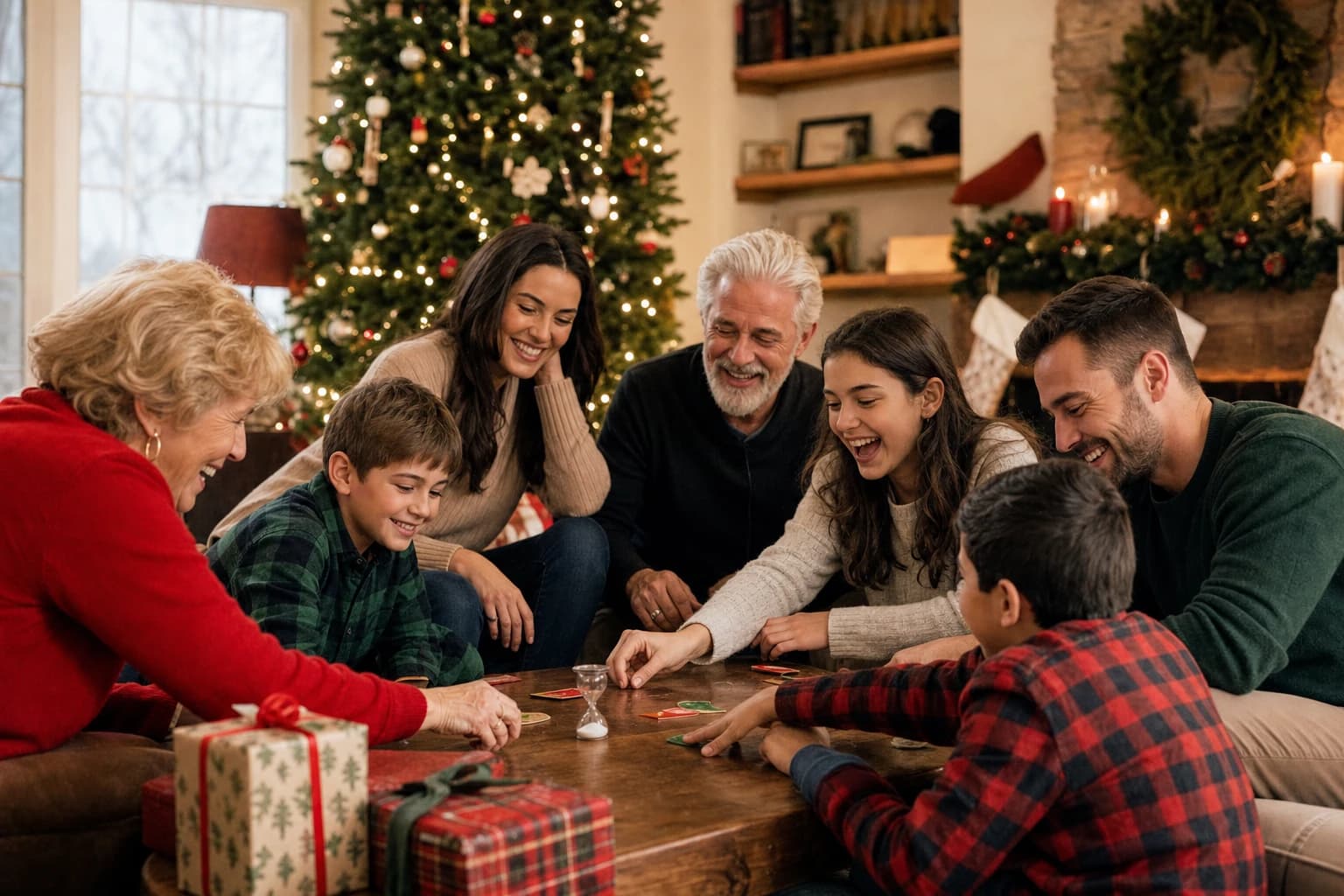
Choosing christmas party games for families can be surprisingly tricky. A game that delights a seven-year-old may feel too silly for teens, while a clever adult game can leave younger kids confused or bored. The best option is usually not one perfect game, but a short lineup with different energy levels: one quiet table game, one active living-room game, one team challenge, and one optional gift-exchange twist.
This guide groups family Christmas games by setting and mood, with practical rules, materials, timing, and age adaptations. The goal is simple: keep everyone included without forcing shy guests to perform, making small children the center of everything, or turning the party into an adults-only competition.
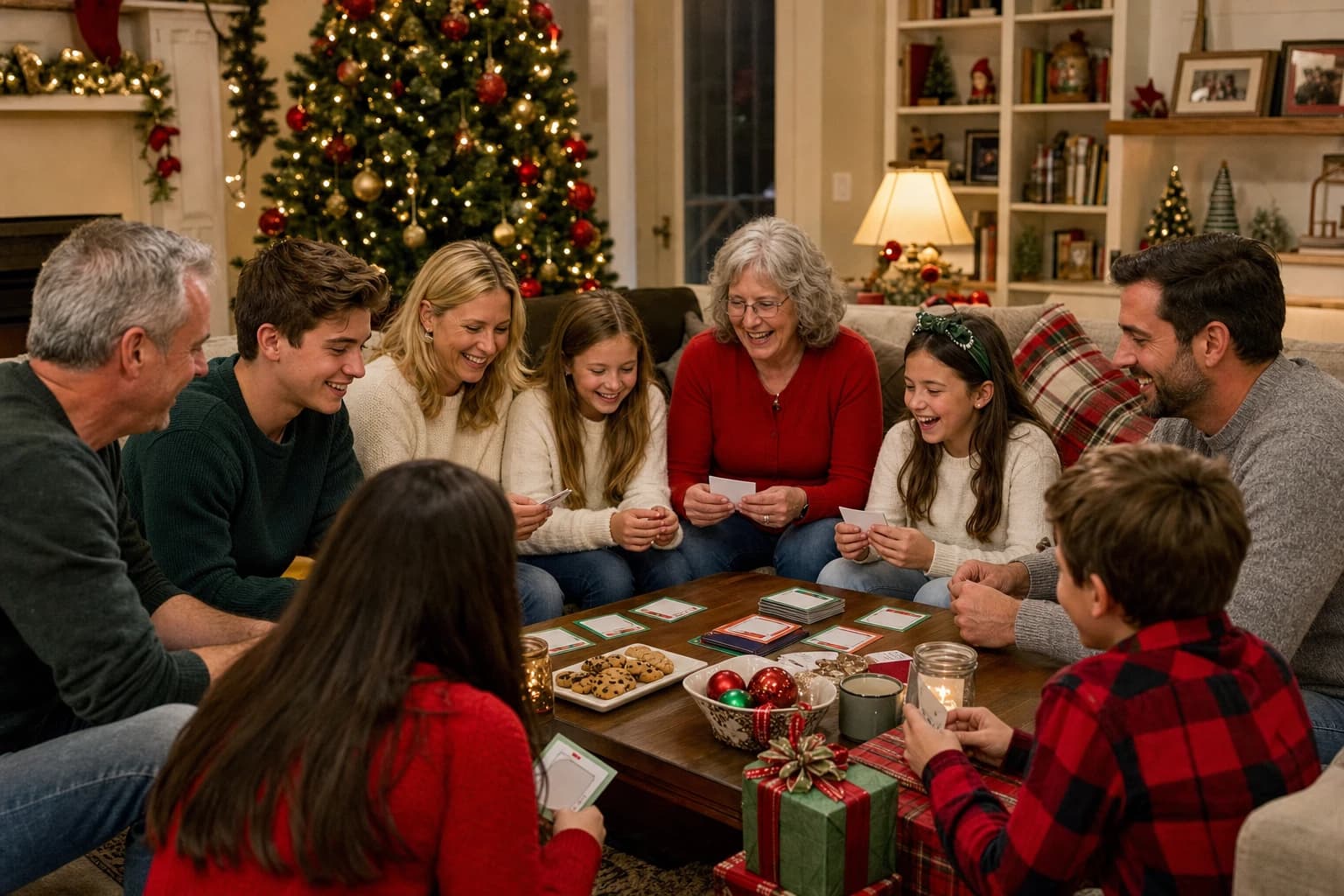
Quick answer: the best mix for a family Christmas party
For most gatherings, plan 3 to 5 games total, not a full night of constant activities. A good order is:
- Start with a low-pressure table game while guests arrive, snacks are out, and younger kids settle in.
- Move to one active indoor Christmas game after everyone has greeted each other.
- Add a team challenge that pairs kids, teens, and adults together instead of separating them by age.
- End with a gift-exchange add-on if your family already exchanges small presents.
If your group includes toddlers, grandparents, very shy guests, or people who do not know each other well, choose games with optional roles: guessing, drawing, scorekeeping, judging, or helping a younger child. That gives people a way to participate without being put on the spot.
Before you choose games: match the game to the room and the group
A family Christmas party usually has competing needs: kids want movement, teens do not want to be treated like little children, adults want conversation, and hosts do not want broken ornaments. Use these four planning questions before printing anything or buying supplies.
- How many people are playing? Table games work well for 4 to 12 people. Team challenges work better for 10 to 30 because players can split into mixed-age groups.
- How much space do you have? A living room can handle charades, relay-style wrapping, or a scavenger hunt, but not running games.
- What is the youngest age? If children under 3 are present, avoid small loose pieces such as beads, tiny bells, mini erasers, or hard candy used as tokens. The U.S. Consumer Product Safety Commission gives guidance on toy safety and small-parts hazards at CPSC.gov.
- How comfortable is the group? If cousins, in-laws, neighbors, or new partners are joining, skip games that require embarrassing stories, pranks, dares, or personal questions.
Simple host kit for holiday party games for all ages
You can run nearly every game in this guide with a small kit. Prepare it in a box or gift bag before guests arrive.
- Index cards or cut paper slips: 50 to 80 pieces
- Two thick markers and several pens
- Painter’s tape or removable tape
- A phone timer or kitchen timer
- Two bowls, baskets, or gift bags for drawing cards
- Printer paper for score sheets and word lists
- Optional: stickers, ribbon, clothespins, paper plates, and small wrapped prizes
At-a-glance comparison of Christmas games for mixed ages
| Game type | Best for | Players | Time | Energy level | Comfort level |
|---|---|---|---|---|---|
| Quiet table games | Arrivals, after dinner, shy guests, grandparents | 4 to 16 | 10 to 25 minutes | Low | Very low pressure |
| Active living-room games | Kids with energy, casual family groups | 6 to 20 | 10 to 20 minutes | Medium | Moderate |
| Team challenges | Large families, mixed generations, teens | 8 to 30 | 15 to 35 minutes | Medium | Low if teams are balanced |
| Gift-exchange add-ons | Families already swapping gifts | 6 to 25 | 15 to 45 minutes | Low to medium | Depends on rules |
Quiet table games for arrivals, dinner, or tired groups
Quiet games are useful because they do not require a cleared room or a loud host voice. They also help bridge age gaps: younger kids can team with adults, teens can contribute clever answers, and older relatives can play without moving around.
1. Christmas Categories
Best for: ages 7 and up, 4 to 12 players. Time: 12 minutes. Materials: paper, pens, timer.
- Choose 6 categories, such as Christmas foods, winter clothing, holiday songs, things at the North Pole, red items, and words that start with S.
- Pick one letter for the round. Avoid difficult letters such as Q, X, and Z unless your family loves word games.
- Set a 2-minute timer. Each person writes one answer per category using that letter.
- Read answers aloud. Give 1 point for a valid answer and 2 points for a valid answer nobody else wrote.
Mixed-age adaptation: Let kids under 9 play with a partner. If a child writes “Santa” for three categories, accept it once and encourage a more specific answer next round.
2. Guess the Christmas Object
Best for: ages 5 and up, 5 to 15 players. Time: 10 to 15 minutes. Materials: a stocking or opaque gift bag, 8 to 10 safe objects.
Place familiar items in a stocking: a candy cane, ornament, pinecone, ribbon spool, cookie cutter, battery candle, mitten, jingle bell, or small gift bow. Players feel one item through the fabric or inside the bag without looking, then write or whisper a guess.
Host tip: Use objects large enough for the youngest child in the room and avoid breakable glass ornaments. For a harder teen-and-adult version, include similar shapes such as two different cookie cutters or a bow and a ribbon spool.
3. Holiday Would You Rather, Family Edition
Best for: all ages who can answer simple questions. Time: 10 minutes. Materials: prepared question cards.
Keep this light, not personal. Read one question at a time and ask guests to point left or right, raise a hand, or stand on one side of the room. Good prompts include:
- Would you rather decorate cookies or build a snowman?
- Would you rather hear the same Christmas song all day or wrap all the presents?
- Would you rather have peppermint hot chocolate or cinnamon rolls for breakfast?
- Would you rather wear a funny sweater or a Santa hat for the whole party?
Avoid: questions about money, politics, religion, relationships, parenting choices, or body image. Family-friendly does not have to mean childish; it means nobody is singled out.
Active indoor Christmas games for the living room
Active games should create laughter without turning your home into an obstacle course. Clear one area, move fragile decorations, and set a “walking only” rule if children are excited or the floor is slippery.
4. Christmas Charades With Three Difficulty Levels
Best for: ages 6 and up, 6 to 20 players. Time: 15 to 25 minutes. Materials: charades cards, bowl, timer.
Write cards in three levels so nobody is stuck acting out something too hard.
- Easy: wrapping a present, building a snowman, eating cookies, ringing a bell, putting up lights.
- Medium: untangling lights, sneaking a cookie, carrying too many gifts, singing carols, waiting for snow.
- Hard: assembling a toy at midnight, finding the last parking spot, hiding a gift, overcooking dinner.
- Divide into two teams with a mix of ages on each team.
- On each turn, the actor chooses easy, medium, or hard before drawing.
- Set a 60-second timer. Award 1 point for easy, 2 for medium, and 3 for hard.
- Let players pass once per turn if they draw something that feels uncomfortable.
This scoring system keeps teens and adults interested without making younger kids feel unsuccessful.
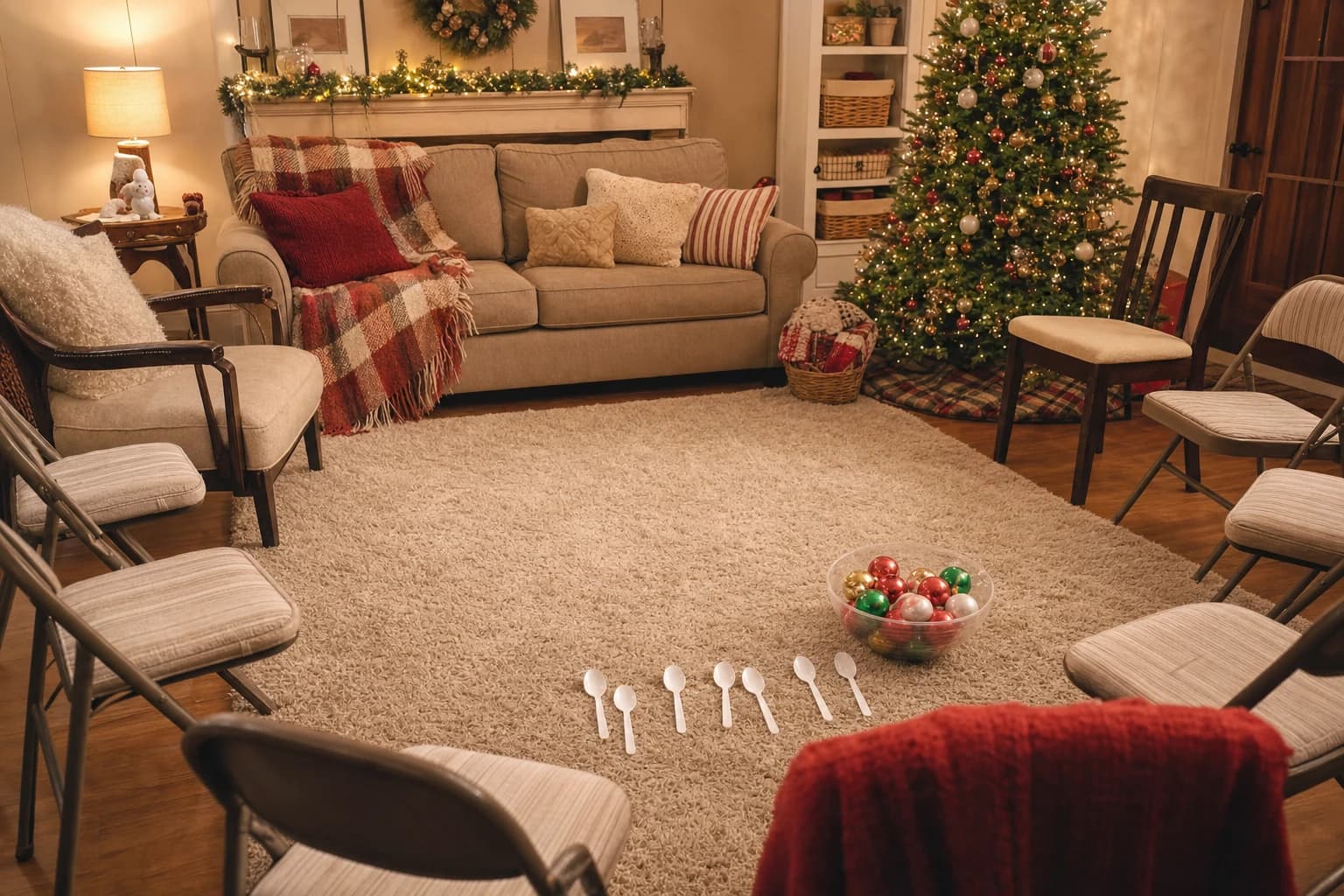
5. Ornament Balance Walk
Best for: ages 5 and up, 6 to 18 players. Time: 10 minutes. Materials: plastic ornaments or pom-poms, large spoons, tape for start and finish lines.
Players carry a plastic ornament on a spoon from one line to another and back. If it falls, they stop, replace it, and continue from the spot where it dropped. Use walking only. For younger children, shorten the distance to 8 feet. For older players, add a gentle challenge such as switching hands at the halfway point.
Why it works: It has movement, but no tackling, blindfolding, or speed that risks crashing into furniture. It is also easy to run in short rounds so nobody waits too long.
6. Santa Says
Best for: ages 4 and up, 5 to 25 players. Time: 8 to 12 minutes. Materials: none.
Play like Simon Says, but with holiday actions: “Santa says wrap a present,” “Santa says shake like a snow globe,” “Santa says tiptoe past the sleeping reindeer.” If the caller gives an action without saying “Santa says,” players should stay still.
Make it less childish: Ask a teen or grandparent to be the caller for one round and encourage clever, not babyish, actions. Adults usually enjoy this more when the pace is quick and the round ends before the joke wears thin.
Team challenges that make kids, teens, and adults work together
Team challenges are often the safest choice for Christmas games for mixed ages because the pressure is shared. Put at least one adult or older teen on each team, and avoid letting all the youngest children cluster together unless the challenge is very simple.
7. Build-a-Sleigh Supply Challenge
Best for: ages 6 and up, 8 to 24 players. Time: 25 minutes. Materials per team: 10 straws, 10 craft sticks, 1 sheet of paper, 24 inches of tape, 12 inches of string, scissors for adult use, and one small toy or wrapped candy to carry.
- Give each team the same supplies in a paper bag.
- Explain the goal: build a “sleigh” that can hold the small toy and slide or be pulled 3 feet across a table.
- Set a 12-minute building timer.
- Run a showcase. Each team explains the design in 30 seconds, then demonstrates it.
- Award points for holding the cargo, moving the full distance, creative design, and teamwork.
Scoring: 3 points for carrying the cargo, 3 for moving 3 feet, 2 for creative use of materials, 2 for a clear team explanation. This keeps the game from being only about engineering skill.
8. Christmas Movie Quote Match
Best for: ages 9 and up, 6 to 20 players. Time: 15 minutes. Materials: printed quote cards and movie-title cards.
Use well-known, family-appropriate holiday movies your group actually knows. Put quotes on one set of cards and titles on another. Teams race to match them, but they may ask for one hint per round. If your family includes younger kids, mix in visual cards such as a train, a snowman, a green grumpy character, or a house with lights so they can contribute without reading every quote.
Important: Do not rely only on pop culture from one generation. Include a few older classics and a few newer animated favorites if your guest list spans grandparents to children.
9. Family Christmas Scavenger Hunt
Best for: ages 5 and up, 6 to 30 players. Time: 15 to 20 minutes. Materials: printed list, pencils, optional phone for photos.
This is an indoor “find and notice” game, not a running hunt. Create a checklist of items guests can spot without opening drawers or entering private rooms:
- Something red and shiny
- A decoration with a star
- A wrapped gift with a bow
- A cookie or dessert with sprinkles
- A holiday card
- Something shaped like a tree
- A person wearing green
- A decoration older than 10 years, if the owner is willing to identify one
Teams earn 1 point per item found. For a calmer version, teams write where they saw the item instead of collecting or touching anything. For a photo version, one adult or teen per team takes pictures and shows them to the host at the end.
Gift-exchange add-ons that do not ruin the mood
Gift games can be fun, but they can also create disappointment if the rules are too cutthroat. For family gatherings, keep gifts similar in value, set rules before the exchange starts, and give children a clear explanation of what can happen to a gift during the game.
10. Left-Right Christmas Story
Best for: ages 6 and up, 6 to 25 players. Time: 10 to 15 minutes. Materials: one wrapped gift per player, a short story using the words “left” and “right.”
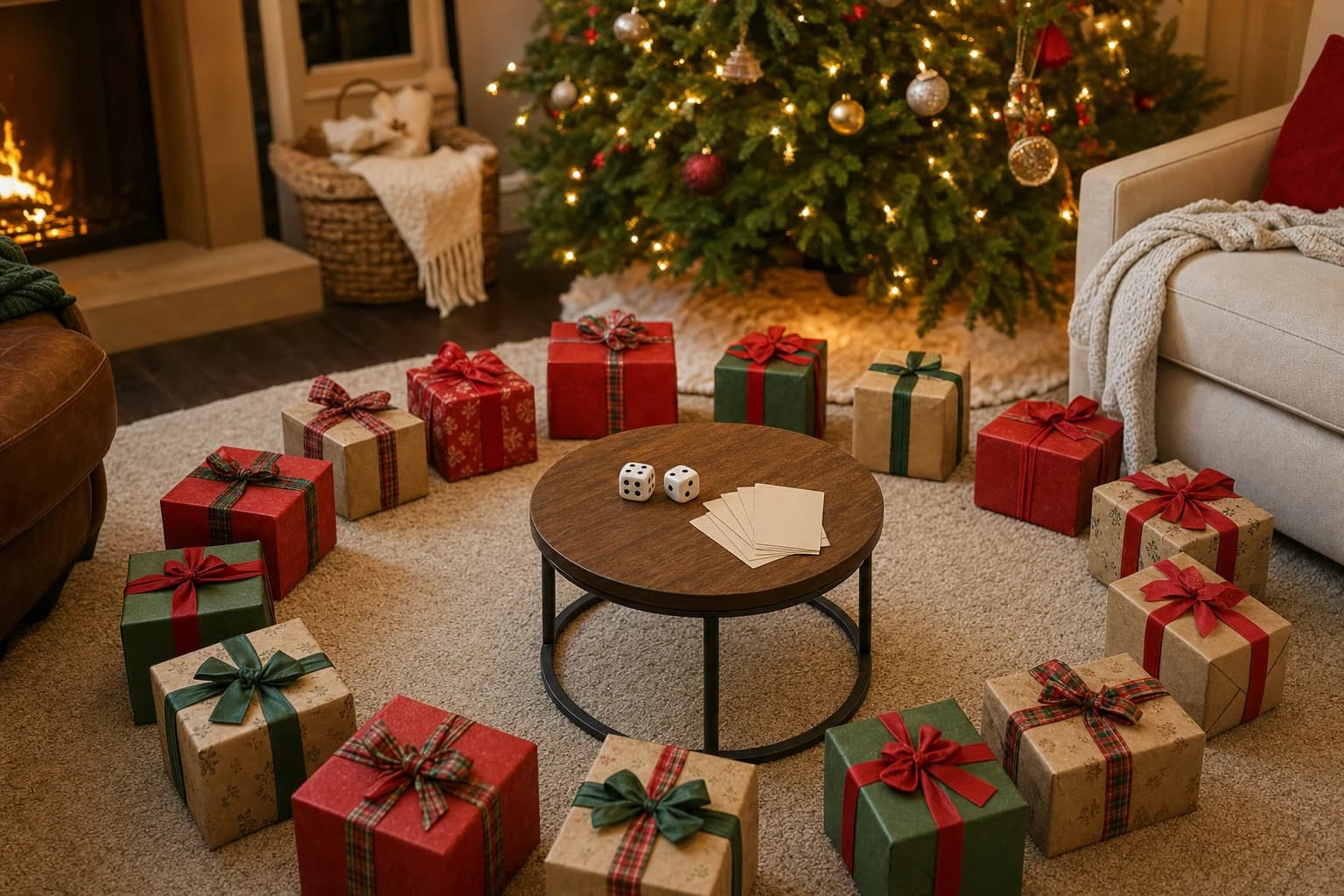
Everyone sits in a circle holding a wrapped gift. The host reads a story. Each time the story says “left,” players pass their gift left; each time it says “right,” they pass right. At the end, each person opens the gift they are holding.
Family-friendly rule: Use gifts of the same type or value, such as mugs, cocoa kits, ornaments, puzzle books, or wrapped treats. This reduces the feeling that someone “lost.”
11. Roll-a-Gift Choice
Best for: ages 8 and up, 6 to 20 players. Time: 20 to 35 minutes. Materials: wrapped gifts, one die, rule card.
Players sit in a circle. On a turn, a player rolls a die and follows the result:
- 1: Choose a wrapped gift from the center.
- 2: Trade with the person on your left.
- 3: Trade with the person on your right.
- 4: Keep your gift and skip trading.
- 5: Trade with anyone who agrees.
- 6: Unwrap your gift if it is still wrapped.
Gentler version: Make all trades optional after a gift is opened. This avoids tears for younger children and keeps the game from feeling mean.
12. Gift Clue Guess
Best for: ages 7 and up, 4 to 16 players. Time: 10 to 20 minutes. Materials: wrapped gifts and clue cards.
Each giver writes one clue about the gift without naming it: “This is useful on a cold morning,” “This belongs in the kitchen,” or “This makes a quiet afternoon better.” Before opening, the receiver reads the clue and guesses what might be inside. Keep guesses light and quick; the point is anticipation, not stumping people.
A simple step-by-step plan for hosting the games
If you are not sure how to fit games into a busy Christmas gathering, use this structure. It works for a two- to three-hour family party and can be shortened if dinner runs late.
- Pick one game from each category. For example: Christmas Categories, Christmas Charades, Build-a-Sleigh, and Left-Right Christmas Story.
- Prepare supplies the day before. Cut cards, print lists, wrap exchange gifts, and place each game’s materials in a labeled bag.
- Choose a host and a helper. The host explains rules; the helper hands out supplies, starts timers, and quietly helps younger children.
- Start with the easiest game. Do not open with a performance game while guests are still arriving or eating.
- Keep explanations under 60 seconds. Demonstrate one sample turn instead of reading a long rule sheet.
- Stop while the game is still fun. End after 3 rounds, 15 minutes, or the agreed score. Family parties do not need championship finals.
Tips for avoiding games that feel too childish or too adult
- Use layered difficulty. Let players choose easy, medium, or hard cards so kids can succeed and adults can stretch.
- Make teams mixed-age. A teen paired with a younger cousin can lead without feeling trapped in a little-kid activity.
- Reward creativity, not just speed. Speed games often favor older kids and competitive adults. Add points for teamwork, funniest answer, or best design.
- Offer non-performing roles. Scorekeeper, timer, clue reader, photographer, judge, and team captain are real participation options.
- Skip humiliation-based fun. Avoid dares, messy food challenges, forced singing solos, or questions that reveal private information.
- Use “pass” rules generously. A no-questions-asked pass makes people more willing to join the next round.
Common mistakes to avoid
Planning too many games is the most common mistake. Guests also want to eat, talk, take photos, and relax. Three well-run games are better than eight rushed ones.
Choosing games that require everyone to perform can backfire. Charades is fun for many families, but not every person wants to act in front of relatives. Balance it with guessing, building, matching, or table games.
Ignoring the youngest and oldest guests can make a game feel chaotic or exclusionary. If toddlers are present, small game pieces and hard candies should stay out of reach. If older relatives are playing, use large print on cards and avoid games that require kneeling, crawling, or quick balance.
Letting competition override the holiday mood is another issue. Keep prizes small and silly: first pick of dessert, a paper crown, a candy cane, or bragging rights. Expensive prizes can make simple family Christmas games feel tense.
FAQ: Christmas party games for families
How many games should I plan for a family Christmas party?
Plan 3 to 5 games for most gatherings. If your party includes a full meal and gift opening, 3 games is usually enough: one quiet game, one active game, and one gift or team game.
What Christmas games work best when ages range from kids to grandparents?
Choose games with shared roles rather than identical tasks for everyone. Christmas Categories, Guess the Christmas Object, team scavenger hunts, and Left-Right gift stories are good choices because players can help each other.
How do I include teens without making the games feel babyish?
Give teens meaningful roles and harder options: team captain, timer, clue writer, builder, or hard-card player. Avoid overly cute instructions, and add creative scoring so their humor and strategy matter.
What if some guests do not want to play?
Do not force participation. Offer low-pressure jobs such as scorekeeping, reading clues, taking photos, or judging the funniest answer. Many reluctant guests join once they see the game is short and friendly.
Are gift-exchange games good for young children?
They can be, but use gentle rules. Avoid aggressive stealing mechanics with young children, keep gifts similar in value, and explain before opening that gifts may move around during the game.
Conclusion
The most successful christmas party games for families are not the loudest or most complicated. They are the ones that give every age group a way to contribute. Build your party around a balanced mix: a quiet table game to warm up, an active indoor game for energy, a team challenge for mixed ages, and a gentle gift-exchange add-on if presents are part of the night.
Keep rules short, teams balanced, supplies simple, and opt-outs acceptable. When the games respect different ages and comfort levels, they become part of the holiday instead of a break from it.