
A short office party can feel harder to host than a long one. You have just enough time for people to feel watched, but not enough time to recover if the first activity lands badly. The safest solution is not a louder game or a complicated challenge. It is a clear 30-minute plan with low-pressure rules, fast transitions, and no moment where the host has to invent what to say next.
This guide gives you a complete plan for 30 minute office party games: what to prepare, exactly how to open the session, three games that work for most office settings, timing by the minute, scripts you can read aloud, and adjustments for small groups, large groups, and hybrid teams.

The 30-Minute Plan at a Glance
The best short work party games have three qualities: the rules can be explained in under one minute, nobody is eliminated, and people can contribute without performing a talent. For an office setting, avoid games that require personal confessions, inside jokes, physical contact, alcohol, or public ranking of coworkers.
Here is the full run of show. It uses three quick office party games: one opening game to warm up the room, one team game to build energy, and one closing game that ends cleanly.
| Time | Activity | Purpose | Host job |
|---|---|---|---|
| 0:00–2:00 | Welcome and ground rules | Lower pressure | Explain that participation is light, optional, and team-based |
| 2:00–9:00 | Game 1: Two-Word Check-In | Get every voice in the room once | Keep answers short and moving |
| 9:00–20:00 | Game 2: Desk Object Pitch | Create shared laughter without embarrassment | Assign teams and manage 60-second pitches |
| 20:00–28:00 | Game 3: Office Match-Up | Finish with a simple guessing challenge | Read clues and reveal answers quickly |
| 28:00–30:00 | Wrap-up | End before energy drops | Thank people and name the winning team lightly |
If your group already knows each other poorly, you may want more warm-up options from Icebreaker Party Games for Adults Who Do Not Know Each Other Well. If your office group is larger than 20 people, the format tips in Large Group Party Games for 20 to 50 People That Keep Everyone Playing are also useful.
Materials and Setup
You can run this session in a conference room, break room, open office area, or video meeting. The in-person version needs very little equipment.
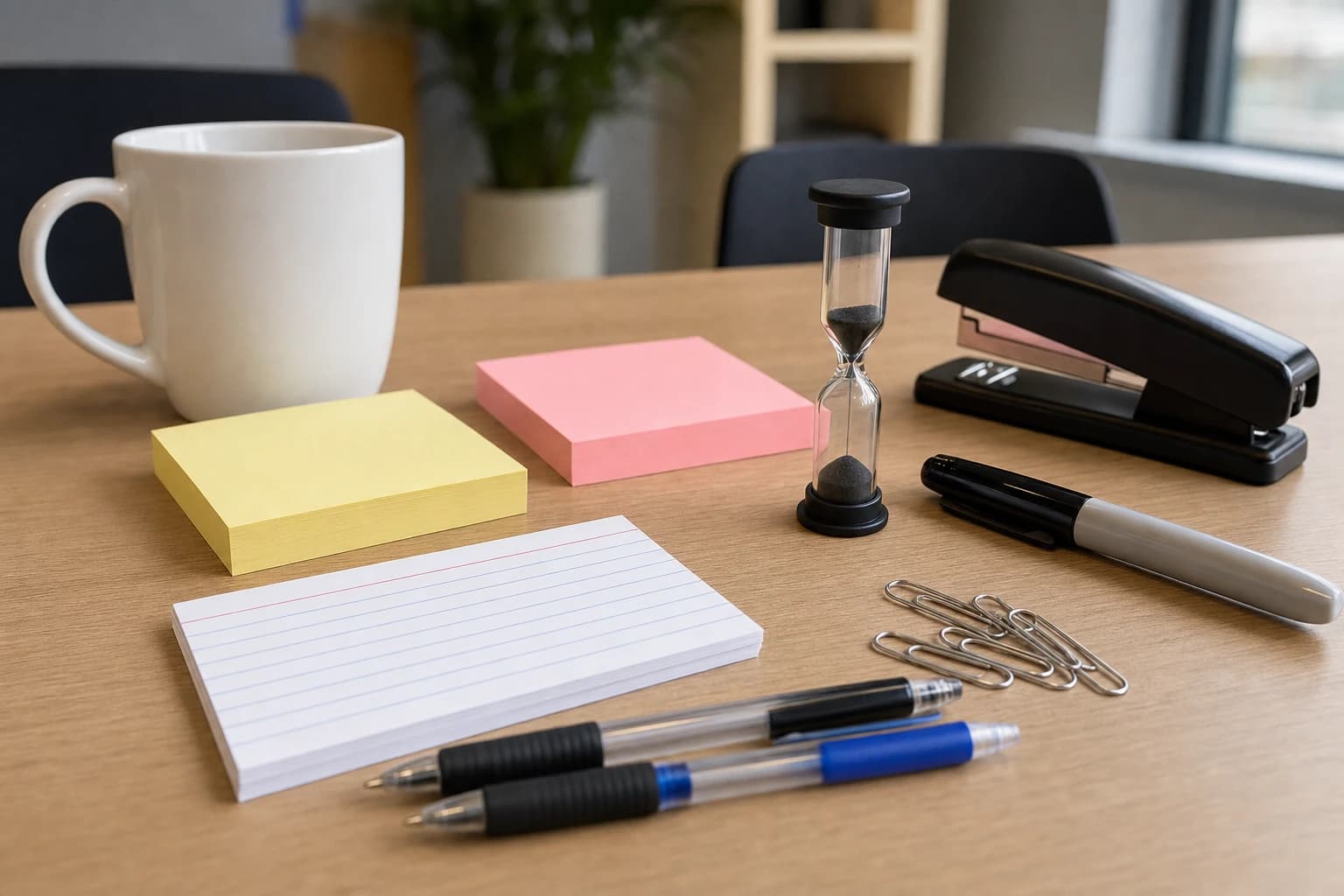
Materials for 6 to 20 people
- One timer or phone with a visible countdown
- One whiteboard, flip chart, or shared screen for scores
- Sticky notes or index cards, 1 per person
- Pens, 1 per person or 1 per pair
- Six to ten ordinary desk objects, such as a stapler, mug, folder, sticky note pad, paper clip, notebook, badge holder, or marker
- A small prize if appropriate, such as first choice of snacks, a funny certificate, or team bragging rights
Room setup
Set the room before people arrive. Place chairs in a loose circle or around one table if possible. Put the desk objects on a side table. Write the three game names on the board so the session feels intentional, not improvised. If the event is hybrid, create a shared document or chat thread where remote participants can submit answers.
Accessibility and comfort note
Keep participation flexible. Some people may prefer to pass, type instead of speak, stay seated, or avoid physical activities. For workplace events, it is sensible to design games with accessibility in mind and to be open to reasonable adjustments. The U.S. Department of Justice explains workplace accommodation concepts in plain language at ADA.gov.
Step-by-Step Hosting Plan With Scripts
The scripts below are written so you can read them almost word for word. Adjust the tone to match your workplace, but keep the instructions short. Long explanations are one of the main causes of awkward silence.
0:00–2:00: Open the Session
Stand where everyone can see you. Smile, hold the timer, and set the expectation that this will be quick. Do not apologize for the games or joke that everyone probably hates icebreakers. That makes people brace for discomfort.
“Thanks for taking 30 minutes. We are going to play three very quick, low-pressure games. No one has to perform, no one gets eliminated, and passing is always fine. The goal is just to end the party with a little more energy than we started with.”
Then explain how teams will work. For 6 to 10 people, use two teams. For 11 to 20 people, use three or four teams. If people are already seated by department, mix teams lightly by counting off: one, two, three, one, two, three.
2:00–9:00: Game 1 — Two-Word Check-In
Best for: 5 to 30 people. Difficulty: very easy. Materials: none, or chat for remote teams.
This is an office icebreaker game that is not awkward because it does not ask for personal stories. Each person answers a safe prompt in exactly two words. The limit makes it quick and mildly funny.
Rules:
- Choose one prompt: “Describe your current energy in two words,” “Name your ideal snack in two words,” or “Describe this week in two words.”
- Go around the room. Each person gives a two-word answer.
- No explanations unless the answer is confusing and the room asks for one.
- If someone wants to pass, they can say “pass” and you move on immediately.
“First game: Two-Word Check-In. I will give a prompt, and each person answers with exactly two words. No speech, no explanation required. Today’s prompt is: describe your current energy in two words. I’ll start: ‘cautiously optimistic.’”
Host tip: Keep your own answer boring enough that people do not feel they need to be clever. If someone gives a long answer, laugh lightly and say, “I am counting that as two creative words,” then move on.
9:00–20:00: Game 2 — Desk Object Pitch
Best for: 6 to 24 people. Difficulty: easy. Materials: one desk object per team, timer, score board.
This is the main energy builder. Each team receives an ordinary office object and has three minutes to invent a ridiculous new use for it. Then each team gives a 60-second pitch. It works well as one of the more flexible team party games for adults because the team can decide who speaks, who demonstrates, and who simply contributes ideas.
Rules:
- Give each team one object, such as a stapler, mug, marker, or folder.
- Teams have three minutes to create a new product idea using that object.
- The pitch must include a product name, the problem it solves, and one silly feature.
- Each team gets exactly 60 seconds to present.
- After all pitches, everyone votes by applause or raised hands. People may not vote for their own team.
“Your team has one ordinary desk object. In three minutes, turn it into a fake product. Your pitch needs three things: a product name, the problem it solves, and one ridiculous feature. You do not need a perfect idea. Bad ideas are welcome; silent brainstorming is not.”
Scoring option: If applause feels too subjective, score each team from 1 to 3 in three categories: clearest name, funniest feature, and most committed pitch. Keep the scoring playful and fast. Avoid declaring that someone is “the best presenter,” because that can make the game feel like work.
20:00–28:00: Game 3 — Office Match-Up
Best for: 6 to 30 people. Difficulty: easy. Materials: sticky notes or index cards, pens, bowl or envelope.
This closing game creates a guessing challenge without asking for private information. Each person writes one harmless preference or office-friendly fact. The host reads the cards, and teams guess who wrote each one.
Safe prompts:
- “A snack I would happily defend is…”
- “A meeting room item I always look for is…”
- “A workday sound I recognize instantly is…”
- “A tiny office convenience I appreciate is…”
Rules:
- Give everyone one card and one prompt.
- Ask them not to write anything private, medical, political, romantic, religious, or embarrassing.
- Collect the cards and shuffle them.
- Read one card at a time. Teams get 10 seconds to guess the person.
- A correct guess earns 1 point. If nobody guesses, the writer can reveal themselves or stay anonymous.
“Last game: Office Match-Up. Write one harmless answer to this prompt: ‘A tiny office convenience I appreciate is…’ Please keep it work-friendly and not too personal. I’ll read the cards, and teams will guess who wrote each one.”
Why it ends well: The game gives people a reason to listen, but it does not demand a big performance. It also creates natural closing comments, such as “Apparently this team has strong feelings about good pens.”

Adjustments by Group Size
The same 30-minute plan can work for different office sizes, but the pacing needs to change. Use the table below before you start.
| Group size | Best format | Timing adjustment | What to avoid |
|---|---|---|---|
| 4–5 people | Play as one group instead of teams | Shorten Desk Object Pitch to two objects total | Over-scoring; it feels too serious in a tiny group |
| 6–10 people | Two teams | Use the plan exactly as written | Long individual stories during the opener |
| 11–20 people | Three or four teams | Limit pitches to 45 seconds if needed | Letting every team debate every answer |
| 21–30 people | Five or six teams | Use only six Office Match-Up cards, not one per person | Full-room introductions; they consume the whole session |
| Hybrid group | Mixed teams with chat answers | Add 30 seconds for tech checks at the start | Making remote people watch without a role |
For very small gatherings, you can also borrow ideas from No-Equipment Party Games for Adults That Work in Small Apartments, because those games usually adapt well to small conference rooms. For mixed-age office family events, Team Party Games for Family Game Night With Mixed Ages may be a better fit.
How to Prevent Awkward Silence
Awkward silence usually happens for one of four reasons: the prompt is too personal, the rules are unclear, people do not know when to stop talking, or the host leaves dead space between activities. You can prevent most of it with structure.
- Give a sample answer first. People respond faster when they know the size and tone of the answer expected.
- Use a timer openly. Say, “You have 60 seconds,” and mean it. Time limits make games feel safer.
- Let teams choose speakers. Do not force the quietest person to present “for fun.”
- Keep personal prompts shallow. Favorite snacks, desk habits, and harmless preferences are safer than childhood memories or hidden talents.
- Move on immediately after a pass. A pass should not become a moment.
- End while people still have energy. A clean 30-minute finish is better than stretching to fill time.
Games to skip in most office settings
Be careful with truth-or-dare-style games, roast games, drinking games, games involving romantic questions, or challenges that require touching, running, blindfolding, or sharing sensitive personal details. Even if some employees enjoy them, they can put others in an uncomfortable position at work.
A Backup Plan If the Room Is Quiet
Sometimes a group is tired, new, or cautious. That does not mean the party has failed. If the room is especially quiet after the opener, switch from performance-based play to written answers.
Use this backup:
- Skip Desk Object Pitch.
- Give every team five sticky notes.
- Ask them to write five answers to a prompt, such as “Things that make a workday slightly better.”
- Collect and read the notes aloud.
- Teams get 1 point when another team laughs, nods, or says “true.”
This keeps the activity social without requiring anyone to stand up and present. It is especially useful for work party games for small groups where one shy person can feel very visible.
FAQ
What are the best 30 minute office party games for a small team?
For 4 to 8 people, use Two-Word Check-In, Office Match-Up, and a simplified Desk Object Pitch with two teams or one shared group. Avoid games that require elimination, because a small group runs out of players quickly.
How many games fit into a 30-minute office party?
Three short games usually fit best: a 5 to 7 minute opener, a 10 to 12 minute main game, and a 6 to 8 minute closer. Plan two minutes at the start and two minutes at the end for transitions.
How do I make office icebreaker games not awkward?
Use safe prompts, give an example first, allow passing, and avoid questions that reveal private information. Team-based answers also reduce pressure because nobody has to carry the whole moment alone.
Can these games work on a video call?
Yes. Use chat for Two-Word Check-In, assign breakout rooms for Desk Object Pitch, and collect Office Match-Up answers through private messages or a shared form. Keep instructions even shorter online.
Should there be prizes?
Prizes are optional. If you use them, keep them small and low-stakes, such as first choice of snacks or a lighthearted certificate. Large prizes can make simple team party games feel too competitive.
Conclusion
A smooth office party game session does not depend on having the funniest host in the room. It depends on choosing quick office party games with simple rules, safe prompts, and clear stopping points. Use the 30-minute plan as written if you want the easiest path: Two-Word Check-In to warm up, Desk Object Pitch for energy, and Office Match-Up to close without awkward silence.
Prepare the materials before people arrive, read the scripts confidently, and keep the timer visible. When people know what is happening next, they relax—and that is what makes a short office party feel natural instead of forced.