Quick answer: match the game to the room, not the trend
If you are comparing Minute to Win It vs Charades vs Trivia, the best choice depends less on which game is most popular and more on who is coming, how much space you have, and how much energy the group has when the games begin.
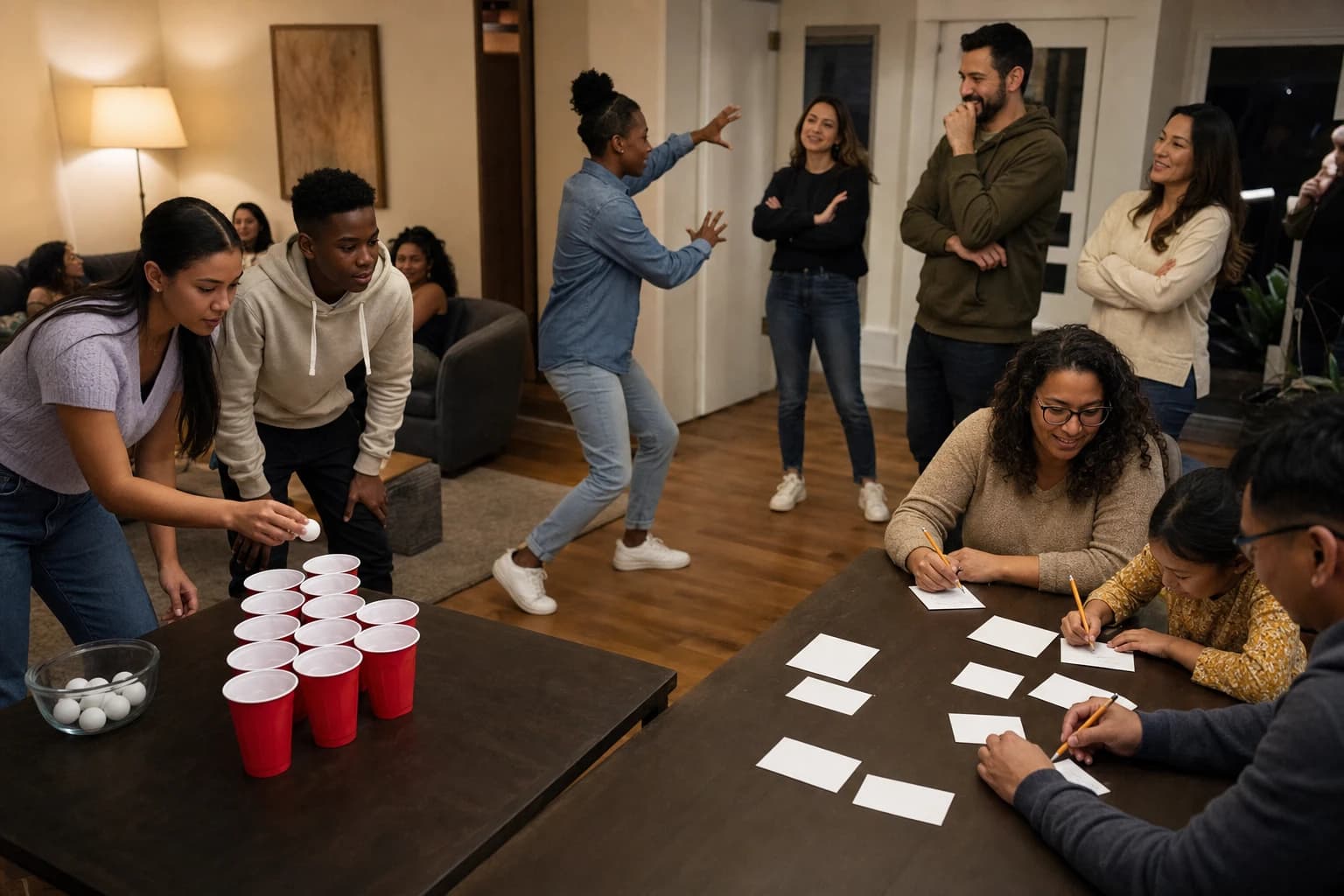
Use Minute to Win It when you want a loud, active party with quick challenges and visible laughs. Use charades when you want a no-equipment game that works well for mixed ages and creative groups. Use trivia when your guests prefer talking, thinking, and team discussion over performing in front of everyone.
This guide compares the three formats by group size, age range, setup effort, competitiveness, shyness level, and hosting situation. It also includes a decision matrix you can use before your next family party, adult game night, office gathering, birthday, or last-minute get-together.
Minute to Win It vs Charades vs Trivia at a glance
Before choosing specific games, compare the formats. The table below focuses on hosting reality: how the game feels in the room, how much prep it takes, and which guests are most likely to enjoy it.
| Criteria | Minute to Win It | Charades | Trivia |
|---|---|---|---|
| Best group size | 6 to 24 players, or more if split into teams and rotating stations | 6 to 20 players; larger groups work if teams take turns quickly | 4 to 40 players, especially in teams of 3 to 6 |
| Energy level | High: fast movement, cheering, and time pressure | Medium to high: performance-based, but not always physical | Low to medium: discussion, guessing, and scorekeeping |
| Setup effort | Medium: needs supplies, timer, and space | Low: needs prompts and a bowl, phone, or cards | Low to medium: needs questions, answer sheets, and scoring |
| Best for shy guests | Mixed: solo challenges can feel exposed unless played in teams | Mixed: acting can be intimidating for quiet guests | Strong: team discussion lets people contribute without performing |
| Best for kids and adults together | Strong if challenges are simple and safe | Strong if prompts are age-neutral | Moderate: questions must be balanced by age and knowledge |
| Space needed | Moderate: clear floor or table space for each challenge | Small to moderate: one acting area is enough | Small: seats, paper, and a host are enough |
| Competition level | High by default | Medium; can be silly rather than serious | High if scored, relaxed if played casually |
| Last-minute suitability | Good if you already have cups, spoons, paper plates, balloons, or ping-pong balls | Excellent: prompts can be written in 10 minutes | Good if you use a small prepared question set |
| Main hosting risk | Mess, waiting turns, or challenges that are too difficult | Embarrassment, unclear prompts, or uneven participation | Questions that are too hard, too niche, or age-biased |
| Best overall use | Parties that need instant energy | Mixed groups that enjoy laughing and guessing | Groups that like conversation, teams, and friendly debate |
What each format is really good at
Minute to Win It: best for action, speed, and visible fun
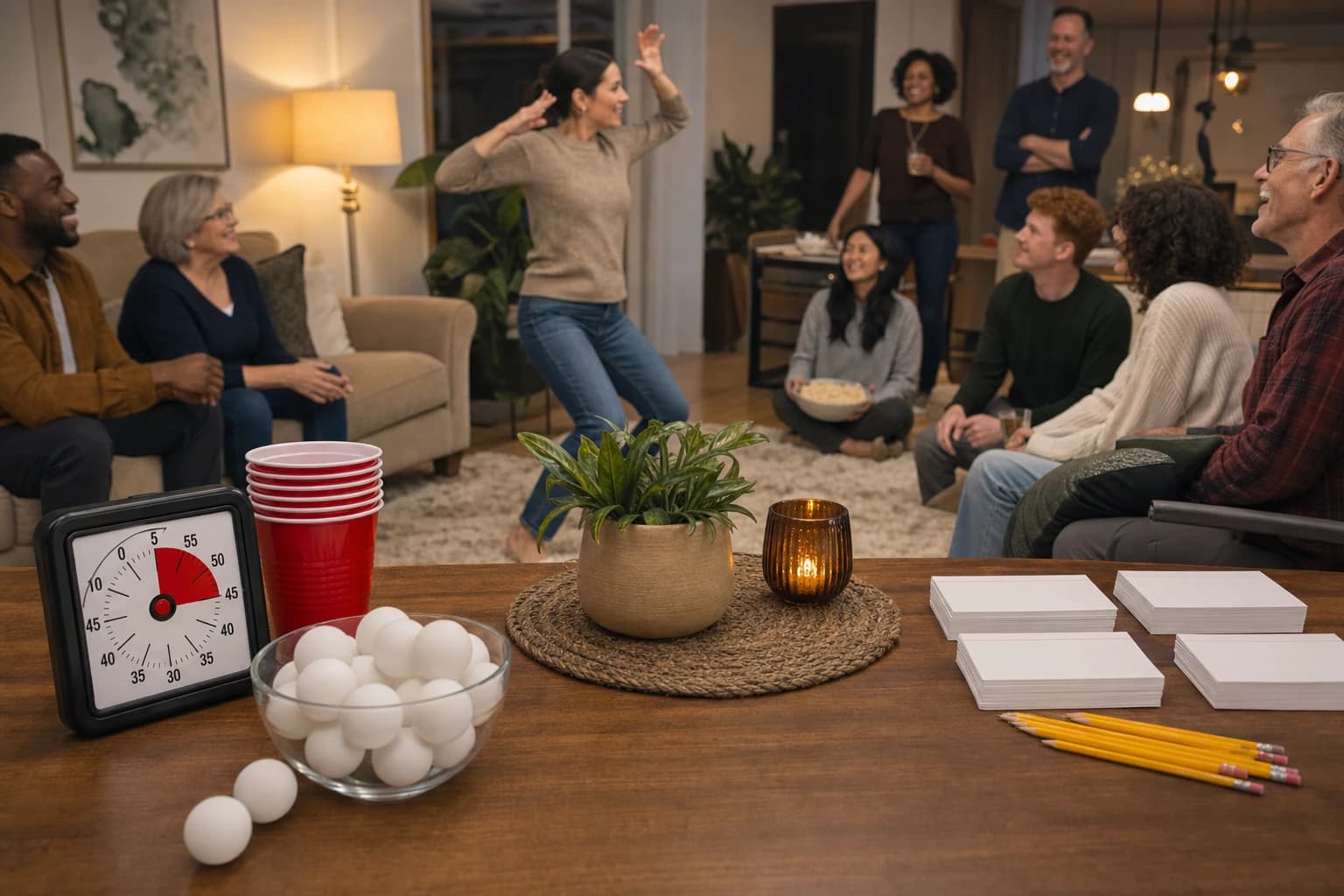
Minute to Win It-style party games are short physical or skill challenges, usually played with a 60-second timer. The format works because the rules are simple, the time limit is clear, and the results are easy for everyone to understand. Stack cups, move a cookie from forehead to mouth, bounce balls into cups, sort candies with chopsticks, or transfer cotton balls with a spoon: the goal is obvious even to someone who just walked into the room.
This format is strongest when the group has energy to burn. It is a smart choice for birthday parties, teen gatherings, family reunions, youth events, and adult parties that need a quick icebreaker after food. It also works well when people do not know each other deeply because guests can cheer for a task without needing long conversation.
The tradeoff is setup. You need supplies, a timer, a score sheet, and enough room to prevent collisions. You also need to pick challenges that do not embarrass guests or create cleanup problems. If you want more low-cost examples, see Minute-to-Win-It Party Games for Teens Using Household Items.
Charades: best for creativity, mixed ages, and no-equipment hosting
Charades is built around nonverbal clues. One player acts out a word, phrase, title, person, or action while teammates guess. The basic idea is old and familiar enough that many guests already understand it. Merriam-Webster defines charade as a word represented in pantomime, which captures the core of the game: communicate without speaking. You can check the dictionary definition at Merriam-Webster.
Charades is the most flexible of the three formats. It can be silly, calm, family-friendly, themed, holiday-based, or competitive. It needs almost no equipment: paper slips, a bowl, and a timer are enough. It also adapts well to mixed ages because a six-year-old can act out brushing teeth while an adult acts out a movie title or famous phrase.
The downside is performance anxiety. Some guests freeze when asked to act in front of others. Charades works best when the host makes it clear that ridiculous acting is part of the fun and allows team play, partner acting, or pass options.
Trivia: best for conversation, teams, and low-movement groups
Trivia is a question-and-answer format that rewards knowledge, memory, and good guessing. It is often the best party game format for adults when the group wants to stay seated, talk, eat, and play at the same time. It is also useful for apartments, restaurants, workplace lunches, and family gatherings where running games would be impractical.
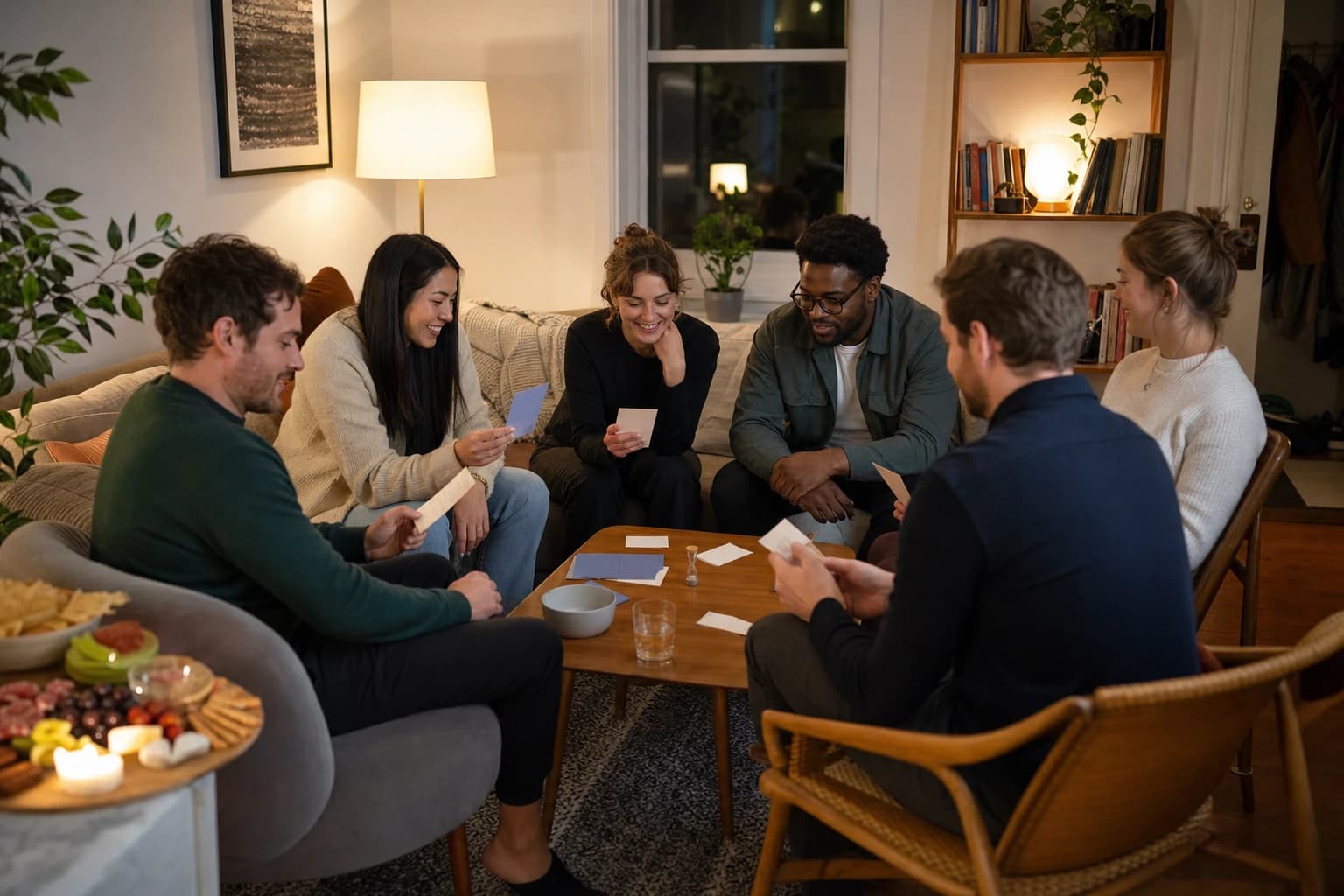
Trivia shines when players are grouped into teams. People can whisper, debate, and contribute in different ways. One guest may know sports, another may know music, another may be good at logic or wordplay. That makes trivia more inclusive for shy adults than games that require acting or physical challenges.
The main risk is poor question design. If questions are too obscure, one team may dominate while everyone else tunes out. If questions are too easy, the game becomes flat. A good party trivia round usually includes a mix of easy, medium, and one or two hard questions per round.
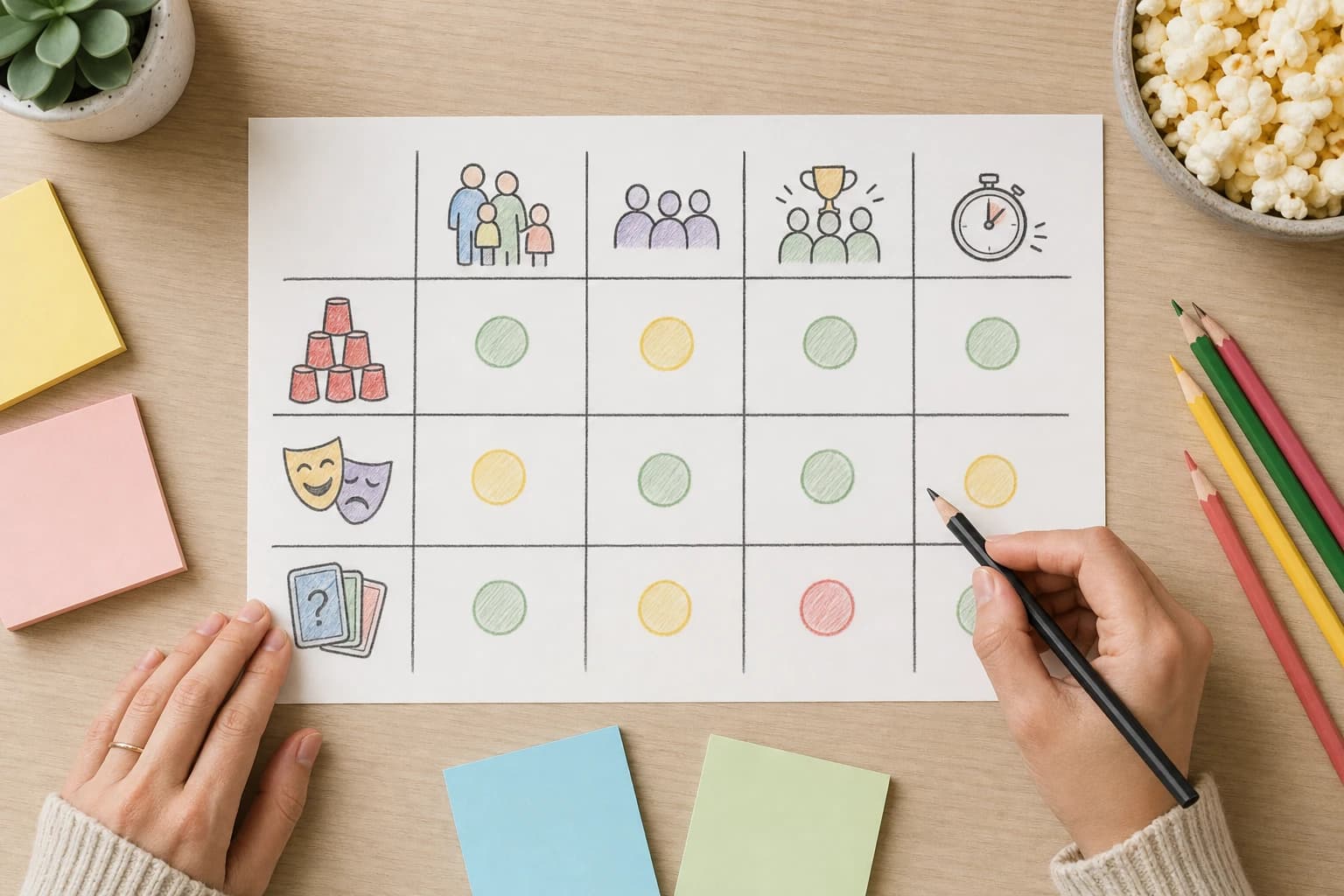
Decision matrix: choose by hosting situation
If you only have a minute to decide, start with the guest list. The best party game ideas by group type are not always the flashiest ones. They are the ones your specific guests will actually join.
| Hosting situation | Best format | Why it works | How to adapt it |
|---|---|---|---|
| Mixed-age family party | Charades or team Minute to Win It | Both can be visual and easy to understand across ages | Use simple prompts or pair children with adults for challenges |
| Shy group or guests who do not know each other | Trivia | People can contribute quietly inside a team | Use teams of 4 and include low-pressure questions with multiple possible guesses |
| Competitive friends | Minute to Win It | Fast rounds, clear winners, and visible skill make competition fun | Use a bracket or point system with 8 to 10 short challenges |
| Last-minute gathering | Charades | Needs the least equipment and can be prepared in 10 minutes | Write 30 prompts on paper and play first-to-10 points |
| Small apartment | Trivia or seated charades | No running or large movement needed | Use paper answer sheets or act from a chair |
| Kids with lots of energy | Minute to Win It | Short challenges help channel movement into structured play | Pick safe table games and avoid slippery or messy tasks |
| Dinner party for adults | Trivia | Players can stay seated and keep conversation going | Use 3 rounds of 10 questions and keep scoring simple |
| Holiday gathering | Charades or trivia | Both are easy to theme without expensive supplies | Use seasonal prompts or a holiday music, food, and movie round |
| Large group of 20 to 50 | Team trivia or station-based Minute to Win It | Teams reduce waiting and keep many people involved | For big groups, avoid single-player elimination games |
For larger events, the biggest issue is downtime. A game can be fun in theory and still fail if 30 people are watching one person play for too long. For more options that avoid that problem, see Large Group Party Games for 20 to 50 People That Keep Everyone Playing.
How to choose the right format in 5 minutes
Use this quick planning process before you commit to a game. It is especially helpful when you are hosting adults, kids, and teens together or when the guest list includes people with different comfort levels.
Tools and materials
- Guest count: exact number or best estimate
- Available time: 20, 30, 45, or 60 minutes
- Space check: seated only, open living room, backyard, or multiple rooms
- Supplies: timer, paper, pens, cups, spoons, balloons, or question cards
- Score method: whiteboard, phone note, paper tally, or no score
Step 1: Count active players, not total guests
If 18 people are attending but 5 will be cooking, supervising kids, or chatting on the side, plan for 13 active players. This matters because charades and trivia tolerate drop-in participation better than Minute to Win It. Physical challenge games need a clearer player order and enough supplies for each round.
Step 2: Rate the group energy from 1 to 3
- Low energy: guests are seated, eating, tired, or dressed for a formal setting. Choose trivia.
- Medium energy: guests are willing to laugh and move a little. Choose charades.
- High energy: guests are standing, noisy, and ready to compete. Choose Minute to Win It.
Step 3: Check the embarrassment factor
Ask yourself one honest question: would most guests be comfortable being watched? If the answer is no, do not start with solo charades or one-person physical challenges. Use team trivia, partner charades, or team-based Minute to Win It relays instead. This is especially important for work parties, new friend groups, and groups that include introverted guests.
Step 4: Decide whether you want a winner
Some groups love a scoreboard. Others become tense when every round is judged. Minute to Win It naturally creates winners because tasks are timed or measured. Trivia also scores easily, but ties are common and easy to break. Charades can be played with points, but it can also work as a casual guessing circle.
Step 5: Pick a format, then reduce rules
The best party games usually have fewer rules than the host first imagines. If your rules take more than 60 seconds to explain, simplify. For Minute to Win It, explain the objective, time limit, and what counts as success. For charades, explain no talking, no letters, and the time limit. For trivia, explain answer format, scoring, and whether phones are allowed.
Best format recommendations by group type
For adults who do not know each other well
Start with team trivia or a gentle icebreaker before switching to a louder game. Trivia gives people a reason to talk without forcing personal stories. Keep teams small enough that everyone can speak: 3 to 5 people per team is usually easier than teams of 8. If your goal is introductions, Icebreaker Party Games for Adults Who Do Not Know Each Other Well pairs naturally with a short trivia round.
For families with kids, teens, and adults
Charades is often the safest first choice because prompts can be adjusted by age. Put younger kids on teams with adults and use categories everyone can understand: animals, chores, sports, food, cartoons, and everyday actions. If the group is energetic, add two or three Minute to Win It team challenges after charades to increase movement without making the whole event chaotic. For more mixed-age ideas, see Team Party Games for Family Game Night With Mixed Ages.
For competitive adult friends
Minute to Win It is usually the best fit. Use 8 challenges, award 3 points for first place, 2 points for second, and 1 point for third. Rotate players so no one person dominates. Good challenge categories include stacking, balancing, tossing, sorting, and memory. Avoid challenges that depend too much on height, strength, or expensive supplies.
For quiet dinner parties
Choose trivia, but keep it short. A good dinner-party structure is 3 rounds of 8 questions, plus one tie-breaker. Mix categories so the same person is not always the expert: food, travel, music, movies, everyday science, wordplay, and local knowledge. Let teams write answers and reveal scores after each round, not after every question, so the conversation is not interrupted constantly.
For last-minute hosting
Charades is the fastest to prepare. Write 30 prompts on slips of paper: 10 easy actions, 10 people or characters, and 10 movie, song, or object prompts. Put them in a bowl. Set a 60-second timer. If the group is large, divide into two teams. If the group is small, play cooperatively and count how many prompts the group can guess in 10 minutes.
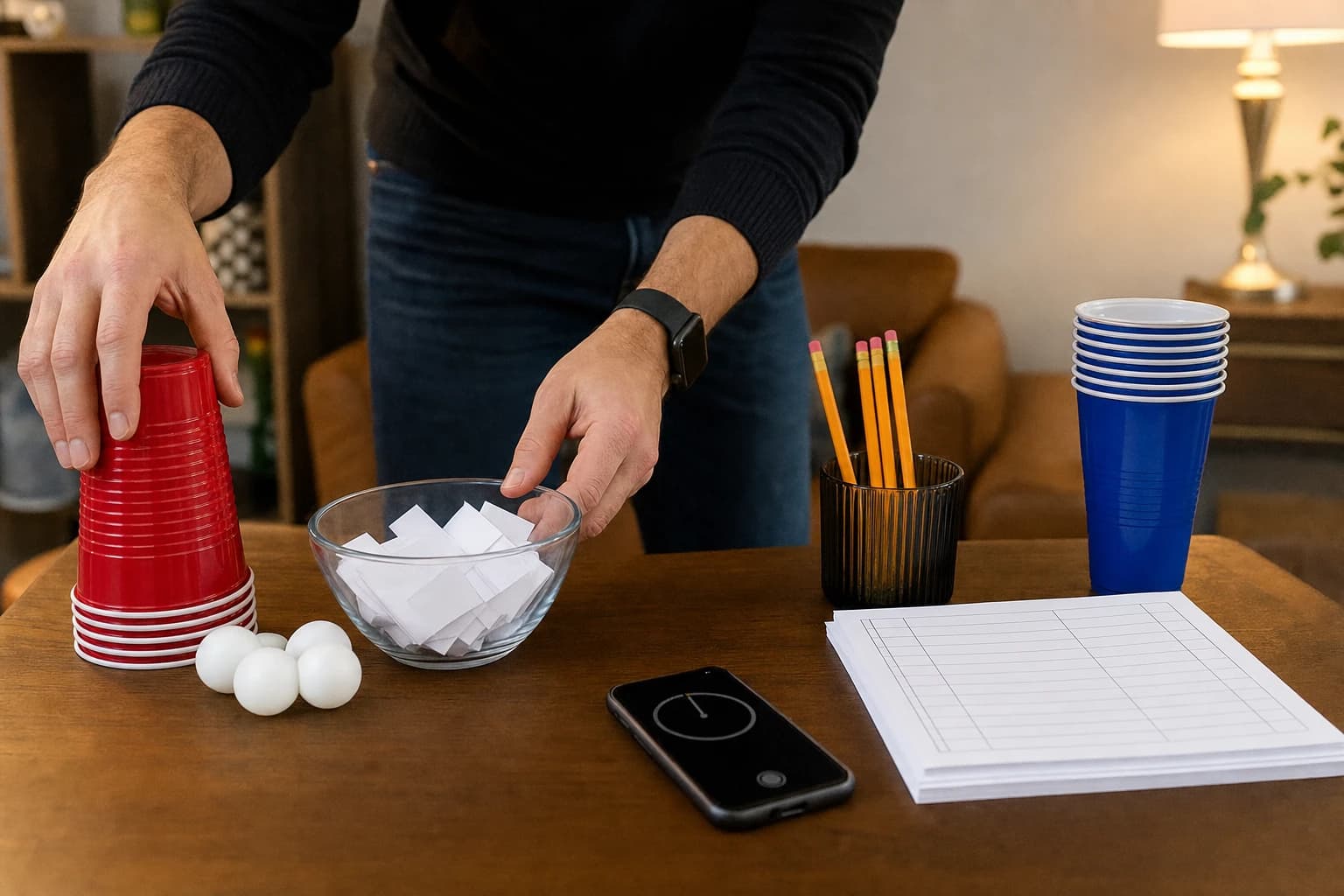
Setup plans for each game format
Minute to Win It setup: 30-minute active party block
- Best group: 8 to 20 players
- Time: 30 minutes
- Difficulty: medium for the host, easy for players
- Supplies: timer, 20 plastic or paper cups, 10 ping-pong balls, 2 spoons, paper plates, score sheet, pen
- Choose 5 challenges that use different skills, such as stacking cups, bouncing balls into cups, balancing a spoon, moving objects with one hand, and sorting by color.
- Set one table or clear floor area for each challenge if possible. If space is small, run one challenge at a time.
- Divide guests into teams of 3 to 5. Each team sends one player per challenge.
- Give each player 60 seconds. Award 3 points for the best result, 2 for second, and 1 for participation if you want a friendly tone.
- End with a team challenge so everyone plays in the final round.
Variation: for younger kids, remove strict scoring and let every team try to beat its own previous result. For adults, keep the timer and scoreboard visible to build tension.
Charades setup: 25-minute flexible party block
- Best group: 6 to 18 players
- Time: 25 minutes
- Difficulty: easy
- Supplies: 40 prompt slips, bowl, timer, score sheet if playing teams
- Create 40 prompts before guests arrive. Use 15 easy actions, 10 objects, 10 familiar people or characters, and 5 harder phrases.
- Split into 2 teams. Seat teams together so they can guess quickly.
- Set a 60-second turn limit. The actor may pass once per turn if the prompt feels too difficult.
- Give 1 point for each correct guess. Switch teams after each turn.
- Stop after 20 minutes or when one team reaches 15 points.
Variation: for a shy group, allow two actors from the same team to act together. This lowers pressure and usually makes the clues funnier.
Trivia setup: 45-minute seated party block
- Best group: 8 to 40 players
- Time: 45 minutes
- Difficulty: medium because question quality matters
- Supplies: 30 questions, answer sheets, pens, host answer key, score sheet
- Create 3 rounds of 10 questions. Use a different category mix in each round.
- Form teams of 3 to 6. Avoid teams of 1 unless everyone prefers individual play.
- Read each question once, then repeat it once. Give teams 30 to 45 seconds to answer.
- Collect or check answers at the end of each round. Award 1 point per correct answer.
- Use one tie-breaker question with a numeric answer. Closest answer wins the tie.
Variation: for mixed ages, make one round visual or multiple-choice. This keeps younger players involved and prevents the game from rewarding only adult knowledge.
Common mistakes that make good games feel awkward
Choosing the game you like instead of the game the group will play
A host who loves trivia may accidentally create a quiz that feels like school. A host who loves energetic games may push physical challenges on guests who wanted to relax. Start with the guest list, not your favorite format.
Making turns too long
Long turns create dead time. For charades and Minute to Win It, 60 seconds is usually enough. For trivia, keep answer time short unless the question is intentionally difficult. A lively pace matters more than perfect fairness.
Letting elimination remove players too early
Elimination can be exciting in a final round, but it often hurts party games because eliminated guests stop participating. Use team points instead. If you want a final winner, save elimination for the last 5 minutes.
Writing prompts or questions for only one age group
This is the biggest issue with charades vs trivia party games for families. Movie titles from one generation, niche sports facts, or internet references may leave half the room out. Mix easy shared categories with a few harder ones.
Ignoring space, noise, and cleanup
A tiny living room can handle trivia or seated charades better than cup-stacking races. A backyard can handle relay-style Minute to Win It. If food is out, avoid games with flour, water, sticky candy, or anything that can spill near electronics.
Which format is best overall?
There is no single winner for every party, but there is a best default for each goal.
- Choose Minute to Win It if your goal is energy, laughter, movement, and clear competition.
- Choose charades if your goal is low setup, mixed-age play, and creative silliness.
- Choose trivia if your goal is seated conversation, team discussion, and adult-friendly structure.
If you are unsure, combine formats instead of forcing one game to do everything. For a 60-minute game block, try 15 minutes of easy team trivia, 20 minutes of charades, and 20 minutes of Minute to Win It team challenges, leaving 5 minutes for instructions and transition. This gives quiet guests time to warm up before the more active games begin.
FAQ
Is Minute to Win It better than charades for adults?
It depends on the adults. Minute to Win It is better for energetic, competitive groups. Charades is better for adults who enjoy creative guessing and do not mind light performance. For a quieter adult group, trivia is usually safer than both.
What is the best party game format for adults in a small apartment?
Trivia is usually the easiest choice because everyone can stay seated and no open floor space is required. Charades can also work if actors stand in one small area or act from a chair. Minute to Win It can work only if you choose tabletop challenges with minimal mess.
How many trivia questions do I need for a party?
For a 30- to 45-minute party game, prepare 25 to 35 questions. A simple structure is 3 rounds of 10 questions plus a few tie-breakers. Use mixed categories so one guest does not have an unfair advantage all night.
How do you make charades less embarrassing?
Use team play, allow one pass per turn, and start with easy prompts. You can also let two people act together. Avoid prompts that mock guests, rely on private jokes, or require awkward body movements.
Can kids and adults play Minute to Win It together?
Yes, if the challenges are simple, safe, and team-based. Pair children with adults or let each age group compete in different roles. Avoid tasks that depend heavily on height, strength, speed, or anything messy that could create slips or spills.
What if my group includes both shy and competitive guests?
Start with team trivia, then move to team-based Minute to Win It. This lets shy guests contribute quietly first and gives competitive guests a stronger finish. Avoid solo performance games as the opening activity.
Conclusion: use the format that creates the right kind of participation
The best comparison of Minute to Win It vs Charades vs Trivia is really a comparison of participation styles. Minute to Win It asks guests to move. Charades asks guests to perform. Trivia asks guests to think and discuss. None is automatically better; each succeeds with the right room.
For mixed-age family parties, start with charades or team challenges. For shy groups, choose trivia first. For competitive friends, use Minute to Win It with a clear scoreboard. For last-minute gatherings, charades is the simplest reliable option. When in doubt, keep teams small, rules short, turns quick, and the mood flexible.