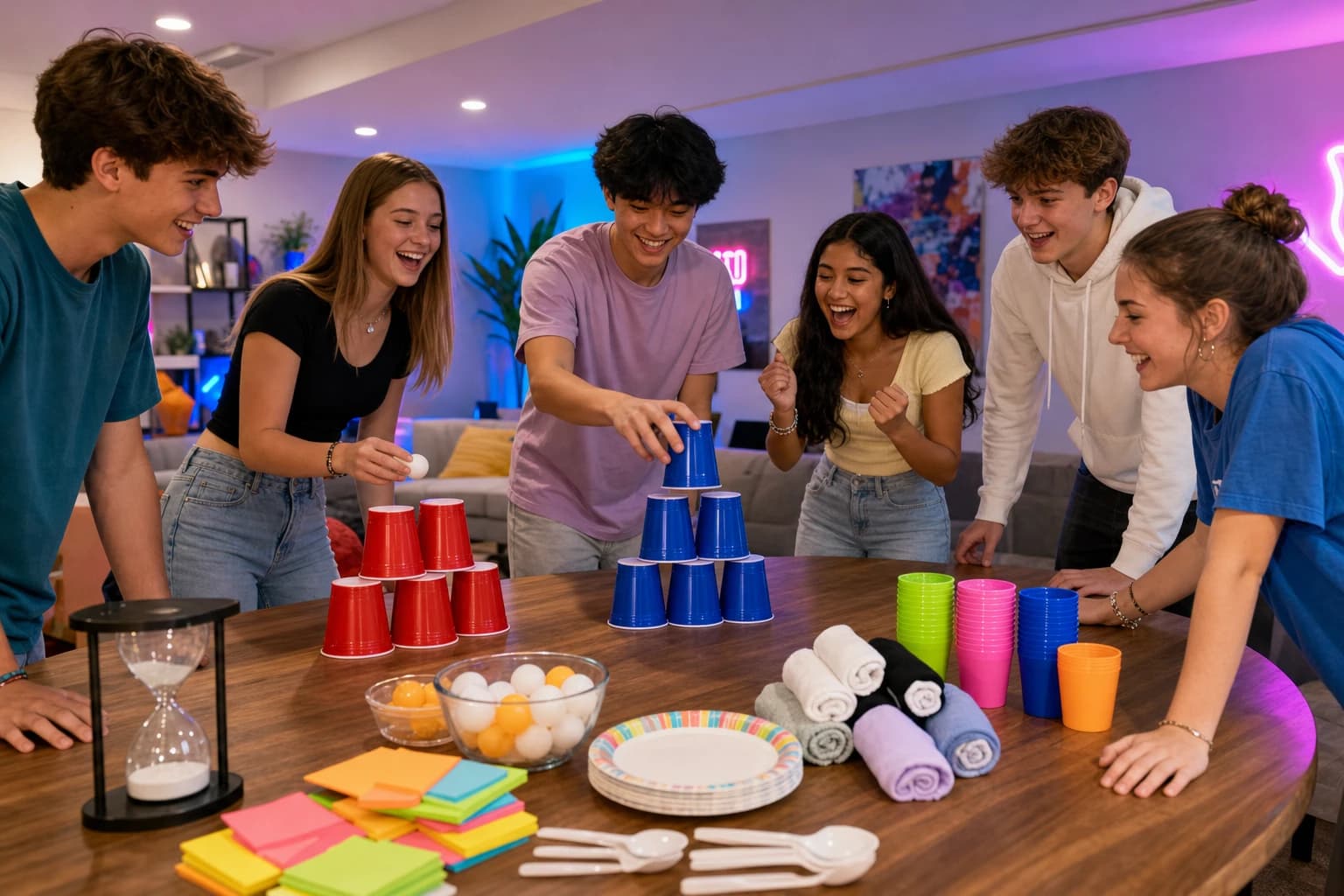
Teen parties work best when the games are quick to explain, easy to reset, and competitive enough that nobody has to pretend they are excited. These minute to win it games for teens use common household items such as cups, spoons, paper plates, straws, sticky notes, socks, rubber bands, and ping-pong balls.
This guide gives you a ready-to-run tournament format, a practical scoring system, team rotation ideas, and safer alternatives for challenges that are often too messy, slippery, or breakable for a living room birthday party. You can use the whole plan for a 60- to 90-minute party block or choose 5 games as a short icebreaker.
Quick overview: how the teen tournament works
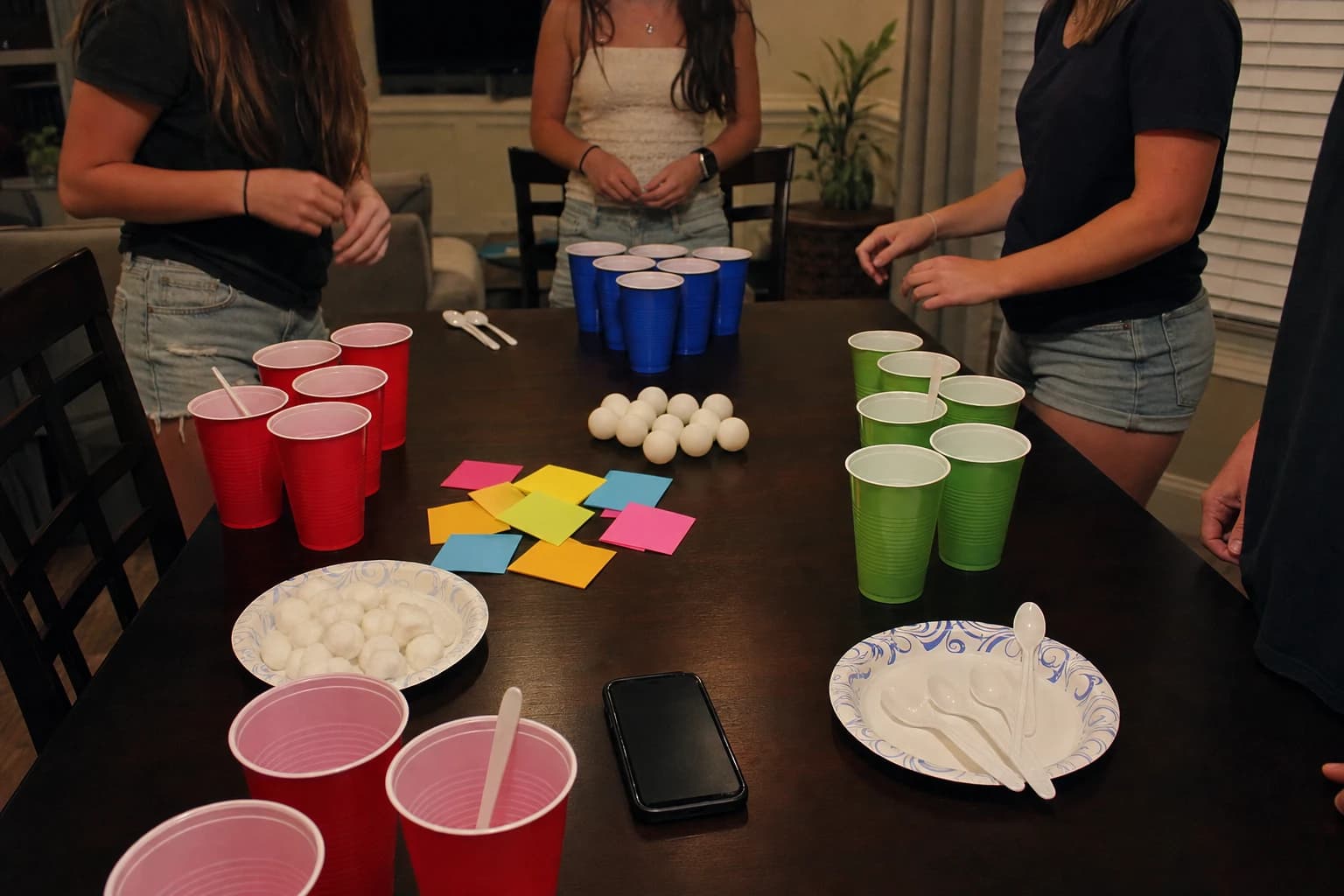
The easiest way to run quick games for teenagers is to set up stations rather than making everyone watch one person play at a time. Divide guests into teams of 3 or 4, assign each team a starting station, and rotate every 4 minutes. Each station includes 1 minute to play, 1 minute to record the score, and about 2 minutes to reset and move.
For 12 teens, use 4 teams of 3 and 4 stations at a time. For 16 teens, use 4 teams of 4. If you have more than 20 guests, run two identical game zones or choose relay-style games so nobody spends the whole party waiting.
Best basic format
- Players: 8 to 20 teens
- Time needed: 45 minutes for 8 games, 75 minutes for 12 games plus a final
- Team size: 3 or 4 players
- Round length: 1 minute of play, then reset
- Scoring: points for each completed item, or rank each team 4-3-2-1 per station
- Space: kitchen table, dining table, garage, patio, or cleared living room
Materials checklist for household-item party games
You do not need to buy a themed kit. Most teen party games with household items work better when every station uses inexpensive objects that are hard to break and easy to clean. Before the party, place each game in a labeled grocery bag or box so a helper can reset it quickly.
- 40 plastic or paper cups, preferably 16-ounce cups
- 20 paper plates
- 10 plastic spoons
- 10 ping-pong balls or lightweight practice balls
- 1 pack of sticky notes
- 1 roll of painter tape or masking tape
- 1 bag of cotton balls
- 1 deck of cards
- 1 package of rubber bands
- 10 clean socks rolled into soft balls
- 10 straws, or reusable straws if you already have them
- 1 timer or phone with a loud alarm
- Score sheets, pens, and a clipboard
- Trash bag, towel, and paper towels for quick cleanup
Safety note before you start
Choose games that fit the room and the group. Avoid glass, sharp objects, blindfolded running, food challenges involving speed eating, and anything that encourages throwing hard objects near faces. If younger siblings are nearby, keep small parts such as rubber bands, coins, and marbles out of reach. The U.S. Consumer Product Safety Commission explains why small parts can be hazardous for children under 3, which is a useful reminder when parties include mixed ages: CPSC small parts guidance.
12 minute to win it games for teens using household items
The games below are designed for teens, not toddlers. They include a little speed, accuracy, coordination, and strategy, but the rules are still simple enough to explain in under 30 seconds. For each game, one team plays at a station during the minute. If you have enough supplies, two teams can play head-to-head at the same station.
| Game | Main items | Best score method | Mess level |
|---|---|---|---|
| Cup Stack Sprint | 21 cups per team | Fastest complete pyramid, or completed stacks | Low |
| Sticky Note Face-Off | Sticky notes | Notes still attached after 60 seconds | Low |
| Spoon Relay Sort | Spoons, cotton balls, bowls | Cotton balls moved | Low |
| Ping-Pong Bounce Target | Cups, ping-pong balls | Balls landed in cups | Low |
| Card Cliffhanger | Deck of cards, table | Cards hanging over edge | Low |
| Sock Toss Ladder | Rolled socks, baskets or plates | Total points | Low |
| Rubber Band Launch Zone | Rubber bands, cups | Cups knocked down | Medium supervision |
| Straw Transfer Challenge | Straws, paper squares | Squares transferred | Low |
| Paper Plate Flip | Paper plates | Successful flips | Low |
| Balloon Balance Walk | Balloons, paper plates | Completed laps | Low |
| Penny Tower Swap | Coins, cardboard, cups | Coins stacked | Low, keep away from younger kids |
| Finale: Team Cup Relay | Cups, tape line | Fastest time or most completed transfers | Low |
1. Cup Stack Sprint
Items: 21 plastic or paper cups per team. Goal: build a 6-5-4-3-2-1 pyramid and collapse it back into one stack within 60 seconds.
- Place one stack of 21 cups on the table.
- When the timer starts, one player builds the pyramid.
- The pyramid must stand for 3 seconds before the player collapses it.
- Score 10 points for a full build and 5 bonus points for a clean collapse before time runs out.
Variation: For larger teams, make it a relay. Each player may place only 5 cups before tagging the next teammate.
2. Sticky Note Face-Off
Items: 25 sticky notes per team. Goal: attach as many sticky notes as possible to one teammate’s shirt, arms, or face-safe areas in 60 seconds.
Use only clean skin or clothing areas and avoid eyes, hair, and mouths. At the end, count only the notes still attached. This is silly without being destructive, and it photographs well if everyone is comfortable with photos.
Safer alternative: If a teen does not want anything on their face or body, use a chair, hoodie, or poster board as the target instead.
3. Spoon Relay Sort
Items: 2 bowls, 1 spoon, and 20 cotton balls per team. Goal: move cotton balls from one bowl to another using only the spoon.
- Put one bowl of cotton balls on the start line.
- Place the empty bowl 6 feet away.
- Players take turns carrying one cotton ball at a time on the spoon.
- If the cotton ball drops, it goes back to the start bowl.
Score 1 point per cotton ball moved. For a smaller room, reduce the distance to 3 feet and require players to use their non-dominant hand.
4. Ping-Pong Bounce Target
Items: 6 cups and 6 ping-pong balls per team. Goal: bounce balls once on the table and land them in cups.
Arrange cups in a triangle about 18 inches from the table edge. Each team gets 60 seconds to land as many balls as possible. Balls that go straight into a cup without bouncing do not count. Score 2 points per ball in a cup.
Room tip: Put a towel or sheet behind the table so balls do not roll under furniture after every attempt.
5. Card Cliffhanger
Items: one deck of cards and a table. Goal: slide cards so they hang over the table edge without falling.
Players take turns sliding one card at a time. At the end of the minute, count cards that are partly over the edge and still touching the table. Score 1 point per card. This game works well as a calmer station between louder activities.
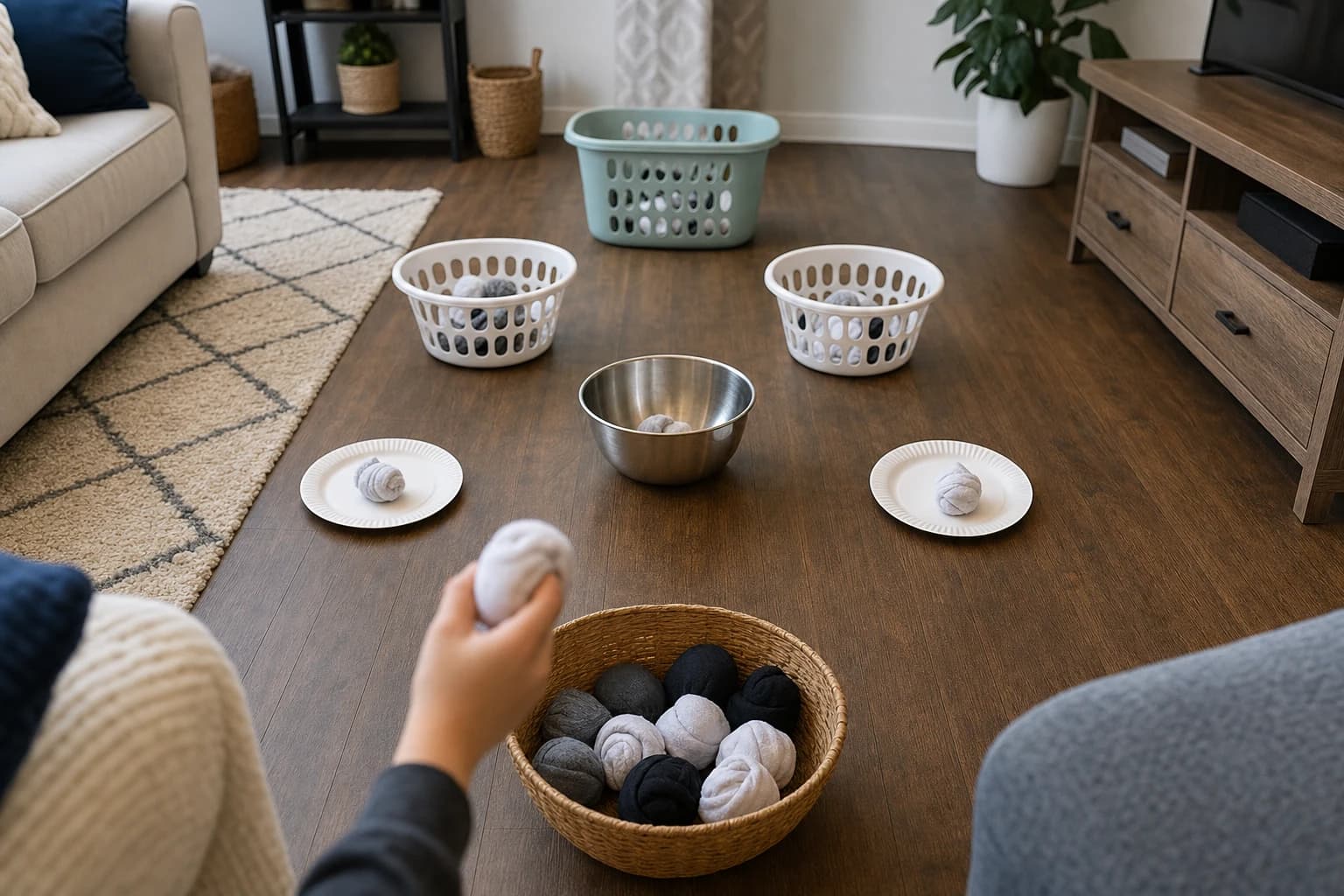
6. Sock Toss Ladder
Items: rolled socks and 3 targets, such as laundry baskets, mixing bowls, or paper plates. Goal: toss socks into targets worth different points.
- Close target at 5 feet: 1 point
- Middle target at 8 feet: 2 points
- Far target at 11 feet: 3 points
Each player retrieves socks only after all socks are thrown. Use rolled socks instead of balls if you are indoors near lamps, picture frames, or a TV.
7. Rubber Band Launch Zone
Items: rubber bands and 10 plastic cups. Goal: knock down as many cups as possible from a marked line.
Stack cups in a low pyramid on a table or the floor. Players stand 6 feet away and launch rubber bands at the cups. Score 1 point per cup knocked down.
Important: Only allow shots toward the target area. No aiming at people, faces, pets, or windows. If the group is too wound up, swap this for Sock Toss Ladder or Paper Plate Flip.
8. Straw Transfer Challenge
Items: straws, 20 small paper squares, and 2 plates. Goal: move paper squares from one plate to another using suction through a straw.
Cut paper into squares about 1 inch wide. Players pick up one square at a time with the straw and transfer it to the second plate 12 inches away. Score 1 point per square moved.
Hygiene option: Give each player their own straw and do not share straws between players. Reusable straws should be washed before and after the party.
9. Paper Plate Flip
Items: 10 paper plates per team. Goal: flip plates from face-down to face-up using one hand.
Spread plates face-down on a table. A player can use only one hand and may not slide a plate off the table to flip it. Score 1 point for each plate that ends face-up. To increase difficulty, require players to alternate hands after every 3 successful flips.
10. Balloon Balance Walk
Items: 1 inflated balloon and 1 paper plate per team. Goal: carry the balloon on the plate around a chair and back as many times as possible.
Set the chair 8 feet from the start line. If the balloon falls, the player returns to the start and the next teammate tries. Score 1 point per completed lap. Keep the walking path clear of bags, cords, and slippery rugs.
11. Penny Tower Swap
Items: coins, 1 square of thin cardboard, and 2 cups. Goal: stack coins on cardboard balanced across two cups.
Place two cups 4 inches apart and lay cardboard across them like a bridge. Players stack coins one by one in the center. Score the number of coins in the standing tower at 60 seconds. If it falls, the team may rebuild, but only the final standing tower counts.
Safer swap: If younger children are present, use checkers, large buttons, or bottle caps instead of coins.
12. Finale: Team Cup Relay
Items: 20 cups and painter tape. Goal: move a stack of cups from one table to another, one cup at a time, as a team relay.
- Mark a start table and finish table 8 to 12 feet apart.
- Each player may carry only one cup at a time.
- When a player returns, they tag the next teammate.
- The team with the most cups moved in 60 seconds wins the finale.
This final game gives every teammate a role and avoids the awkwardness of ending the tournament with only one person playing.
Scoring sheet suggestions that are easy to manage
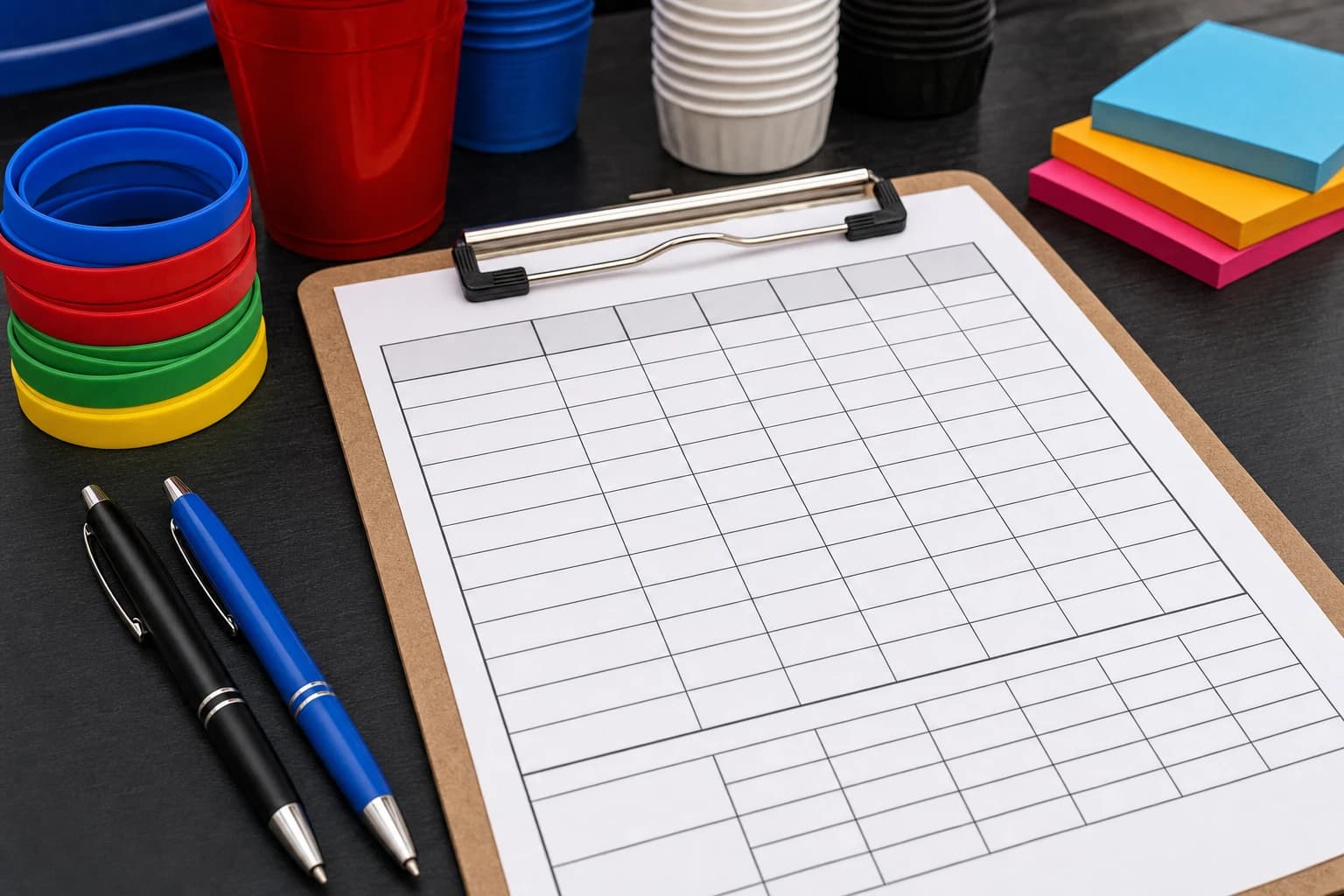
For teen birthday games, simple scoring is better than perfect scoring. You want enough structure to feel competitive without turning the host into a referee for an hour. Print one score sheet per team or use a whiteboard everyone can see.
| Station | Raw score | Rank points | Notes |
|---|---|---|---|
| Cup Stack Sprint | Completed pyramid plus bonus | 4 / 3 / 2 / 1 | Use timer if tied |
| Sticky Note Face-Off | Notes still attached | 4 / 3 / 2 / 1 | Count after alarm |
| Spoon Relay Sort | Cotton balls moved | 4 / 3 / 2 / 1 | Dropped pieces return |
| Ping-Pong Bounce Target | Balls in cups x 2 | 4 / 3 / 2 / 1 | Bounce required |
| Finale | Cups transferred | Double points | Optional comeback round |
Raw-score method: Add the actual number of points earned in every game. This rewards teams that dominate one station, but it can create a runaway leader.
Rank-points method: After each station, give 4 points to first place, 3 to second, 2 to third, and 1 to fourth. This keeps the tournament close and is easier when games have different scoring styles.
Recommended: Use rank points for the main tournament and double points for the finale. If two teams tie, use one 30-second tiebreaker: Cup Stack Sprint with 10 cups.
Team rotation ideas for different party sizes
The right rotation keeps energy high and prevents the common problem of half the group sitting on the couch. Post the rotation on the wall or put it on a clipboard that travels with the scorekeeper.
8 to 12 teens
Make 4 teams of 2 or 3. Set up 4 stations. Everyone plays at the same time, then rotates clockwise. Run 8 stations total by swapping in 4 new games halfway through.
13 to 20 teens
Make 4 or 5 teams of 3 or 4. Use 5 stations if you have enough space. If not, create one rest station where teams decorate a team name card, choose a chant, or review the scoreboard for 4 minutes.
More than 20 teens
Use two identical tournament zones if possible: Zone A and Zone B. Each zone needs the same supplies and the same scoring sheet. The top team from each zone meets in the finale. This is much smoother than forcing 24 teens through one station at a time.
Safer alternatives for messy or breakable challenges
Some classic one minute party games are fun on video but risky in a real home. The problem is not that teens cannot handle competition; it is that speed plus clutter plus fragile items can create avoidable messes. Use these swaps to keep the party fun without turning cleanup into the main event.
| Instead of... | Use this... | Why it works better |
|---|---|---|
| Raw egg balancing | Plastic spoon with a cotton ball | No slippery floor or broken egg cleanup |
| Glass cup stacking | Paper or plastic cup stacking | Less breakage and safer around fast hands |
| Flour digging games | Cotton ball spoon relay | Less dust, easier cleanup, fewer allergy concerns |
| Water balloon toss indoors | Balloon balance walk | Still tense, but no soaked furniture |
| Hard ball target games | Rolled sock toss | Better near walls, lamps, and screens |
| Speed eating contests | Straw transfer or cup relay | Avoids pressure to eat quickly |
Host tip: create a reset tray
Keep spare cups, extra sticky notes, a towel, painter tape, and pens in one tray near the scorekeeper. When a station breaks down, replace the item instead of pausing the whole tournament.
Common mistakes to avoid
- Explaining every game at the beginning. Teens will forget. Explain only the first station, then put a short rule card at each station.
- Making teams too large. Teams of 6 usually mean two people play and four people watch. Keep teams to 3 or 4 when possible.
- Using messy games too early. If you include water or food at all, save it for outdoors at the end.
- Letting arguments slow the party. Decide before the first round that the host or scorekeeper makes the final call.
- Skipping reset time. A 1-minute game often needs 2 minutes to reset. Build that into the schedule.
FAQ: minute to win it games for teens
How many minute to win it games do I need for a teen party?
Plan 8 games for a 45-minute activity block or 12 games for a 75-minute tournament with a finale. If the party schedule is loose, prepare 2 backup games in case the group moves faster than expected.
What are the best household items for teen party games?
Cups, paper plates, sticky notes, spoons, cotton balls, socks, straws, cards, and ping-pong balls are the most flexible. They are inexpensive, easy to reset, and work in small indoor spaces.
How do I make the games fair for different ages?
Use team scoring instead of individual elimination. Mix older and younger teens across teams, and choose games that combine different skills, such as balance, accuracy, speed, and strategy.
Can these games work for a birthday party in a small apartment?
Yes. Choose tabletop games such as Card Cliffhanger, Cup Stack Sprint, Straw Transfer Challenge, Sticky Note Face-Off, and Paper Plate Flip. Avoid running relays unless you have a clear walkway.
What prizes should I give?
Small prizes work fine: candy bags, stickers, phone grips, fuzzy socks, or first pick of dessert. You can also give funny paper awards such as Best Comeback, Most Dramatic Miss, or Fastest Reset Helper.
Conclusion
The best minute to win it games for teens are fast, clear, and easy to reset. A station-based tournament keeps everyone involved, while simple rank scoring prevents one game from deciding the whole party. Start with low-mess household items, use soft substitutes around breakable objects, and post the rotation so teams know where to go next.
If you prepare the supplies in labeled bags, print one score sheet per team, and choose a strong finale, you can turn a pile of cups, sticky notes, socks, and spoons into a full teen party activity without buying much of anything.