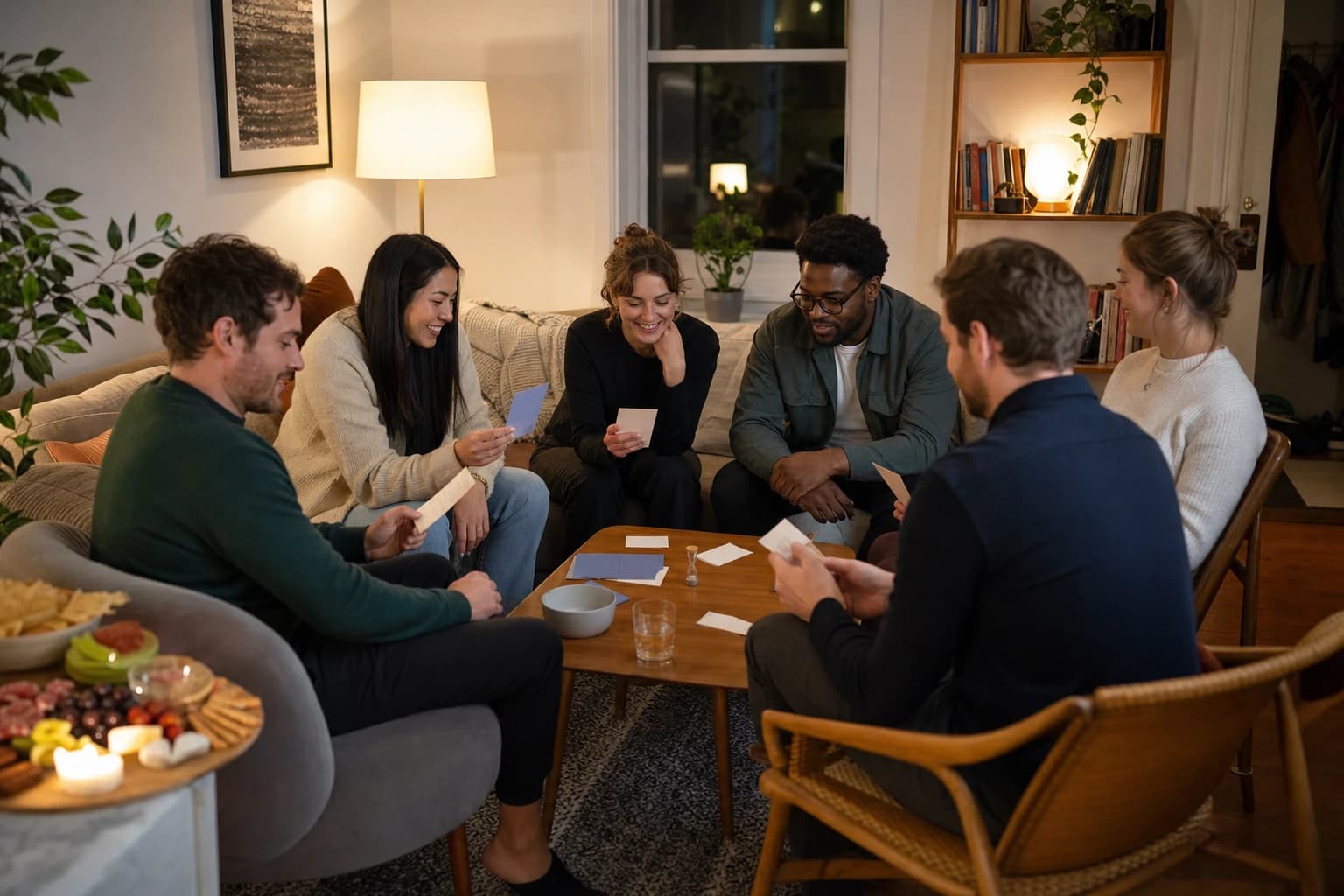
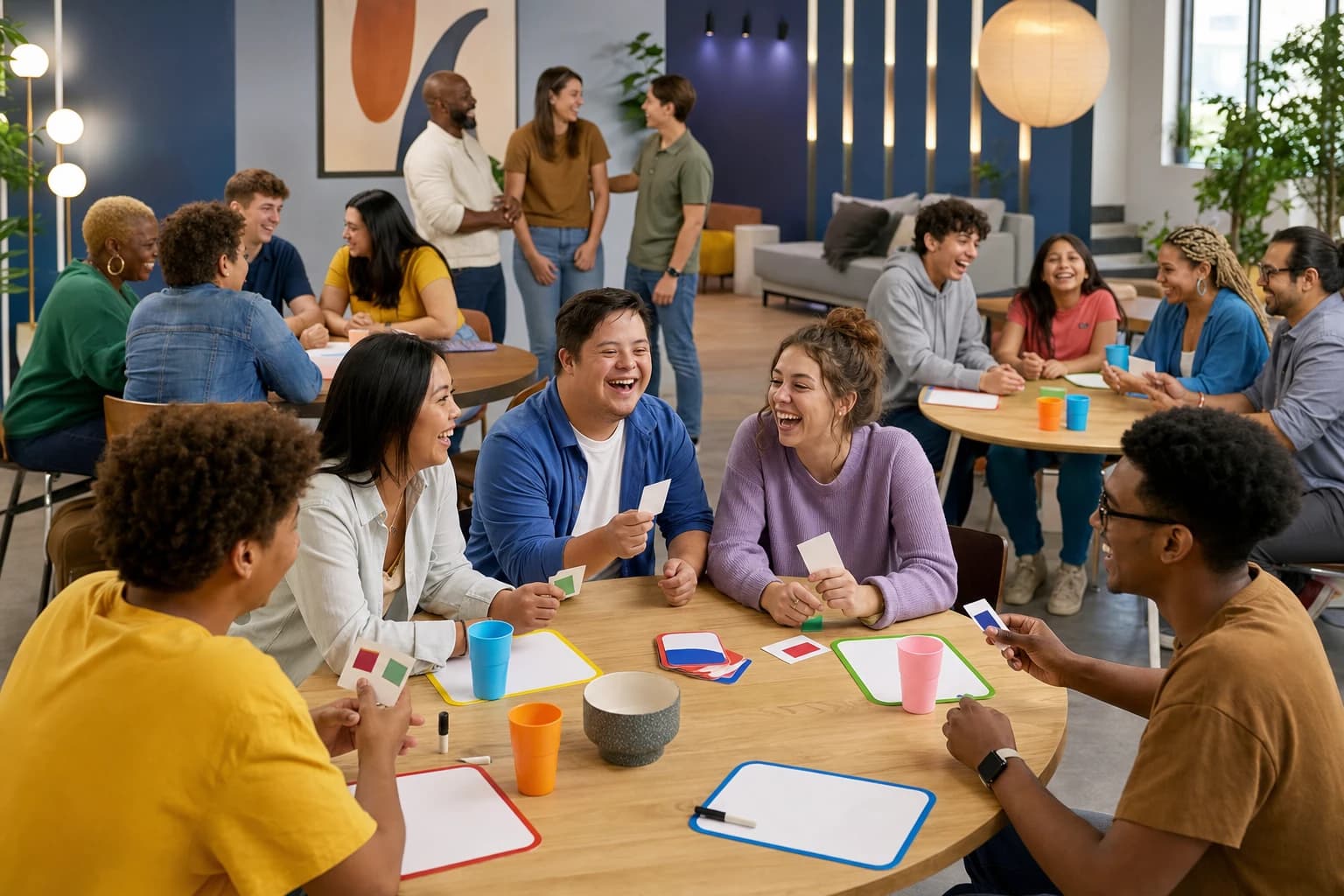
Large gatherings can be awkward to entertain because classic party games often make people wait too long, put shy guests on the spot, or eliminate half the room in the first few minutes. If you are hosting 20, 30, 40, or 50 people, the best games are the ones where everyone has something to do at the same time.
This guide focuses on large group party games for 20 to 50 people that avoid early elimination. You will find quick setup advice, a comparison table, and practical rules for team games, mixed-age groups, uneven numbers, and parties where guests do not all know each other yet.

Quick answer: what works best for 20 to 50 players?
The most reliable party games for large groups use one of four formats:
- Team challenges: divide guests into teams of 5 to 8 and score each round instead of removing players.
- Station games: set up 4 to 6 small activities and rotate teams every 6 to 10 minutes.
- Whole-room prompt games: everyone responds to the same question, movement cue, or category at once.
- Creative build or guessing games: teams draw, act, build, write, or solve together under a timer.
For most parties, plan for 45 to 75 minutes of games. That is enough time for several rounds without making the party feel like a formal event. If your crowd is closer to 50 people, avoid games where one person performs while 49 people watch. Use multiple teams, identical supplies, and visible timers.
Basic setup for no-elimination large group games
A little structure makes a big difference when you are managing a room of 20 to 50 people. The goal is not to over-control the party; it is to remove confusion so guests can relax and join in.
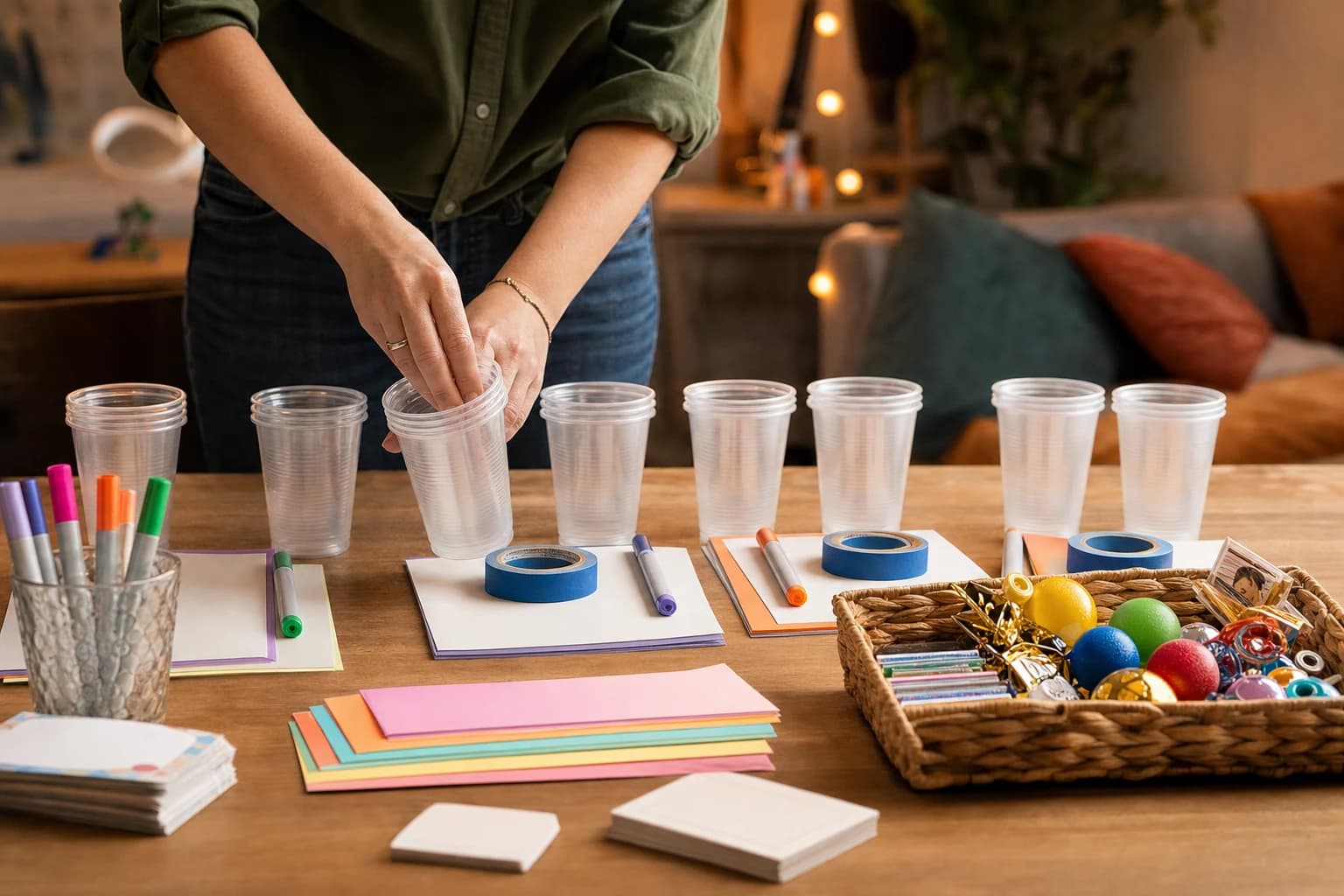
Materials to prepare
- 1 phone timer or kitchen timer that can be heard clearly
- 1 scoreboard: whiteboard, poster paper, or notes app mirrored to a screen
- 1 marker per team, plus 2 spare markers
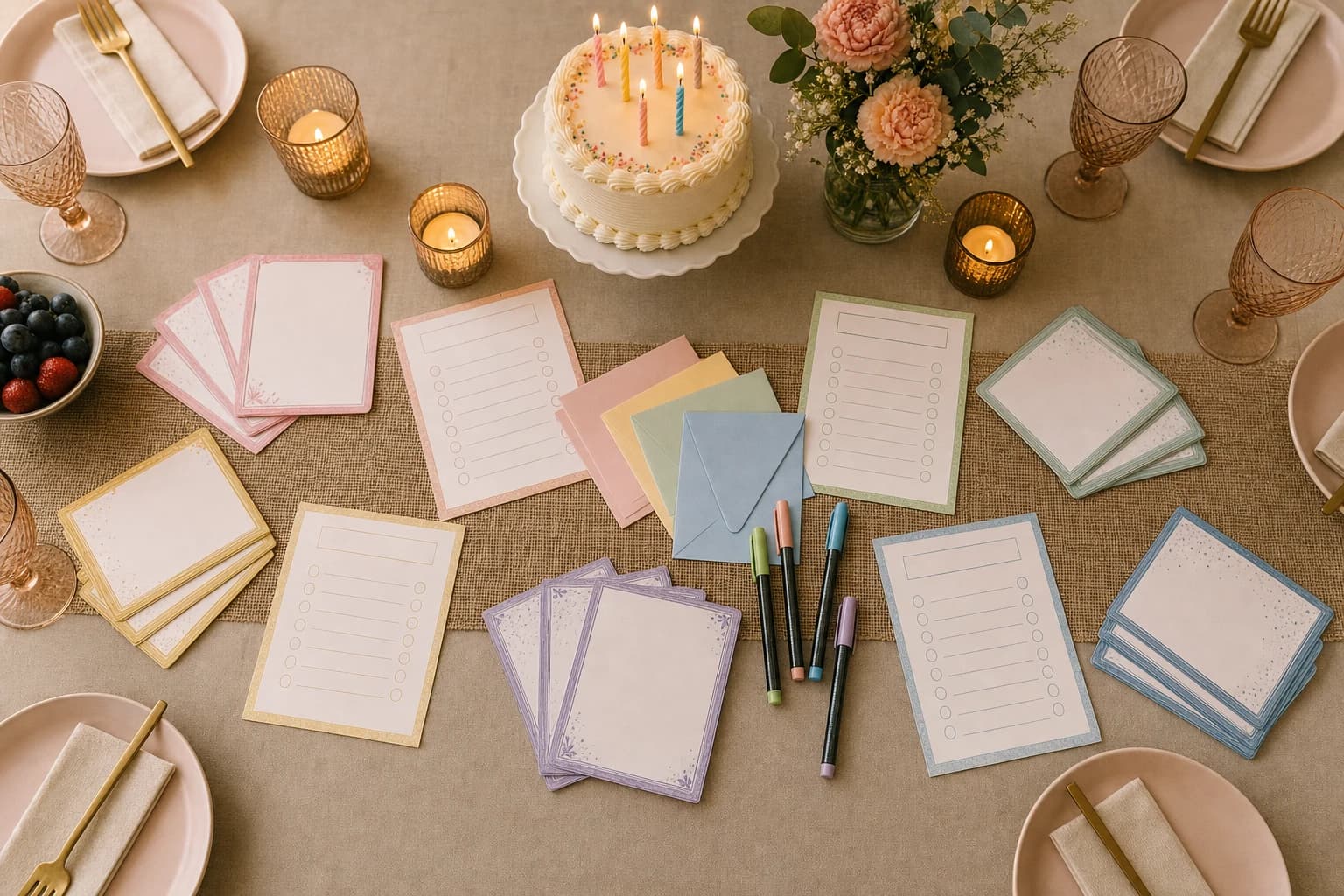
- Index cards or slips of paper, about 10 per team
- Painter's tape for team signs or station labels
- Optional: small prize basket with candy, stickers, novelty medals, or first-choice dessert tickets
Simple planning steps
- Choose a team size. For 20 people, use 4 teams of 5. For 30 people, use 5 teams of 6 or 6 teams of 5. For 40 to 50 people, use 6 to 8 teams of 6 to 7 players.
- Name the teams before the first game. Use colors, table numbers, animals, or random draw cards. Do not let team selection drag on.
- Limit each round. Use 3-minute rounds for guessing games, 5-minute rounds for writing games, and 8 to 10 minutes for building or scavenger challenges.
- Score teams, not individuals. Give points for correct answers, completed tasks, creativity, or teamwork. Nobody sits out because they missed a question.
- Keep rules under 60 seconds. If a game needs a long explanation, simplify it before the party.
- Have a quiet role available. Some guests may prefer writing answers, tracking clues, drawing, photographing, or timekeeping instead of performing.
Game picker: best party games for large groups
Use this table to choose games based on your space, energy level, and how well the guests know each other.
| Game | Best group size | Time per round | Materials | Movement level | Why it avoids elimination |
|---|---|---|---|---|---|
| Team Photo Scavenger Hunt | 20 to 50 | 10 minutes | Phones, prompt list | Medium | Teams complete as many prompts as possible |
| Human Bingo With Team Bonus | 20 to 50 | 12 minutes | Bingo sheets, pens | Medium | Players keep mingling after the first bingo |
| Whiteboard Quiz Dash | 20 to 50 | 2 minutes per question | Whiteboards or paper | Low | All teams answer every question |
| Silent Line-Up Races | 20 to 40 | 3 minutes | None | Medium | Teams race to arrange themselves, then reset |
| Pass-the-Draw Story | 20 to 48 | 8 minutes | Paper, pens | Low | Everyone adds one part of the chain |
| Build the Tallest Tower | 20 to 50 | 10 minutes | Cups, tape, paper | Low to medium | All teams build at the same time |
| Categories Corners | 20 to 50 | 5 minutes | Corner signs | Medium | Corners score as teams instead of losing players |
| Crowd Charades Relay | 20 to 50 | 6 minutes | Prompt cards | Medium | Teams rotate actors quickly |
| One-Minute Commercial | 20 to 50 | 8 minutes prep, 1 minute perform | Random objects | Low | Every team creates and presents |
| Opinion Line | 20 to 50 | 5 minutes | Room space | Low | No correct answers and no knockouts |
10 no-elimination games for 20 to 50 people
The games below are written for home parties, office socials, school-safe gatherings, community events, reunions, and mixed friend groups. Adjust the prompts to fit your crowd.
1. Team Photo Scavenger Hunt
Best for: energetic groups, birthdays, reunions, office parties. Players: 20 to 50. Time: 10 to 15 minutes.
Divide guests into teams of 5 to 7. Give each team the same list of photo prompts and set a 10-minute timer. Examples include: take a photo with something blue, recreate a movie poster, form a human letter, find three people wearing different shoe colors, or make the smallest team member look like the team boss.
Award 1 point for each completed prompt and 2 bonus points for the funniest or most creative photo. Keep it inclusive by banning running indoors and making every prompt possible without touching strangers or entering private rooms. For younger players, use object-finding prompts. For adults, add harmless creative prompts such as dramatic album cover or fake restaurant review face.
2. Human Bingo With Team Bonus
Best for: groups where many guests do not know each other. Players: 20 to 50. Time: 12 minutes.
Create bingo sheets with 5 by 5 squares. Use prompts that are easy to answer without embarrassment: has visited another country, owns a pet, likes spicy food, has the same birth month as you, can name three board games, has sung karaoke, prefers tea to coffee.
Traditional Human Bingo ends when one person gets a line. For a large party, keep everyone involved by using team scoring. Each player tries to fill their own sheet, then the team adds all completed lines together. A full sheet gets 5 bonus points. This keeps people moving even after the first bingo.
Uneven numbers are fine because everyone plays individually while contributing to a team total. If you have children and adults together, include neutral prompts such as favorite pizza topping or can whistle instead of job, school, or travel questions.
3. Whiteboard Quiz Dash
Best for: indoor parties, dinner events, trivia-friendly groups. Players: 20 to 50. Time: 20 to 30 minutes.
Give each team a small whiteboard or a sheet of paper. Ask one question at a time. Teams write answers and hold them up together after 30 to 45 seconds. Every team answers every question, which avoids the slow feel of one-player-at-a-time trivia.
Use categories that do not require expert knowledge: name the Disney movie from a quote, guess the celebrity from three clues, finish the song lyric, rank these items by year released, or name something found in a kitchen that starts with B. Mix easy, medium, and silly questions so the same team does not dominate.
For games for 30 people, 5 teams of 6 works especially well. Rotate the team writer every 3 questions so one confident guest does not take over.

4. Silent Line-Up Races
Best for: groups that can move around comfortably. Players: 20 to 40 indoors, up to 50 outdoors. Time: 10 minutes total.
Each team must arrange itself in a specific order without speaking. Use prompts such as birthday month, shoe size, height, first name alphabetically, distance traveled to the party, or number of siblings. When a team thinks it is finished, they raise their hands.
Score 3 points for the first correct team, 2 for the second, and 1 for every other team that finishes correctly within the time limit. Nobody is out if the order is wrong; the team simply corrects and tries again in the next round.
For mixed ages, avoid prompts that feel too personal. Birthday month is safer than exact age. If mobility is a concern, have teams arrange numbered cards or sit in order around their table instead of standing in a line.
5. Pass-the-Draw Story
Best for: seated groups, creative crowds, family parties. Players: 20 to 48. Time: 8 to 12 minutes.
Give every player a piece of paper. Step 1: each person writes a simple sentence at the top, such as a penguin opens a pizza shop. Step 2: everyone passes the paper to the right. Step 3: the next person draws the sentence, then folds the sentence out of sight. Step 4: the next person writes a sentence describing the drawing, then folds the drawing out of sight. Continue for 6 to 8 passes.
At the end, teams read the chains aloud. Score lightly, if at all: funniest transformation, best drawing, most dramatic misunderstanding. The point is shared laughter, not artistic skill.
For 50 people, split into circles of 8 to 10. Large circles make the game too slow and increase the chance that papers get lost.
6. Build the Tallest Tower
Best for: team party games large groups, office socials, school-safe events. Players: 20 to 50. Time: 10 minutes build, 3 minutes judging.
Give each team the same supplies: 20 plastic cups, 10 sheets of paper, 1 meter of masking tape, and 5 straws. Set a timer for 10 minutes. Teams must build the tallest freestanding tower that remains standing for 10 seconds after time ends.
To avoid arguments, define the rules before starting: the tower must stand without hands, it may not be taped to the wall or table, and only the provided materials count. Award points for height, stability, and best design. If a team has fewer players, give them a 1-minute planning bonus or let them choose their table first.
7. Categories Corners Without Knockouts
Best for: fast energy and simple rules. Players: 20 to 50. Time: 10 to 15 minutes.
Label four areas of the room A, B, C, and D. Read a category question with four possible choices, such as which snack would you save from extinction: chips, cookies, fruit, or popcorn? Guests move to the corner matching their answer.
Instead of eliminating the least popular corner, reveal a scoring twist. For example: the smallest corner gets 4 points, the largest gets 1 point, or the corner chosen by the birthday person gets 3 points. This turns a common elimination game into a whole-room strategy game.
Use fun preference questions, not questions that expose private beliefs or finances. Good prompts include ideal superpower, best breakfast food, most useful household item, or which fictional setting you would visit for one day.
8. Crowd Charades Relay
Best for: lively groups that enjoy performing in small doses. Players: 20 to 50. Time: 15 to 25 minutes.
Prepare a deck of charades prompts. Put each team in a small cluster. One actor from each team comes to the host, sees the same prompt, returns, and acts it out silently. When the team guesses correctly, a new actor runs or walks to get the next prompt.
Use a 6-minute timer. Teams score 1 point per correct prompt. Because every team acts at the same time, nobody is stuck watching one long performance. Rotate actors so no one person performs repeatedly.
Prompt examples: brushing teeth on a roller coaster, making pancakes, losing your keys, walking a tiny dog, fighting an umbrella, or trying to stay awake in a meeting. For mixed ages, keep prompts physical but harmless.
9. One-Minute Commercial
Best for: creative adults, family reunions, workplace mixers. Players: 20 to 50. Time: 20 minutes.
Give each team one random object: a spatula, sock, paper clip, plastic cup, scarf, or empty box. Teams have 8 minutes to create a 60-second commercial for a ridiculous new use of that object. Everyone should have a role: speaker, demonstrator, sound effects, product model, slogan writer, or prop manager.
After performances, score by applause or by host-selected categories: clearest product, funniest problem, best team participation, and most convincing slogan. Avoid a single winner if your group is sensitive to competition; give several category awards instead.
10. Opinion Line
Best for: warm-ups, mixed ages, low-pressure conversation. Players: 20 to 50. Time: 10 minutes.
Mark one side of the room as strongly agree and the other as strongly disagree. Read a statement and ask guests to stand anywhere along the line. Use harmless prompts: pineapple belongs on pizza, mornings are better than nights, cats are more dramatic than dogs, a beach trip beats a mountain trip, or board games are better than video games.
Invite two or three volunteers to explain their position in one sentence. Keep it quick and light. There are no points unless you want teams to earn a point when all members spread across at least three different positions.
Safety and accessibility notes for large group games
Large groups need clearer boundaries than small groups. Before starting, point out no-play zones, stairs, fragile furniture, and any rooms that are off-limits. If children are present, avoid blindfolded movement, rough tag, or challenges that reward speed in crowded indoor spaces.
Think about accessibility before the party, not after someone is left out. Offer seated versions, writing roles, judging roles, or partner roles for guests who do not want to run, shout, or perform. If your gathering is a public or community event, the ADA.gov guide to accessible temporary events is a useful official resource for thinking through routes, seating, restrooms, and participation areas.
How to adapt games for uneven numbers
Uneven teams are normal at real parties. Do not spend 10 minutes trying to create perfect groups. Use one of these fixes:
- Give smaller teams a small advantage. For building games, let them choose supplies first. For quizzes, give them one joker card worth double points.
- Use floating helpers. A host, late arrival, or shy guest can join the smallest team for one round and move later.
- Score by average only when fair. In Human Bingo, divide total lines by number of team members if team sizes differ widely.
- Create assistant roles. A non-playing scorekeeper, photographer, music controller, or prompt reader still feels part of the event.
- Avoid games that require pairs only. Pair games can work, but with 31 or 47 guests they create unnecessary delays.
Common mistakes that make large group games fall flat
Starting with a high-pressure performance game
Charades can be great, but not as the first activity for strangers. Start with Human Bingo, Opinion Line, or a team scavenger hunt so people talk in smaller, safer moments before performing.
Explaining too many rules at once
If the explanation takes longer than the first round, guests will tune out. Demonstrate one sample turn, start the timer, and clarify as needed.
Letting eliminated players become spectators
Early elimination drains energy from the room. If you love a traditional knockout game, convert it: eliminated players become judges, bonus-point voters, clue givers, or members of a comeback team.
Using prompts that are too personal
Large parties often include coworkers, relatives, neighbors, partners, and kids. Avoid prompts about income, politics, dating history, body size, alcohol use, or anything that could embarrass a guest.
Not planning the physical space
For 20 people, one living room may work. For 50, you need zones. Put team supplies on tables, leave a walking lane, and keep food and drinks away from active play areas.
FAQ: large group party games for 20 to 50 people
What is the easiest game for 30 people?
Whiteboard Quiz Dash is one of the easiest options for 30 people. Make 5 teams of 6, ask 12 to 15 questions, and let every team answer at the same time. It needs very little space and works indoors.
How many teams should I make for 50 people?
Use 7 or 8 teams. Teams of 6 to 7 people are large enough for collaboration but still small enough that everyone can speak, write, act, or help.
What games work when guests do not know each other?
Human Bingo, Opinion Line, Team Photo Scavenger Hunt, and Categories Corners work well because they create quick conversation without forcing long personal introductions.
How do I keep shy guests involved?
Use team formats and offer different roles. A shy guest can write answers, draw, organize supplies, take photos, keep time, or help solve clues without being the main performer.
Should I give prizes?
Prizes are optional. If you use them, keep them small and funny rather than valuable. Award multiple categories, such as best teamwork or funniest answer, so the party does not feel overly competitive.
Conclusion
The best large group party games for 20 to 50 people do not make guests wait for a turn or leave the game early. Choose short rounds, team scoring, and prompts that let everyone contribute at the same time. For most hosts, a strong game plan is simple: start with a mixer, play one active team challenge, add a seated quiz or creative round, and finish before the energy drops.
If you are unsure what to choose, combine Human Bingo, Team Photo Scavenger Hunt, Whiteboard Quiz Dash, and One-Minute Commercial. That mix covers conversation, movement, teamwork, and laughter while keeping every guest in the game until the end.