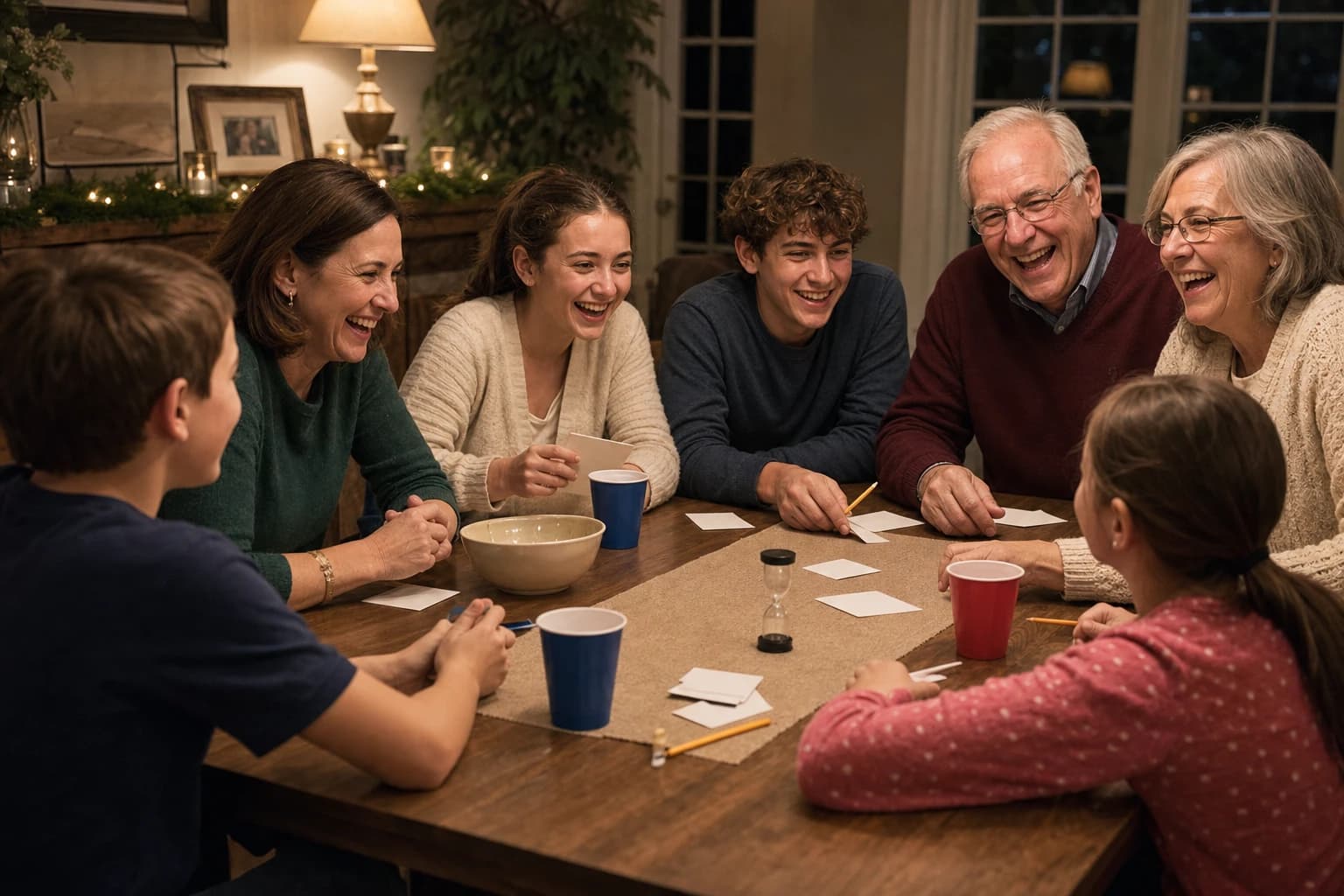
Finding team party games for family game night can be tricky when the table includes a 6-year-old, a competitive teen, two parents, and grandparents who would rather laugh than sprint. The best games are not just easy to explain; they also give different ages useful roles so one fast thinker or loud player does not take over every round.
This guide shows how to form fair mixed-age teams, adjust difficulty for younger players, and run team games for kids and adults without making anyone feel like a passenger. You will also find ready-to-play game ideas, a comparison table, and simple house rules that keep the night moving.
Quick answer: what makes a family team game work?
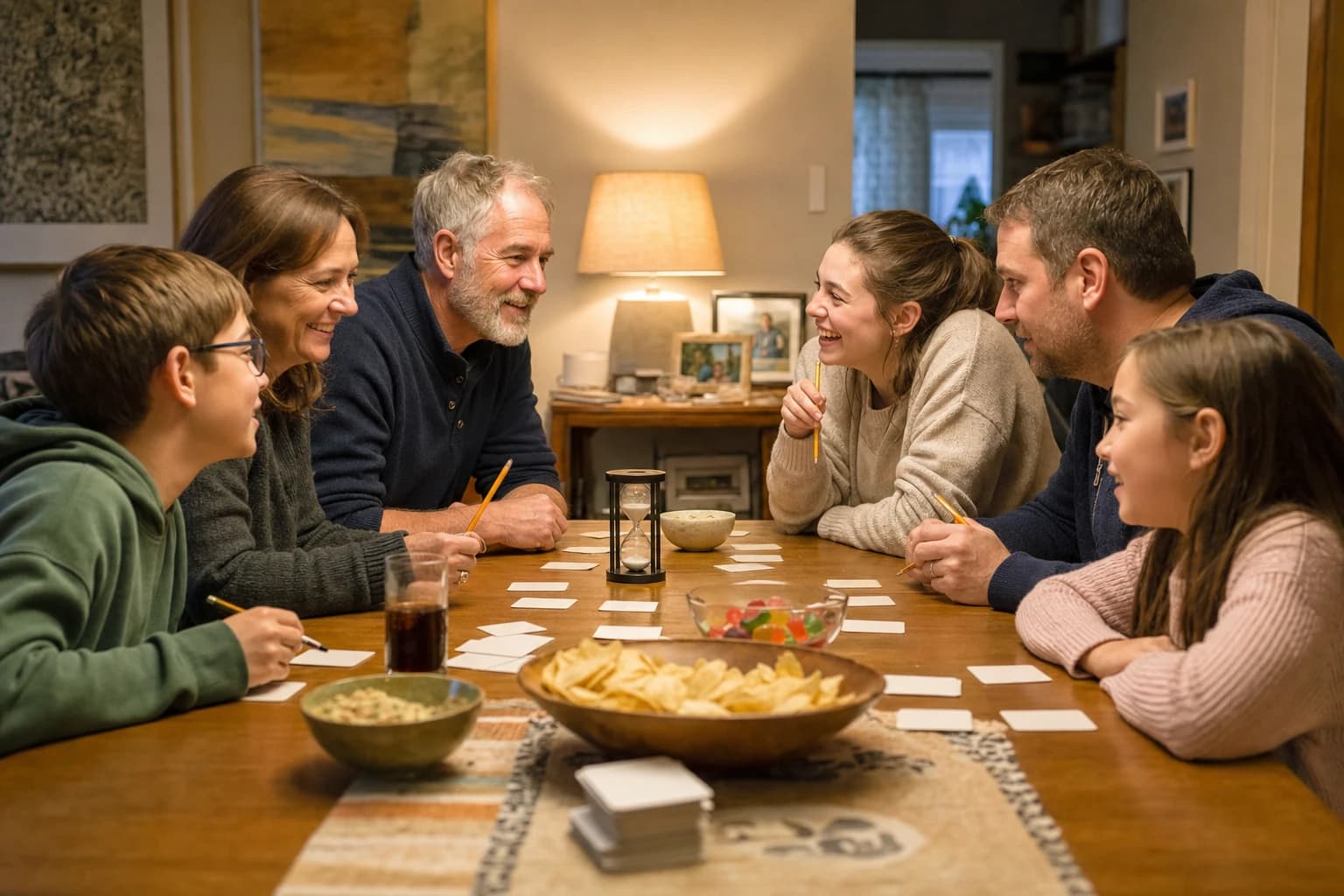
A good mixed-age team game has three features: short turns, flexible roles, and visible progress. Short turns keep younger kids and older adults from waiting too long. Flexible roles let a child draw, a teen guess, a parent keep time, and a grandparent give clues. Visible progress, such as points, tokens, or completed challenge cards, helps everyone understand how the team is doing.
For most family game nights, aim for 2 teams of 3 to 5 players or 3 teams of 3 players. If you have more than 12 people, split into smaller tables or use large-group formats like relay guessing and survey games. For a bigger gathering, you may also find ideas in Large Group Party Games for 20 to 50 People That Keep Everyone Playing.
Basic setup for a 60-minute team game night
- Players: 6 to 12 works best, but many games below can stretch to 16.
- Team size: 3 to 5 players per team.
- Round length: 60 to 90 seconds for active games; 2 minutes for drawing or building games.
- Total games: Choose 4 games and play each for 10 to 12 minutes.
- Scoring: Use 1 point per correct answer or completed challenge. Avoid complicated bonus math.
Materials and preparation
You can run most of these family team games with household supplies. Put everything in one basket before players arrive so you do not lose momentum between rounds.
Materials list
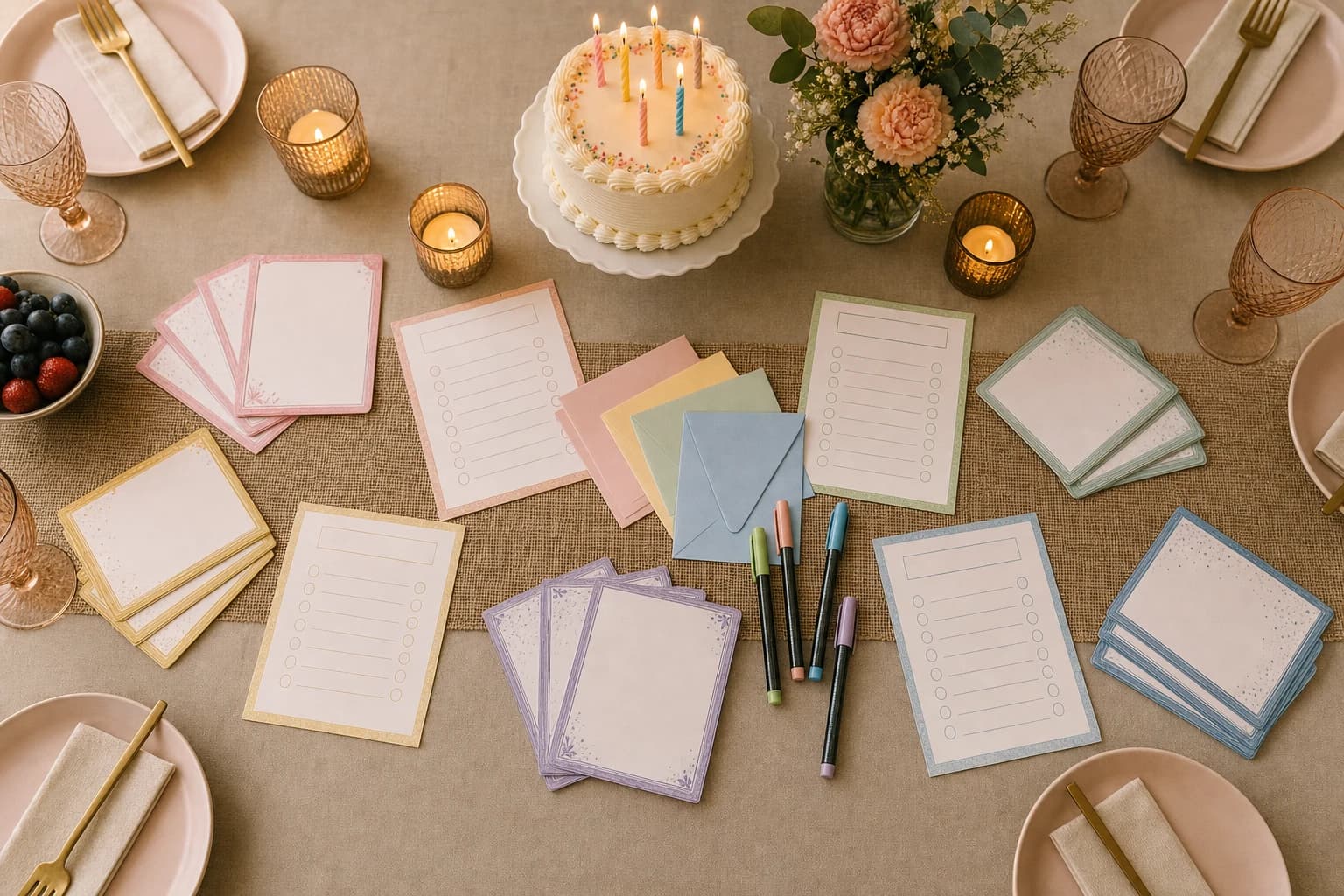
- 40 blank index cards or slips of paper
- 2 pens or markers per team
- 1 phone timer or kitchen timer
- 1 bowl or hat for drawing prompts
- Paper for scorekeeping
- Optional: sticky notes, plastic cups, rubber bands, craft sticks, and a few small building items such as blocks or LEGO-style bricks
Step-by-step setup
- Choose the room. Pick a space where people can hear each other. A dining table works for clue, drawing, and trivia games. A living room works better for charades and relays.
- Set a time limit. A 60-minute night is enough for four team games, a snack break, and a final round. If you need a full schedule, see How to Plan a 60-Minute Family Game Night for Mixed Ages Without Anyone Getting Bored.
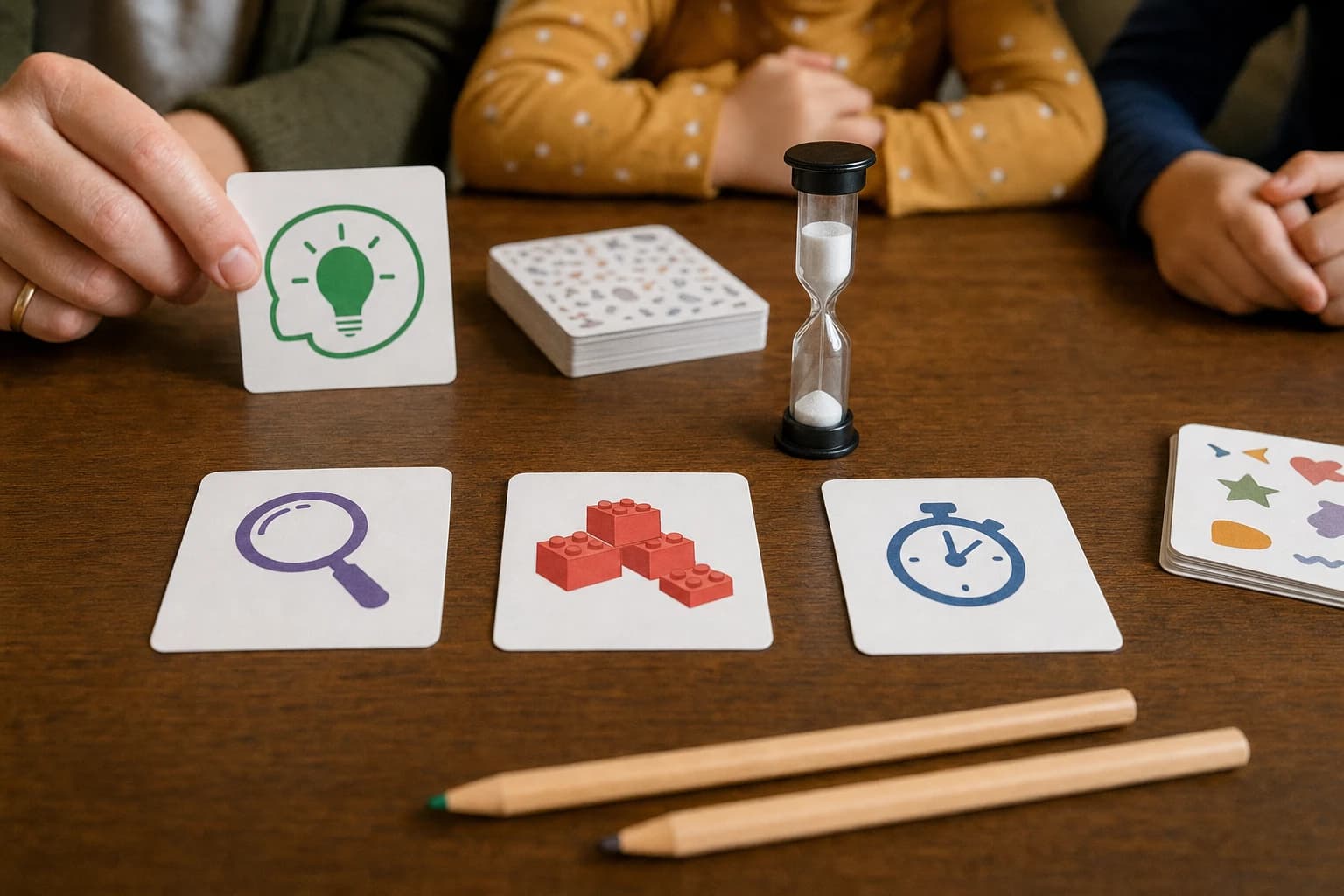
- Make three prompt piles. Label cards Easy, Medium, and Hard. Easy cards can include cat, pizza, rainbow, or school bus. Medium cards can include dentist, camping, popcorn machine, or airport. Hard cards can include family reunion, lost suitcase, or surprise party.
- Build teams before explaining games. People pay better attention when they already know who they are playing with.
- Start with a practice round. Do not score the first 60 seconds. It removes pressure and lets younger players see how the game works.
How to form fair mixed-age teams
The easiest mistake is letting people choose teams freely. Children may cluster together, teenagers may pick the most competitive adults, and quieter players may get left behind. Use a simple team-building method instead.
The age-balance method
Sort players into loose groups: children, teens, adults, and older adults. Then deal players onto teams like cards. If you have 10 players, a fair split might be one grandparent, two adults, one teen, and one child on each team. If one child needs reading help, place that child with a patient reader rather than the fastest player.
The buddy method for younger players
For children under about 8, pair them with a buddy for reading, writing, or remembering rules. The buddy can whisper options or read a card aloud, but the child still makes the final choice when possible. This keeps the child active without putting the whole team on hold.
The rotating captain method
Instead of one permanent team captain, rotate the captain after every round. The captain does not make every decision. Their job is to choose the next player role, draw the prompt, or decide which difficulty card the team will attempt. Rotating this job prevents one confident player from directing the entire night.
A fair team is not a team where every player has the same skill. It is a team where every player has a useful way to contribute.
Best team party games for family game night
Use this table to choose games based on your group size, energy level, and the ages involved. For each game, the final column shows a practical way to stop one strong player from dominating.
| Game | Best players | Time per round | Best for | Anti-domination rule |
|---|---|---|---|---|
| Team Charades Relay | 6 to 14 | 60 seconds | Active kids, teens, adults | Each player acts once before anyone repeats |
| Picture Clue Relay | 6 to 12 | 90 seconds | Mixed reading levels | Rotate the artist every card |
| Category Countdown | 4 to 12 | 60 seconds | Quick thinking without equipment | One answer per player until all teammates have tried |
| Build It Together | 6 to 10 | 2 minutes | Hands-on players and younger kids | Assign builder, describer, and checker roles |
| Family Survey Showdown | 8 to 16 | 2 minutes | Big families and holiday nights | Spokesperson changes each question |
| Reverse Trivia | 6 to 12 | 60 seconds | Kids and adults with uneven knowledge | Kids answer kid cards; adults answer family-memory cards |
| Pass-the-Story Draw | 6 to 12 | 3 minutes | Creative groups | Everyone adds one drawing or sentence |
| Minute Stack Relay | 6 to 12 | 60 seconds | High-energy short breaks | Players rotate after each attempt, not after success |
Game rules and mixed-age variations
1. Team Charades Relay
Write 30 action prompts on cards. Use easy prompts such as brushing teeth, flying a kite, or making pancakes for younger players. Use harder prompts such as missing the bus or trying to wrap a present for teens and adults. One player acts while their team guesses. When the team gets it, the next teammate becomes the actor. Score 1 point per correct card in 60 seconds.
Mixed-age adjustment: Let younger children choose from 2 face-up easy cards instead of drawing blindly. If a child is shy, allow a teammate to act with them, but the child must start the motion.
2. Picture Clue Relay
This is a team drawing game with no artistic pressure. One player draws a prompt while teammates guess. The artist may not use letters or numbers. Once the team guesses correctly, a new artist draws the next card. Use 90-second rounds.
Helpful rule: The official rules for many clue-based games limit what the clue giver can say or show. For example, the official Codenames rules from Czech Games Edition use clear clue limits so the guessing challenge stays fair. Apply the same idea here: no writing words, no initials, and no pointing at objects in the room.
3. Category Countdown
Choose a category, such as animals, breakfast foods, cartoon characters, things at the beach, or things that are red. Teams take turns naming one item that fits. A player has 5 seconds to answer. If they repeat an answer or cannot answer, the other team can steal with one correct answer.
Anti-domination rule: Use a one-answer-per-player rule. The fastest adult cannot give five answers in a row. Everyone on the team must attempt an answer before the turn cycle resets.
4. Build It Together
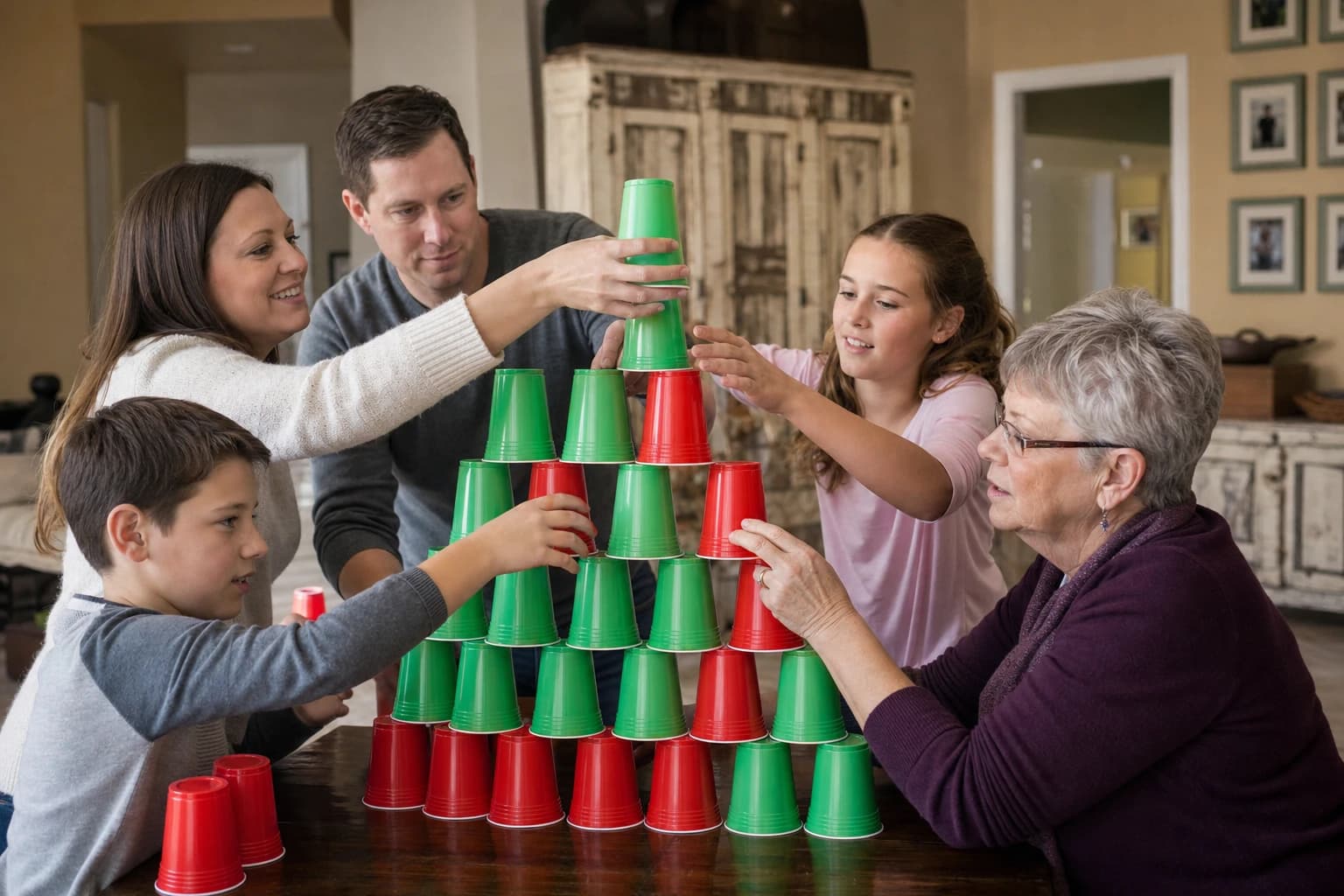
Give each team the same small set of materials: 10 plastic cups, 6 craft sticks, 4 rubber bands, and 1 sheet of paper. Announce a challenge such as build the tallest tower, build a bridge that holds a spoon, or build an animal shape. Teams have 2 minutes.
Role version: One player is the builder and may touch the materials. One player is the describer and gives ideas. One player is the checker and watches the timer or measures the result. Rotate roles every challenge. This is especially useful for grandparents or younger kids who may prefer planning to rushing.
5. Family Survey Showdown
Before game night, write 10 light survey questions that most ages can answer: Name something people eat at a picnic, name something found in a backpack, or name a reason someone might be late. During the game, one player from each team gives an answer. If the answer seems reasonable, award 1 point. If you want a stricter version, ask five family members for answers before the party and use those as your answer key.
Fairness tip: Avoid questions that depend on adult life experience, pop culture from one generation, or school subjects only one child has studied. Good survey questions are broad, ordinary, and a little funny.
6. Reverse Trivia
Regular trivia often favors one person who knows everything. Reverse Trivia fixes that by letting the team choose who should answer. Make three card types: kids, adults, and everyone. A kids card might ask, What color do you get when you mix blue and yellow? An adults card might ask, Which family member is most likely to fall asleep during a movie? An everyone card might ask, Name three pizza toppings.
Scoring: Easy card = 1 point, medium card = 2 points, hard card = 3 points. A team may choose any level, but each player must answer at least one card before the team can use the same player again.
7. Pass-the-Story Draw
Each team starts with a blank sheet. Player 1 writes one sentence, folds the paper so only the sentence is hidden, and passes it. Player 2 draws what they think the sentence described, folds the paper, and passes it. Player 3 writes a sentence based only on the drawing. Continue alternating for 3 minutes, then read the final story aloud.
Why it works: This is less about winning and more about shared laughter. Award points for categories such as clearest drawing, funniest twist, and best teamwork rather than only accuracy.
8. Minute Stack Relay
Set 10 plastic cups at the center. A player has one attempt to stack them into a pyramid and unstack them. Whether they succeed or fail, the next teammate takes over. The team scores 1 point for each completed stack-and-unstack cycle in 60 seconds.
Safety note: Keep the challenge seated or at table height if older adults or very young children are playing. Avoid running relays in rooms with slippery floors, pets, or sharp furniture corners.
How to adjust difficulty without embarrassing younger players
Mixed age party games work best when adjustments feel like normal rules, not special treatment. Use visible difficulty choices so everyone sees that the game is designed for different ages from the start.
- Use color-coded cards. Green cards are easy, yellow cards are medium, and blue cards are hard. Let the team choose the risk level.
- Give picture options. For early readers, draw small icons on prompt cards or use simple objects from the room.
- Allow team whispers. Give each team one 10-second whisper break per round, where they can help a younger player plan without taking over.
- Change the scoring, not the praise. A child who completes an easy card earns the same team celebration as an adult who completes a hard card. If you use bonus points, keep them quiet and simple.
- Shorten waiting time. If a player is out of a round for more than 2 minutes, the game is probably too slow for mixed ages.
If your family prefers less competition, cooperative games may be a better fit. See Best Cooperative Board Games for Families Who Do Not Like Competitive Game Nights for options where the whole table works together.
How to prevent one strong player from taking over
Dominating usually happens for understandable reasons: someone is quick, confident, or trying to help the team win. The fix is not to scold that person. Build limits into the rules so sharing turns feels automatic.
Use role cards
Create four role cards: clue giver, guesser, builder, and checker. Each round, players take a different role. If there are five players, add timekeeper or encourager. The encourager can remind the team to listen, invite quieter players, and celebrate completed turns.
Add a silent start
For brainstorming games, require the first 10 seconds to be silent. Everyone thinks of an answer before anyone speaks. This small pause gives quieter players and younger kids a chance to form an idea before the fastest person fills the space.
Limit repeat turns
Use the circle rule: a player cannot take the same active role again until everyone on the team has had that role. This works for acting, drawing, answering, building, and clue giving.
Give each team a pause card
Once per game, a team may use a pause card for 15 seconds to reorganize roles or help a confused player. This prevents frustration without letting the team debate every answer forever.
Common mistakes to avoid
- Starting with the most complicated game. Begin with charades, drawing, or categories before moving to survey or trivia games.
- Letting teams sit too far apart. If teammates cannot hear each other, louder players will naturally take over.
- Using only pop-culture prompts. A category based on one TV show or video game can exclude grandparents or younger kids.
- Keeping score too seriously. A visible score is fun, but arguments over half-points are not. If an answer is close and funny, consider giving the point.
- Eliminating players. Avoid formats where someone sits out after a mistake. Family game night party games should keep everyone active.
For children-heavy parties, you can borrow simple prompt and timing ideas from 25 Indoor Birthday Party Games for Kids Ages 6–10 With Simple Rules. For teen-friendly high-energy rounds, Minute-to-Win-It Party Games for Teens Using Household Items has ideas that can be converted into team relays.
A simple 60-minute game night plan
- 0:00 to 0:05: Make teams, explain the circle rule, and run a no-score practice prompt.
- 0:05 to 0:17: Team Charades Relay.
- 0:17 to 0:29: Picture Clue Relay.
- 0:29 to 0:36: Snack and team switch if teams feel uneven.
- 0:36 to 0:48: Build It Together.
- 0:48 to 0:58: Family Survey Showdown or Reverse Trivia.
- 0:58 to 1:00: Announce a fun award for each team, such as best comeback, funniest clue, or calmest teamwork.
FAQ
What are the best team party games for family game night with young kids?
Charades relay, picture clue relay, build challenges, and category games are usually the easiest. They use short turns, simple prompts, and do not require every player to read quickly.
How do you make teams fair when ages are very different?
Deal players into teams by age group rather than letting everyone choose. Try to place at least one patient reader or helper on each team, and rotate captain roles so one adult does not control every decision.
What if one player keeps shouting answers?
Use a one-answer-per-player rule, a 10-second silent start, and rotating role cards. These rules feel more neutral than telling one person to be quiet, and they protect quieter players.
Can grandparents play these games if they do not want active movement?
Yes. Choose drawing, survey, trivia, story, and building games. For charades, grandparents can be clue judges, timers, or guessers instead of actors if they prefer.
How many games should we play in one night?
For a 60-minute family night, four games is enough. More than that can make rules blur together, especially for children. Keep each game to about 10 to 12 minutes.
Should we keep score?
Score can add energy, but it should stay simple. Use 1 point per completed card or challenge, and consider giving end-of-night awards that recognize teamwork, humor, and creativity, not just winning.
Conclusion
The best team games for kids and adults are not the ones with the most elaborate rules. They are the ones that make room for different strengths: a child can act, a teen can solve, a parent can organize, and a grandparent can give the clue that cracks the round open. Start with balanced teams, rotate roles, and use difficulty levels that are built into the game instead of added as an afterthought.
If you keep turns short and make participation visible, team party games for family game night can feel lively without becoming chaotic. Most importantly, everyone leaves with a story from the same game, not a memory of waiting for someone else to play.