
PLAYATME editorial note: This guide was prepared as a teacher-facing planning resource and curriculum-checked against publicly available upper-elementary standards. It avoids invented testing claims; use the card banks and routines below as adaptable templates for your own class, homeschool, tutoring group, or after-school program.
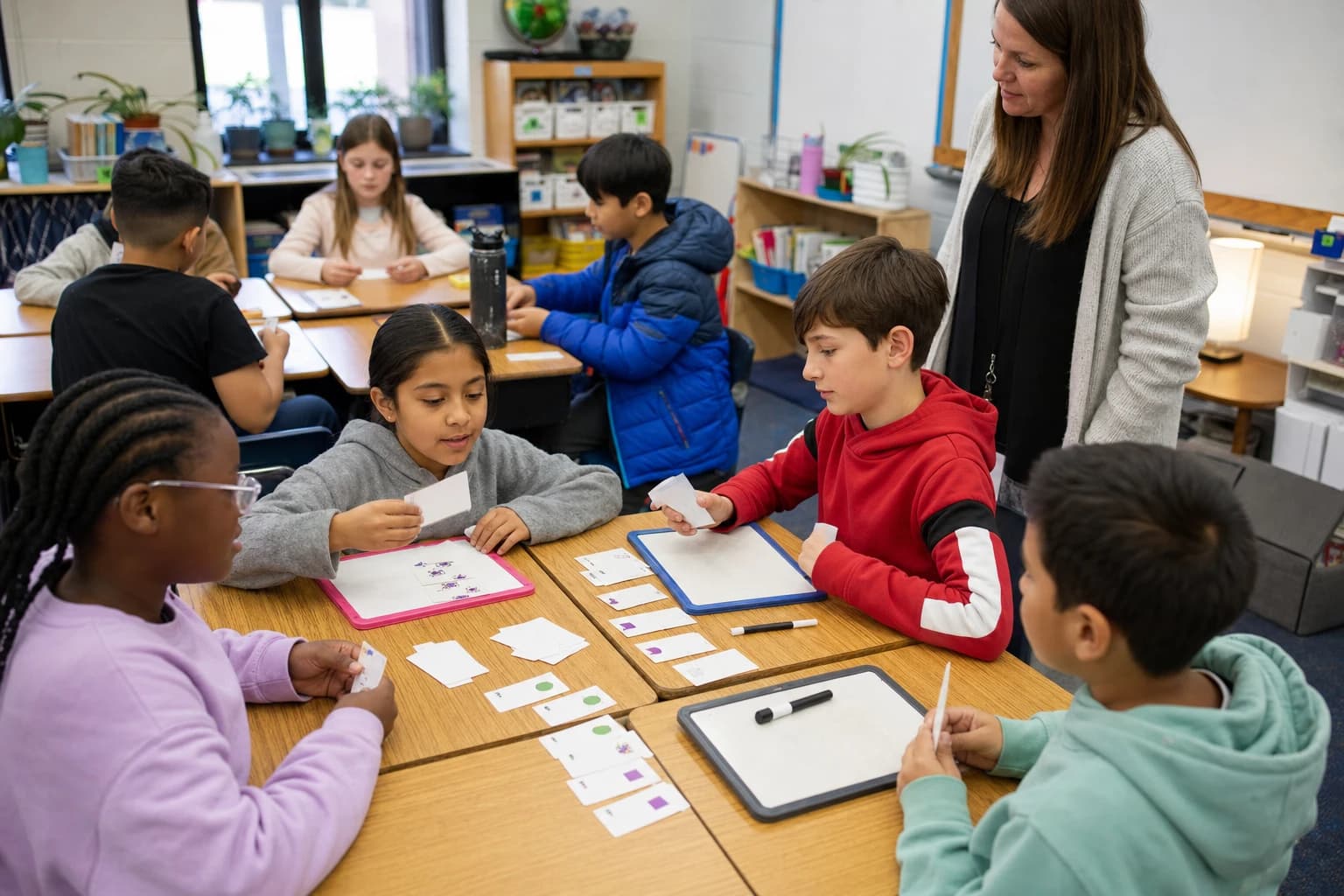
Indoor review time does not have to mean another worksheet, a noisy free-for-all, or a screen-based activity. With a stack of 3 × 5 index cards, one timer, and clear student roles, you can run educational indoor classroom games for grades 3-5 that practice multiplication, spelling, vocabulary, grammar, and memory while still feeling active.
This guide gives you five classroom-ready games, exact materials, step-by-step directions, grade-specific prompt cards, a 20-minute sample lesson plan, and fast teacher callouts for noise level, group size, and limited materials. For more options, you may also like PLAYATME guides to indoor recess games, math games for kids, spelling games for kids, and homeschool learning games.
Quick Pick Table: Choose by Skill, Noise Level, and Time
Use this table when you have 5 minutes to plan and need the best fit for today’s room energy.
| Game | Use when... | Main skill | Noise level | Group size | Exact time |
|---|---|---|---|---|---|
| Factor Relay at Desks | You need a quick math review with light energy | Multiplication, division, factors | Level 1-2 partner voices | Pairs or teams of 3 | 12 minutes |
| Spelling Switch | You want spelling practice without a written quiz | Word patterns, suffixes, homophones | Level 1 partner voices | Teams of 2-4 | 10 minutes |
| Memory Grid Challenge | The class needs a calmer transition after lunch or recess | Recall, matching, vocabulary, facts | Level 0-1 | Individuals, pairs, or teams | 10 minutes |
| Build-a-Sentence Grammar Race | You want grammar review with controlled movement | Parts of speech, punctuation, sentence structure | Level 2 team voices | Teams of 3-5 | 15 minutes |
| Math-Spelling-Memory Quest | You need one mixed-review station rotation | Math, spelling, vocabulary, explanation | Level 1-2 | 4 stations of 4-7 students | 20 minutes |
Best quick option
Use Spelling Switch if you have 10 minutes or less, limited space, and only dry-erase boards available.
Lowest-noise option
Use Memory Grid Challenge with written responses and a silent 30-second viewing round.
Best for a small class
Use Factor Relay as a partner game and let students try to beat their own number of accurate cards from Round 1 to Round 2.
Materials and Setup Kit
You can build a reusable kit for these classroom games without worksheets with inexpensive materials. If you already have index cards and dry-erase boards, the cost is usually $0.
- 60 blank 3 × 5 index cards: 30 prompt cards, 20 answer cards, and 10 challenge cards.
- 1 timer: set to exact rounds of 30 seconds, 2 minutes, 5 minutes, or 10 minutes.
- 6 small cups, envelopes, or zip bags: label them Math, Spelling, Memory, Grammar, Solved, and Retry.
- 1 dry-erase board per team: or one sheet of scrap paper per team.
- 1 answer key: keep it with the teacher or assign one reliable student checker per station.
- 12 tokens or tally marks: use for solved cards only; avoid complicated point systems.
- Optional: sticky notes for rows and columns in the memory grid.
For standards alignment, compare the skills you choose with your local curriculum. The official Common Core State Standards for Mathematics outline grade-level expectations for operations, algebraic thinking, fractions, place value, and related upper-elementary skills. For literacy, the Common Core English Language Arts standards include language expectations such as conventions, vocabulary, and word relationships.
Printable-Ready Teacher Checklist
Before students play, check these 10 items. This prevents most game-day problems.
- 1. Skill target: Write one clear goal on the board, such as ‘I can identify factor pairs of whole numbers.’
- 2. Card count: Prepare 12 cards for a 10-minute game, 24 cards for a 20-minute rotation, or 36 cards for a full review block.
- 3. Team size: Use pairs for quiet work, teams of 3 for balanced participation, and teams of 4 only when roles are assigned.
- 4. Voice level: Choose 0, 1, or 2 before play starts. Do not wait until the room is loud.
- 5. Roles: Reader, writer, checker, and reporter. In pairs, combine reader/reporter and writer/checker.
- 6. Practice turn: Model exactly one card that does not count for points.
- 7. Accuracy rule: A card counts only when the answer is correct and the team can explain the strategy.
- 8. Retry pile: Wrong answers go to Retry, not the trash. Students fix them later.
- 9. Stop signal: Use one signal only: raised hand, chime, or timer tone.
- 10. Debrief: Save 2 minutes for ‘What strategy helped?’ and ‘What mistake should we watch for next time?’
Game 1: Factor Relay at Desks
Difficulty: Easy to moderate. Prep time: 8 minutes. Play time: 12 minutes. Best for: multiplication facts, factor pairs, division, multiples, prime and composite numbers.
Use when...
Your class has energy but you cannot allow running. Students stay seated or stand behind their own chairs.
Low-material version
Write 12 problems on the board and have teams solve them in order on one scrap-paper sheet.
Setup
- Make 24 problem cards: 8 Level A, 8 Level B, and 8 Level C.
- Put students in teams of 3. Assign reader, writer, and checker.
- Give each team 8 cards face down, one board or paper, and one marker or pencil.
- Set the timer for 6 minutes for Round 1 and 4 minutes for Round 2.
How to play
- Reader flips the top card and reads it once.
- The team solves together using a whisper or partner voice.
- Writer records the answer.
- Checker compares with the answer key or raises a hand for a teacher check.
- Correct cards go to Solved. Incorrect cards go to Retry and return at the end.
- Students rotate roles after every card.
Grade-specific examples
- Grade 3: 7 × 6 = ?; 56 ÷ 8 = ?; complete 9 × __ = 72.
- Grade 4: List three factor pairs for 36; is 29 prime or composite?; name the first five multiples of 8.
- Grade 5: Find two factors of 72, then divide 72 by the larger factor; solve 0.6 × 7; write 3/4 as a decimal.
Teacher-tested-style management note
If a team argues over answers, pause that team for 30 seconds and require this script: ‘My strategy is __ because __.’ The card counts only after two students can agree on the explanation. This shifts attention from winning to reasoning.
Game 2: Spelling Switch
Difficulty: Easy. Prep time: 6 minutes. Play time: 10 minutes. Best for: spelling patterns, prefixes, suffixes, syllables, homophones, and vocabulary.
Best quick option
Use this for the last 10 minutes of literacy block. It feels like a game but still checks spelling, meaning, and word structure.
Low-noise version
Students write answers silently, then hold boards at chest height on your signal. Discuss only 2 selected words aloud.
Setup
- Choose 12 spelling or vocabulary words from your current unit.
- Make 12 prompt cards and one answer key.
- Students play in teams of 2 or 3.
- Set each prompt for 40 seconds. Use 10 prompts for a 10-minute game.
How to play
- Read one prompt aloud or show it for 10 seconds.
- Teams write the answer and underline the part of the word that changed.
- On the signal, boards go up.
- Award 1 solved-card point for correct spelling and 1 bonus point for a correct pattern explanation.
Sample round
- Prompt 1: Add -ness to kind. Answer: kindness.
- Prompt 2: Choose the correct spelling: separate, seperate, seprate. Answer: separate.
- Prompt 3: Spell the homophone that means to listen. Answer: hear.
- Prompt 4: Break unbelievable into meaningful parts. Answer: un + believe + able.
- Prompt 5: Add -ed to stop. Answer: stopped.
To make this more than memorization, ask one follow-up after every third prompt: ‘What rule or word part helped?’ or ‘What mistake would a rushed speller make?’
Game 3: Memory Grid Challenge
Difficulty: Easy to moderate. Prep time: 10 minutes. Play time: 10 minutes. Best for: memory, vocabulary review, math facts, science terms, social studies dates, and spelling patterns.
Use when...
Students need a calm reset after recess, lunch, an assembly, or a noisy transition.
Small-class version
Use a 3 × 3 grid with 9 cards and let one student act as the caller while the other student answers.
Setup
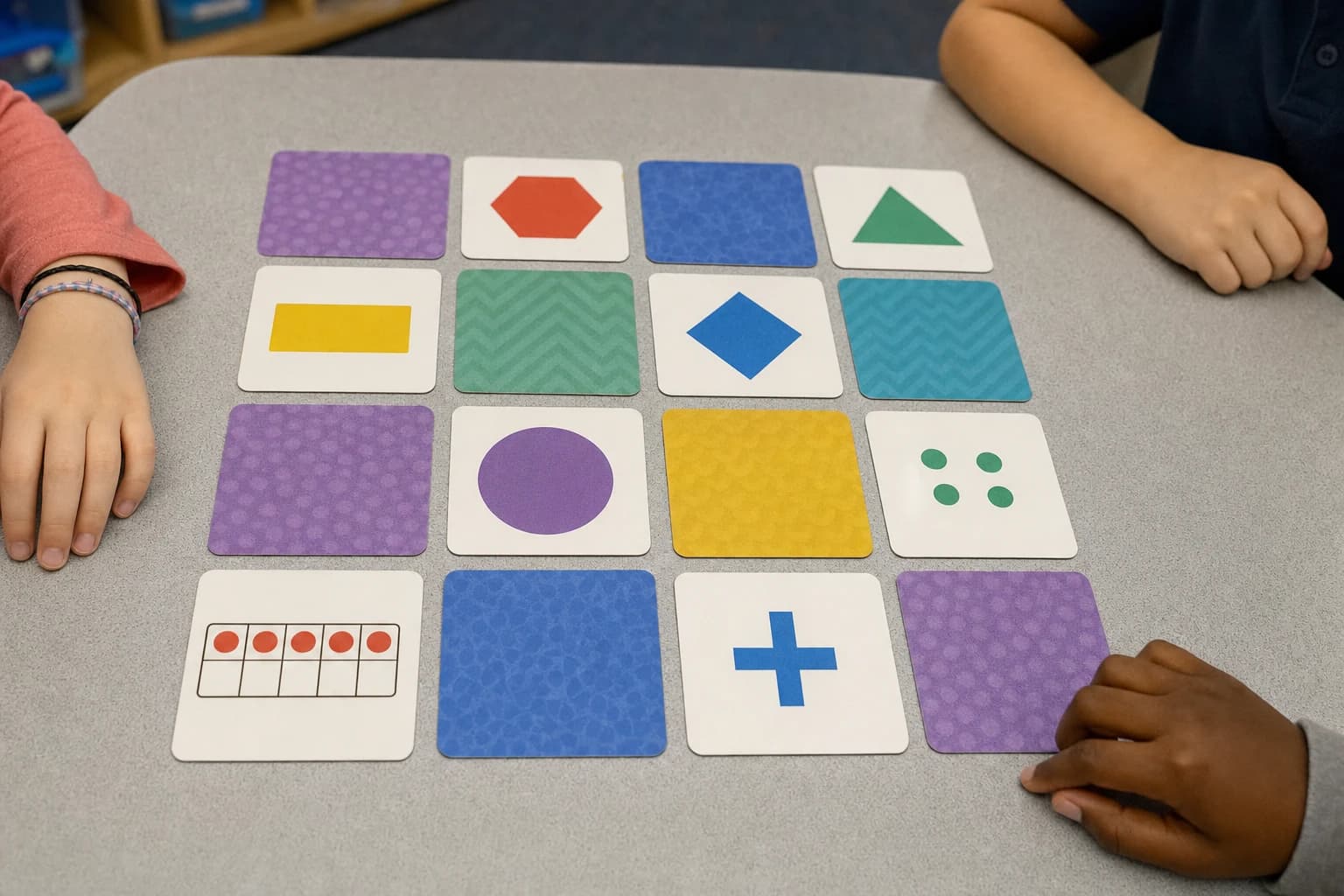
- Create a 4 × 4 grid with 16 cards on a table, pocket chart, board, or document camera.
- Use 8 matching pairs: equation and answer, word and definition, spelling word and missing-letter version, or term and example.
- Label rows A-D and columns 1-4 with sticky notes.
- Let students view the grid silently for 45 seconds.
- Cover the grid with paper or flip the cards over.
How to play
- Ask a location question, such as ‘Where was the answer 42?’
- Teams write a coordinate such as B3.
- Reveal the card and give 1 point for the correct location.
- Ask one match question, such as ‘What matched perimeter?’
- Continue for 8 prompts, then debrief one memory strategy.
Example memory grid pairs
- 6 × 7 and 42
- Area and length × width
- Prefix and word part added to the beginning
- Necessary and ne__essary
- Synonym and word with a similar meaning
- Prime number and number with exactly two factors
For a struggling group, start with 9 cards instead of 16. For advanced students, use a 5 × 5 grid with 25 cards and 3 distractor cards.
Game 4: Build-a-Sentence Grammar Race
Difficulty: Moderate. Prep time: 12 minutes. Play time: 15 minutes. Best for: parts of speech, sentence variety, punctuation, vocabulary, and grammar review.
Setup
- Create 30 word cards per team: 8 nouns, 8 verbs, 6 adjectives or adverbs, 4 connectors, and 4 punctuation cards.
- Give each team one flat workspace: a desk group, table, or floor square.
- Write one target on the board, such as ‘Build a compound sentence using one vocabulary word.’
- Allow each team up to 3 handwritten words if they need articles or prepositions.
How to play
- Teams have 3 minutes to build a sentence that meets the target.
- One reporter reads the sentence aloud.
- The class checks the target using thumbs: up for yes, sideways for needs revision.
- Teams revise for 60 seconds.
- Repeat with a new target for 3 total rounds.
Example target: ‘Create a sentence that uses an adjective, a strong verb, and a comma.’ A strong response could be: The nervous explorer opened the ancient door, and the room filled with dust. This creates a useful discussion about word choice, commas, and complete thoughts.
Game 5: Math-Spelling-Memory Quest
Difficulty: Moderate. Prep time: 15 minutes. Play time: 20 minutes. Best for: mixed review days, test review, homeschool co-ops, and indoor recess with an academic purpose.
This station format combines math, spelling, and memory practice in a natural way without forcing awkward keyword-stuffed routines. Each station uses the same card method, so students learn the routine once and then focus on the content.
Setup for four stations
- Station 1: Math facts. 10 cards with multiplication, division, fractions, or decimals.
- Station 2: Spelling patterns. 10 cards with missing letters, suffix changes, prefixes, or homophones.
- Station 3: Memory match. 12 cards that form 6 pairs.
- Station 4: Explain it. Students choose one solved card and explain their thinking orally or in one sentence.
How to run it
- Divide the class into 4 groups. In a class of 28, each group has 7 students; split each group into pairs plus one trio.
- Give each station 4 minutes.
- Use a 30-second cleanup and rotation between stations.
- At each station, students aim for accurate solved cards, not speed.
- End with a 2-minute reflection: ‘Which strategy helped your team most today?’
20-Minute Sample Lesson Plan: Memory Grid for Vocabulary and Multiplication
Use this plan when you need a complete, start-to-finish indoor lesson that blends memory, math, and vocabulary practice.
| Minute | Teacher action | Student action |
|---|---|---|
| 0:00-2:00 | State the goal: ‘We will recall locations and explain matches for multiplication and vocabulary cards.’ Show the 4 × 4 grid. | Sit with teams of 2 or 3. Materials stay flat on desks. |
| 2:00-3:00 | Model one practice pair, such as 6 × 7 and 42. Explain how to remember its location. | Watch without writing. This turn does not count. |
| 3:00-3:45 | Reveal the full grid for 45 seconds. Use silent viewing. | Study the grid silently. No pointing or talking. |
| 3:45-5:00 | Cover the grid and ask Prompt 1 and Prompt 2. | Write coordinates such as A2 or C4. |
| 5:00-13:00 | Ask 8 total prompts, alternating math and vocabulary. Reveal and discuss each answer for 20 seconds. | Answer, check, and add corrected cards to the Retry note if needed. |
| 13:00-16:00 | Run a quick challenge: teams write one matching pair they remember and explain it. | Write one pair and one explanation. |
| 16:00-18:00 | Collect 2 example explanations from students. | Listen and compare strategies. |
| 18:00-20:00 | Debrief: ‘What memory strategy helped? What math or word mistake did we catch?’ | Share one strategy or correction. |
Ready-to-Copy Card Bank: 30 Prompts by Grade Band
Copy these onto index cards or paste them into your own printable learning activities. If you want more no-prep ideas, see PLAYATME’s printable learning activities.
10 Math Prompt Cards
| Grade band | Prompt | Expected answer or response |
|---|---|---|
| Grade 3 | 6 × 8 = ? | 48 |
| Grade 3 | Write a division fact that matches 7 × 5 = 35. | 35 ÷ 7 = 5 or 35 ÷ 5 = 7 |
| Grade 3 | Round 347 to the nearest ten. | 350 |
| Grade 4 | List all factor pairs for 24. | 1 × 24, 2 × 12, 3 × 8, 4 × 6 |
| Grade 4 | Is 31 prime or composite? Explain. | Prime; exactly two factors, 1 and 31 |
| Grade 4 | What is 3/8 + 2/8? | 5/8 |
| Grade 5 | What is 0.4 × 6? | 2.4 |
| Grade 5 | Write 3/5 as a decimal. | 0.6 |
| Grade 5 | Solve: 18 ÷ (3 × 2). | 3 |
| Grade 5 challenge | A rectangle is 7 cm by 4 cm. What are its area and perimeter? | Area 28 square cm; perimeter 22 cm |
10 Spelling and Word Study Prompt Cards
| Grade band | Prompt | Expected answer or response |
|---|---|---|
| Grade 3 | Add -ful to hope. | hopeful |
| Grade 3 | Choose the correct word: their, there, they are. __ books are on the desk. | Their |
| Grade 3 | Spell the word with the /ch/ sound: teach or teech? | teach |
| Grade 4 | Add -ness to happy. | happiness |
| Grade 4 | Which is correct: separate, seperate, seprate? | separate |
| Grade 4 | Break preview into prefix and base word. | pre + view |
| Grade 5 | Add -able to comfort. | comfortable |
| Grade 5 | Which word means to affect deeply: influence or influense? | influence |
| Grade 5 | Break transportation into meaningful parts. | transport + ation, or trans + port + ation if taught |
| Grade 5 challenge | Use the word evidence in a sentence that shows its meaning. | Sentence should show proof or support for an idea |
10 Memory Prompt Cards
| Grade band | Memory pair or task | Expected answer or response |
|---|---|---|
| Grade 3 | Pair 9 × 4 with its answer. | 36 |
| Grade 3 | Remember the location of the word perimeter. | Correct grid coordinate |
| Grade 3 | Match synonym with same meaning. | Synonym pair |
| Grade 4 | Pair area with its formula for a rectangle. | length × width |
| Grade 4 | Remember which card showed a prime number. | Correct card and explanation |
| Grade 4 | Match prefix with added to the beginning. | prefix |
| Grade 5 | Pair 0.25 with its fraction form. | 1/4 |
| Grade 5 | Match theme with message or lesson of a text. | theme |
| Grade 5 | Remember the coordinate of the word analyze. | Correct grid coordinate |
| Grade 5 challenge | Recall two matched pairs and explain both. | Two correct pairs plus explanations |
Adapting Games for Real Classroom Problems
If the class is noisy
- Switch from teams of 4 to pairs for the next round.
- Use a Level 1 voice rule: only the person holding the card may speak first.
- Cut the round from 10 minutes to 5 minutes and add a 60-second reset.
- Replace cheering with silent thumbs-up or moving a solved card to the center of the desk.
If you have a small class or homeschool group
- Use one learner versus the timer: 6 accurate cards in 5 minutes is the first goal.
- Play adult versus child, but require both players to explain one answer per round.
- Use a 3 × 3 memory grid instead of 4 × 4.
- Let the student create 3 challenge cards after solving the main set.
If materials are limited
- No index cards: write prompts on the board and number them 1-12.
- No dry-erase boards: use half-sheets of scrap paper.
- No timer: use a wall clock and run 5-minute rounds.
- No space for stations: rotate the card envelopes, not the students.
If abilities vary widely
Use three levels of cards and a simple rule: two required, one choice. Each student completes two teacher-assigned cards, then chooses one review card or one challenge card. This keeps students from being stuck only with easy work or overwhelmed by tasks that are too hard.
- Level A: direct recall, such as 8 × 4 = ?
- Level B: application, such as write two equations with a product of 36.
- Level C: explanation, such as explain why 37 is prime.

Common Mistakes to Avoid
- Explaining rules for too long. If directions take more than 2 minutes, simplify the game.
- Rewarding speed only. Fast guessing weakens the practice. Count only accurate cards with explanations.
- Letting one student dominate. Rotate roles after every card or every 2 minutes.
- Using elimination. Students who are out stop practicing. Use solved piles, retries, and personal bests instead.
- Skipping the debrief. Save exactly 2 minutes for one strategy and one common mistake.
FAQ
How long should indoor classroom games last for grades 3-5?
Most upper-elementary review games work best in 10-15 minutes. A station rotation can run 20 minutes if you use 4-minute stations, 30-second transitions, and a 2-minute debrief.
Can these games work without worksheets?
Yes. Students can answer on dry-erase boards, scrap paper, orally to a partner, or by sorting cards. The key is that each card has a clear academic target and a way to check accuracy.
What is the best game for a noisy class?
Start with Memory Grid Challenge. Use silent viewing, written coordinates, and pair discussion only after answers are revealed. Avoid relay-style games until the class can maintain Level 1 or Level 2 voices.
How do I make the games fair for mixed-ability learners?
Use Level A, B, and C cards. Require two assigned cards and one choice card per student. This gives support without making every learner do the exact same task at the same pace.
Are these games appropriate for homeschool learning?
Yes. For one child, play against a timer or use a personal-best score. For two or more children, use pairs, parent-versus-child rounds, or a small station rotation at the kitchen table.
How often should I use classroom games for review?
Use short games when they match a lesson goal: for example, 10 minutes after direct instruction, 15 minutes on a review day, or 20 minutes for a mixed-skill station rotation. Games should support practice, not replace instruction.
Conclusion
Educational indoor classroom games for grades 3-5 work best when they are simple, skill-focused, and easy to reset. You do not need screens, prizes, or complicated equipment. You need clear cards, exact time limits, student roles, and prompts that require thinking.
Start with one low-noise game, such as Memory Grid Challenge or Spelling Switch. Once students understand the routine, add Factor Relay, Grammar Race, or a 20-minute Math-Spelling-Memory Quest. The same card system can support math review, spelling practice, vocabulary work, homeschool lessons, tutoring sessions, and meaningful indoor recess.