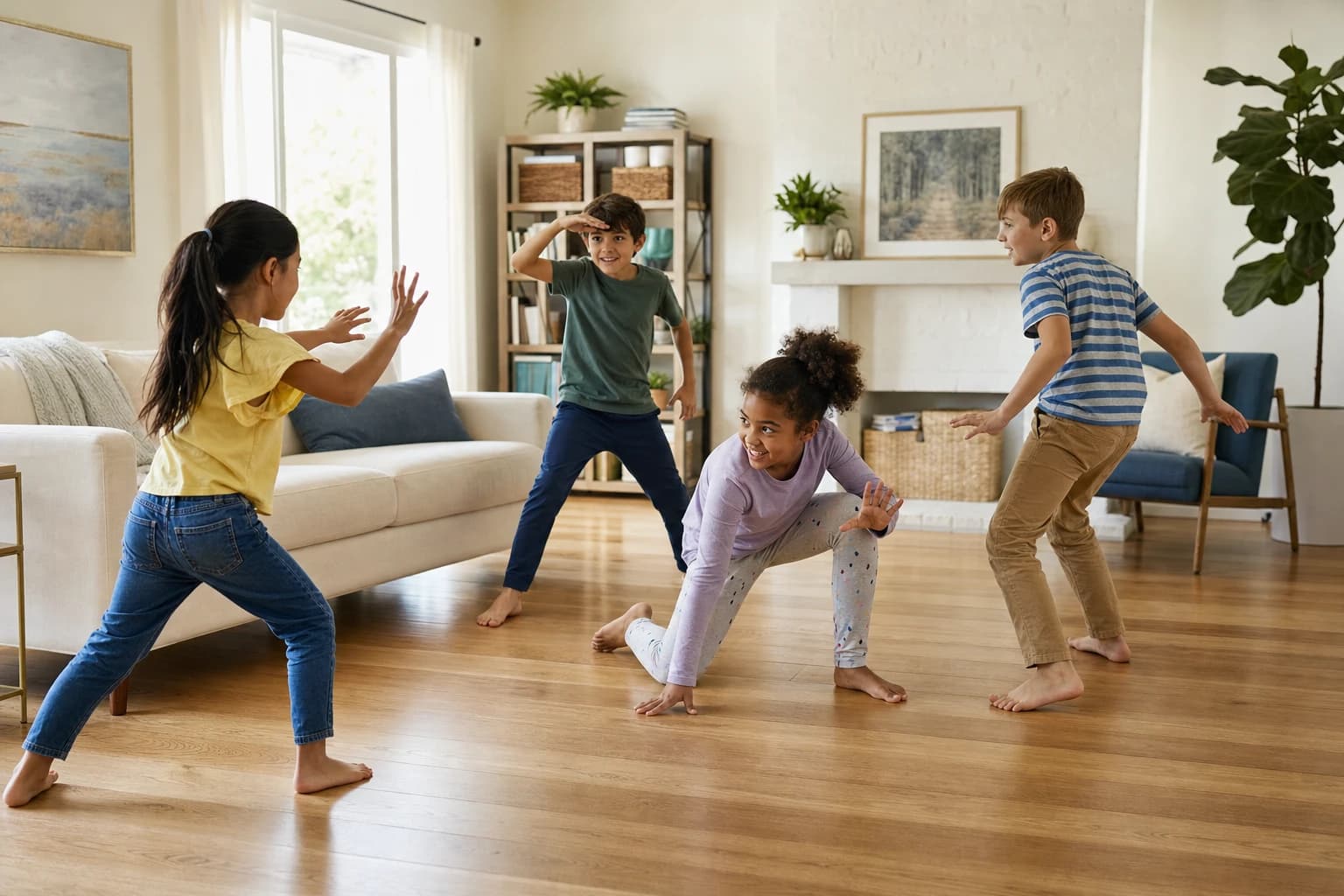
When an 8-year-old needs to move, laugh, or burn off rainy-day energy, you may not have craft supplies, board games, or much floor space available. The good news is that many of the best indoor games for 8-year-olds with no equipment need only clear rules, a safe boundary, and a few minutes of attention.
This guide organizes no-equipment indoor games by energy level, player count, noise level, and time. Each game includes step-by-step rules, a sample round, quick variations for 2 to 6 players, and simple ways to prevent rough play in a living room, bedroom, hallway, or small family space.
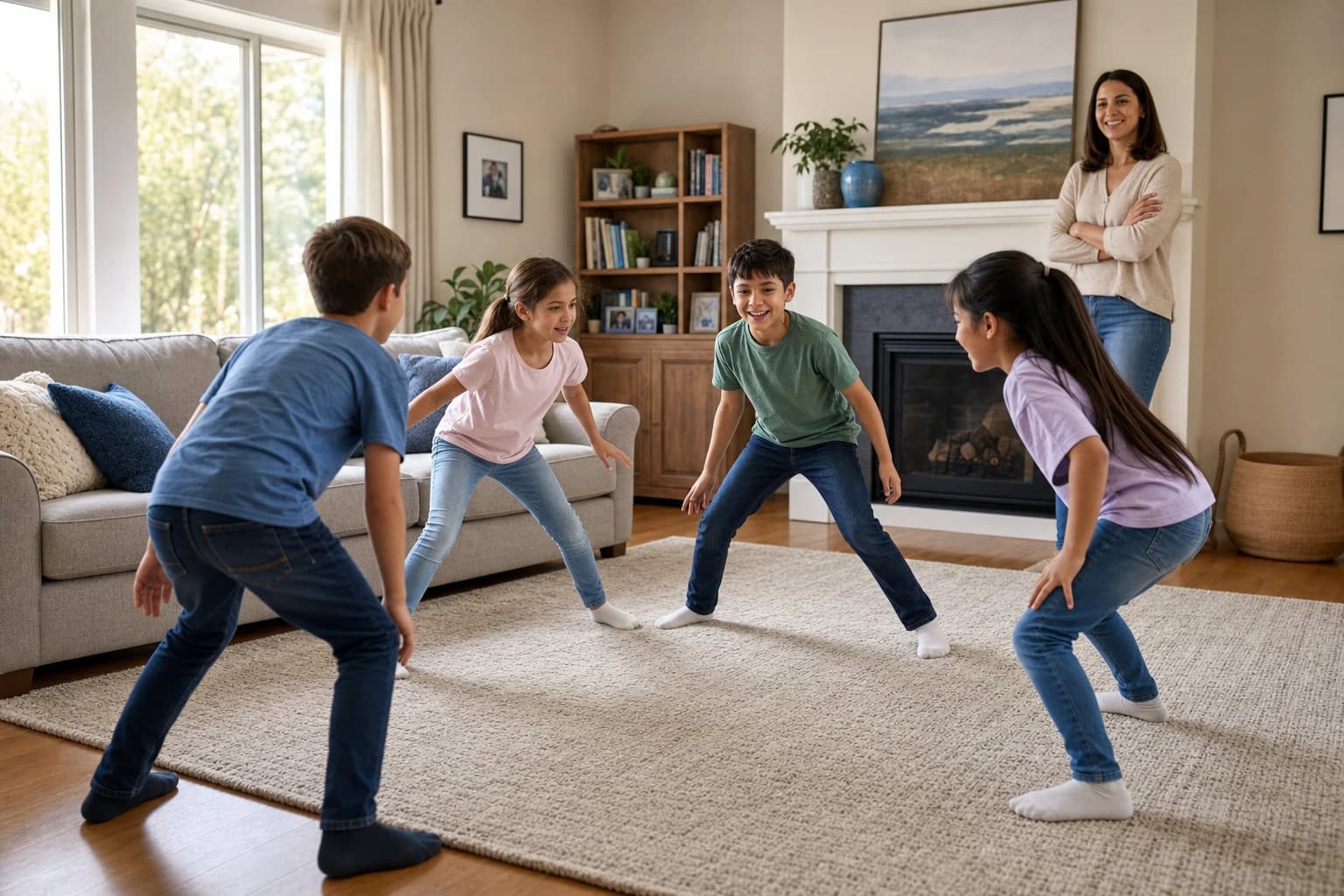
Quick Setup: Make a Small Room Game-Ready in 2 Minutes
For these no equipment indoor games for kids, the material list is intentionally short: no balls, no paper, no toys, and no furniture setup. Still, a two-minute room check makes the difference between fun movement and indoor chaos.
Materials and space
- Required materials: none.
- Optional helper: an adult counting out loud instead of using a timer.
- Best space: a clear area about the size of a rug, open hallway, or space between couch and wall.
- Safety boundary: choose a start line, a stop line, and at least one no-go zone, such as near a TV, table edge, stairs, or door.
- Time per game: 3 to 8 minutes is usually enough before changing rules or switching energy levels.
- Clear the edges. Move hard or breakable items away from the play path if you can do so safely.
- Name the boundary. Say, for example, The rug is the game zone, the couch is not part of the game.
- Choose the energy level. Pick low, medium, or high based on bedtime, noise tolerance, and the child’s mood.
- Explain one rule first. Add variations only after the first round works.
- Stop before it gets wild. A short game that ends happily is better than a long game that ends with shoving or tears.
For general movement guidance, the CDC physical activity guidelines for children recommend that school-age children get regular daily physical activity. Indoor games can help on rainy days, but they should still be matched to the space and the child’s self-control that day.
Choose a Game by Energy, Noise, Players, and Time
Use this table when you need a fast decision. The noise rating assumes normal indoor voices, not yelling. If you live in an apartment or have a sleeping sibling nearby, start with low-noise games and make whispering part of the challenge.
| Game | Energy | Noise | Players | Best time | Space needed |
|---|---|---|---|---|---|
| Silent Mission | Low | Very low | 1 to 6 | 3-6 minutes | Bedroom or living room |
| Mirror Match | Low-medium | Low | 2 to 6 | 4-8 minutes | Standing space |
| Category Freeze | Medium | Medium | 2 to 6 | 5-8 minutes | Rug-size area |
| Number Corners Without Corners | Medium | Low-medium | 3 to 6 | 5-10 minutes | Small room with four named zones |
| Floor Is Lava: Tiny Edition | Medium-high | Medium | 1 to 4 | 3-6 minutes | Living room with safe stepping spots |
| Statue Switch | High | Medium-high | 2 to 6 | 4-7 minutes | Open floor patch |
Low-Energy Games for Calm Indoor Play
Low-energy games are useful before dinner, after screen time, during bad weather, or when you need indoor games without supplies that do not turn the room into a racetrack.
1. Silent Mission
Best for: 1 to 6 players, quiet play, 3 to 6 minutes.
- One person becomes the Mission Leader.
- The leader gives a silent action using only gestures: tiptoe to the wall, balance on one foot, make a sleepy robot face, or move in slow motion.
- Players copy the action without talking.
- If someone talks, laughs loudly, or bumps another player, they do 5 seconds of statue freeze and then rejoin.
- After 4 missions, choose a new leader.
Example round: The leader points to the ceiling, moves like a slow astronaut, touches the doorway, then freezes with hands on hips. Everyone copies silently. The goal is not to eliminate players; it is to finish the mission as a team.
Variations: For 2 players, take turns leading every mission. For 4 to 6 players, make a rule that movements must fit inside each person’s personal bubble. For bedtime, use only slow animal missions, such as turtle, owl, or sleepy cat.
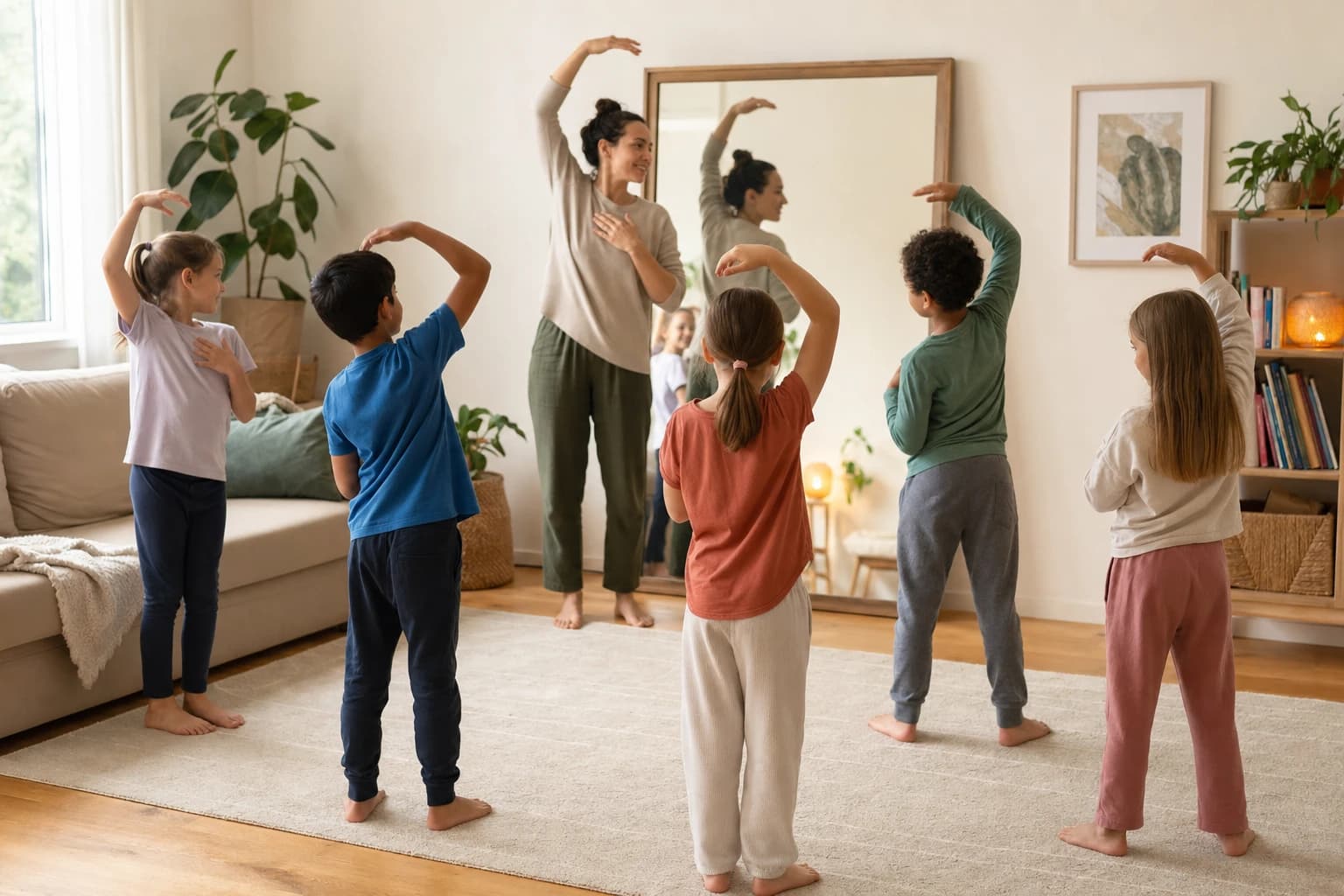
2. Mirror Match
Best for: 2 to 6 players, low noise, 4 to 8 minutes.
- Pair up or choose one leader for the group.
- The leader moves slowly while everyone mirrors the movement.
- Use smooth actions: reaching, turning, making faces, stretching tall, shrinking small.
- After 30 seconds, switch leaders.
- Make it harder by adding emotions: surprised mirror, serious mirror, wobbly mirror.
Example round: One child raises both hands like a tree, leans left, makes a fish face, and slowly sits into a pretend chair. The other player copies as closely as possible.
Variations: With 3 players, one person watches and chooses the best mirror before joining the next round. With 5 or 6 players, make a mirror chain: Player 1 leads Player 2, Player 2 leads Player 3, and so on.
Medium-Energy Games for a Living Room or Small Room
These small space games for 8 year olds let kids move without needing to sprint. The key is to use quick rounds and clear stop signals.
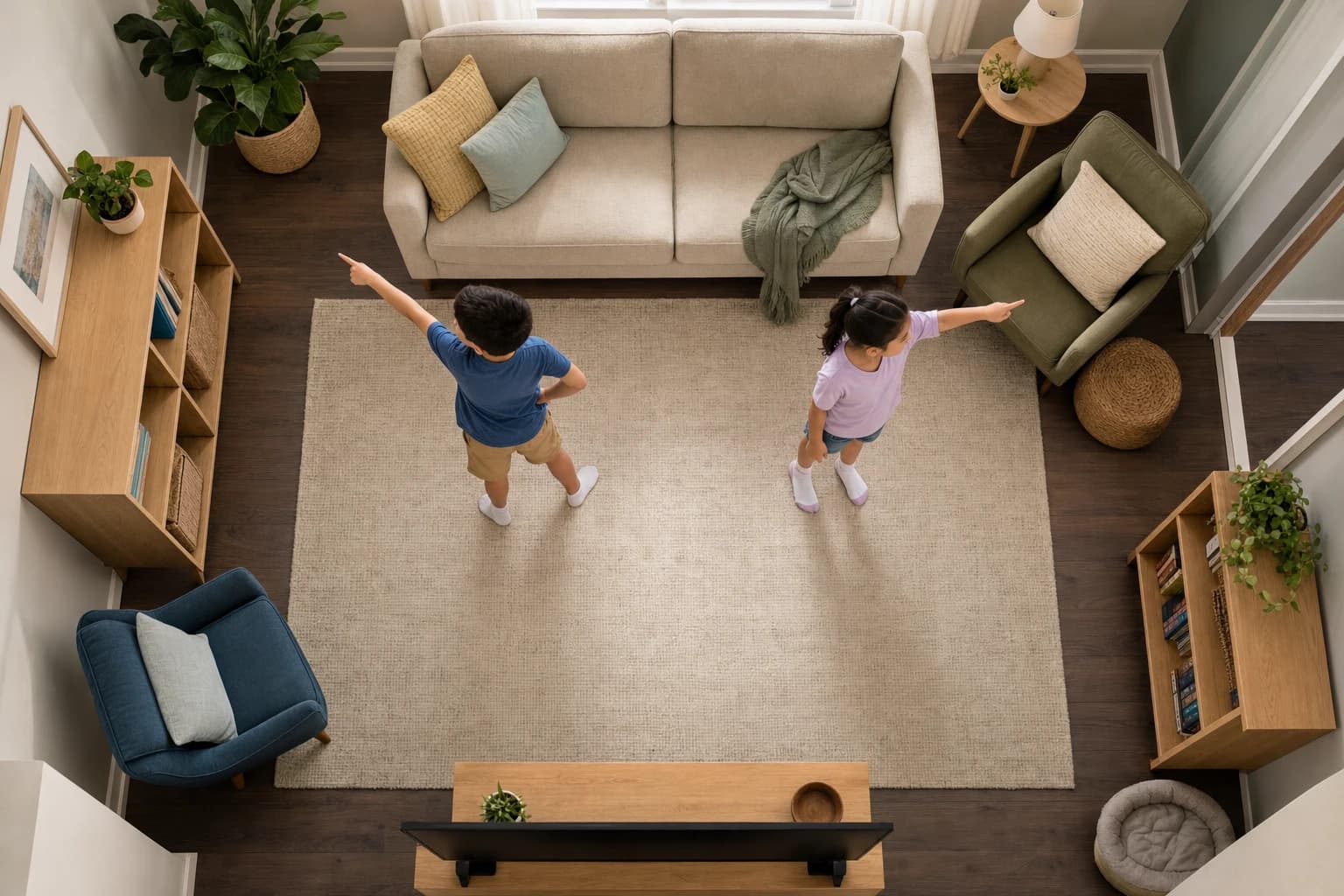
3. Category Freeze
Best for: 2 to 6 players, medium movement, 5 to 8 minutes.
- Choose one caller.
- The caller names a category, such as animals, sports, foods, weather, or machines.
- Players move around the room acting like something in that category.
- When the caller says freeze, everyone stops in a pose.
- The caller guesses what each player is. Then choose a new category.
Example round: The category is weather. One player swirls like wind, one drips like rain, and one stands tall like a sunny day. When the caller says freeze, everyone holds the pose for 5 seconds.
Variations: For 2 players, one acts and one guesses. For 3 or more, players cannot copy the same idea twice in a row. For quieter play, all movement must be silent and the guesses happen in whispers.
4. Number Corners Without Corners
Best for: 3 to 6 players, small rooms, 5 to 10 minutes.
This is useful when the room does not have safe corners. Instead of physical corners, name four zones: door, window, couch, and wall; or north, south, east, and west. No markers are needed if everyone can point to the zones before the game starts.
- Choose one caller who closes their eyes or looks down.
- The caller counts slowly from 1 to 10.
- Players quietly move to one of the four named zones.
- The caller names one zone without looking.
- Anyone in that zone does 3 funny freezes, then rejoins. No one sits out.
- Change callers after 3 rounds.
Example round: The caller counts to 10. Two players choose window, one chooses couch, and one chooses door. The caller says window. The two window players do three robot freezes and return for the next round.
Variations: For 3 players, use three zones instead of four. For 6 players, add a rule that no zone can have more than two people. For low-noise play, players must walk heel-to-toe while moving.
High-Energy Games That Still Work Indoors
High-energy indoor play needs stronger boundaries. Keep rounds short, avoid chasing, and remove any rule that rewards crashing, grabbing, or diving. These are good rainy day games for 8 year olds when kids need activity but the weather will not cooperate.
5. Floor Is Lava: Tiny Edition
Best for: 1 to 4 players, 3 to 6 minutes.
Classic floor-is-lava games can become unsafe if children leap between furniture. This version keeps feet on the floor and uses pretend rules instead of actual climbing.
- Everyone stands in the game zone.
- The caller names safe movements: tiptoe islands, crab-walk bridge, one-foot rock, slow-motion hop.
- Players move only inside the boundary.
- When the caller says lava rise, everyone freezes on two feet for 3 seconds.
- If someone bumps furniture or another person, the group resets and chooses a slower movement.
Example round: The caller says Tiptoe islands to the wall, crab-walk bridge back to the rug, lava rise! Everyone freezes. The fun comes from imagination, not from risky jumping.
Variations: For 1 player, give a 5-part mission and have the child narrate the adventure. For 2 players, one calls and one plays. For 4 players, all movement must go in the same direction around the room to avoid collisions.
6. Statue Switch
Best for: 2 to 6 players, 4 to 7 minutes.
- Choose a caller and a safe movement: marching, slow jogging in place, side steps, or tiny jumps.
- Players move until the caller says a statue word, such as superhero, chef, penguin, or giant.
- Everyone freezes in that statue pose.
- The caller picks the clearest statue, not the fastest player.
- The winner becomes the next caller.
Example round: Players march in place. The caller says penguin. Everyone freezes with arms at their sides and feet turned out. The caller chooses the pose that looks most penguin-like.
Variations: For 2 players, take turns naming statue words. For 5 or 6 players, require arm’s-length spacing before each round starts. For quieter play, use whispered statue words and slow-motion movement only.
Timing Plan: A 20-Minute No-Equipment Indoor Game Session
If you want a simple plan instead of choosing one game at a time, use this 20-minute sequence. It starts calm, builds movement, and ends calm again.
- Minutes 0-2: Room check, boundary reminder, and one practice freeze.
- Minutes 2-6: Silent Mission to focus attention.
- Minutes 6-11: Category Freeze with two categories and two callers.
- Minutes 11-16: Floor Is Lava: Tiny Edition or Statue Switch.
- Minutes 16-19: Mirror Match with slow movements.
- Minute 19-20: One-word check-in: each child says a word for the next game mood, such as silly, calm, fast, or mystery.
For a shorter break between homework tasks, choose one 5-minute game. For a long rainy afternoon, rotate three games and repeat only the favorite variation. Eight-year-olds often enjoy having input, so offer two choices instead of asking an open-ended question that leads to debate.
Rules That Prevent Rough Play Indoors
The same game can feel fun or chaotic depending on the first two minutes. Set expectations before excitement builds.
Use these house rules for every game
- No grabbing bodies or clothing. Tagging, pulling, and blocking are not needed for these games.
- Feet stay low. Tiny jumps are fine only if there is space and the child can land quietly.
- Furniture is not game equipment. Couches, beds, tables, and shelves are boundaries, not obstacles.
- Freeze means freeze now. Practice the stop signal once before high-energy play.
- Reset without blame. If someone bumps, trips, or gets too loud, pause and restart slower instead of turning it into a punishment.
A helpful phrase is: Make the game smaller, not rougher. If children want more challenge, add thinking rules, such as categories, memory, silent movement, or opposite actions. Avoid making the challenge about speed in a crowded room.
Common Mistakes to Avoid
- Starting with the wildest game first. Begin with a low- or medium-energy game so children hear the rules before they are fully excited.
- Using elimination too early. Sitting out can lead to arguing. For this age, quick silly resets usually work better than elimination.
- Changing rules mid-round. Finish the round, then add the variation.
- Ignoring noise level. A game can be safe but still unsuitable for apartment living, sleeping siblings, or late evening.
- Letting one child control every round. Rotate the caller after a set number of rounds so confident kids do not dominate.
FAQ
What are the easiest indoor games for 8-year-olds with no equipment?
Silent Mission, Mirror Match, and Category Freeze are the easiest to start because they need no setup and work with only two people. They also scale well for small groups.
How much space do these games need?
Most games in this list work in a clear rug-size area or a small room. Avoid games that require running, chasing, diving, or jumping onto furniture.
Can one child play these games alone?
Yes. Silent Mission can become a self-guided adventure, and Floor Is Lava: Tiny Edition can use spoken missions. A caregiver can also act as caller while doing light supervision.
How do I keep indoor games quiet?
Choose whisper rules, slow-motion movement, silent missions, and pose-based challenges. Avoid races and games where players are rewarded for being first.
What should I do if the game gets too rough?
Pause immediately, restate the boundary, and switch to a smaller movement such as marching in place or statue poses. If rough play continues, end that game and choose a calm one.
Conclusion
The best indoor games for 8-year-olds with no equipment are not complicated. They use imagination, short rounds, clear boundaries, and movement that fits the room. Start with calm rules, choose the right energy level, and rotate callers so everyone gets a turn.
For a small space, pick Silent Mission or Mirror Match. For a livelier rainy day, use Category Freeze, Number Corners Without Corners, Floor Is Lava: Tiny Edition, or Statue Switch. Keep furniture out of the game, end before play gets rough, and use variations to make the game smarter rather than louder.