Rainy days can feel long when a preschooler has energy to burn and your home does not have much space. The goal is not to keep children silent all day. It is to give them simple, satisfying play that stays calm, protects floors and furniture, and does not bother downstairs neighbors.
This guide focuses on quiet indoor games for preschoolers on rainy days, especially for apartments, condos, shared homes, and small living rooms. The activities are organized by time: 5-minute resets, 10-minute games, and 15-minute play rounds. Each idea includes easy rules, caregiver prompts, skill-building notes, cleanup tips, and a quiet-time transition.
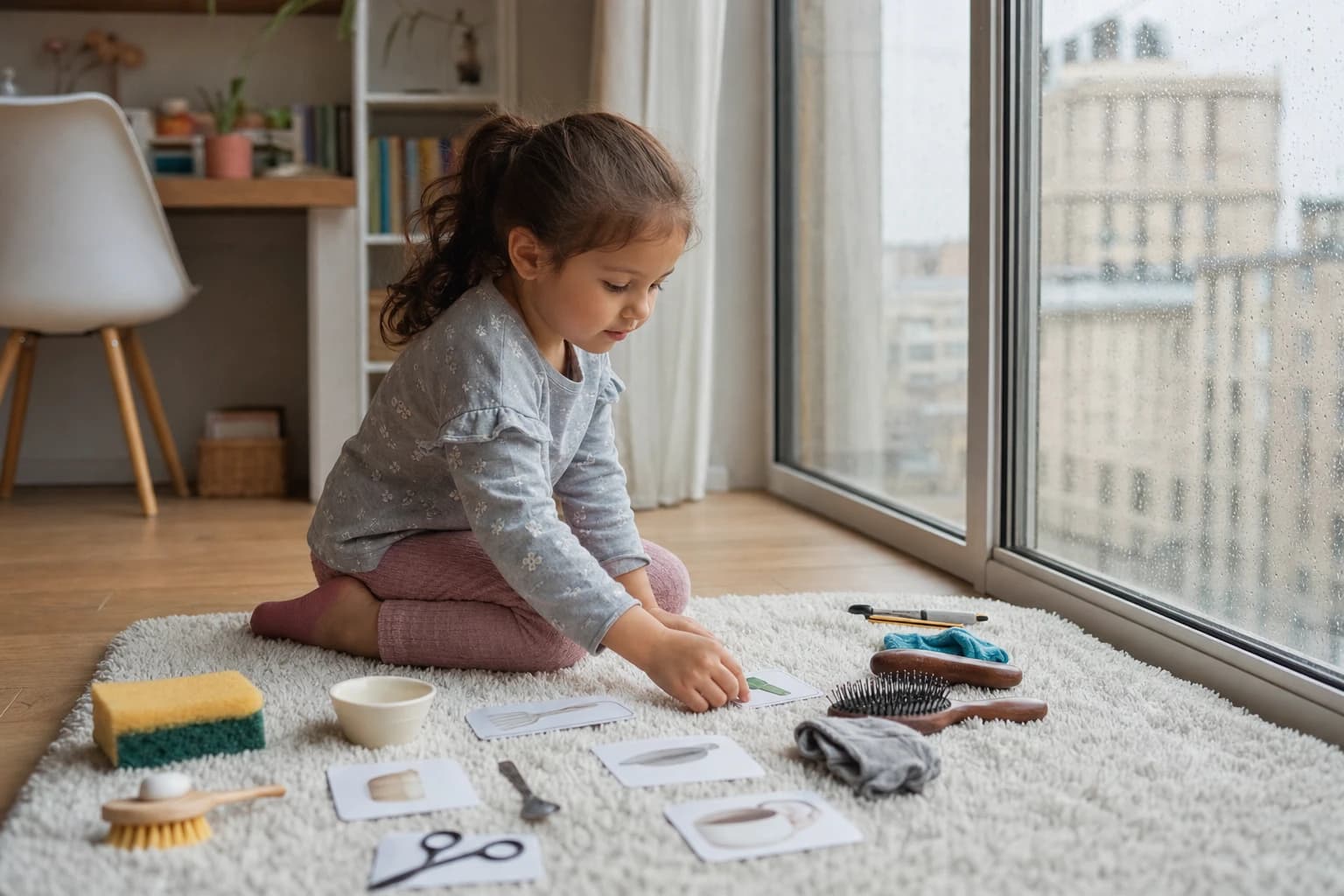
Quick Answer: What Makes a Rainy Day Game Apartment Friendly?
The best apartment friendly indoor games are quiet, low-mess, and easy to stop. They use soft materials, tabletop items, paper, books, blocks, scarves, stuffed animals, or painter’s tape. They avoid jumping, throwing hard objects, running laps, loud music, water play, glitter, and anything that takes longer to clean than to play.
For preschoolers ages 3 to 5, the sweet spot is a game with one clear job: find, match, sort, balance, pretend, whisper, build, or remember. Children this age are developing language, early problem-solving, coordination, and social play skills; the CDC’s developmental milestone resources are a useful reference for understanding typical skills across early childhood. Keep expectations flexible, because attention span and frustration tolerance vary from child to child.
Simple Setup for Low-Mess Indoor Games
Before choosing a game, create a small play zone. This makes cleanup easier and helps your child understand where the activity begins and ends.
Helpful materials
- One blanket, bath towel, yoga mat, or washable rug to mark the play space
- A small basket or tray for game pieces
- Painter’s tape for temporary floor lines or sorting boxes
- Index cards or scrap paper
- Crayons or washable markers
- Stuffed animals, socks, soft blocks, cups, or board books
- A timer set to 5, 10, or 15 minutes
Three setup steps
- Choose one surface. Use the coffee table, kitchen table, or a floor towel. Avoid spreading materials across the room.
- Limit the pieces. For a preschooler, 6 to 12 pieces is usually enough for matching, sorting, or pretending.
- Name the ending. Say, “When the timer rings, the blocks go back in the basket and we choose a book.”
5-Minute Quiet Indoor Games for Fast Rainy Day Resets
Use these when your child is restless, dinner is almost ready, a sibling is napping, or you need a short reset before quiet time.
1. Whisper Detective
Supplies: 5 familiar objects, such as a spoon, sock, toy car, crayon, and small book. Space: tabletop or towel. Difficulty: easy.
- Place the objects in front of your child.
- Whisper one clue: “I am thinking of something soft.”
- Your child points to the object instead of grabbing it.
- Switch roles and let your child give a clue.
Caregiver prompts: “What do you notice?” “Can you give me a clue without saying its name?”
Skills: listening, vocabulary, self-control, descriptive language.
Cleanup and transition: Ask your child to carry the objects back “as quietly as a mouse,” then choose a seated activity.
2. Tiny Treasure Sort
Supplies: 10 safe household items, such as large buttons for older preschoolers, toy animals, socks, blocks, or plastic lids. Avoid small parts for children who still mouth objects. The U.S. Consumer Product Safety Commission explains why small parts are a choking concern for younger children.
- Put all items in one bowl or basket.
- Ask your child to sort them into two groups: soft and hard, red and not red, round and not round.
- Change the rule once: “Now sort by things we wear and things we do not wear.”
Skills: early math, classification, attention, flexible thinking.
Cleanup and transition: Count the pieces back into the basket together. End with, “The treasure is sleeping now.”
3. Statue Story
Supplies: none. Space: one rug or mat. Noise level: very low.
- Tell a slow story: “A cat tiptoes across the room and sees a sleepy dragon.”
- Your child makes a quiet statue for each character.
- Pause for 5 seconds after each pose.
Caregiver prompts: “Show me a tiny dragon.” “Can your statue breathe slowly?”
Skills: body awareness, imagination, impulse control.
Cleanup and transition: No materials to clean. Finish with three slow breaths while still in the final statue pose.
10-Minute Low-Mess Indoor Games for Preschoolers
Ten-minute games are long enough to feel like real play but short enough to prevent fatigue or chaos. These are useful after snack, before bath, or during a stormy afternoon.
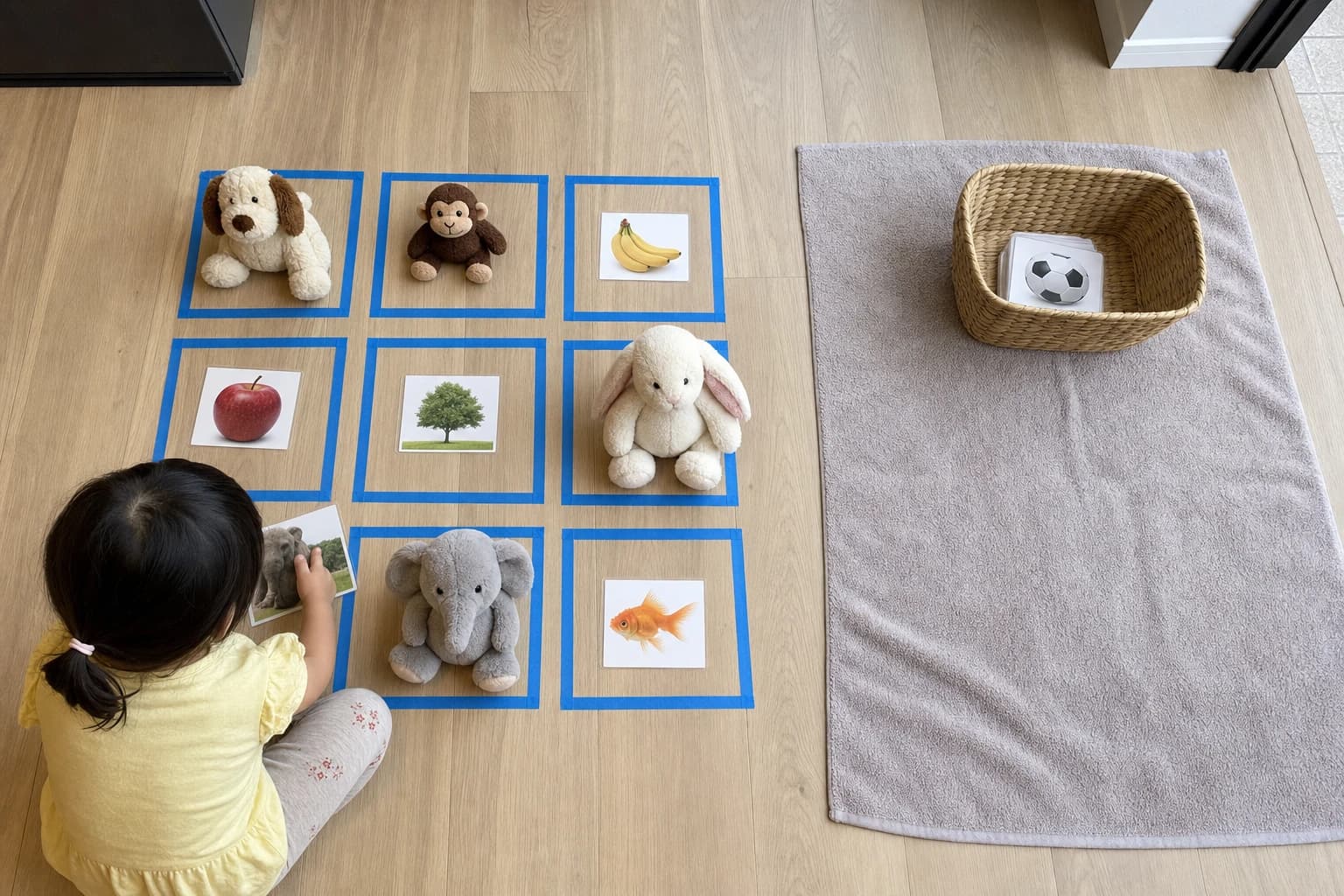
4. Quiet Delivery Service
Supplies: 4 stuffed animals, 4 paper “letters,” and a basket. Space: hallway or living room corner.
- Place stuffed animals in different spots around the room.
- Give your child one paper letter at a time.
- Say, “Please deliver this to the bear, walking feet only.”
- Add a memory challenge: “First deliver to the rabbit, then the dog.”
Caregiver prompts: “How can the mail carrier move quietly?” “Who gets the next letter?”
Skills: following directions, pretend play, memory, gentle movement.
Cleanup and transition: The mail carrier collects all letters and parks the basket by the couch.
5. Book Cover Match
Supplies: 6 picture books and 6 small cards. Prep: Draw a simple symbol from each cover on a card, such as a moon, truck, flower, or cat.
- Lay the books on the floor or table.
- Hand your child one card.
- Ask them to match the card to the book cover.
- After each match, invite them to tell one sentence about what might happen in the book.
Skills: visual discrimination, print awareness, storytelling, memory.
Cleanup and transition: Stack the books in size order, then read one of them quietly.
6. Sock Pattern Shop
Supplies: 6 to 10 clean socks. Space: towel or sofa cushion. Mess level: very low.
- Make a simple pattern: striped sock, plain sock, striped sock, plain sock.
- Ask, “What comes next in the shop window?”
- Let your child create a new pattern for you to copy.
- Roll pairs into soft balls only if they can stay seated and gentle.
Skills: early math, pattern recognition, fine motor work, turn-taking.
Cleanup and transition: Pair socks together and “close the shop” by putting them in a drawer or laundry basket.
Pick a Game by Time, Space, and Cleanup
| Game | Best Time | Space Needed | Cleanup | Best For |
|---|---|---|---|---|
| Whisper Detective | 5 minutes | Tabletop | Return 5 objects | Listening and calm focus |
| Tiny Treasure Sort | 5 minutes | Tray or towel | Count pieces into basket | Sorting and early math |
| Quiet Delivery Service | 10 minutes | One room or hallway | Collect paper letters | Gentle movement |
| Story Mat Theater | 15 minutes | One blanket | Fold blanket, basket toys | Pretend play and language |
| Silent Builder Challenge | 15 minutes | Floor mat or table | Sort blocks by color | Planning and fine motor skills |
15-Minute Calm Indoor Activities Ages 3 to 5
Fifteen-minute games work best when you give a clear beginning, middle, and ending. For children who are easily overwhelmed, shorten the game to one round and save the rest for later.
7. Story Mat Theater
Supplies: one blanket, 3 stuffed animals, 3 blocks, and 2 paper cards. Space: a blanket-sized area.
- Lay the blanket down and call it the stage.
- Choose one animal as the main character.
- Use blocks as a house, bridge, or bed.
- Ask your child to help tell a short story with three parts: hello, problem, solution.
- End with every character going to sleep or home.
Caregiver prompts: “What does the puppy want?” “What could help?” “How can the story end calmly?”
Skills: sequencing, emotional language, cooperation, imagination.
Cleanup and transition: Fold the blanket slowly with the animals inside, then move to a real book or rest time.
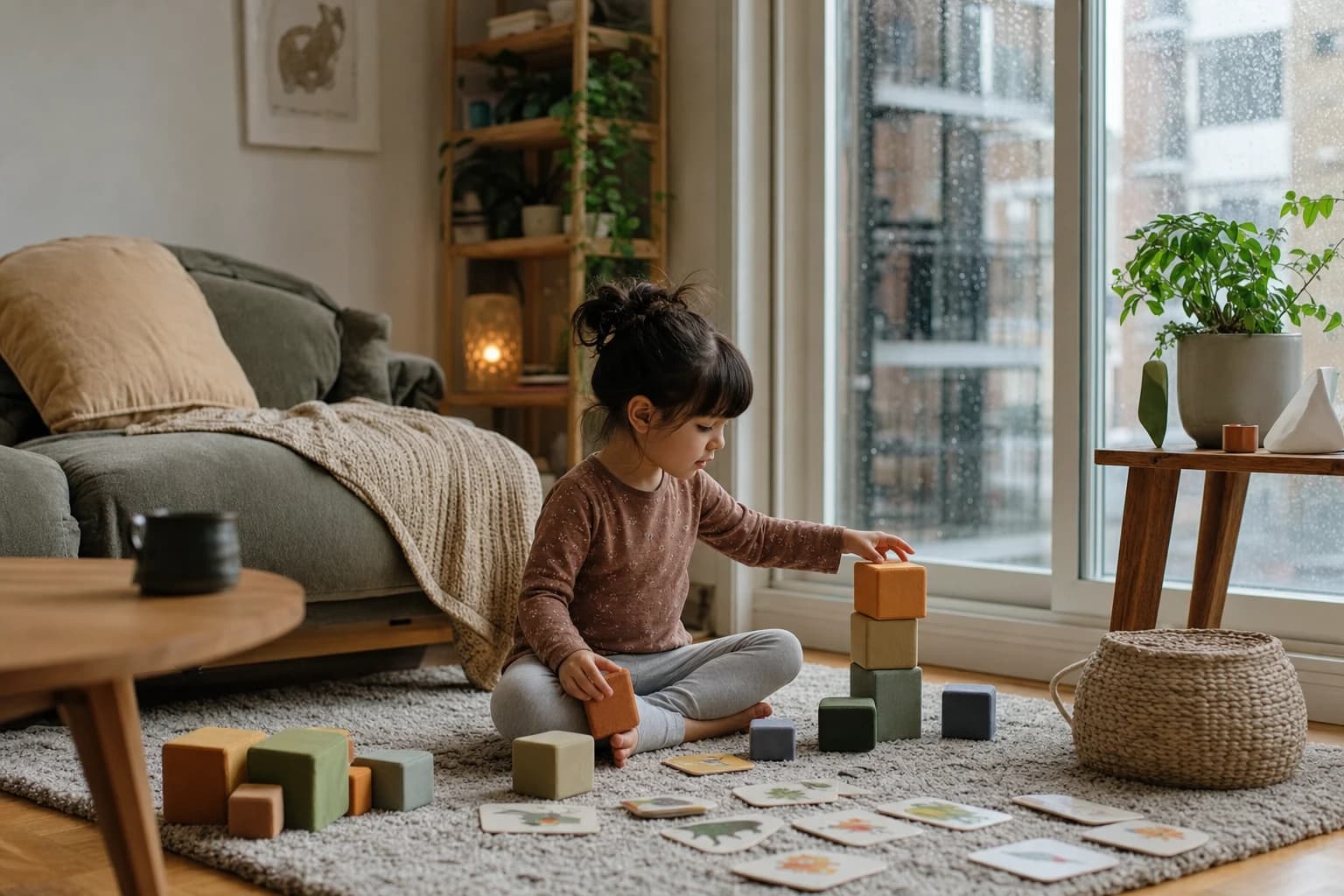
8. Silent Builder Challenge
Supplies: 10 to 20 soft blocks, wooden blocks, or large interlocking bricks. Space: table or mat. Noise tip: build on a towel to soften clacks.
- Choose one challenge: build a bed for a toy, a tiny tower, or a bridge for a spoon.
- Set a “quiet hands” rule: blocks are placed, not dropped.
- Let your child build for 8 to 10 minutes.
- Use the last few minutes to describe the structure together.
Caregiver prompts: “What part is strongest?” “What should go on the bottom?” “How can we fix it without getting loud?”
Skills: planning, spatial reasoning, patience, problem-solving.
Cleanup and transition: Sort blocks by color or size as they go back in the bin.
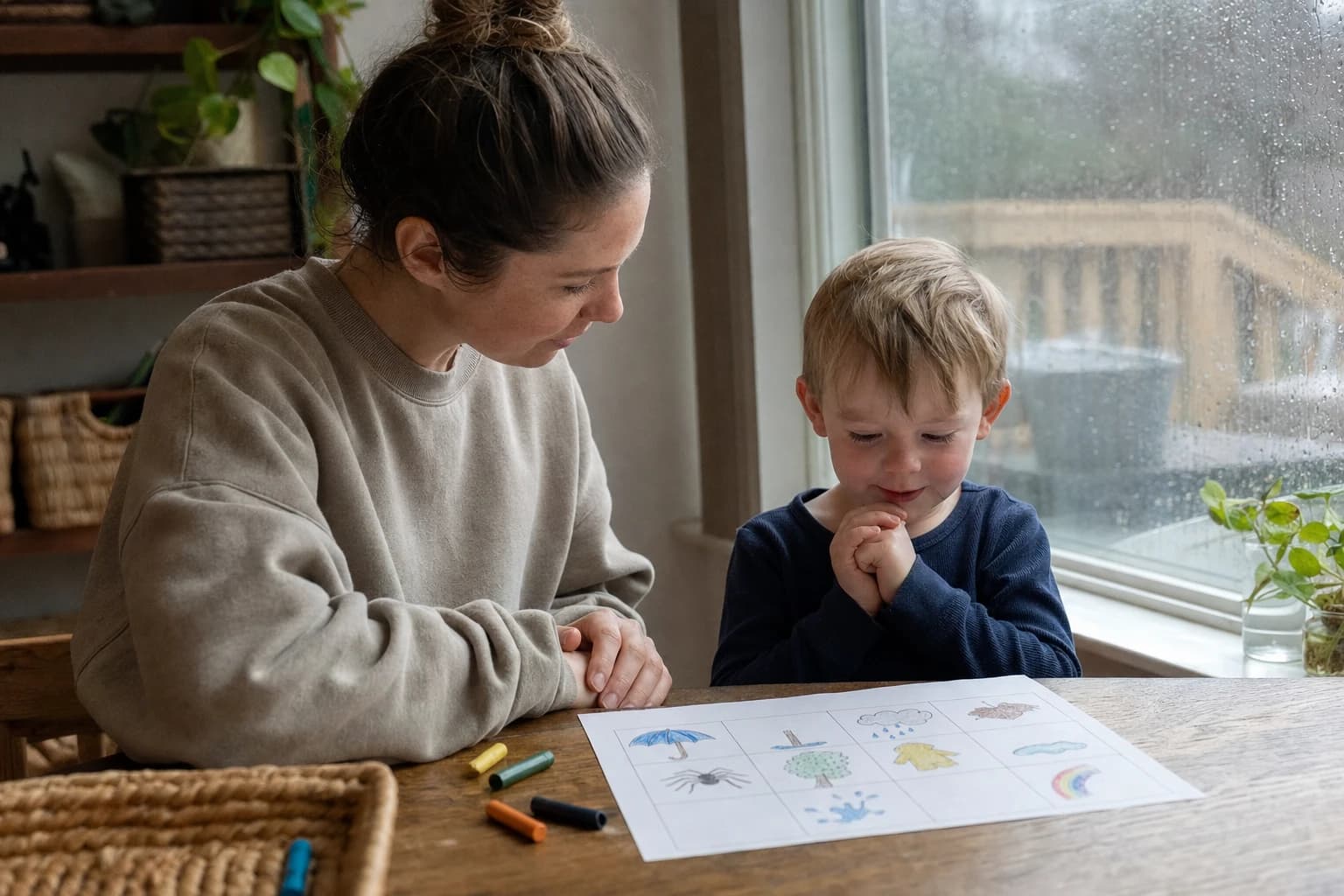
9. Rainy Window Bingo
Supplies: paper, crayon, and a window view. Prep: Draw a 2-by-3 grid with simple pictures: umbrella, car, tree, puddle, bird, light.
- Sit near the window together.
- When your child spots one item, they color that square.
- If the item is not visible, invite them to listen instead: rain tap, car whoosh, wind, footsteps.
- Finish when three squares are colored or when attention fades.
Skills: observation, patience, vocabulary, fine motor practice.
Cleanup and transition: Put the bingo sheet on the fridge or recycle it, then close the game with, “Goodbye, rainy window.”
Common Mistakes That Make Quiet Games Fall Apart
- Starting with too many pieces. A big bin often turns into dumping. Offer a small tray instead.
- Choosing games with winners and losers too soon. Many preschoolers handle cooperative goals better on tired rainy days.
- Letting movement games grow bigger. “Walk like a cat” can quickly become jumping. Set the rule before the game starts: feet stay soft, bodies stay on the rug.
- Skipping the ending. A clear closing phrase, song, or cleanup job helps prevent meltdowns when play stops.
- Using messy supplies when patience is low. Paint, glue, rice bins, and water play can be wonderful, but they are not ideal when you need low mess indoor games for preschoolers.
Quiet-Time Transitions After the Game
A transition is easier when it feels connected to the game. After a delivery game, the mail carrier can “clock out.” After a building game, the construction site can “close for rain.” After a story game, all characters can go to sleep.
Try one of these short transitions:
- Three-breath ending: “Smell the soup, cool the soup” three times.
- Final helper job: Your child returns exactly 5 items to the basket.
- Book bridge: Move from play to one picture book using the same theme, such as animals, rain, or vehicles.
- Soft voice countdown: Whisper from 5 to 1 while putting hands in lap.
FAQ: Quiet Rainy Day Games for Kids
What are the easiest quiet indoor games for preschoolers on rainy days?
Start with Whisper Detective, Tiny Treasure Sort, or Book Cover Match. They use common household items, need little space, and can end in 5 to 10 minutes.
How do I keep indoor games quiet in an apartment?
Use rugs, towels, or blankets under toys; choose soft items; avoid running and jumping; and give a specific rule such as “blocks are placed, not dropped.” Short rounds also help keep energy from escalating.
What if my preschooler refuses to clean up?
Make cleanup part of the game instead of a separate chore. Ask for a small, exact job: “Put 6 blocks in the basket” or “Deliver the letters back to the tray.”
Are these games suitable for 3-year-olds and 5-year-olds?
Yes, with adjustments. For a 3-year-old, use fewer pieces and one-step directions. For a 5-year-old, add memory challenges, patterns, storytelling, or simple planning tasks.
What should I avoid for low-mess rainy day play?
Avoid glitter, loose sensory fillers, open cups of water, permanent markers, and large toy bins if you need quick cleanup. Save messy projects for times when you can supervise closely and clean without rushing.
Conclusion
Quiet rainy day play does not need special toys or a large playroom. A towel, a small basket, a few household objects, and a clear ending can turn a restless afternoon into manageable play. Choose 5-minute games for quick resets, 10-minute games for calm engagement, and 15-minute games when your child is ready for a fuller activity. The best calm indoor activities ages 3 to 5 are simple enough to explain in one sentence and peaceful enough to clean up without starting a new storm indoors.