Kickball is easy to start, but a game can get messy fast if nobody agrees on the rules first. These kickball rules for kids are written for teachers, parents, camp counselors, and group leaders who need a clear version that works at recess, picnics, and in the backyard.
You’ll find a simple field setup, a short equipment list, step-by-step directions for how to play kickball, age-friendly out rules, fair rotation ideas, and adaptations for small or mixed-skill groups. Use this as a ready-to-read rule sheet before the first pitch.

Quick Answer: The Basic Kickball Rules for Kids
Kickball is played like a simplified version of baseball or softball. One team kicks and runs the bases while the other team fields the ball and tries to make outs. After a set number of outs or after everyone on the kicking team has kicked, the teams switch sides.
- Players: Best with 6 to 20 players, but it can be adapted for fewer.
- Teams: Two teams with the same number of players when possible.
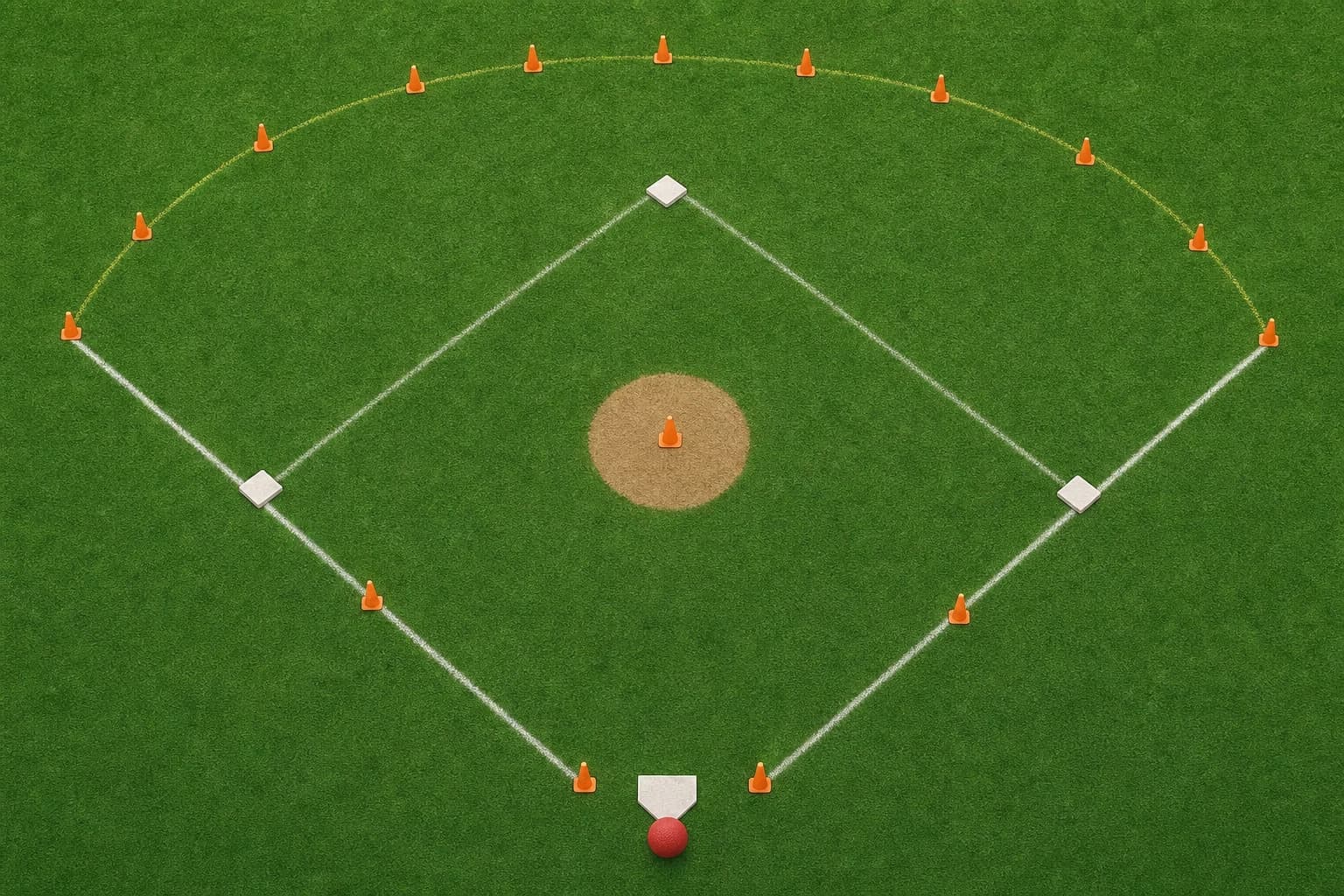
- Field: Four bases in a diamond: home plate, first base, second base, and third base.
- Ball: A soft playground ball, usually 8.5 to 10 inches wide.
- Goal: Score runs by kicking the ball and safely running around the bases back to home.
- Inning: Each team gets one turn kicking. For kids, 3 innings or 20 to 30 minutes is usually enough.
- Outs: A player can be out if the ball is caught in the air, the runner is tagged with the ball, the base is touched for a force out, or the runner kicks out of order.
Formal adult leagues have more detailed rulebooks, and the details vary by organization. For example, the CLUBWAKA kickball rules describe the traditional diamond layout, kicking order, fair and foul balls, and outs in a league format. For a school or backyard game, it is better to simplify those ideas so children can keep playing without constant arguments: CLUBWAKA Kickball Rules.
Equipment and Kickball Game Setup
You do not need a regulation field to run a good game. The most important part of kickball game setup is choosing safe spacing and making the boundaries obvious before play starts.
Materials
- 1 soft rubber playground ball, ideally 8.5 to 10 inches in diameter
- 4 bases, cones, flat markers, towels, or chalk squares
- 8 to 20 cones for foul lines, outfield limits, and waiting areas if available
- A whistle or clear hand signal for teachers and group leaders
- Optional: clipboard or paper for kicking order
Suggested Field Sizes
| Group and Space | Base Distance | Best For | Adjustment |
|---|---|---|---|
| Small backyard | 20 to 30 feet | Ages 5 to 8 or 4 to 8 players | Use a lighter roll from the pitcher and allow no head shots. |
| School blacktop or small field | 35 to 45 feet | Ages 7 to 11 or 8 to 16 players | Mark foul lines clearly with cones or chalk. |
| Large grass field | 50 to 60 feet | Older kids or 14 to 24 players | Add a “no blast zone” near home if strong kickers dominate. |
If you are using a paved surface, choose flat bases or chalk marks instead of loose objects that can slide. On grass, cones, rubber bases, or even jackets can work, but make sure players know they should touch the marker and keep running rather than jump onto it.
How to Play Kickball: Step-by-Step
- Choose two teams. Split the group as evenly as possible by age, speed, and confidence. If there are older children, place them on both teams instead of stacking one side.
- Set the kicking order. Every player on a team kicks before anyone kicks a second time. Write the order down or have children stand in line behind home plate.
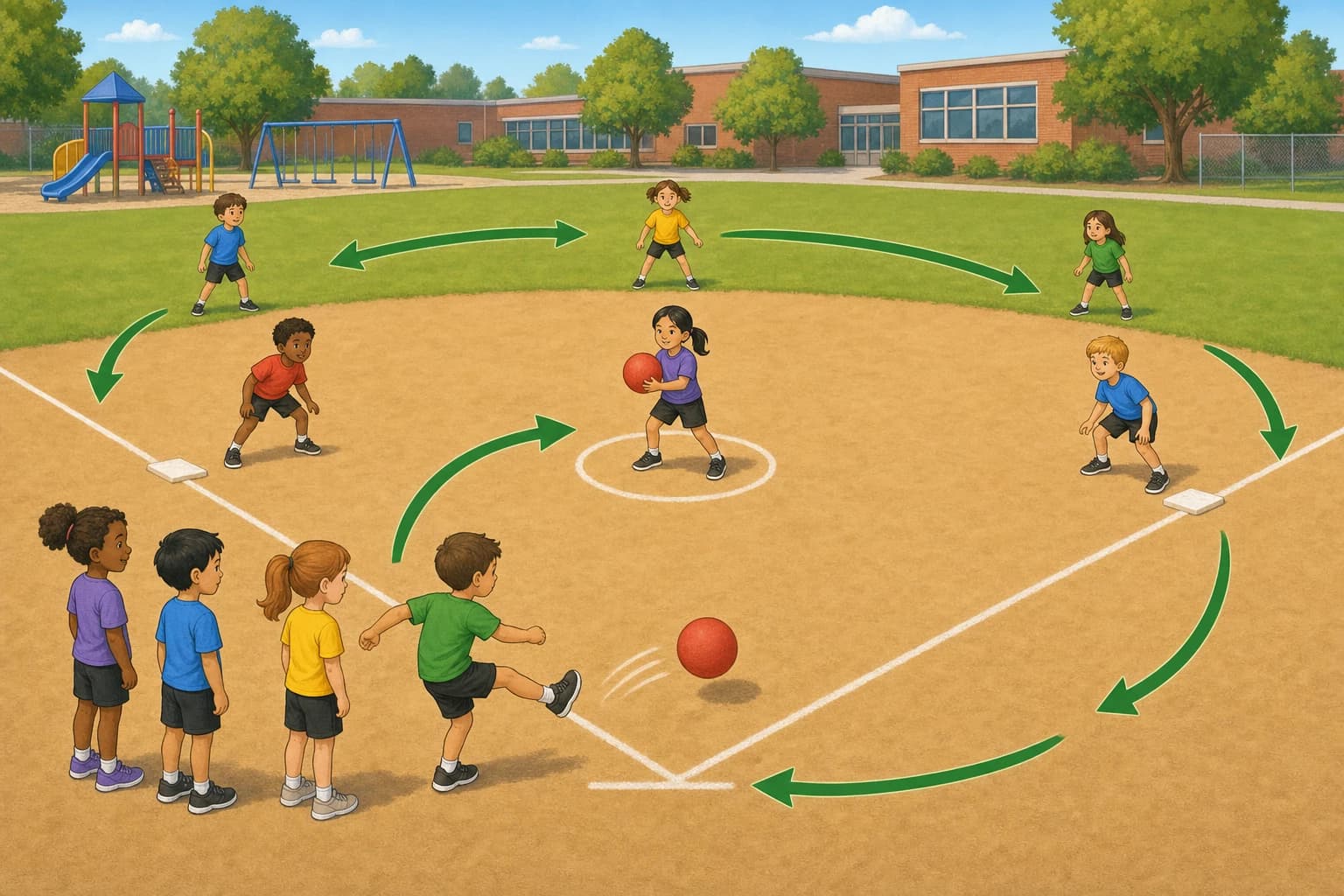
- Place the fielders. Use a pitcher, first base, second base, third base, shortstop, and outfielders. With younger children, skip strict positions and simply spread them out so everyone has space.
- Roll the pitch. The pitcher rolls the ball smoothly toward home plate. For kids, the ball should bounce as little as possible and arrive slowly enough that the kicker can try.
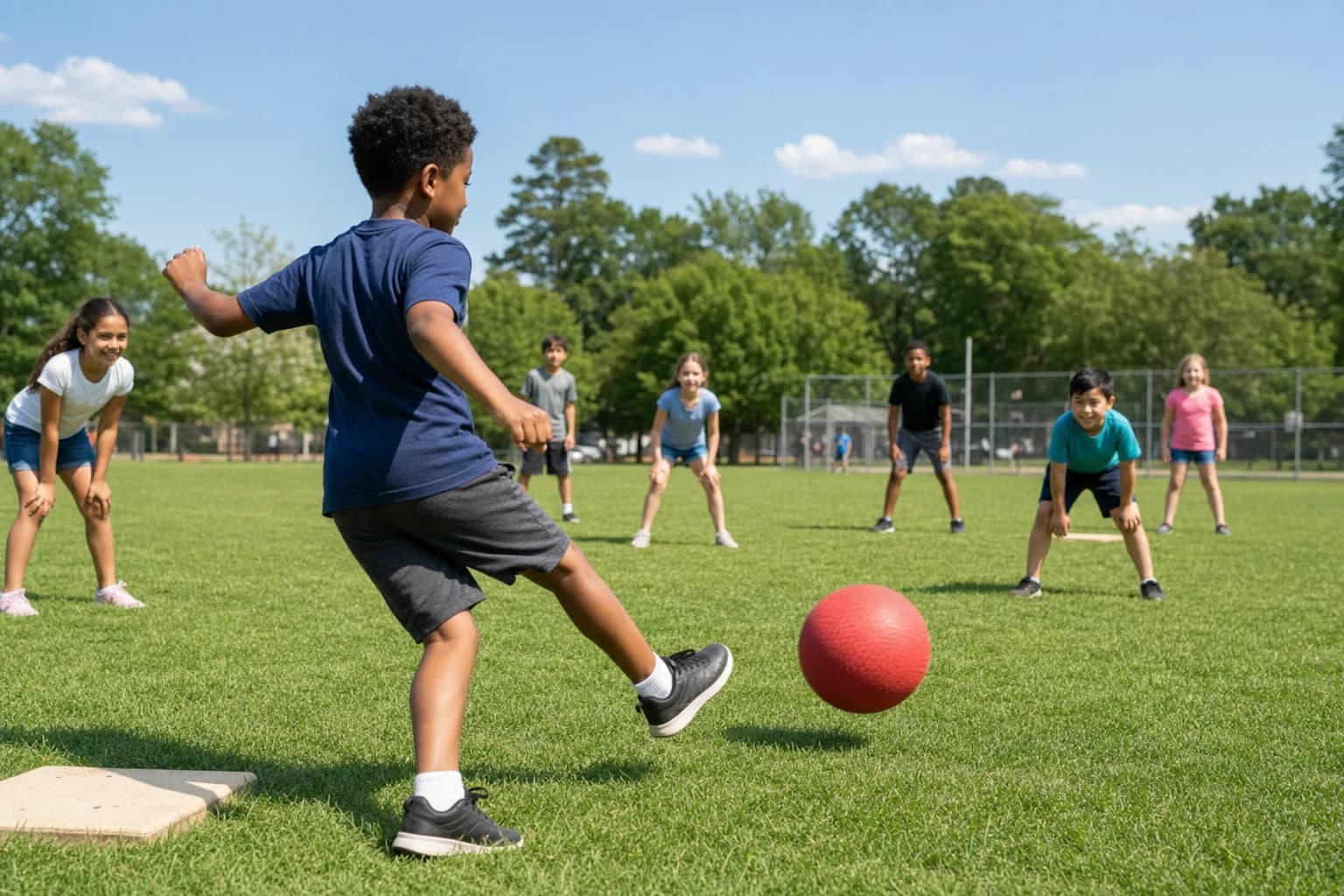
- Kick and run. The kicker kicks the ball from near home plate and runs to first base. If the kick is fair, runners may keep advancing until the ball is controlled and returned toward the infield.
- Make outs. The fielding team tries to catch the ball, tag a runner, or touch a forced base before the runner arrives.
- Score runs. A run scores when a runner touches first, second, third, and then home safely.
- Switch sides. Switch after 3 outs, after 5 runs, or after the whole kicking team has kicked. For recess, the “everyone kicks once” rule is often the fairest.
- End the game. Play 3 innings, set a 20-minute timer, or finish when both teams have had the same number of kicking turns.
For school recess, the easiest format is often one full kicking order per side. This avoids the problem of a few skilled players taking long turns while quieter children wait.
Fair Balls, Foul Balls, and Bunting Rules
A fair ball is a kicked ball that travels between the foul lines into the field of play. A foul ball goes outside the first-base or third-base line before passing those bases, or is kicked behind home plate.
For kids, keep the foul rule simple: each kicker gets up to 3 good pitches. If the child fouls the third good pitch, let them try once more instead of calling an automatic out. This keeps early learners involved and reduces pressure.
Bunting can be fun in older games, but it may slow down a children’s game. If fast players are tapping the ball two feet and racing to first every time, add one of these rules:
- The ball must travel past an agreed “kick line,” such as 10 feet from home plate.
- Each team gets 2 bunts per inning.
- No bunting for the strongest runners, but younger players may use gentle kicks.
Simple Outs That Kids Understand
The best kickball rules for school are easy to explain in one minute. Use these four outs and skip trickier rules unless your group is ready.
- Catch out: A fielder catches the kicked ball before it touches the ground.
- Force out: A fielder holding the ball touches the base a runner must reach. Example: the kicker runs to first, so the first baseman can touch first base while holding the ball.
- Tag out: A fielder gently tags the runner with the ball in hand.
- Order out: A player kicks in the wrong order after one reminder has already been given.
Use a no-throw-at-runners rule for younger kids
Some playground games allow fielders to throw the ball at a runner below the shoulders. For mixed-age groups, recess, and backyard kickball, a safer and calmer option is to ban throwing at runners entirely. Require a hand tag or a force out instead. If you do allow thrown tags with older kids, make the rule “below the waist only,” and stop play immediately for any throw near the head.
Fair Team Rotation and Participation Rules
Kickball can become frustrating when the same players pitch, kick hardest, or control every play. A few rotation rules make the game feel fair without turning it into a long lecture.
- Rotate pitcher each inning. No player pitches more than one inning in a row.
- Use a full-team kicking order. Everyone kicks before the top of the order repeats.
- Switch field positions every inning. Move outfielders to infield and infielders to outfield.
- Give new players a base coach. An adult or older child can stand near first or third and call “stop” or “run.”
- Limit power kicking if needed. Strong kickers can be challenged to kick with their non-dominant foot or aim for open space instead of blasting the ball.
Small-Group and Backyard Kickball Variations
Backyard kickball often has fewer players, uneven ground, and odd boundaries. That is fine. The key is to make the space fit the group instead of forcing a full-field game.
4 to 6 Players: Ghost Runner Kickball
Use one pitcher, one or two fielders, and one kicker at a time. When a kicker reaches base safely, use a “ghost runner” to remember their place. For example, if Ava reaches second and the next child kicks, Ava returns to the kicking line while everyone agrees there is a ghost runner on second. Ghost runners advance the same number of bases as the next live runner.
6 to 10 Players: One-Base Kickball
Set one base about 30 feet from home. The kicker runs to the base and back home to score. Fielders get the runner out by tagging them or touching home with the ball before the runner returns. This version is fast, simple, and useful for narrow yards.
Mixed Ages: Coach-Pitch Kickball
An adult or neutral helper rolls every pitch. This prevents one team from gaining an advantage because of a strong pitcher. Give younger children 4 or 5 good pitches and older children 3.
Large Groups: Two-Ball Waiting Game
If you have 20 or more players, long waiting times can ruin the game. Create a kicking line activity with a second ball: the next two kickers practice gentle passes off to the side while they wait. Keep it well away from home plate so it does not interfere with the live game. For more group formats where nobody sits out for long, see Large Group Party Games for 20 to 50 People That Keep Everyone Playing.
Rules for Mixed Skill Levels
A good kids’ kickball game should not punish beginners for learning. These adjustments help strong players stay engaged while less experienced players still get real turns.
| Situation | Problem | Helpful Rule |
|---|---|---|
| One player kicks much farther than everyone else | Outfielders back up and younger players feel unsafe | Make that player kick with the opposite foot or require a grounder. |
| Some children miss every pitch | They feel rushed or embarrassed | Allow 5 good pitches, then let them kick a still ball from home plate. |
| Runners do not know when to stop | Multiple runners crowd the same base | Use adult base coaches for first and third. |
| Fielders fight over the ball | Collisions and arguments | Assign zones: infield, left outfield, center outfield, right outfield. |
| The score becomes lopsided | One team loses interest | Cap each inning at 5 runs and reset encouragement each inning. |
If weather pushes the group inside after a game, you can switch to quieter movement or party games. These Indoor Games for 8-Year-Olds With No Equipment are useful when you need a backup plan without setting up supplies.
Common Mistakes to Avoid
- Starting before explaining boundaries. Children need to know what counts as out of bounds, where to wait, and where spectators should stand.
- Letting the pitcher control the whole game. A very fast or bouncy roll can turn kickball into a guessing game. Require smooth, rollable pitches.
- Using hard balls. A soft playground ball is better for children than a hard sport-specific ball.
- Arguing every close play. For recess, use “tie goes to the runner” or “do-over” for close calls. Pick one rule before the game.
- Keeping eliminated players inactive. If a child gets out, they should return to the kicking line or rotate into the field soon, not sit for the rest of the game.
Printable-Style Kids’ Kickball Rule Sheet
- Teams take turns kicking and fielding.
- Everyone kicks in order.
- Kick the ball forward between the foul lines.
- Run to first, then second, third, and home.
- A run scores when a runner reaches home safely.
- Outs are catches, force outs, gentle tags, or repeated kicking out of order.
- No throwing the ball at heads or faces. For younger groups, no throwing at runners at all.
- Switch sides after 3 outs, 5 runs, or everyone has kicked once.
- Use kind words, give space, and accept the leader’s call.
FAQ: Kickball Rules for Kids
How many players do you need for kickball?
A standard kids’ game works well with 6 to 20 players. If you have fewer than 6, use ghost runners or one-base kickball. If you have more than 20, use a full-team kicking order and rotate field positions often.
How long should a kids’ kickball game last?
For recess or camp, 20 to 30 minutes is usually practical. You can also play 3 innings, as long as both teams get the same number of kicking turns.
Can a runner stay on a base in kickball?
Yes. A runner may stop safely on first, second, or third. If another runner is forced to that same base, the first runner must advance if the rules of force play apply.
What happens if a kicked ball is caught?
The kicker is out. In a simple kids’ version, runners should return to the base they started from unless your group is old enough to understand tagging up.
Are head shots allowed in kickball?
No. A children’s game should not reward throws near the head. The simplest rule is no throwing at runners; use gentle hand tags and force outs instead.
What is the easiest version for young children?
Use coach-pitch kickball with short bases, 4 or 5 good pitches per kicker, no thrown tags, and a rule that every child kicks once before teams switch.
Conclusion
The best kickball rules for kids are clear, fair, and flexible. Set a simple diamond, use a soft ball, explain fair and foul lines, and choose a switching rule before the first kick. For most school, picnic, and backyard games, the smoothest version is: everyone kicks in order, no throwing at runners, simple outs only, and teams switch after everyone has had a turn or after 3 outs.
Once the group understands the basics, you can adjust the field size, base distance, pitching rules, and scoring cap to match the age and space. That is what makes backyard kickball and recess kickball so useful: the game is structured enough to feel like a sport, but flexible enough for almost any group of kids.