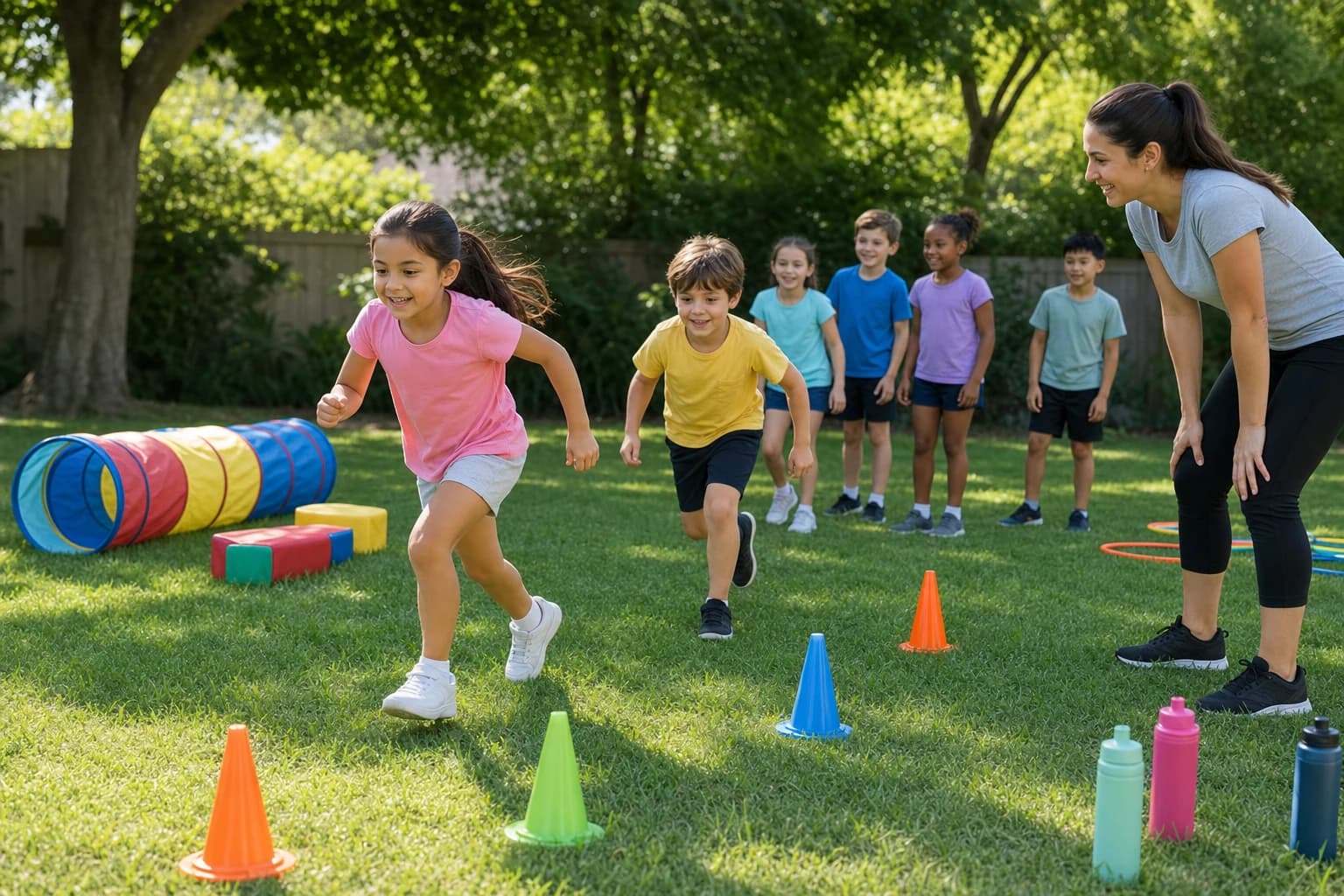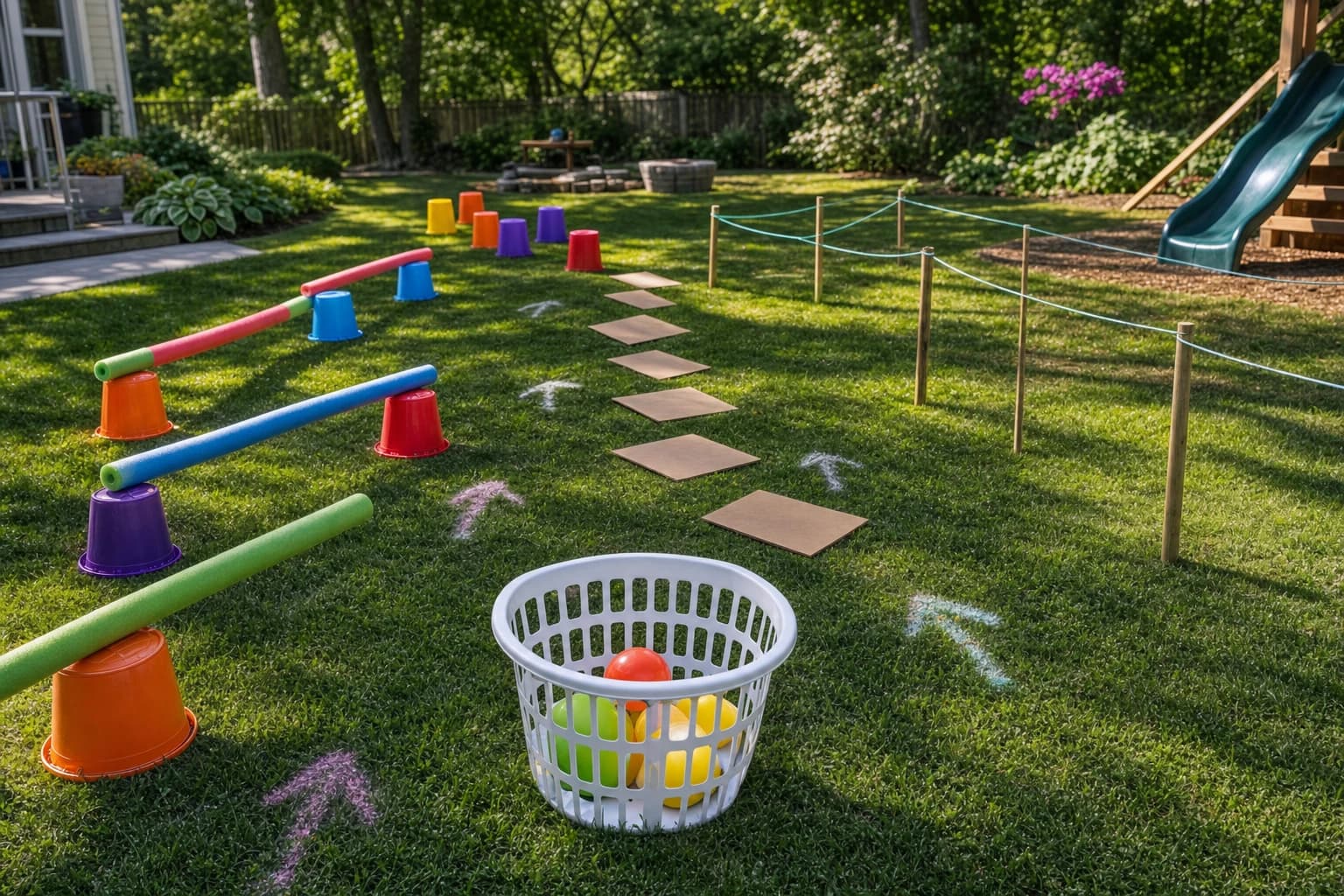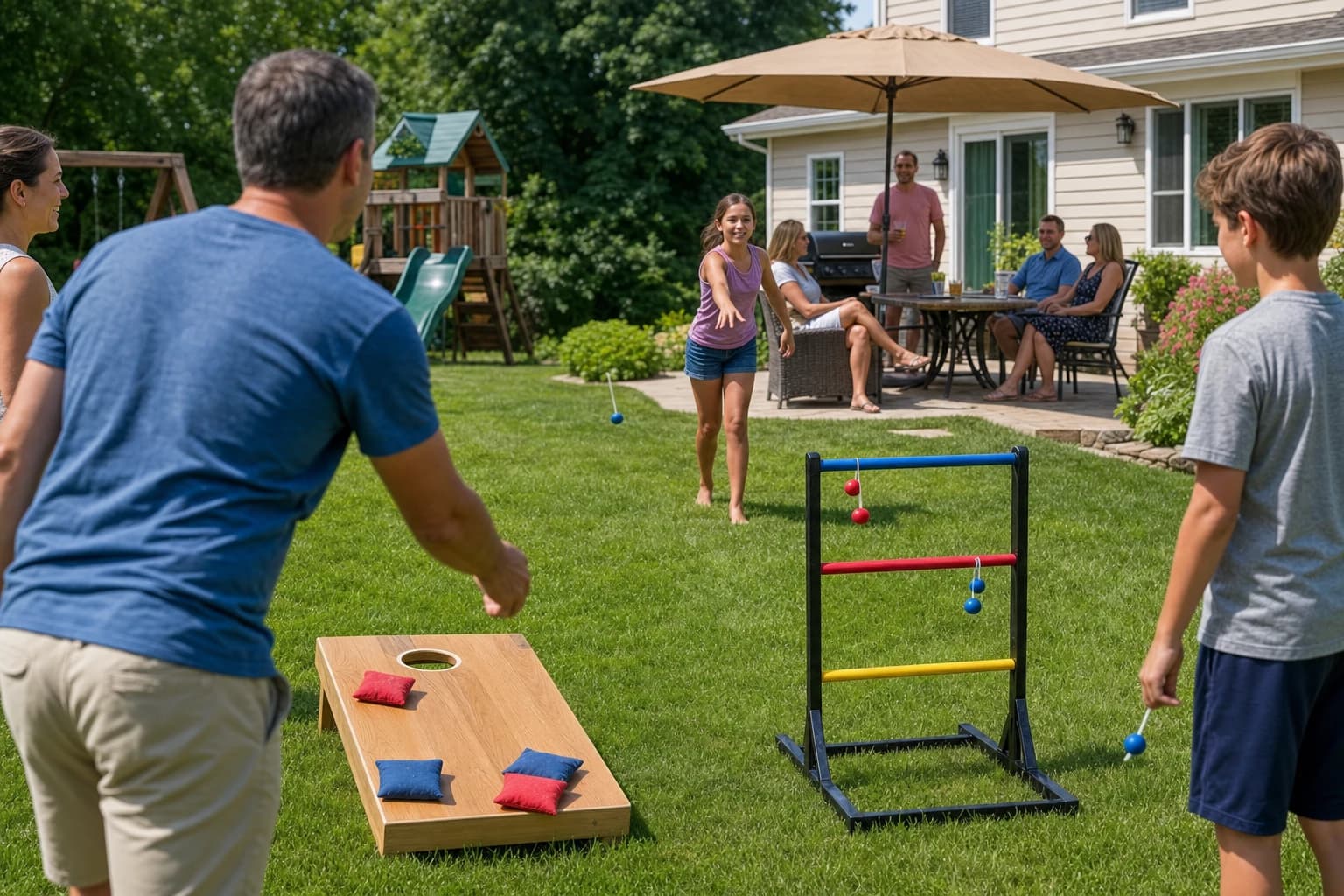
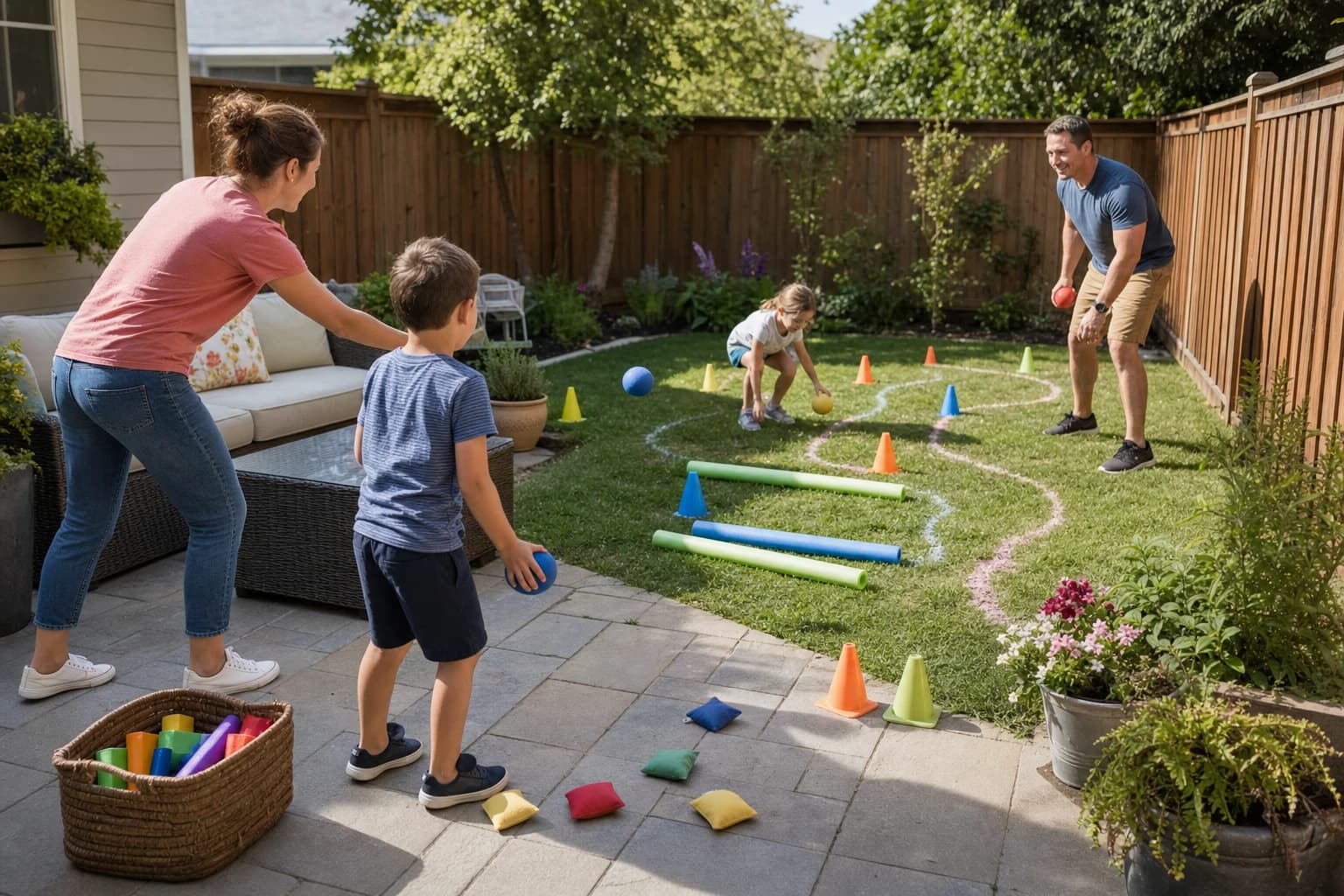
A small yard can make classic lawn games feel impossible. A full kickball field, regulation cornhole setup, or wide-open tag game may not fit safely between a fence, patio furniture, and a garden bed. The good news: many outdoor games for small backyards still feel active if you shrink the playing area, use softer equipment, and choose rules that reward quick movement instead of long-distance running.
This guide focuses on games that work in compact yards, patios, driveways, and narrow outdoor spaces. For each idea, you will find the recommended space, player count, noise level, equipment, and an easy modification for younger children.
Quick Setup Rules for a Small Backyard
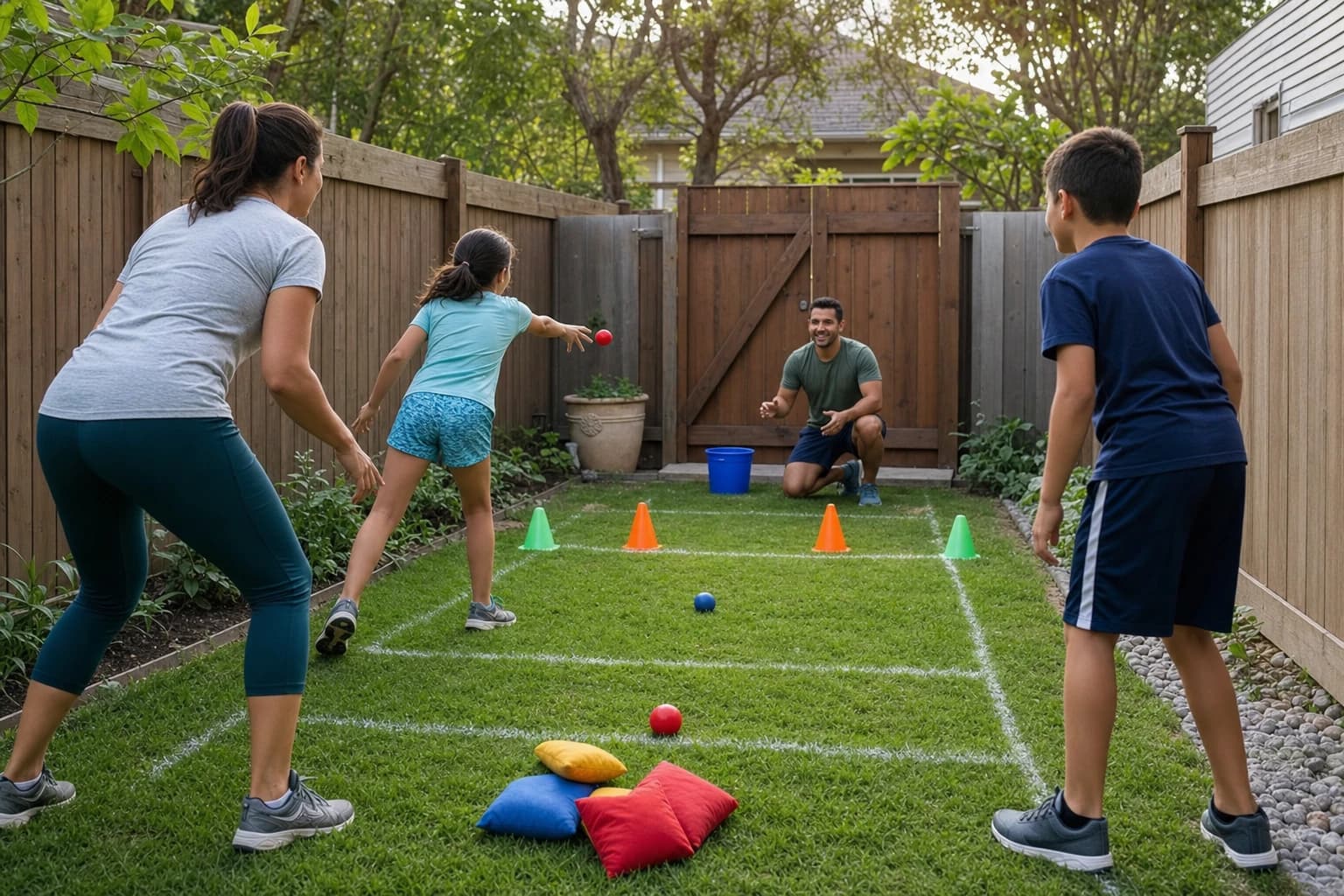
Before choosing a game, measure the safe play zone rather than the whole yard. A 12-by-18-foot patio with a grill, chairs, and steps may only have an 8-by-12-foot clear rectangle. Use cones, chalk, painter’s tape, or garden-safe rope to mark boundaries so players know where to stop.
- Best surface: flat grass, rubber patio tiles, smooth concrete, or a clean deck with enough grip.
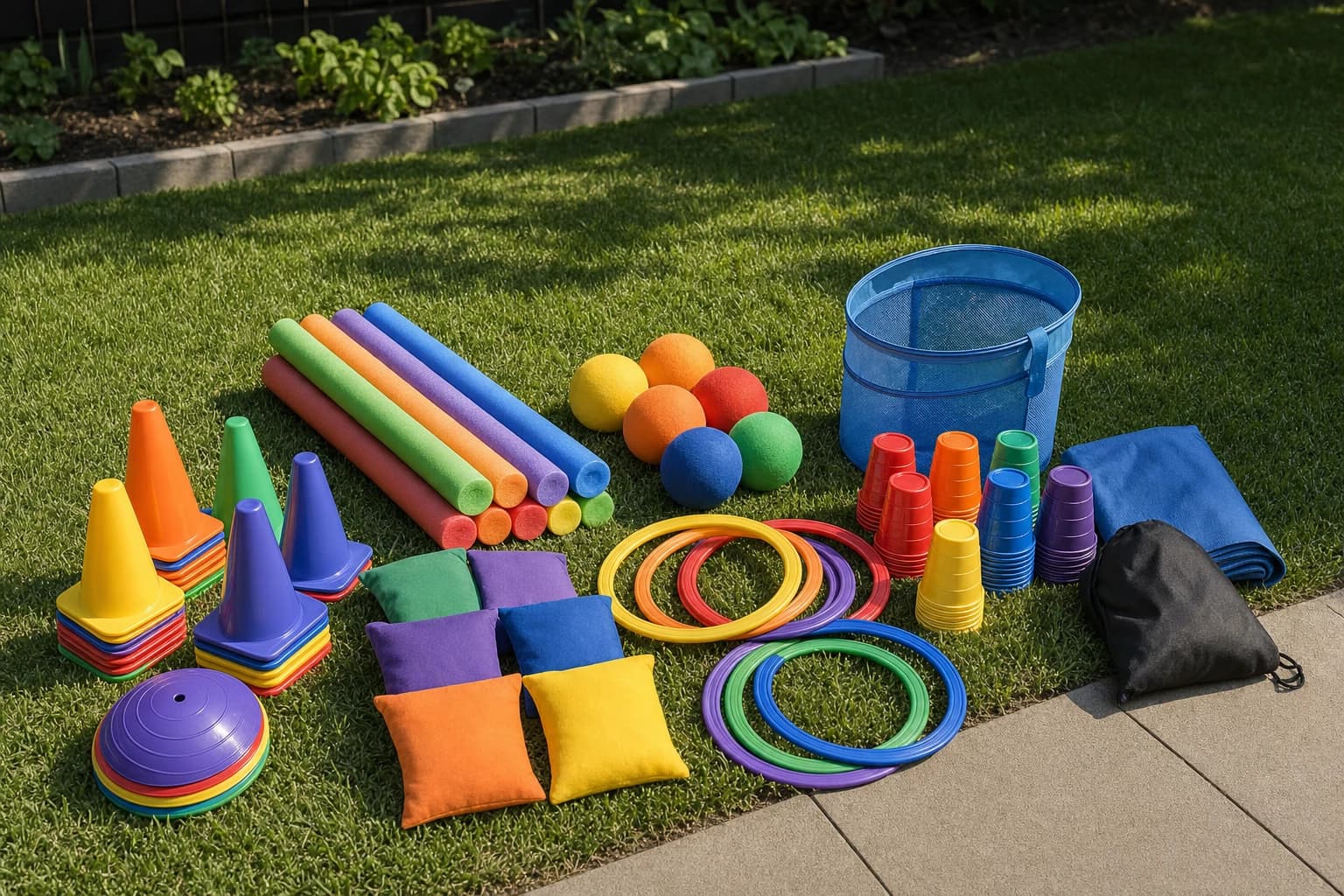
- Best equipment: foam balls, beanbags, cones, sidewalk chalk, plastic cups, pool noodles, and soft rings.
- Best rule change: replace running with shuffling, hopping, balancing, aiming, or quick turns.
- Safety check: keep at least 3 feet of clearance from grills, glass doors, stairs, sharp planters, and low branches.
For general activity guidance, the CDC recommends children ages 6 to 17 get 60 minutes or more of moderate-to-vigorous physical activity daily. Short backyard games can be one practical way to add movement, but they should be matched to the child’s age, space, and comfort level.
At-a-Glance Comparison: 15 Small Backyard Games
| Game | Minimum space | Players | Noise | Equipment | Younger-child modification |
|---|---|---|---|---|---|
| Beanbag Target Sprint | 8 x 10 ft | 2–6 | Low | Beanbags, buckets | Walk instead of sprint |
| Mini Obstacle Loop | 8 x 12 ft | 1–6 | Medium | Cones, hoops, noodle | Remove timed scoring |
| Four-Corner Switch | 10 x 10 ft | 4–8 | Medium | 4 markers | Use animal walks |
| Sidewalk Chalk Fitness Path | 3 x 15 ft | 1–5 | Low | Chalk | Use pictures instead of words |
| Foam Ball Wall Toss | 6 x 8 ft | 1–4 | Low | Foam ball, wall | Let ball bounce twice |
| Pool Noodle Limbo | 6 x 8 ft | 2–8 | Medium | Pool noodle | Keep noodle high |
| Mini Ring Toss Relay | 5 x 12 ft | 2–6 | Low | Rings, bottles/cones | Move targets closer |
| Balloon Keep-Up Zone | 6 x 6 ft | 1–5 | Low | Balloons | Use two-hand taps |
| Backyard Bowling | 3 x 12 ft | 1–6 | Low | Plastic bottles, soft ball | Use a ramp or closer line |
| Shadow Tag | 10 x 12 ft | 2–6 | Medium | Sunlight | Use slow-motion steps |
| Mini Soccer Gates | 8 x 14 ft | 2–4 | Medium | Soft ball, cones | No goalie charging |
| Patio Pickleball Dinks | 8 x 16 ft | 2–4 | Medium | Paddles, foam ball, line | Use balloon or beach ball |
| Treasure Dash | 8 x 10 ft | 2–8 | Medium | Small objects, basket | Sort by color only |
| Statue Dance Freeze | 6 x 8 ft | 2–10 | Varies | Music optional | Use claps instead of music |
| Cone Knockdown | 6 x 12 ft | 2–6 | Low | Cones, foam ball | Roll the ball |
15 Outdoor Games for Limited Space
1. Beanbag Target Sprint
Set three buckets or hula hoops 6 to 10 feet from the starting line. Players carry one beanbag at a time, drop it into a target, return, and tag the next player. In a narrow side yard, place the targets in a straight line; on a patio, arrange them in a triangle. Keep it active by adding a movement rule, such as side steps on the way out and backward walking on the return.
Best for: ages 4+, 2 to 6 players. Space: 8 x 10 feet. Noise: low.
2. Mini Obstacle Loop
Create a loop with four simple stations: step over a pool noodle, weave around three cones, toss a beanbag into a bucket, and balance on one foot for five seconds. One lap should take 20 to 40 seconds, which keeps turns short and prevents crowding. For mixed ages, let older kids do two laps while younger kids do one.
For more event-style planning in a compact yard, see Outdoor Games for a 10-Person Kids Birthday Party in a Small Backyard.
3. Four-Corner Switch
Mark four corners with cones, chalk circles, or upside-down buckets. One caller stands in the middle and shouts a corner color or number. Everyone moves to a new corner without touching another player. In a small space, the challenge is quick decision-making rather than speed. Add rules such as “no running,” “move like a crab,” or “take only three giant steps.”
Best for: 4 to 8 players. Space: 10 x 10 feet. Noise: medium because of calling and laughing.
4. Sidewalk Chalk Fitness Path
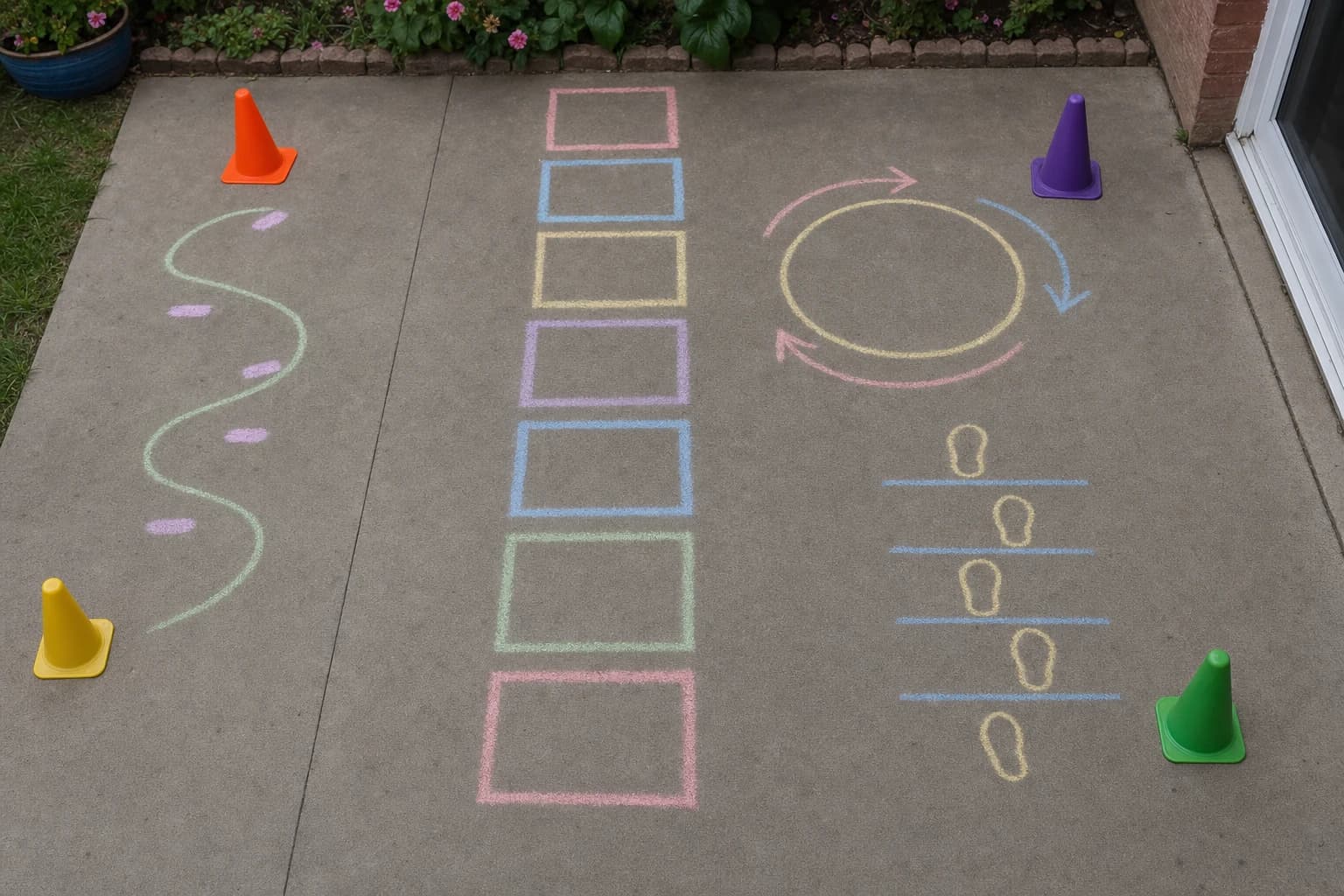
Draw a path of 10 to 15 chalk squares. Put one action in each square: hop three times, spin once, touch toes, tiptoe to the next square, balance for five seconds, jump the river, or stretch tall. This is one of the easiest active games for small yards because it works in a long strip as narrow as 3 feet.
For preschoolers, draw icons: feet for hopping, a star for jumping, a hand for high-fives, and a wavy line for slow walking. Avoid slick chalk dust on very smooth surfaces by sweeping lightly before play.
5. Foam Ball Wall Toss
If you have a safe wall or fence panel, mark three target zones with painter’s tape or chalk. Players stand 4 to 6 feet back and toss a foam ball underhand. Add movement by requiring a squat, clap, or quick side step after each catch. Use only a soft foam ball, and avoid throwing against windows, siding that dents easily, or shared fences where noise may bother neighbors.
6. Pool Noodle Limbo
Two people hold a pool noodle while each player walks, shuffles, or dances under it. Because the noodle is soft and light, it is better than a broom handle for close play. Start at shoulder height for the shortest child and lower it only if everyone is comfortable. Make it more active by adding a “freeze pose” after crossing.
7. Mini Ring Toss Relay
Place three cones or filled plastic bottles in a line, 3 to 8 feet from the throw line. Players toss one ring, jog back, and hand the next ring to a teammate. If the yard is too narrow for side-by-side teams, run it as a time challenge: how many rings can the group land in two minutes?
Space: 5 x 12 feet. Equipment: foam or rope rings, cones, bottles, or sturdy cups.
8. Balloon Keep-Up Zone
Mark a square about 6 by 6 feet and challenge players to keep a balloon in the air without stepping outside the line. For two players, require alternating touches. For a family version, use two balloons at once. This is gentle, quiet, and surprisingly active because players bend, reach, and shuffle in place.
Use close supervision with balloons around young children, and clean up broken pieces immediately.
9. Backyard Bowling
Set up six to ten empty plastic bottles as pins at the end of a 10- to 12-foot lane. Fill each bottle with a small amount of water if wind knocks them over too easily. Roll a soft ball from behind a chalk line. To add movement, players reset the pins after their own turn or do five jumping jacks after a spare.
10. Shadow Tag
On a sunny day, shadow tag needs no equipment and less contact than regular tag. The “tagger” steps on another player’s shadow instead of touching the person. Keep the area small and require walking, skipping, or slow-motion running. This works best when shadows are long enough to see clearly but not stretched across the entire yard.
If you like tag variations but have more room another day, 10 No-Equipment Tag Games for Elementary School Recess has broader ideas that can be adapted carefully.
11. Mini Soccer Gates
Use two pairs of cones as small goals, each 2 to 3 feet wide. Play one-on-one or two-on-two with a soft ball and a rule that shots must stay below knee height. In tight yards, skip goalies so no one dives into furniture or fencing. A good small-space rule is “three touches before shooting,” which rewards foot control instead of power.
12. Patio Pickleball Dinks
A regulation pickleball court is 20 by 44 feet, according to USA Pickleball, so most small backyards cannot host a real game. A dink-only version can still be fun in an 8-by-16-foot rectangle. Mark a low center line with chalk, string, or a pool noodle and use a foam ball or lightweight training ball. The goal is to tap the ball gently over the line, not smash it.
Best for: older kids, teens, and adults. Noise: medium, depending on paddles and surface.
13. Treasure Dash
Scatter 20 small objects around a defined area: toy coins, beanbags, plastic eggs, or colored blocks. Call out a category such as “find two red items” or “bring back one smooth object.” Players return items to a basket one at a time, which creates repeated movement without long sprints. For fairness, give each player a personal basket or assign colors.
14. Statue Dance Freeze
Use music if noise is acceptable, or clap a rhythm if you need a quieter game. Players dance, march, or move around a small zone until the leader stops the sound. Everyone freezes like a statue. Add a challenge: freeze on one foot, freeze low, freeze like an animal, or freeze with elbows and knees bent.
For very quiet family options when outdoor play is not practical, try Rainy-Day Family Games for a Small Living Room.
15. Cone Knockdown
Line up five to eight cones or plastic cups along a fence-safe edge. Players roll or gently toss a foam ball to knock them down. The active part comes from retrieving the ball, resetting cones, and changing positions. For older children, make the throw line 8 to 12 feet away; for younger children, start at 4 feet.
How to Make Small Backyard Games Feel More Active
- Use rounds of 2 to 5 minutes. Short rounds keep energy high and reduce waiting.
- Give every player a job. If someone is not throwing, they can reset pins, count points, call colors, or collect beanbags.
- Limit hard throws. In compact areas, rolling, underhand tossing, and foam equipment are better than overhand throws.
- Rotate movement styles. Switch between hopping, side-stepping, tiptoeing, crab walking, and balancing to make a small area feel bigger.
- Use team goals. Instead of eliminating players, challenge the group to land 20 beanbags, complete 12 laps, or keep a balloon up for 60 seconds.
Common Mistakes to Avoid
The biggest mistake is choosing a full-size lawn game and simply squeezing it into a small yard. Some games need distance to be safe and enjoyable. For example, traditional lawn games such as cornhole, bocce, and ladder toss often work better with more length than a small patio provides; this comparison of Cornhole vs Bocce Ball vs Ladder Toss can help if you are deciding what fits your space.
- Do not place goals near glass doors. Shift goals toward a fence or open corner and use a soft ball.
- Do not mix toddlers and older kids in speed games without rule changes. Give younger children shorter distances or separate turns.
- Do not ignore noise. Paddles, hard balls, and shouting can feel much louder in fenced yards and shared outdoor spaces.
- Do not keep score too seriously. In small spaces, close contact and repeated turns matter more than winning.
If your group includes a wide age range, it is worth reading Common Mistakes to Avoid When Running Outdoor Games for Mixed-Age Groups.
FAQ: Outdoor Games for Small Backyards
What is the best outdoor game for a very small patio?
Balloon Keep-Up Zone, Sidewalk Chalk Fitness Path, and Backyard Bowling are good choices because they can work in a 6-by-8-foot or narrow 3-by-12-foot area with soft equipment and limited running.
How much space do kids need for active backyard games?
Many active games can work in a clear 8-by-10-foot space if the rules avoid full-speed running. For games with balls, leave extra clearance around windows, stairs, furniture, and garden edges.
What games are best for a narrow side yard?
Choose linear games: Chalk Fitness Path, Mini Ring Toss Relay, Backyard Bowling, Beanbag Target Sprint, or Cone Knockdown. These use length more than width and keep players moving in one direction.
How can I keep small backyard games quieter?
Use foam balls, beanbags, balloons, chalk, and pool noodles. Avoid hard balls, plastic paddles on concrete, loud music, and games that require constant shouting.
Can adults play these games too?
Yes. Adults can make them more challenging by increasing distance, using non-dominant hands, adding balance tasks, or setting a time goal. Keep the same small-space safety rules in place.
Conclusion
The best small backyard games are not just smaller versions of big-field games. They are designed around short distances, soft equipment, clear boundaries, and movement that feels active without needing a full lawn. Start with a simple kit: cones, chalk, beanbags, a pool noodle, balloons, and a foam ball. With those supplies, a compact patio or narrow yard can support relay games, target challenges, balance paths, gentle ball games, and family backyard games that work for different ages.
If you are unsure where to begin, choose one quiet game, one relay-style game, and one no-equipment game. That gives you enough variety for a weekend afternoon without overcrowding the space.