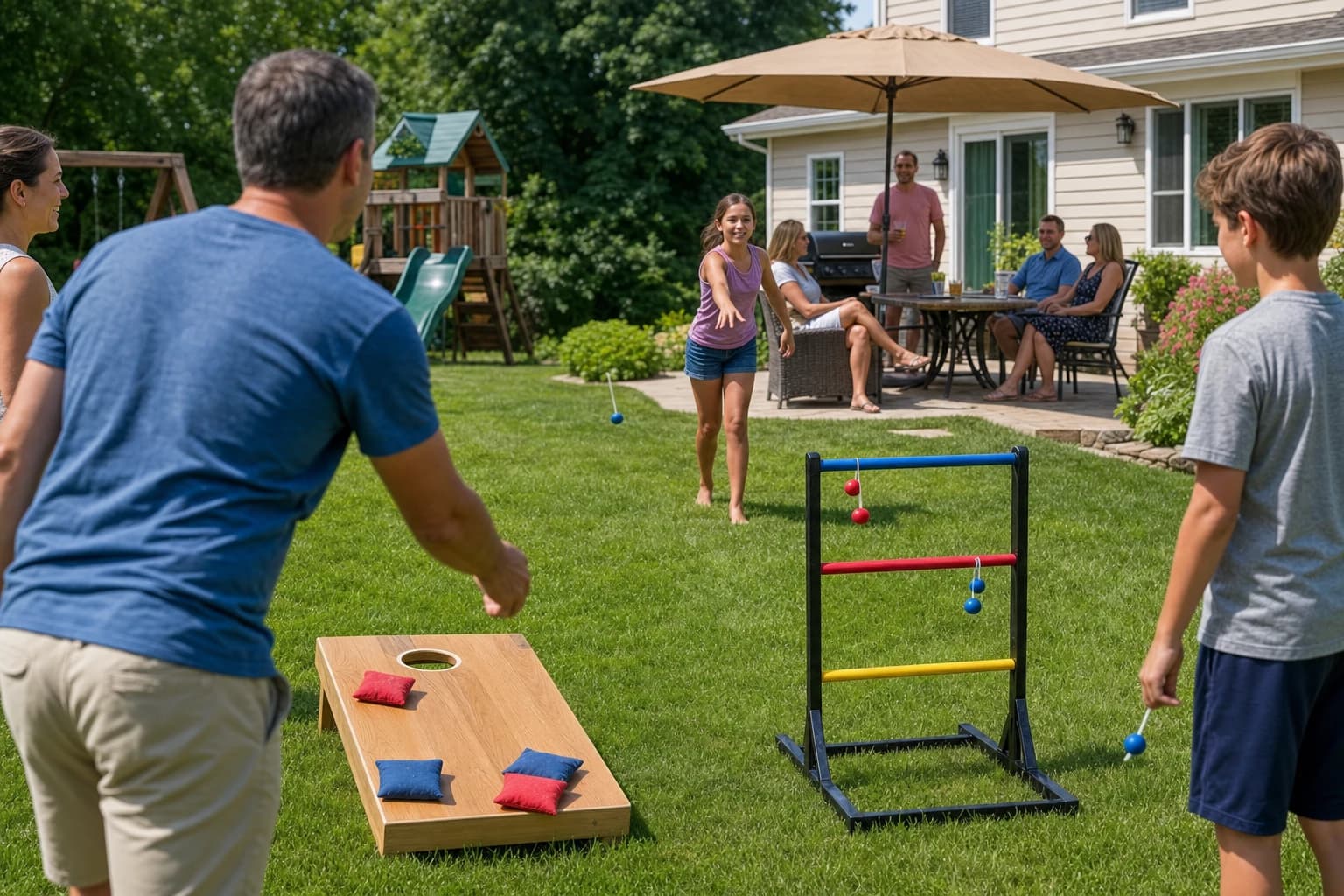
Choosing between cornhole and ladder toss sounds simple until you picture the actual gathering: kids running through the yard, grandparents looking for a comfortable game, limited grass space, and guests who may not want to learn complicated rules. This cornhole vs ladder toss guide compares the two games in the ways that matter most before you buy, pack, or host.
Both are strong outdoor party games. Cornhole is steadier, more familiar, and easier to adapt for mixed ages. Ladder toss is lighter to carry, quicker to reset, and often feels more playful in a tight backyard. The better choice depends on who is playing, how much space you have, and how much supervision the group needs.
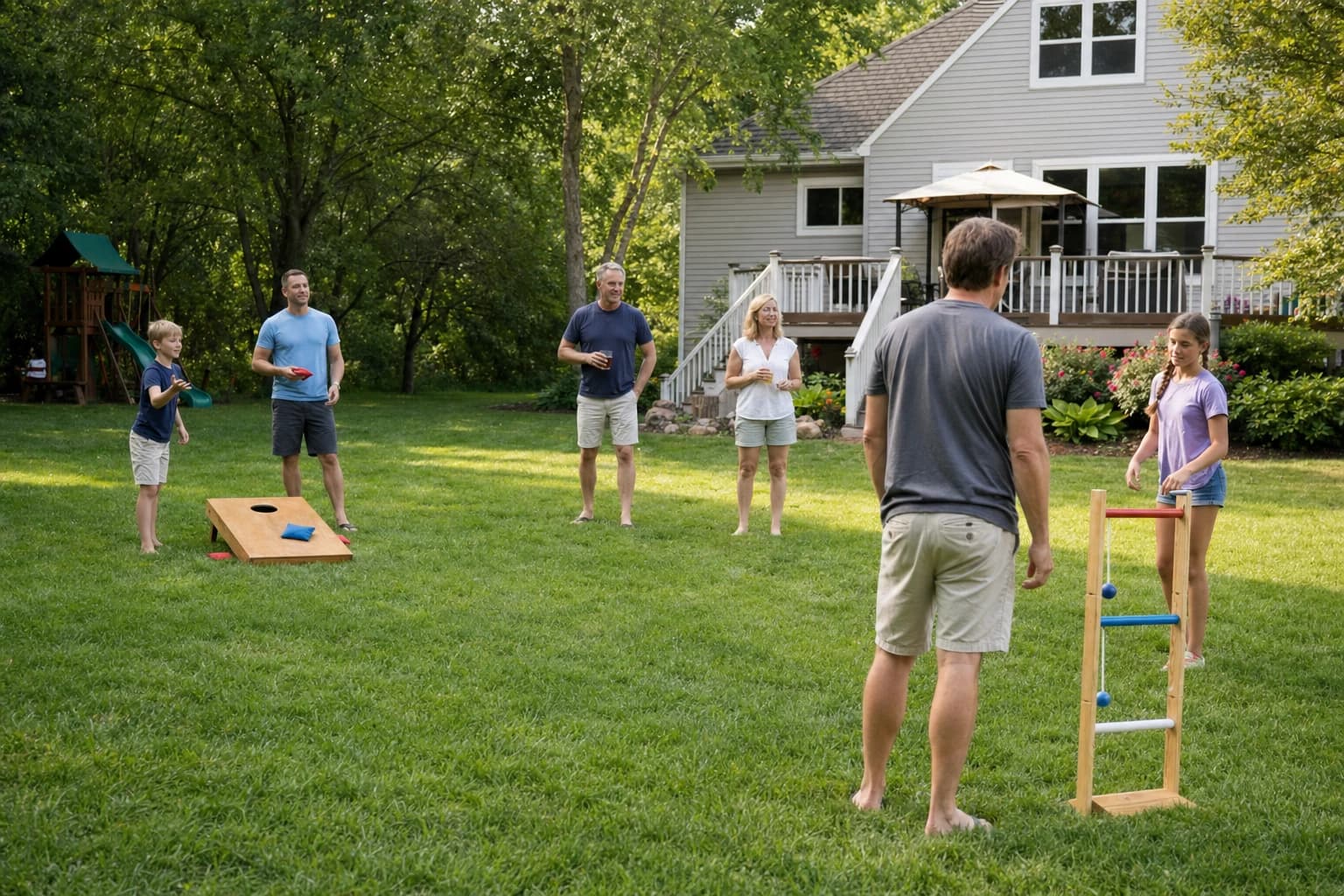
Quick Answer: Cornhole Is More Universal, Ladder Toss Is More Compact
If you need one game for a broad family gathering, cornhole is usually the safer all-around pick. It has a simple target, familiar scoring, and works well for kids, adults, and older players when you shorten the throwing distance. It also feels more like a repeatable tournament game, which helps at reunions, cookouts, and neighborhood parties.
Ladder toss is better when portability and storage matter most. A ladder toss set is usually easier to carry than full-size wooden cornhole boards, and the game can fit into a smaller activity zone. It is also satisfying for players who enjoy a little unpredictability because the bolas can bounce, wrap, or miss in funny ways.
For a mixed-age family event where you want fewer safety concerns and fewer arguments about the equipment, choose cornhole. For a casual picnic, camping trip, or smaller patio gathering with supervised players, ladder toss can be the more convenient choice.
Cornhole vs Ladder Toss: Side-by-Side Comparison
| Criteria | Cornhole | Ladder Toss | Better Choice |
|---|---|---|---|
| Basic object | Toss bean bags onto a sloped board or into the hole. | Toss connected balls, called bolas, so they wrap around ladder rungs. | Tie |
| Typical full setup distance | Regulation play places boards 27 feet apart from front edge to front edge, according to the American Cornhole Organization rules. | Many home sets use about 15 feet between ladders, but rules vary by manufacturer. | Ladder toss for small yards |
| Learning curve | Very easy: aim, toss, count 1 or 3 points in common scoring. | Easy, but the bola motion takes a few throws to control. | Cornhole |
| Setup time | Fast, but boards are heavier and need a flat lane. | Fast if the ladder frame snaps together easily; slower if pieces are loose. | Tie |
| Kid safety | Soft bags are easier to manage around younger children. | Bolas swing and can hit faces, fingers, or nearby guests if thrown carelessly. | Cornhole |
| Portability | Portable if you buy lightweight or foldable boards, but bulky. | Usually packs smaller and lighter. | Ladder toss |
| Older adult accessibility | Strong option because players can stand still and toss underhand. | Also usable, but retrieving bolas from low rungs or tangled cords may be annoying. | Cornhole |
| Replay value | High because skill improvement is obvious and team play is natural. | High for casual play, but some groups may treat it as a shorter novelty game. | Cornhole |
| Storage | Requires wall, garage, shed, or under-bed space for boards. | Disassembles into a bag or small box in many sets. | Ladder toss |
For official cornhole dimensions and distance, the American Cornhole Organization rules are a useful reference. Family gatherings do not need to follow tournament distances, but knowing the standard helps you adjust fairly.
How Each Game Works
Cornhole basics
Cornhole uses two raised boards with a round hole near the top. Players throw fabric bags filled with corn, resin pellets, or similar filling. A common scoring system gives 3 points for a bag in the hole and 1 point for a bag that lands and stays on the board. Many casual groups use cancellation scoring, where only the difference between the two sides’ points counts each round.
The major advantage is that the goal is visually obvious. Even a first-time player understands the assignment after one throw. Younger children can stand closer, teens can play from a longer distance, and adults can play competitively without changing the equipment.
Ladder toss basics
Ladder toss uses a freestanding frame with three horizontal rungs. Players throw bolas, which are two balls connected by a cord. The goal is to wrap a bola around a rung. Many home rule sets score 3 points for the top rung, 2 for the middle, and 1 for the bottom, although scoring can vary.
The appeal is the toss itself. A bola can wrap cleanly, bounce away, swing around a rung, or knock another bola loose. That makes ladder toss funny and social, especially for groups that care more about laughs than precision.
Setup Time and Space: Which Fits Your Yard Better?
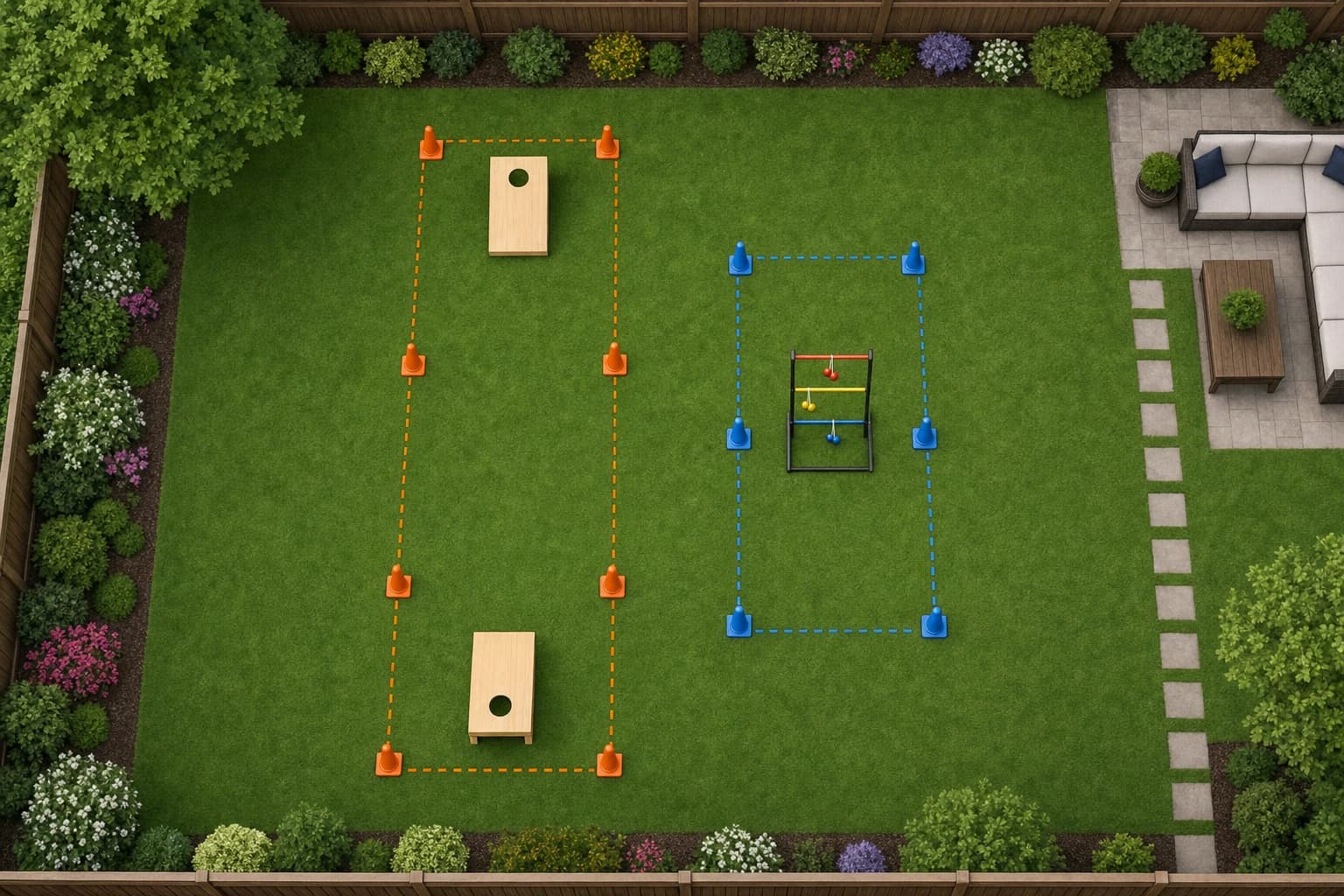
Both games can be set up in minutes, but they ask for different kinds of space. Cornhole needs a longer, straighter lane. A regulation layout is too long for many small backyards once you include safe space behind the boards, chairs, coolers, and people walking through. For a family party, you can shorten the distance to 12, 15, 18, or 21 feet depending on the players.
Ladder toss usually needs less length, which helps on patios, campsites, and narrow side yards. However, it needs a clear area around the throwing line because the bola swings during the throw. If a child steps across the line at the wrong moment, the cord and balls can hit them. A smaller footprint does not mean zero supervision.
For a backyard game comparison, use this practical spacing rule: add at least 3 feet of buffer on both sides of the throwing lane and keep spectators behind the throwers, not beside the targets. Cornhole boards can be placed along a fence line or driveway. Ladder toss works well in a corner of the yard if you can keep people from crossing between the thrower and ladder.
Best Setup for a Mixed-Age Family Gathering
- For cornhole: Start children at 10 to 12 feet, casual adults at 15 to 21 feet, and experienced players farther back if space allows.
- For ladder toss: Use the distance listed with your set, then shorten it for kids or anyone who has trouble throwing accurately.
- For both games: Mark a throw line with painter’s tape, cones, a rope, or a flat garden stake so players do not creep forward every round.
- For parties: Put the game away from the grill, driveway, pool edge, and food table.
Learning Curve: Which Game Is Easier for New Players?
Cornhole is easier to learn because the equipment behaves predictably. The bag flies, lands, slides, or stops. New players can adjust their next throw quickly: aim higher, throw softer, or stand closer. This makes cornhole especially good for groups that include shy players, kids who dislike losing immediately, or adults who want to join without a long explanation.
Ladder toss is still simple, but the throwing motion is less familiar. Some players throw the bola too hard. Others release it like a baseball and send it spinning sideways. A smooth underhand toss usually works best, but it may take several rounds before the game feels controlled.
If your event has many first-time guests rotating in and out, cornhole has the edge. If your group likes silly attempts and does not mind a few wild throws, ladder toss can be more entertaining early on.
Safety for Kids: The Biggest Practical Difference
For families with toddlers, preschoolers, or children who wander into play areas, cornhole is usually the safer choice. The bags are soft, the target stays on the ground, and the throw is easy to stop when someone crosses the lane. You still need basic supervision, especially because boards can be tripping hazards, but the equipment is comparatively forgiving.
Ladder toss requires more active supervision. Bolas are designed to swing, and that movement is the whole point of the game. A child standing too close can be hit by the balls or cord. Younger children may also be tempted to spin bolas around like toys, which can create problems in a crowded yard.
That does not mean ladder toss is unsafe for every family. It means the host should set firmer boundaries. Use a clear throw line, allow only one thrower at a time, and make a simple rule that nobody retrieves bolas until all throws are finished. If the gathering includes very young children, keep ladder toss in a supervised zone rather than the center of the party.
Common Safety Mistakes to Avoid
- Letting kids retrieve bags or bolas while another player is still throwing.
- Setting the game lane across a natural walking path to the food, bathroom, or seating area.
- Using full adult distances for children, which encourages hard, uncontrolled throws.
- Placing ladder toss too close to windows, parked cars, pets, or the grill.
- Leaving equipment out after dark where guests can trip over boards, ladders, or cords.
For more hosting pitfalls with mixed ages, see Common Mistakes to Avoid When Running Outdoor Games for Mixed-Age Groups.
Portability and Storage: Which Is Easier to Bring Along?
Ladder toss wins for portability in most cases. Many sets break down into short tubes, rungs, and bolas that fit into a carrying bag. That makes it convenient for camping, tailgating, beach days where permitted, and family picnics. If you need to carry chairs, a cooler, and party supplies too, the smaller packed size matters.
Cornhole boards are bulkier. Full-size boards can be awkward for one person to carry, especially if they are made of solid wood. Some sets fold or latch together, and smaller recreational boards are easier to move, but they still take up more storage space than a typical ladder toss set.
The tradeoff is durability and feel. A sturdy cornhole board can last for years if stored dry and handled well. Lightweight ladder toss frames can be convenient, but some inexpensive plastic sets may wobble, tip, or come apart if players throw hard. Before buying either game, check how it stores, not just how it looks in product photos.
Accessibility for Older Adults and Different Ability Levels
For older adults, cornhole is often more comfortable. Players can stand in one place, throw underhand, and use a shorter distance without changing the rules. The bags are easy to grip and do not require a whipping motion. If bending is difficult, another player can retrieve bags between rounds.
Ladder toss can also work well, but the bolas may require a slightly more coordinated release. Some players find the cords awkward to hold. Retrieving bolas from the ground, untangling cords, or removing them from lower rungs can be less comfortable for people with limited mobility or hand strength.
If your gathering includes grandparents and young children together, cornhole is usually the best lawn game for family gatherings because everyone can play the same game from different distances. You can make teams with one child and one adult, let players rotate after each round, and keep the pace slow enough for conversation.
If you are planning a broader lineup of intergenerational games, you may also like Team Party Games for Family Game Night With Mixed Ages or Best Board Games for Grandparents and Kids to Play Together at Family Game Night.
Replay Value: Which Game Holds Attention Longer?
Cornhole tends to have stronger long-term replay value because small improvements are easy to feel. Players learn how to throw a flatter bag, aim for the front of the board, block the hole, or slide a bag in. Even casual players begin to develop a personal style.
It also supports easy formats: singles, doubles, kids versus adults, family teams, bracket play, or a simple “winner stays” rotation. For a longer cookout, cornhole can run in the background for hours without much hosting effort.
Ladder toss has strong short-session appeal. It is fun, visual, and quick. Guests often laugh at unexpected wraps and near misses. However, some groups may lose interest sooner if the frame is wobbly, the scoring feels random, or the same skilled player wins repeatedly. It works best as one of several party stations rather than the only activity for a long afternoon.
Which Should You Buy? Use These Scenarios
Choose cornhole if...
- You are hosting a large family cookout, reunion, graduation party, or neighborhood gathering.
- You want a game that works for kids, teens, adults, and older adults with only distance adjustments.
- You have a driveway, lawn, or open area long enough for a comfortable throwing lane.
- You like team play, simple scoring, and tournament-style replay.
- You want fewer concerns about swinging equipment around younger children.
Choose ladder toss if...
- You need a compact game for a campsite, patio, small yard, or picnic area.
- You want something light enough to carry with other party supplies.
- Your players are old enough to follow throw-line and retrieval rules.
- You prefer a casual game with funny bounces and less serious competition.
- You have limited storage space at home.
Choose both if...
If budget and space allow, cornhole and ladder toss pair well because they attract different players. Cornhole can be the main game, while ladder toss acts as a side station. This is especially useful when you have more than 8 people and do not want guests waiting too long for turns. For a wider three-game comparison, see Cornhole vs Bocce Ball vs Ladder Toss: Best Lawn Game for Your Family.
Simple Hosting Plan for Either Game
A good game can still flop if the setup is confusing. Use this quick plan to make either cornhole or ladder toss run smoothly at a family event.
- Pick the lane first. Choose a flat area away from doors, food, pets, grills, and the main walking route. Do this before guests arrive.
- Set a beginner distance. Do not start with the hardest distance. Begin closer, then move back only if players want more challenge.
- Explain the game in 30 seconds. Show one throw, explain the scoring, and start. Long rule speeches make casual players drift away.
- Use teams for mixed ages. Pair a child with an adult or a beginner with a confident player. This keeps the game social instead of intimidating.
- Rotate after a short score. Play to 11 or 15 at parties instead of insisting on longer games. More guests get turns and the energy stays up.
- Pause for safety. Make it normal to stop throwing whenever someone walks through the lane.
For children’s parties in tighter spaces, Outdoor Games for a 10-Person Kids Birthday Party in a Small Backyard has more ideas that do not require a large lawn.
Buying Checklist Before You Decide
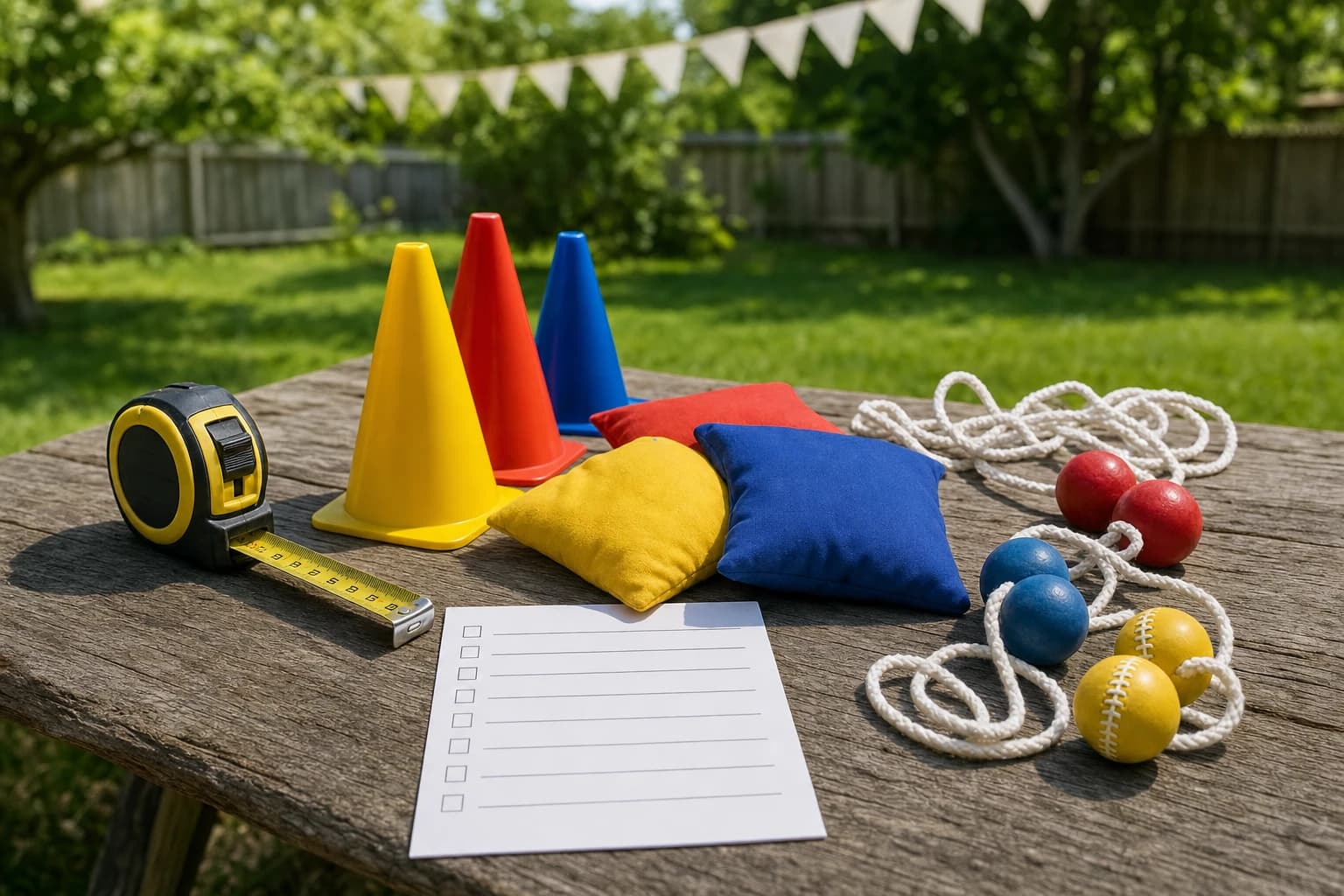
- Measure your space: Do not guess. Measure the usable throwing lane and leave room for people behind the line.
- Check packed size: If the game must fit in a car trunk or apartment closet, storage may decide the winner.
- Look at the players: Younger kids and older adults usually favor cornhole; mobile adults and teens may enjoy ladder toss more.
- Check build quality: Cornhole boards should sit flat without bouncing excessively. Ladder toss frames should stand stable and not twist easily.
- Plan supervision: If you cannot watch the play area, choose the game with fewer moving hazards.
Verdict: Cornhole or Ladder Toss?
For most family gatherings, cornhole is the better single purchase. It is easier to teach, easier to adapt, safer around young children, and more likely to hold attention over repeated events. It also feels fair to a wider range of players because the target and scoring are straightforward.
Ladder toss is still a great outdoor game when portability, compact storage, and quick casual play matter more than broad accessibility. It is a smart choice for camping trips, small patios, or gatherings where the players are old enough to handle bolas safely.
The simplest way to decide is this: if your biggest concern is including everyone, choose cornhole. If your biggest concern is carrying and storing the game, choose ladder toss.
FAQ: Cornhole vs Ladder Toss
Is cornhole or ladder toss better for young kids?
Cornhole is usually better for young kids because the bags are soft and the throwing motion is simple. Shorten the distance and use clear rules about waiting until all throws are finished before retrieving bags.
Which game needs less space?
Ladder toss usually needs less length than cornhole, especially compared with regulation cornhole spacing. However, it still needs a safe buffer around the thrower because bolas swing during the throw.
Which game is easier to take to a picnic or campsite?
Ladder toss is typically easier to transport because many sets disassemble into a small carrying bag. Cornhole can travel too, but boards are bulkier and may require more trunk space.
Can older adults play both games?
Yes. Many older adults can enjoy both, especially with shorter distances and a relaxed pace. Cornhole often has the advantage because the bags are easier to hold and the throwing motion is more controlled.
Do you need official rules for a family gathering?
No. Official rules are useful as a reference, but family games should be adjusted for space, age, and ability. Shorter distances, smaller teams, and lower winning scores usually make parties more enjoyable.
Which game is better if guests will play all afternoon?
Cornhole usually has better all-afternoon replay value because it supports teams, scorekeeping, and gradual skill improvement. Ladder toss is excellent as a lighter side game or quick rotation station.
Final Takeaway
In the cornhole vs ladder toss decision, there is no bad choice, but there is a better fit. Cornhole is the dependable crowd-pleaser for mixed ages and repeat play. Ladder toss is the portable, compact option for casual groups with enough supervision. Match the game to your space and guests, and your family gathering will run more smoothly from the first throw.