Choosing between cornhole, bocce ball, and ladder toss is mostly a question of space, ages, and how much structure your family wants. All three are familiar backyard games, but they do not feel the same in real use. Cornhole is simple and social, bocce is strategic and slower, and ladder toss is compact with a little more swing-and-aim chaos.
This guide compares cornhole vs bocce ball vs ladder toss for families by setup time, portability, learning curve, storage, durability, age range, and where each game works best: the backyard, park, picnic, campsite, or family reunion.
Quick Answer: Which Lawn Game Is Best for Most Families?
For most families, cornhole is the safest all-around choice. It is easy to explain, works for mixed ages, has a clear target, and does not require a perfectly flat or manicured lawn. It is also one of the easiest games for guests to join mid-party without stopping the flow.
Bocce ball is best if your family has a larger yard, likes slower strategy, and includes adults or older kids who enjoy judging distance and placement. It is less ideal for small, crowded yards because the balls roll well beyond the starting area if players throw too hard.
Ladder toss is best if you want a lightweight game for picnics, camping, tailgates, or a smaller backyard. It has a tiny footprint compared with bocce, but younger kids may need reminders not to swing the bolas near people.
- Best overall family pick: Cornhole
- Best for small yards and travel: Ladder toss
- Best for strategy and relaxed adult play: Bocce ball
- Best for parks and open grass: Bocce ball or cornhole
- Best for younger children: Cornhole with a shortened distance
At-a-Glance Comparison Table
| Criteria | Cornhole | Bocce Ball | Ladder Toss |
|---|---|---|---|
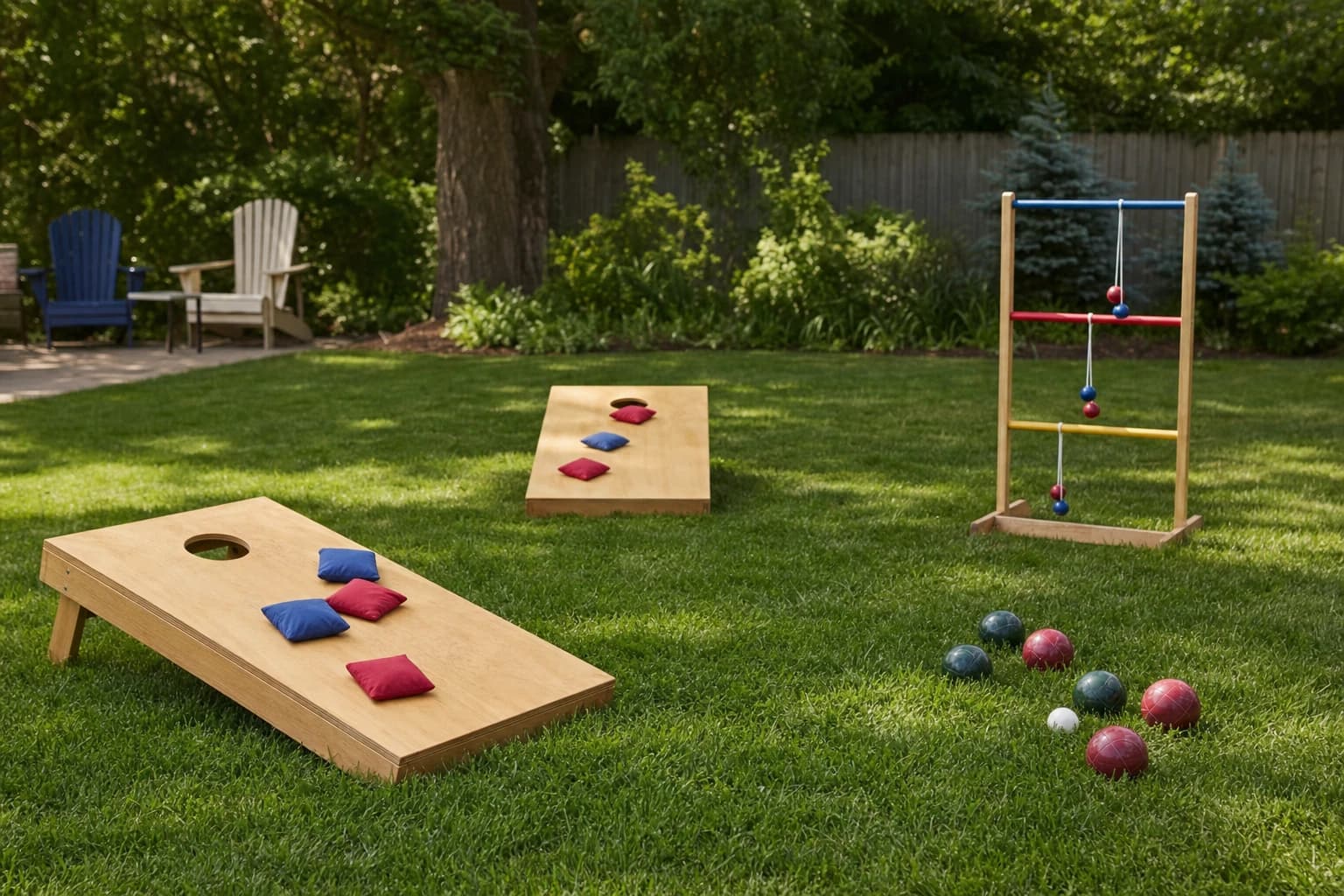
| Typical equipment | 2 angled boards and 8 bean bags | 8 larger balls and 1 smaller pallino/jack | 2 ladder targets and 6 bolas |
| Space needed for family play | Moderate; can shorten distance for kids | Largest; needs open rolling space | Small to moderate; easiest to fit in compact areas |
| Setup time | 2 to 5 minutes | 1 to 3 minutes, if the play area is already clear | 3 to 8 minutes, depending on assembly |
| Learning curve | Very easy | Easy rules, more skill in touch and strategy | Easy concept, slightly trickier throw |
| Best age fit | Young kids through adults with distance changes | Older kids, teens, and adults; younger kids can play gently | School-age kids, teens, and adults with supervision |
| Portability | Good if boards are lightweight or folding; bulky if full-size wood | Good in one bag, but heavy | Very good if the frame breaks down |
| Storage | Needs wall or garage space for boards | Compact but dense and heavy | Compact if disassembled |
| Durability | Wood boards can last years if kept dry | Very durable balls; storage bag may wear first | Plastic frames are convenient but can crack; wood frames are sturdier |
| Best setting | Backyard parties, tailgates, reunions | Parks, large yards, beaches with firm sand, relaxed gatherings | Picnics, camping, small yards, casual competitions |
| Main drawback | Boards take storage space | Needs room and can feel slow for impatient players | Bolas can be misused if kids swing them around |
Game 1: Cornhole
Cornhole is the most familiar of the three for many families: players toss bean bags toward a raised board with a hole near the top. A bag on the board scores, and a bag through the hole scores more. Official-style boards are 2 feet wide by 4 feet long, and competitive rules place the front edges of the boards 27 feet apart. Those dimensions are described by the American Cornhole League in its rules and regulations at iplaycornhole.com/rules-regulations.
For family backyard games, you do not need to use competition distance. Shortening the throw is often what makes cornhole work well for kids, grandparents, and mixed-skill groups. A young child can stand 6 to 10 feet away. Older kids can move to 12 to 18 feet. Adults can use the full distance if the yard allows it.
Why families like cornhole
Cornhole is easy to join. A guest can watch one round and understand enough to play. It also supports conversation because players take turns rather than sprinting, chasing, or constantly resetting equipment. That makes it a strong fit for barbecues, birthdays, holiday weekends, and relaxed afternoons when some people want to play and others want to watch.
It is also forgiving. The bag does not roll far, and a missed throw usually lands near the board. That matters in yards with fences, flower beds, patio furniture, or pets nearby. Compared with bocce, there is less chasing after equipment. Compared with ladder toss, the throwing motion is more natural for younger children.
Where cornhole struggles
The biggest drawback is storage. Two full-size wooden boards are not tiny, even if they are not difficult to move. Folding-leg sets help, and lighter boards are easier to carry to parks, but very lightweight boards may bounce more when bags land. If you live in an apartment or have limited garage space, cornhole may feel bulky.
Weather is another consideration. Fabric bags can absorb moisture, and wooden boards should not be left in rain. If you want a game that can sit in a deck box all season, bocce balls generally tolerate rough storage better than cornhole boards and bags.
Game 2: Bocce Ball
Bocce ball is a rolling and placement game. One small target ball, often called the pallino or jack, is thrown first. Players then roll or toss larger balls, trying to finish closer to the pallino than the other team. In casual play, you can use almost any flat patch of grass, dirt, or firm sand. More formal bocce uses a defined court, and official rule sets are available through organizations such as Special Olympics, which publishes bocce resources at resources.specialolympics.org.
Bocce has a different pace from cornhole. It is less about hitting a fixed target and more about reading distance, blocking an opponent, and deciding whether to roll gently or throw with more force. For families who enjoy a little strategy without complicated rules, that is a major advantage.
Why families like bocce
Bocce is excellent when you have open space and a group that enjoys watching the result develop over several throws. A round can swing as balls cluster around the pallino. One careful roll can beat several stronger throws. That makes it satisfying for players who may not be the most athletic but have patience and touch.
It also adapts well to parks and picnics. A bocce set usually stores in one case or bag. The tradeoff is weight: bocce balls are compact, but a full set can be noticeably heavy for a child to carry. Adults may find it easier to pack than cornhole because it is smaller, but it is not necessarily lighter.
Where bocce struggles
Bocce needs the most space of the three games. A small yard can work if players agree to roll gently and use a shorter distance, but cramped areas become frustrating. Balls can roll under cars, into landscaping, toward sidewalks, or into other picnic groups if the play area is not clear.
You also need to think about surface. Very bumpy grass can make bocce unpredictable. A slight slope is playable for casual families, but a strong slope can make every round feel unfair. Firm sand, short grass, or a smooth open field usually works better than thick uneven lawn.
Game 3: Ladder Toss
Ladder toss, also called ladder ball, uses two upright ladder-style targets and soft-ended rope bolas. Players throw the bolas so they wrap around one of the rungs. Many casual sets score the top, middle, and bottom rungs differently, though house rules vary by set.
The appeal is portability. Many ladder toss sets break down into short tubes or wooden rails and fit in a bag. For families choosing among the best lawn games for families, ladder toss is often the easiest one to bring to a campsite, picnic shelter, or small backyard.
Why families like ladder toss
Ladder toss has a fun visual payoff. A good throw wraps around the rung instead of simply landing near a target. This feels different from both cornhole and bocce, so it can be a nice change if your family already owns one of the other games.
It also uses less ground space. You need a clear throwing lane and room behind the targets, but you do not need a long rolling field. If your backyard has a patio, a small lawn strip, or limited flat grass, ladder toss may fit better than bocce.
Where ladder toss struggles
The same bolas that make ladder toss fun also require supervision. Younger children may be tempted to spin them like a toy. For family play, set a simple rule before starting: bolas stay in hands only when it is your turn, and no one stands near the target while someone is throwing.
Durability varies widely. Lightweight plastic sets are convenient and affordable, but the frames can shift, wobble, or crack if stepped on. Wood ladder toss sets are usually sturdier but heavier and less compact. If you expect frequent use by kids, a stable frame matters more than fancy colors.
Space Needed: Backyard, Park, Picnic, or Campsite
Space is the first filter because a great game in the wrong location becomes annoying fast.
- Small backyard or side yard: Ladder toss is usually easiest. Cornhole can work if you shorten the throwing distance. Bocce is possible only with gentle rolling and clear boundaries.
- Medium backyard: Cornhole is the strongest pick. Ladder toss also works well. Bocce can work if you have an open strip of grass without fragile landscaping nearby.
- Large yard or public park: Bocce becomes much more appealing. Cornhole is still excellent, especially if you want a central gathering spot.
- Picnic shelter or campsite: Ladder toss wins for portability. Cornhole is good if you can carry the boards easily. Bocce works if there is a safe open area away from tables and walking paths.
- Beach or firm sand: Bocce can be fun on packed sand, while cornhole boards may become awkward if the ground is uneven. Ladder toss depends on whether the frame stands securely.
If your outdoor area is busy with kids running around, consider games with predictable movement. Cornhole bags stop quickly. Bocce balls keep rolling. Ladder toss bolas stay near the target but can swing during the throw.
Learning Curve and Age Range
For mixed-age families, the best game is not always the one with the simplest rules. It is the one that lets everyone participate without constant correction.
Cornhole is easiest for young kids because the throw is similar to tossing a bean bag into a bucket. The main adaptation is distance. You can give children a front throwing line and adults a back throwing line. You can also remove cancellation scoring and simply count every point so the math is easier.
Bocce is simple to understand but requires more judgment. Younger children may throw too hard or forget whose ball is closest. It becomes more rewarding around the age when kids can slow down, aim, and accept that a gentle roll can beat a powerful toss.
Ladder toss is easy in theory but the throwing motion is less familiar. Some kids learn it quickly; others overspin or throw too high. It is best for school-age children who can follow safety rules and wait behind the throwing line.
Simple family rule adjustment
Use flexible throwing lines instead of one fixed distance. Let younger kids stand closer, adults farther back, and anyone with limited mobility choose a comfortable spot. The game will feel more welcoming, and the final score will matter less than keeping everyone involved.
Setup Time, Storage, and Portability
If a game is annoying to set up, families use it less. The practical winner depends on where you store it and how often you travel with it.
Fastest setup
Bocce has the fewest parts: open the case, choose a starting area, and play. Cornhole is almost as fast if the boards are already assembled. Ladder toss may take longer if the frame uses push-fit tubes that must be assembled each time.
Easiest to store
Bocce takes the least floor space but is heavy. Ladder toss can be very compact if it breaks down. Cornhole boards take the most room, especially if you do not have a garage wall, shed, or basement corner where the boards can stand upright.
Easiest to carry
Ladder toss is usually easiest for one adult to carry. Cornhole depends heavily on the set; compact and folding sets travel well, while full-size wood boards are bulky. Bocce is compact but dense, so it may be better for short walks from car to picnic table than long carries across a park.
Durability and Maintenance
Bocce balls are the most durable core equipment. They can scratch, but they are not usually harmed by normal grass play. The weak point is often the bag, zipper, or carrying handle.
Cornhole durability depends on board construction and storage. Solid wood or well-built plywood boards can last a long time if kept dry. Bags may eventually split, lose filling, or get dirty. If your family plays often, replacement bags are easier to store than replacement boards.
Ladder toss durability depends on the frame. Plastic tube sets are light and convenient, but they should not be used as climbing toys, leaned on, or left in extreme heat for long periods. Wood frames are sturdier but may need more storage space.
Safety note for family play
Keep all three games away from grills, driveways, windows, and crowded walkways. Bocce balls are hard and heavy, cornhole boards can trip people if placed near foot traffic, and ladder toss bolas should only be thrown when the area around the target is clear.
Best Use Cases by Family Situation
For families with young children
Choose cornhole first. Use a short distance, skip strict scoring, and let kids celebrate bags that land anywhere on the board. If you already have younger kids who enjoy rolling balls gently, bocce can work, but keep the play area small and clear.
For grandparents and kids playing together
Cornhole and bocce are both strong choices. Cornhole is better if standing in one place and taking short turns is preferred. Bocce is better if everyone is comfortable walking to the balls after each round. For indoor alternatives when the weather turns bad, see Best Board Games for Grandparents and Kids to Play Together at Family Game Night.
For large family reunions
Cornhole is the best tournament game because it is easy to bracket, easy to watch, and simple for late arrivals to understand. Ladder toss also works well as a second station. Bocce can be wonderful, but it needs more open space and clearer boundaries.
For picnics and camping
Ladder toss is the most convenient if your set packs into a small bag. Bocce is good if you are close to the car and have open ground. Cornhole is fun but only practical if carrying boards is not a problem.
For active kids who need to burn energy
None of these three is as active as running games. If the goal is movement rather than turn-taking, add a second activity such as Kickball Rules for Kids: Recess, Picnic, and Backyard Games or Capture the Flag Rules for Parks, Camps, and School Fields.
How to Choose: A Simple Family Decision Checklist
If you are still deciding, use these questions in order. They narrow the choice faster than comparing every feature equally.
- How much open space do you have? Choose ladder toss for limited space, cornhole for moderate space, and bocce for the most open grass.
- Who will play most often? Choose cornhole for mixed ages, bocce for patient older kids and adults, and ladder toss for school-age kids who can follow throwing rules.
- Will you travel with it? Choose ladder toss if portability is the top priority. Choose bocce if you can handle the weight. Choose cornhole if you have a folding or lightweight set.
- Do you want a social party game or a strategy game? Cornhole is more social and casual. Bocce is more tactical. Ladder toss sits in between.
- Where will it be stored? If garage wall space is limited, avoid full-size cornhole boards unless they fold or hang neatly.
A practical two-game combination for many households is cornhole plus ladder toss. Cornhole covers family parties and mixed ages; ladder toss covers travel and smaller spaces. If you have a large yard or live near a park, cornhole plus bocce gives you one fixed-target game and one rolling strategy game.
Common Mistakes When Buying Lawn Games
- Buying only for adults. A full-distance setup may be fine for adults, but younger kids will enjoy the game more with shorter lines and lighter expectations.
- Ignoring storage before purchase. Measure where the game will live. Cornhole boards are the most likely to become clutter if there is no planned storage spot.
- Choosing the cheapest plastic ladder toss set for heavy use. Lightweight sets are fine for occasional picnics, but frequent family play benefits from a more stable frame.
- Playing bocce too close to people or property. Bocce balls can travel farther than expected, especially on hard ground or a slope.
- Using strict scoring too soon. For first-time players, play a few casual rounds before introducing cancellation scoring, tournament brackets, or house-rule penalties.
If you are planning a larger afternoon of activities, it can help to mix lawn games with scavenger hunts or relay games so kids are not waiting too long for turns. For more outdoor planning ideas, see How to Set Up a Backyard Scavenger Hunt for Kids Ages 5–10.
FAQ: Cornhole vs Bocce Ball vs Ladder Toss
Which is easiest for beginners: cornhole, bocce, or ladder toss?
Cornhole is usually easiest for beginners because the target is obvious and the tossing motion is familiar. Bocce has simple rules but more judgment. Ladder toss is easy to understand, but the bola throw can take a few turns to learn.
Which lawn game needs the least space?
Ladder toss usually needs the least space, especially if you shorten the throwing distance for casual play. Cornhole needs a clear lane between two boards. Bocce needs the most open space because the balls roll beyond the throw area.
Is bocce ball good for kids?
Bocce can be good for kids who can roll gently and pay attention to where others are standing. For very young children, cornhole is often easier because the bags are softer and do not roll away.
Can you play cornhole in a small backyard?
Yes. You can shorten the distance and use a kid-friendly or casual throwing line. You do not need official spacing for family play unless you specifically want competition-style practice.
Which game is best for a picnic?
Ladder toss is often the most picnic-friendly because many sets break down and carry easily. Bocce is compact but heavy. Cornhole is fun at picnics if you can comfortably transport the boards.
Which game is most durable?
Bocce balls are generally the most durable individual pieces. Cornhole boards can be very durable if stored dry. Ladder toss durability depends on whether the frame is lightweight plastic or sturdier wood.
Conclusion: The Best Lawn Game Depends on Your Family’s Space and Style
In the choice of cornhole vs bocce ball vs ladder toss, there is no single winner for every household. Cornhole is the best overall pick for most families because it is easy, social, and adaptable for different ages. Bocce ball is the best choice for larger yards, parks, and families who enjoy a slower strategy game. Ladder toss is the best compact travel option for picnics, camping, and smaller play areas.
If you want one reliable game for backyard gatherings, start with cornhole. If you have open grass and enjoy relaxed competition, consider bocce. If you need something portable and quick to pack, ladder toss may be the game that actually gets used most often.