
Recess can fall apart quickly when there are not enough balls, cones, jump ropes, or organized stations for everyone. The good news is that many of the best elementary playground games need no equipment at all. This guide lists 10 no equipment tag games that are easy to explain, active, and flexible enough for small or large groups.
Each game includes simple rules, suggested ages, ideal group size, space needs, and supervision notes. Use them for recess, after-school programs, field days, camp warmups, or any time children need outdoor games without equipment that still feel fresh.
Quick setup for no-equipment tag games
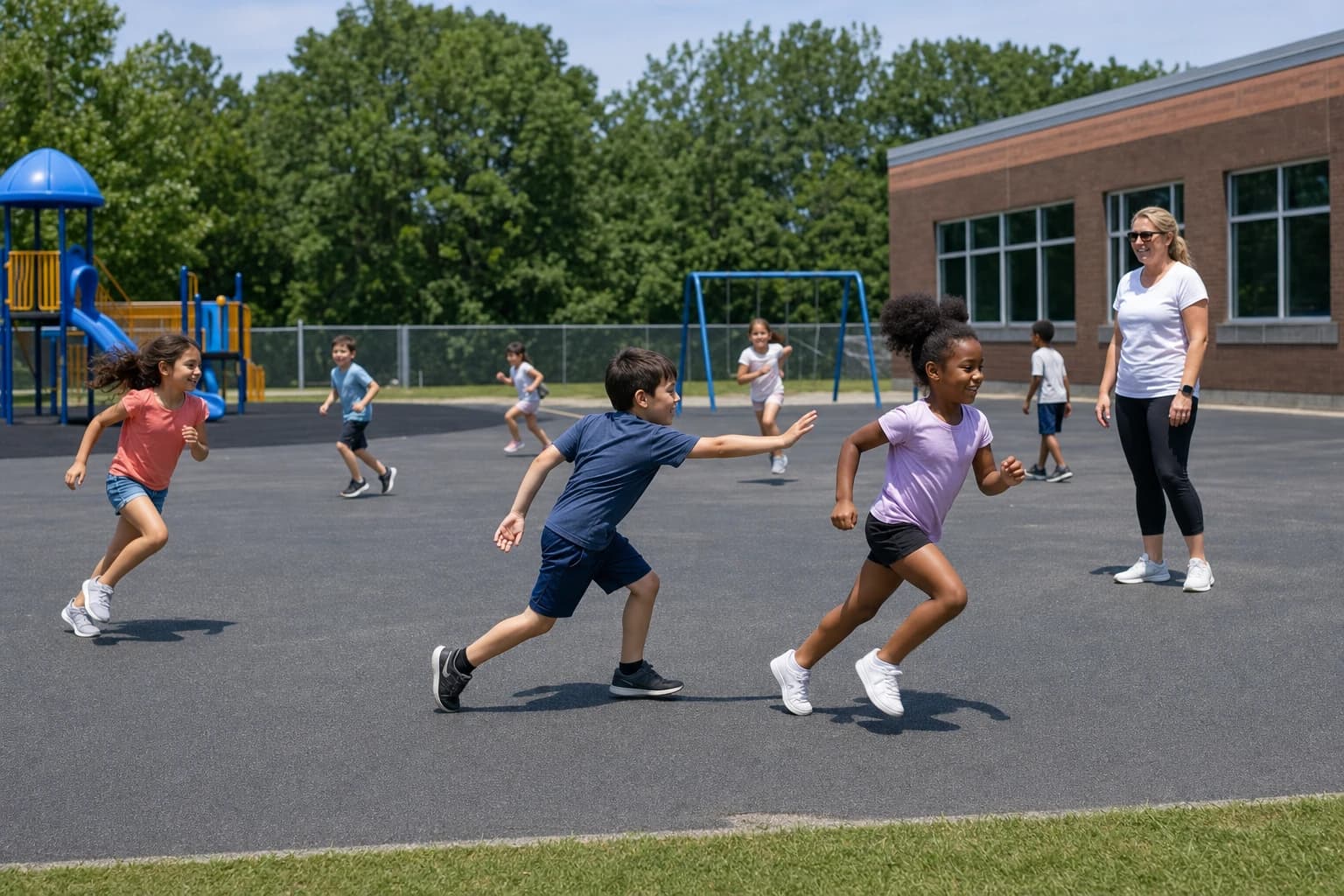
Even the simplest playground tag variations run better with a short setup. Before choosing a game, decide how much space is available and how long the round should last. For most elementary groups, rounds of 3 to 6 minutes are long enough to feel exciting without leaving slower runners stuck on the sidelines or exhausted.
Tag is a vigorous activity for many children, but it should be one part of a balanced recess, not a forced fitness test. The CDC recommends children and adolescents get 60 minutes or more of physical activity each day, and games like tag can contribute to that when children have safe, welcoming ways to join in.
Before the first round
- Set boundaries: Use existing lines, fences, walls, trees, or the edge of a blacktop. Avoid areas near swings, slides, doors, or parking lots.
- Define a tag: A tag is a light touch on the shoulder, upper arm, or back. No pushing, grabbing, tripping, or clothing pulls.
- Choose a restart signal: Use a whistle, hand clap pattern, or call such as “freeze and look.”
- Pick safe zones carefully: If you use a home base, limit it to 5 seconds so it does not stop the game.
- Rotate roles: Change taggers often so the same children are not always chasing or being chased.
Best tag game at a glance
| Game | Best ages | Ideal group size | Space needed | Why it works |
|---|---|---|---|---|
| Freeze Tag | 6-10 | 8-30 | Medium to large | Easy rules and lots of teamwork |
| Tunnel Tag | 6-9 | 8-24 | Medium | Fun rescue rule without equipment |
| Shadow Tag | 7-11 | 4-20 | Open sunny space | No-touch option for calmer play |
| Chain Tag | 7-11 | 10-30 | Large | Builds cooperation among taggers |
| Blob Tag | 7-11 | 10-30 | Large | Funny group movement challenge |
| Everyone’s It | 8-11 | 6-20 | Medium | No waiting for a turn as tagger |
| Octopus Tag | 6-11 | 10-40 | Long rectangle | Great for large recess groups |
| Partner Tag | 7-11 | 8-28 | Medium | Adds quick strategy and switching |
| Line Tag | 6-10 | 6-20 | Painted court lines | Uses the playground surface as the game board |
| Color Call Tag | 6-9 | 8-25 | Medium | Good for younger children who like simple prompts |
10 no-equipment tag games for elementary recess
1. Freeze Tag
Best for: ages 6-10, groups of 8-30. Space: an open blacktop or grass area about the size of a small basketball court for 15 children.
Choose 1 or 2 taggers. When a player is tagged, they freeze with feet planted and arms out. A free player can unfreeze them by giving a gentle high-five or tapping their hand. The round ends when everyone is frozen or after a set time, such as 4 minutes.
Helpful variation: Use “three rescues only” for older children. Each player may rescue others three times, then must focus on escaping. This keeps the game from becoming endless.
Safety note: Frozen players should stand tall rather than crouch or lie down. This prevents running children from tripping over them.
2. Tunnel Tag
Best for: ages 6-9, groups of 8-24. Space: medium open area with good visibility.
Tunnel tag is a playful version of freeze tag. When tagged, a player freezes with feet apart to make a “tunnel.” Another player can unfreeze them by crawling or carefully moving through the tunnel.
For school recess, adjust the rescue rule to fit the surface. On grass, crawling may be fine. On blacktop, use a safer standing version: the rescuer walks between the frozen player’s feet without touching them, or gives a low five through the “tunnel.”
Supervision tip: Do not use tunnel tag on wet grass, gravel, or crowded areas. If children are bumping into each other during rescues, switch to regular freeze tag.
3. Shadow Tag
Best for: ages 7-11, groups of 4-20. Space: open sunny area without too many shade patches.
Shadow tag is one of the best no-touch tag games for kids. Instead of touching a person, the tagger steps on another player’s shadow. If the tagger clearly touches the shadow with a foot, that player becomes the new tagger or joins the tagger team.
This game works best in the morning or afternoon when shadows are easier to see. At noon, shadows may be too short. Before playing, remind children not to stomp near feet; they are aiming for the shadow, not the person.
Adaptation: For younger players, allow the tagger to say the player’s name and “shadow tag” when stepping on the shadow, so there is less arguing about close calls.

4. Chain Tag
Best for: ages 7-11, groups of 10-30. Space: large field or open blacktop.
Start with 1 tagger. Each tagged player joins hands or links elbows with the tagger to form a chain. Only the two players at the ends of the chain can tag. As the chain grows, the group must communicate and move together.
For safety, keep chains short. When a chain reaches 4 players, split it into two chains of 2. This prevents whipping, pulling, and accidental falls. The game ends when all players have joined a chain or when the timer runs out.
Good rule to add: If a chain breaks, it must stop moving, reconnect, and count “one, two, three” before chasing again.
5. Blob Tag
Best for: ages 7-11, groups of 10-30. Space: large open area.
Blob tag is similar to chain tag but sillier. Tagged players join the “blob,” usually by holding hands in a group. The blob moves together and tries to tag free players. For a safer recess version, allow the blob to split into groups of 3 or 4 once it becomes too large.
This game is especially good for children who enjoy teamwork more than pure speed. A slower blob can still catch fast runners by planning, spreading out, and using the boundary lines.
Safety note: Make it clear that the blob walks or jogs. No dragging another child to reach a runner.
6. Everyone’s It
Best for: ages 8-11, groups of 6-20. Space: medium open area.
In Everyone’s It, every player is both a tagger and a runner. When someone is tagged, they take a knee or stand outside the boundary for 10 seconds, then rejoin. If two players tag each other at the same time, both step out for the short reset.
This variation is fast and exciting, but it needs clear honesty rules. Encourage children to call their own tags and accept close calls without arguing. Keep rounds short: 2 or 3 minutes is usually enough.
Best use: This is better for older elementary students who can handle quick decisions and personal responsibility.
7. Octopus Tag
Best for: ages 6-11, groups of 10-40. Space: long rectangle, such as a field lane or basketball court.
One or two players stand in the middle as octopuses. The rest line up at one end. When the octopuses call “go,” runners try to cross to the opposite side without being tagged. Tagged players become “seaweed”: they stand where tagged and keep one foot planted. Seaweed can tag runners with their hands but cannot move from the spot.
The game continues with runners crossing back and forth until only a few remain. Restart before the middle becomes too crowded.
Why it is useful: Octopus tag gives large groups a clear direction, so children are not sprinting randomly in every direction.
8. Partner Tag
Best for: ages 7-11, groups of 8-28. Space: medium open area.
Players pair up and stand scattered around the play area, linking elbows or standing shoulder to shoulder. Choose one runner and one chaser. The chaser tries to tag the runner. The runner can become safe by linking onto any pair. When that happens, the person on the opposite side of the pair pops off and becomes the new runner.
This game is excellent for teaching quick awareness, but it takes a demonstration. Walk through three examples before starting at full speed.
Simpler version: Instead of linking elbows, pairs stand side by side with hands at their sides. The runner stands next to a pair, and the outside person leaves.
9. Line Tag
Best for: ages 6-10, groups of 6-20. Space: a blacktop with painted court lines.
Players may only move along painted lines. Basketball, four square, hopscotch, and court markings become the game board. Choose 1 or 2 taggers. If a player steps off a line, they do 5 jumping jacks at the side and then rejoin, or they become the new tagger.
Line tag is useful when only part of the playground is available because the lines naturally limit the space. It also slows the game slightly, which can help younger children or mixed-age groups.
Safety note: Do not play line tag on icy, wet, or sandy blacktop. Sharp turns on slippery lines can lead to falls.
10. Color Call Tag
Best for: ages 6-9, groups of 8-25. Space: medium area with clear boundaries.
One tagger stands in the middle. The other players quietly choose a color in their mind. The tagger calls out a color, such as “blue.” Anyone who picked blue must run from one side of the area to the other while the tagger tries to tag them. Tagged players become taggers or wait one round before rejoining, depending on group size.
This game adds anticipation without needing cards or cones. It also gives children brief rest moments between runs.
Variation: Use categories instead of colors: animals, fruits, favorite seasons, or months of the year.
Safety and supervision notes that actually help
Tag is simple, but it still needs active supervision. The U.S. Consumer Product Safety Commission’s Public Playground Safety Handbook emphasizes that playground areas should be inspected and maintained with attention to surfacing, layout, and hazards. For tag games, that means checking for loose gravel, wet spots, broken glass, uneven ground, and traffic patterns before children start running.
- Keep tag away from equipment: Do not allow chasing under swings, at the bottom of slides, or through climbing structures.
- Use touch rules every time: A tag is not a shove. Say this before play, not after a fall.
- Change games before frustration builds: If arguing starts, reset with a simpler variation such as freeze tag or octopus tag.
- Offer lower-speed roles: Some children enjoy being seaweed in octopus tag, a rescuer in freeze tag, or a boundary judge for one round.
- Avoid permanent elimination: Recess games no equipment should keep children moving. Use short waits, rescue rules, or quick restarts.
If the weather sends everyone inside, you may want quieter options such as Indoor Games for 8-Year-Olds With No Equipment or Quiet Indoor Games for Preschoolers on Rainy Days. For bigger mixed groups outside of school, Large Group Party Games for 20 to 50 People That Keep Everyone Playing has more no-elimination ideas.
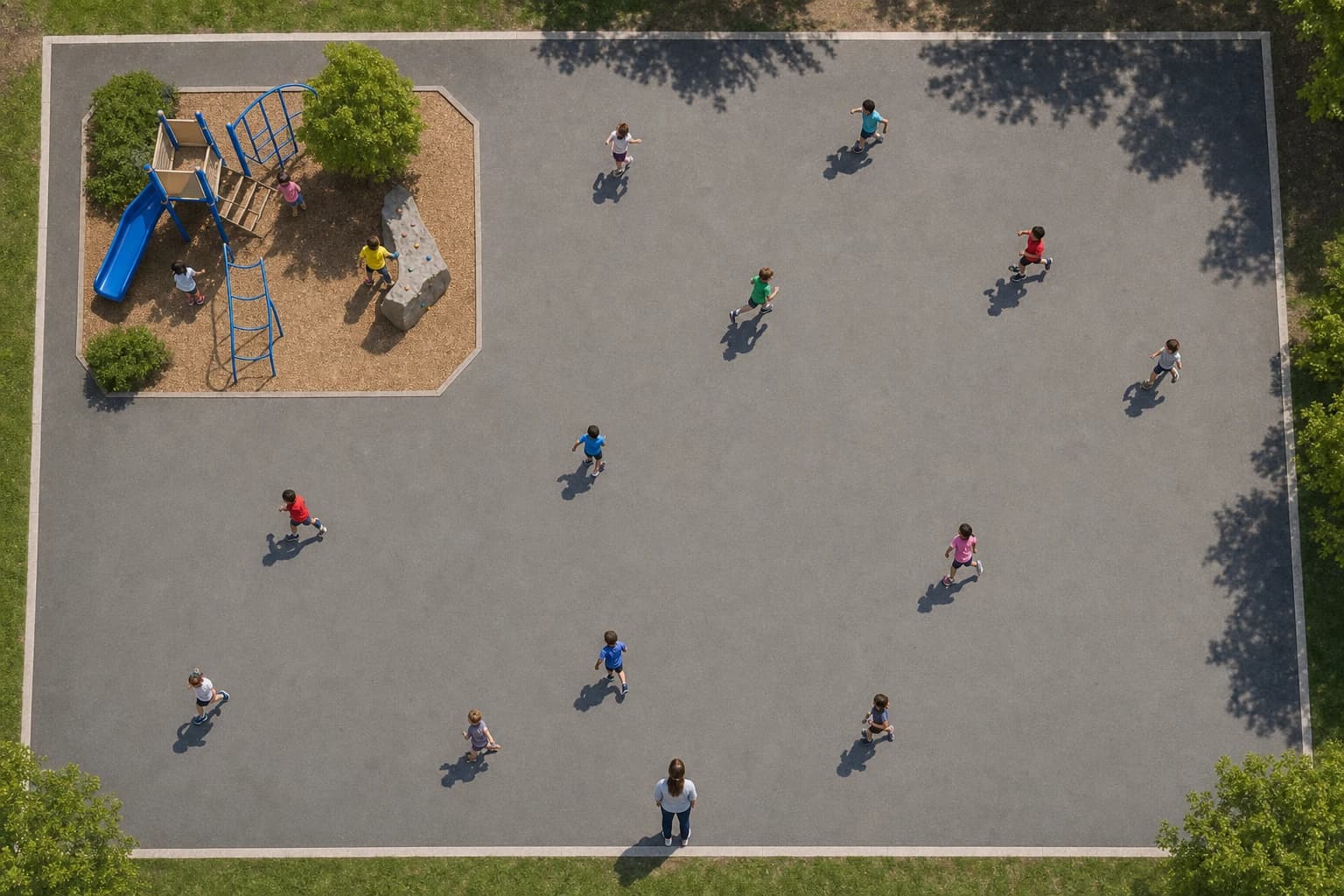
How to choose the right tag variation
For younger elementary students, choose games with one clear action: freeze, cross the line, or run when your color is called. Freeze tag, octopus tag, and color call tag are usually easier than Everyone’s It or partner tag.
For older students, add strategy. Chain tag, blob tag, and partner tag require communication and quick choices. These games can also reduce the advantage of the fastest runner because teamwork matters.
For very large groups, avoid games where everyone runs in different directions at full speed. Octopus tag and freeze tag are easier to supervise because the play pattern is more predictable. For small groups, shadow tag, line tag, and Everyone’s It keep the game lively without needing many players.
For birthday parties or indoor backup plans, you can pair these playground ideas with structured activities from 25 Indoor Birthday Party Games for Kids Ages 6–10.
FAQ
What are the easiest no equipment tag games for first and second grade?
Freeze tag, octopus tag, and color call tag are usually the easiest. They have simple goals, obvious boundaries, and quick restarts when children are tagged.
How many taggers should a recess game have?
For 8-15 children, start with 1 tagger. For 16-30 children, use 2 or 3 taggers. If runners are never getting caught, add a tagger; if the game ends too quickly, reduce the number.
What is a good tag rule to prevent rough play?
Define a legal tag as a light touch on the shoulder, upper arm, or back. Make pushing, grabbing clothing, blocking with the body, and tagging the head against the rules.
Which tag game works best for a very large playground group?
Octopus tag is often the easiest large-group option because everyone moves from one side to the other at the same time. It is easier to watch than a game where 40 children scatter in every direction.
How long should a round of tag last at recess?
Most rounds work well at 3 to 6 minutes. Short rounds help rotate taggers, reduce arguments, and give children natural water or breathing breaks.
Conclusion
No equipment tag games are popular for a reason: they are quick to start, easy to adapt, and active enough for a short recess period. The key is choosing the right variation for the group. Use freeze tag or color call tag for younger children, octopus tag for large groups, shadow tag for a no-touch option, and chain or partner tag when older students are ready for more strategy.
Before each round, set boundaries, explain safe tagging, and choose a clear restart signal. Those small steps turn familiar tag games for kids into smoother, safer, and more inclusive recess games.