Screen-free games that actually work in the car
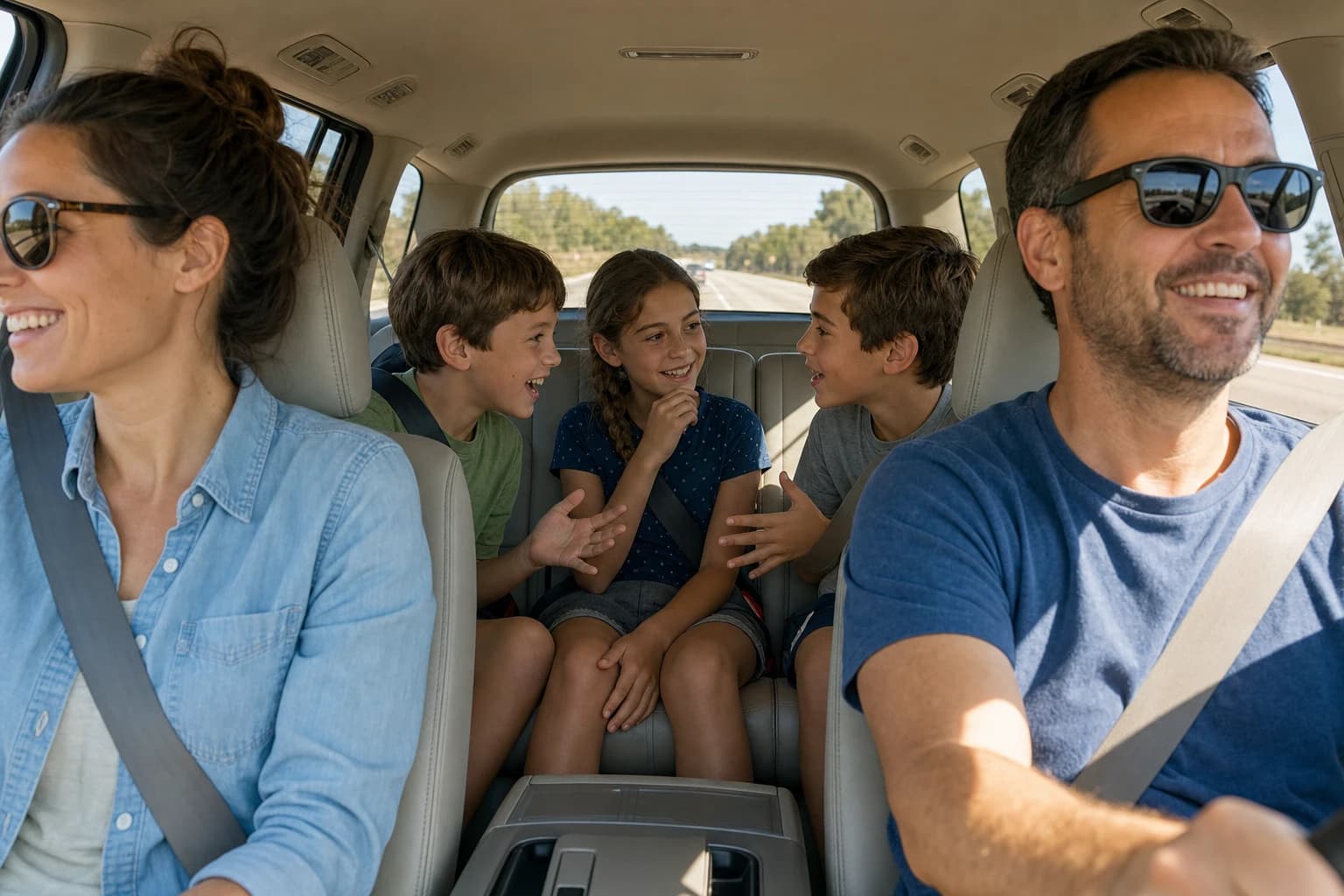
Long drives can make even patient kids restless, especially when everyone is seat-belted, snacks are limited, and there is nothing new to look at. The best no equipment family games for car rides do not need cards, pencils, apps, or anyone turning around in their seat. They use listening, memory, observation, storytelling, and simple wordplay.
This guide focuses on car ride games for kids 6 to 12 that are easy to explain, fair for mixed ages, and safe for the person driving. You will find quiet options, cooperative versions, and practical rules that help prevent arguments before they start.
First rule: keep the driver out of complicated play
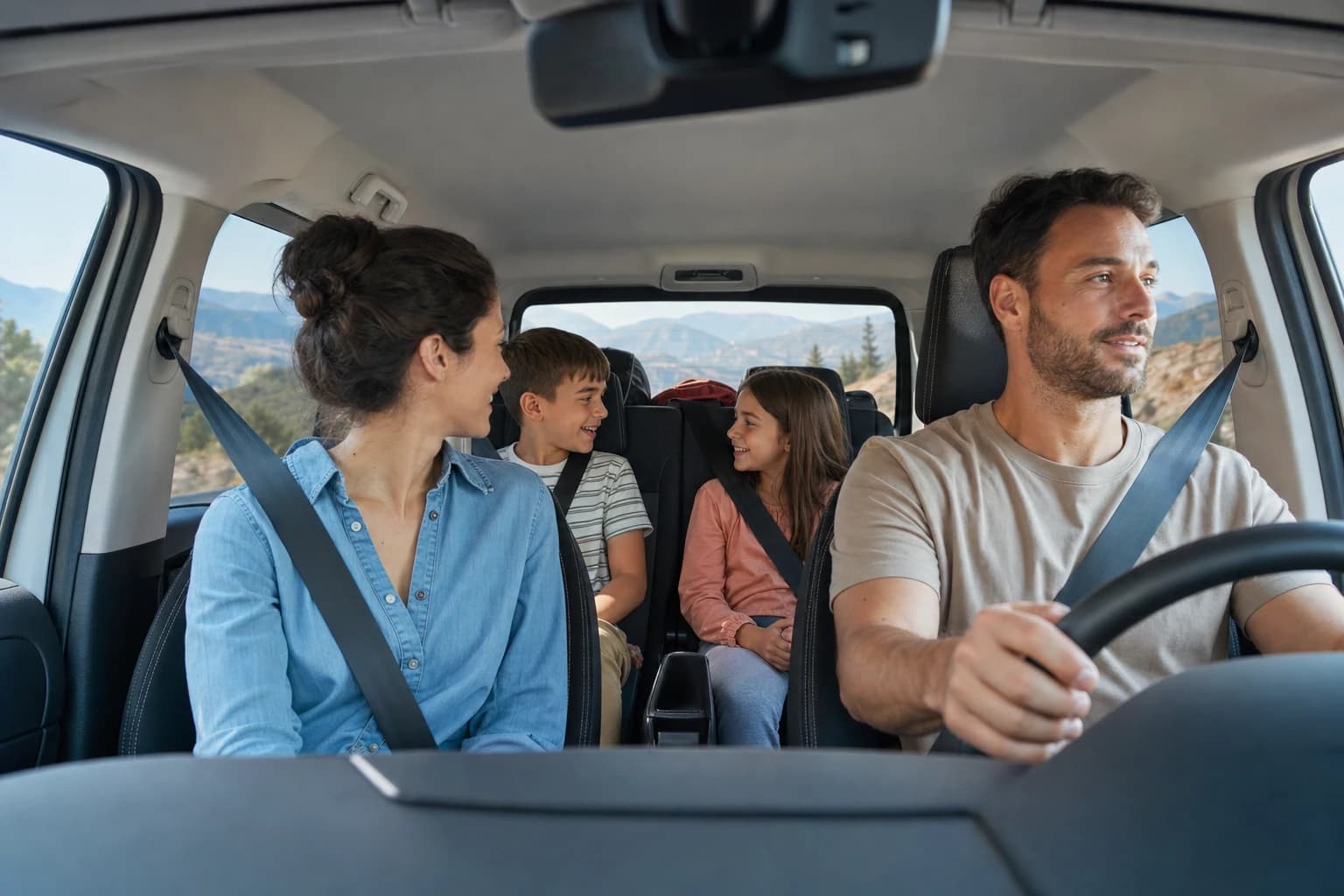
For car games, safety matters more than clever rules. The driver should not be the scorekeeper, judge, timer, or main storyteller. If a game requires reading signs, searching for small details, or remembering several answers, assign that role to a passenger.
The National Highway Traffic Safety Administration warns that distracted driving includes any activity that diverts attention from driving, including visual, manual, or cognitive distractions. You can read its guidance at NHTSA.gov. For family road trip games without supplies, the safest approach is simple: the driver may listen or answer only when it is easy, but should never be pressured to play.
Car game house rule: passengers run the game, the driver gets a free pass, and everyone stays buckled.
Quick setup before the first game
Even verbal games for long car rides go better with a few ground rules. Spend one minute setting expectations before the first round.
Materials
- Nothing required: no paper, pencils, cards, apps, dice, or toys.
- Optional only: a passenger can use a phone timer, but counting out loud works just as well.
Simple setup steps
- Choose a game leader. Pick one passenger, not the driver. Rotate the leader every 10 to 15 minutes so one child does not control the whole ride.
- Use short rounds. For ages 6 to 8, keep rounds to about 3 minutes. For ages 9 to 12, 5 to 8 minutes is usually enough before switching.
- Decide if the game is competitive or cooperative. If siblings are tired, choose a group goal instead of individual winners.
- Set a challenge rule. Each player gets one polite challenge per round. After that, the leader decides and everyone moves on.
- Add a quiet signal. If an adult says, ‘quiet round,’ players whisper, point, or give one-word answers until normal voices are okay again.
If your family also likes no-supply games at home, you may enjoy these indoor games for 8-year-olds with no equipment for small spaces after the trip.
Best no-equipment car games at a glance
| Game | Best ages | Noise level | Driver role | Best for |
|---|---|---|---|---|
| Alphabet Road Hunt | 6 to 12 | Low to medium | Optional listener only | Looking out windows without arguing |
| Fortunately, Unfortunately | 7 to 12 | Medium | No role needed | Storytelling and laughs |
| 20 Questions: Family Edition | 6 to 12 | Low | Can skip turns | Quiet stretches and night drives |
| One-Word Movie | 8 to 12 | Low | No role needed | Creative older kids |
| Category Countdown | 6 to 12 | Medium | No role needed | Fast rounds at restlessness points |
| Team Memory Chain | 6 to 10 | Medium | Optional listener only | Cooperative play |
| Would You Rather: Road Trip Rules | 6 to 12 | Low | Can answer if safe | Calming arguments |
12 no-equipment family games for car rides
1. Alphabet Road Hunt
Players look for the letters A through Z in order on road signs, license plates, billboards, storefronts, or truck logos. The first player says where they found A, then everyone searches for B. For a cooperative version, the whole car works together to finish the alphabet before the next fuel stop.
Make it fair: For younger kids, allow any visible word. For older kids, allow only the first letter of a word. Skip Q, X, and Z after 3 minutes each if the game is dragging.
2. Fortunately, Unfortunately
One person starts a story with a simple sentence: ‘We found a tiny dragon at the rest stop.’ The next player begins with ‘Fortunately’ and adds a good twist. The next begins with ‘Unfortunately’ and adds a problem. Keep alternating.
Example: ‘Fortunately, the dragon knew the way to the hotel.’ ‘Unfortunately, it only gave directions in rhymes.’ This game works well because no one needs to win. End after two full rounds around the car.
3. 20 Questions: Family Edition
One player thinks of a person, place, animal, food, or object. Everyone else asks yes-or-no questions. The group gets 20 total questions, then one final guess. For ages 6 to 8, use broad categories such as animal or food. For ages 9 to 12, allow book characters, landmarks, sports, or science topics.
Quiet version: The answerer can reply only with ‘yes,’ ‘no,’ or ‘sometimes.’ It is one of the easiest travel games for families when people are tired.
4. Category Countdown
Pick a category, then each player names one item that fits. Try animals, pizza toppings, things that are blue, school supplies, countries, superheroes, or things you might find in a kitchen. The round ends when someone repeats an answer or cannot think of one within 5 seconds.
Cooperative version: Set a group target of 25 answers. If the car reaches 25 without a repeat, everyone wins.
5. Team Memory Chain
The first player says, ‘I packed a suitcase with…’ and names one item. The next player repeats that item and adds another. Continue around the car, building the list. To make the theme more fun, change the container: a spaceship, beach bag, haunted backpack, zoo cart, or picnic basket.
Age adjustment: Kids 6 to 8 can use any item. Kids 9 to 12 can follow a rule, such as every item must start with the next letter of the alphabet.
6. Would You Rather: Road Trip Rules
Players ask gentle choice questions: ‘Would you rather have pancakes for dinner or pizza for breakfast?’ After each answer, the player gives one sentence explaining why. Keep questions silly, not embarrassing. Avoid questions that target one person or cause teasing.
Argument-proof rule: No one is allowed to say, ‘That is wrong.’ The only follow-up is, ‘Why did you choose that?’
7. One-Word Movie
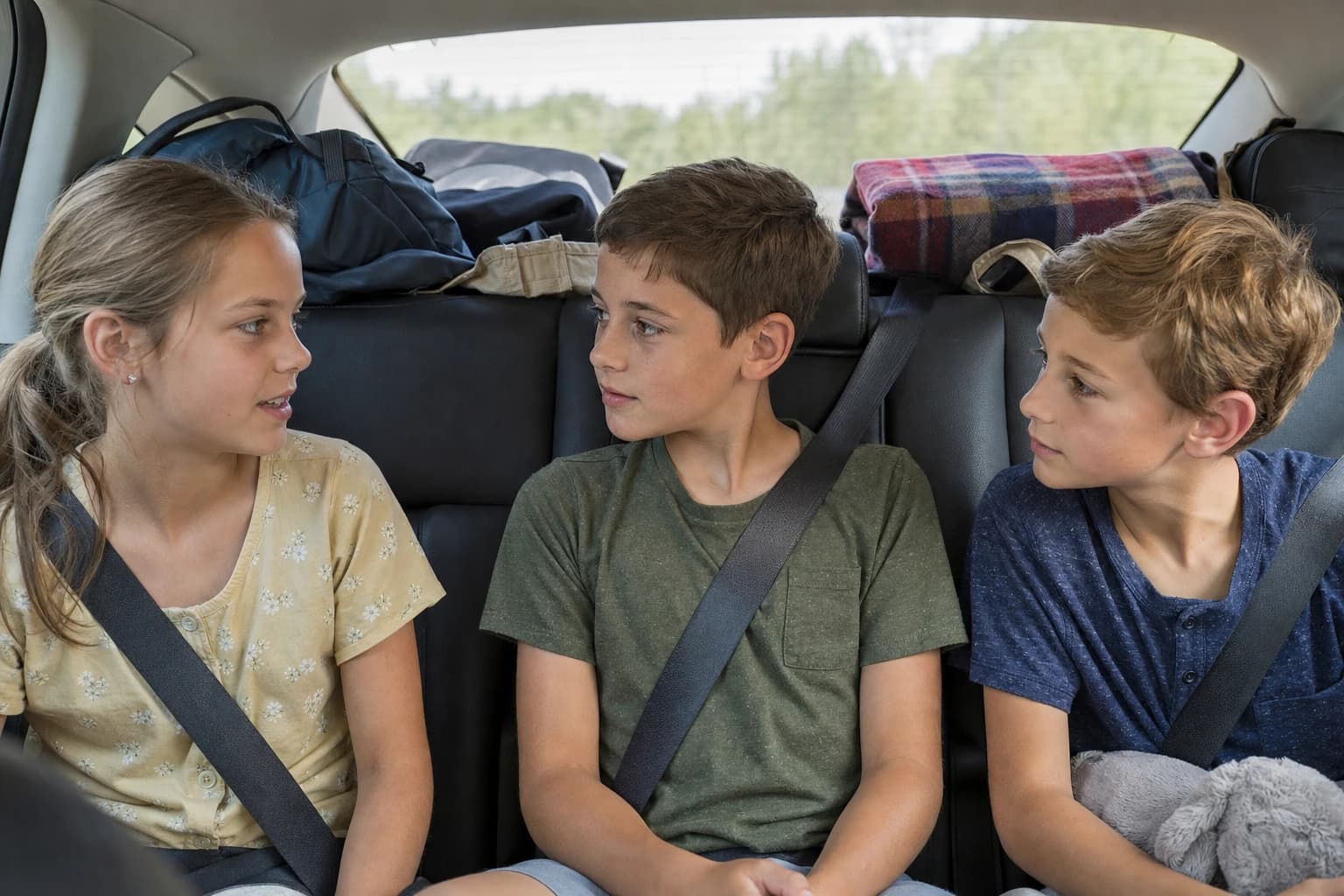
The group creates an imaginary movie one word at a time. Player one says one word, player two adds one word, and so on until the sentence becomes a scene. For example: ‘The purple hamster drove carefully through space.’ After 10 to 15 words, someone says ‘scene,’ and the next player starts a new sentence.
Best for: Older kids who enjoy being funny. If younger kids get frustrated, allow two-word turns.
8. Rhyme Relay
Choose a simple word such as cat, tree, road, light, or snack. Players take turns saying real rhyming words. For a harder version, allow phrases: ‘flat hat,’ ‘blue shoe,’ or ‘night light.’ Stop the round when the group reaches 10 rhymes or gets stuck.
Quiet version: Use whisper rhymes. This is helpful in traffic, near bedtime, or when an adult needs a break from high-energy play.
9. Guess the Soundtrack
One player hums a short part of a familiar song, show theme, or nursery tune. Others guess. Keep humming short: 5 to 7 seconds is enough. If the song is not guessed after 3 tries, the hummer gives a clue such as ‘animated movie’ or ‘holiday song.’
Driver note: This can become loud quickly. Use it during open highway stretches when passengers can play without bothering the driver.
10. The License Plate Story
Use the letters on a nearby license plate to make a sentence. If the plate includes BRT, a child might say, ‘Bears race turtles.’ If it includes MKS, another might say, ‘Monkeys knit sweaters.’ Do not ask the driver to locate plates; passengers use whatever they can safely see from their own seats.
Variation: Instead of a sentence, make a business name, superhero name, or restaurant name from the letters.
11. Two Clues and a Guess
One player thinks of something and gives two clues. For example: ‘It is cold. You eat it with a spoon.’ Other players guess: ice cream. If no one gets it, the player adds one more clue. This is easier than 20 Questions and better for younger kids because they do not have to plan many yes-or-no answers.
Age adjustment: For older kids, clues must be indirect: ‘It disappears faster in July’ instead of ‘It is cold.’
12. Kindness Points
This is a cooperative game for the final tiring hour. The family earns a point whenever someone notices a helpful or patient action: sharing space, using a calm voice, letting someone else choose the next game, or saying thank you. No one loses points. Try to reach 10 before the next stop.
Why it works: It shifts attention from complaints to behavior kids can control. Keep it light and do not turn it into a lecture.
How to scale games for ages 6 to 12
A six-year-old and a twelve-year-old can play together, but not always under the same difficulty. The easiest fix is to give different players different versions of the same rule.
- For ages 6 to 8: Allow extra thinking time, broad categories, clues, and help from a sibling.
- For ages 9 to 10: Add a timer, alphabet order, or a no-repeat rule.
- For ages 11 to 12: Add strategy, indirect clues, themed rounds, or leadership roles.
- For mixed ages: Let younger kids answer first, or put one older child and one younger child on a team.
The goal is not to make every round perfectly equal. The goal is to keep everyone included without making older kids feel the game is too babyish. For more small-space, low-movement ideas, see indoor games for 10 people in a small room.
Quiet versions for traffic, headaches, and tired parents
Not every part of a long drive can handle noisy games. Use these quiet formats when adults need concentration or kids are winding down.
- Whisper round: Everyone speaks at whisper level for 5 minutes.
- One-word answers: Good for 20 Questions, Would You Rather, and Two Clues and a Guess.
- Point-and-name: For Alphabet Road Hunt, players quietly point to the sign and say only the letter.
- Pass allowed: Any player may pass without being teased. This prevents tired kids from melting down over a turn.
- Rest round: One person tells a calm story while everyone else only listens.
Ways to prevent arguments before they start
Most car game arguments are not really about the game. They happen because kids are tired, crowded, hungry, or worried that a sibling is being favored. Simple rules help.
- Rotate the first player. Use seat order: left back seat, middle, right back seat, front passenger, then repeat.
- Use team goals after two competitive games. A good rhythm is competitive, competitive, cooperative, quiet.
- Ban personal put-downs. Silly answers are fine. Comments about someone being bad at a game are not.
- Keep rounds short. End while people still like the game. A 6-minute round that ends well is better than a 20-minute round that ends in complaints.
- Let the leader make final calls. If the leader is unsure, the answer counts and the game continues.
If you are planning games for a larger family gathering after the trip, these Christmas party games for families include options for kids, teens, and adults together.
FAQ
What are the best no equipment family games for car rides at night?
Choose games that do not depend on seeing signs or scenery. 20 Questions, Fortunately Unfortunately, Would You Rather, Two Clues and a Guess, and Team Memory Chain all work well in the dark.
How do I keep a 6-year-old and a 12-year-old playing the same game?
Use the same theme but different difficulty. Let the younger child use direct clues or extra time, while the older child uses harder clues, alphabet rules, or a shorter answer time.
Should the driver play car ride games?
The driver should not manage the game, keep score, search for objects, or make decisions that take attention away from driving. If the game is simple and the road conditions allow, the driver can listen or answer occasionally without pressure.
What games work when kids are starting to argue?
Switch to cooperative games such as Alphabet Road Hunt as a team, Category Countdown with a group target, or Kindness Points. Avoid elimination games when kids are already frustrated.
How long should one car game last?
For kids ages 6 to 8, 3 to 5 minutes is often enough. For ages 9 to 12, try 5 to 8 minutes. It is better to rotate games often than to force one game until everyone is bored.
Conclusion
The best no-equipment family road trip games are simple, flexible, and easy to stop. They keep kids engaged while everyone stays buckled and the driver stays focused on driving. Start with low-conflict games such as 20 Questions, Alphabet Road Hunt, and Would You Rather, then move into storytelling or memory games when the car has more energy.
For a smooth trip, rotate leaders, keep rounds short, use cooperative goals, and give everyone permission to pass. With a small menu of verbal games for long car rides, a family can fill miles of travel without screens, supplies, or complicated setup.