
Indoor Games for 10 People in a Small Room: What Works Best?
Finding indoor games for 10 people in a small room is tricky because many group games assume there is space to run, chase, spread out, or set up stations. In a living room, classroom corner, apartment, church room, or party room, the best games keep everyone involved while staying seated or standing in one safe spot.
This guide focuses on no-running indoor games that work for kids, teens, mixed-age families, and casual groups. You will find a comparison table, setup notes, clear rules, timing suggestions, and quieter options for rooms where noise matters.
The games below use simple items such as paper, pens, sticky notes, cups, or household objects. Many require no equipment at all. If your group includes younger children, you may also like Indoor Games for 8-Year-Olds With No Equipment for simpler small-space rules.

Quick Room Setup for 10 Players
Before choosing a game, set the room up so the activity fits the space instead of forcing the space to fit the activity. A good small-room layout prevents bumping, keeps the rules clear, and helps shy players feel included.
Basic setup
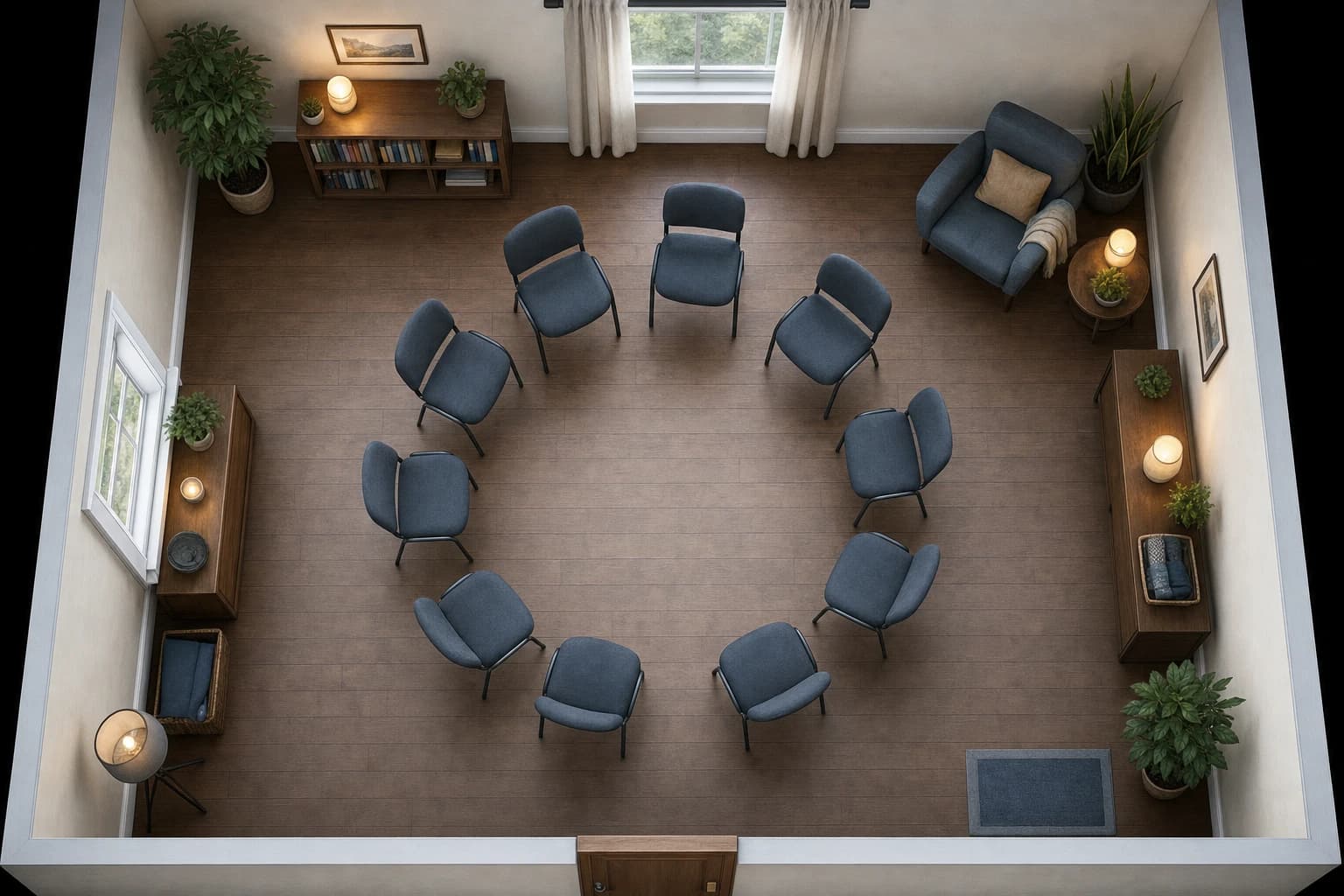
- Best layout: one circle of 10 chairs, cushions, or floor spots.
- Minimum useful play area: enough space for each person to sit or stand without touching shoulders; a typical living room or classroom corner can work if furniture is pushed back.
- Clear zone: remove bags, loose cords, glass items, sharp-edged stools, and unstable side tables from the middle.
- Teams: split into 2 teams of 5 when you want competition, or keep one circle for cooperative games.
- Game length: choose 5-minute rounds for kids, 8- to 12-minute rounds for teens and families, and 15 minutes only for calm games.
Play is valuable for children’s learning, social skills, and problem-solving. The American Academy of Pediatrics explains that play supports cognitive, physical, social, and emotional well-being, which is a helpful reminder that simple group games can still have real value when chosen thoughtfully. You can read their clinical report here: The Power of Play.
Comparison Table: Small Room Group Games for 10 Players
Use this table to pick a game quickly based on the age group, room size, noise level, setup time, and best use case. The room-size notes assume players are seated or standing mostly in place.
| Game | Best Age Range | Room Size Needed | Noise Level | Setup Time | Best Use Case |
|---|---|---|---|---|---|
| Pass the Clap | 6+ | 10-seat circle | Medium | 0 minutes | Fast warm-up for kids or families |
| One-Word Story Circle | 7+ | 10-seat circle | Low to medium | 0 minutes | Creative, low-movement game |
| Detective Switch | 8+ | 10-seat circle | Medium | 1 minute | Observation and memory practice |
| Zip Zap Zop | 9+ | Standing or seated circle | Medium | 0 minutes | Energy without running |
| Who Am I? | 8+ | Any seated setup | Low | 3 minutes | Guessing game for mixed ages |
| Silent Line-Up | 8+ | Standing line or semicircle | Very low | 0 minutes | Quiet challenge for classrooms or apartments |
| Memory Tray | 6+ | Table or floor center | Low | 4 minutes | Calm game for younger kids and families |
| Paper Tower Challenge | 9+ | Two floor or table spots | Medium | 3 minutes | Team challenge for teens or family night |
| Category Countdown | 10+ | Any seated setup | Medium | 1 minute | Quick thinking without equipment |
| Team Password Chain | 12+ | Two team clusters | Medium | 5 minutes | Teen party or family competition |
| Would You Rather Corners, Seated | 7+ | 10 chairs or floor spots | Low to medium | 2 minutes | Conversation starter without movement |
| Human Bingo, Small-Room Version | 10+ | Seats plus small walking gaps | Medium | 8 minutes | Icebreaker when players do not know each other |
Materials List: What to Keep Ready
You do not need a full party kit. For most small room group games, one small basket of supplies is enough.
- 20 sheets of scrap paper or index cards
- 10 pens or pencils
- 10 sticky notes or small labels for guessing games
- 1 timer or phone timer
- 10 small household objects for Memory Tray, such as a key, spoon, coin, button, toy figure, eraser, paper clip, receipt, cap, and rubber band
- 20 sheets of newspaper or printer paper for tower challenges
- Masking tape, optional, for marking sitting spots or team areas
If you are planning a birthday group with younger children, 25 Indoor Birthday Party Games for Kids Ages 6–10 has more party-style options that can be adapted to limited space.
Circle Games That Fit 10 People
Circle games are the safest starting point because everyone can see each other and the organizer can control the pace. They work especially well when furniture is pushed to the sides and each person has a chair, cushion, or taped floor spot.
1. Pass the Clap
Best for: ages 6+, warm-ups, family gatherings. Time: 5 to 8 minutes. Difficulty: easy.
- Seat all 10 players in a circle.
- Player 1 turns to the person on the left and claps once.
- That player turns left and passes the clap to the next person.
- After one practice round, add a rule: two claps reverses the direction.
- After another round, add a silent fake clap. If someone reacts to a fake clap, they miss one turn.
Why it works in a small room: there is movement, laughter, and focus, but no one needs to leave their spot.
Variation for teens: add a rhythm pattern such as clap, snap, clap. A player who breaks the rhythm becomes the next starter instead of being eliminated.
2. One-Word Story Circle
Best for: ages 7+, calmer groups, mixed ages. Time: 8 to 12 minutes. Difficulty: easy to medium.
- Choose a story theme, such as “lost in a museum,” “a strange school day,” or “a family picnic gone wrong.”
- Player 1 says one word. Player 2 adds the next word, and the story continues around the circle.
- Each player may say only one word per turn.
- After every full circle, the organizer may add a twist, such as “now the story must include a door” or “now the story is becoming silly.”
- End after 5 full circles or when the story reaches a natural ending.
Tip: for younger kids, allow two words per turn. For adults and teens, require correct grammar as much as possible, which makes the game funnier and more challenging.
3. Detective Switch
Best for: ages 8+, observation, quiet competition. Time: 10 minutes. Difficulty: medium.
- Choose one player as the Detective. The Detective looks carefully at the group for 20 seconds.
- The Detective leaves the room or turns around and closes their eyes.
- Two players switch a visible item: seats, sweaters, hair clips, glasses, watches, or a small object they are holding.
- The Detective returns and gets 3 guesses to identify what changed.
- Choose a new Detective each round.
Small-room rule: only switch items or seats if it can be done without climbing over people. In very tight rooms, switch objects only.
Guessing Games for Small Rooms
Guessing games are ideal when you need no running indoor games that still feel social. They are also useful when the group includes different ages because older players can use harder clues while younger players use simpler ones.
4. Who Am I?
Best for: ages 8+, parties, family nights. Time: 10 to 15 minutes. Materials: 10 sticky notes and a pen.
- Write one character, animal, object, or famous public figure on each sticky note. Keep choices age-appropriate and familiar to the group.
- Place one sticky note on each player’s forehead or back without letting them see it.
- Players take turns asking yes-or-no questions, such as “Am I alive?” or “Do I appear in movies?”
- Each player asks 1 question per turn.
- A player may guess their identity on their turn. If wrong, they wait until their next turn.
- Continue until all 10 players have guessed or the timer reaches 12 minutes.
Good categories: animals, school supplies, cartoon characters, foods, occupations, sports, or household objects.
Small-room version: keep everyone seated. Instead of mingling, go clockwise so players do not have to move around.
5. Mystery Object Questions
Best for: ages 6+, calm groups. Time: 8 minutes. Materials: one small object hidden in a bag or box.
- Place a small object in a bag so no one can see it.
- The group gets 20 yes-or-no questions total.
- Players ask questions in order around the circle.
- After question 10, allow one group discussion for 30 seconds.
- After question 20, each player writes or says one final guess.
Organizer tip: choose objects that are not too obscure. A spoon, toy car, battery, sock, glue stick, or orange is better than a tiny specialized item.
6. Team Password Chain
Best for: ages 12+, teens, adults, older families. Time: 15 minutes. Materials: 20 word cards.
- Split 10 players into 2 teams of 5.
- Prepare 20 cards with common nouns, such as ladder, ocean, candle, pizza, guitar, winter, backpack, and robot.
- Team A chooses one clue-giver. The clue-giver draws a card and gives a one-word clue.
- The team gets one guess. If correct, they score 1 point. If wrong, the other team may steal with one guess.
- Rotate clue-givers every card so everyone participates.
- Play until each team has attempted 10 cards.
Rule that keeps it fair: clues cannot be part of the answer word, a rhyme, a spelling hint, or a gesture. For example, for “guitar,” “music” is allowed, but air-guitar motions are not.
For more teen-friendly challenges using simple household items, see Minute-to-Win-It Party Games for Teens Using Household Items.
Team Challenges for 10 Players Without Running
Team challenges are useful when the group has extra energy but the room is too small for active movement. Split the group into 2 teams of 5, give each team a clear work area, and keep all scoring based on building, guessing, memory, or communication rather than speed across the room.
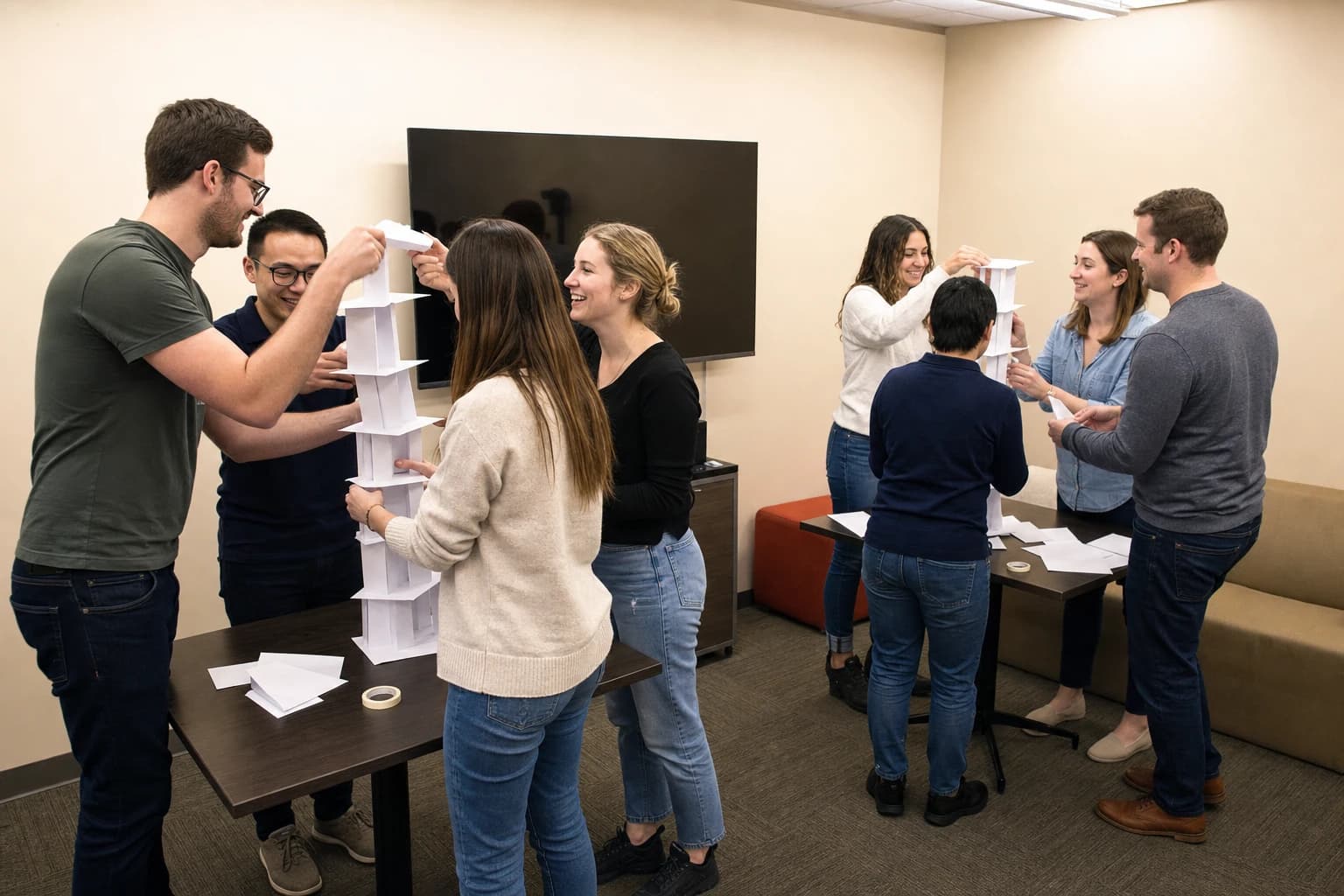
7. Paper Tower Challenge
Best for: ages 9+, families, teens. Time: 12 minutes. Materials: 20 sheets of paper and 60 centimeters of tape per team, or no tape for a harder version.
- Split the group into 2 teams of 5.
- Give each team 10 sheets of paper and the same tape amount.
- Set a timer for 7 minutes.
- Teams build the tallest freestanding tower they can.
- When time ends, hands off. The tower must stand for 10 seconds.
- Measure only if needed; if one tower is clearly taller and stable, declare the winner.
Small-room setup: each team builds on a coffee table, dining table, or marked floor square. Keep a walkway between teams so players do not lean into each other.
Variation: instead of tallest tower, build the strongest bridge that can hold 5 coins. This version is better for quieter groups.
8. Alphabet List Race, Seated
Best for: ages 10+, classrooms, family game nights. Time: 8 to 10 minutes. Materials: paper and pens.
- Divide players into 2 teams of 5.
- Give each team one sheet of paper with letters A to Z written down the side.
- Choose a category, such as foods, places, animals, movies, or things in a house.
- Teams have 4 minutes to write one answer for as many letters as possible.
- Score 1 point for each valid answer. If both teams write the same answer for the same letter, both still get the point unless you want a harder rule.
Example: for “foods,” A could be apple, B could be bread, C could be carrot, and so on. Avoid categories that require specialized knowledge unless everyone shares that interest.
9. Draw It in Ten Lines
Best for: ages 8+, mixed-age groups. Time: 10 minutes. Materials: paper and pens.
- Write 12 simple drawing prompts on slips of paper, such as bicycle, castle, birthday cake, elephant, school bus, or beach.
- Split into 2 teams of 5.
- One drawer from Team A picks a prompt and has 45 seconds to draw it.
- The drawer may use only 10 lines. Curved lines count as lines.
- The team guesses. A correct answer earns 1 point.
- Alternate teams and rotate drawers.
Why the 10-line rule helps: it prevents one player from drawing for too long and keeps the game moving, especially in a small room where waiting can feel crowded.
Calm Large Group Indoor Games for Families
Not every group needs a loud competition. Calm games are better after food, near bedtime, in apartments, or when younger children are overstimulated. These large group indoor games for families still include all 10 players but reduce shouting and sudden movement.
10. Memory Tray
Best for: ages 6+, families with younger children. Time: 8 minutes. Materials: 10 small objects, tray, towel.
- Place 10 small objects on a tray.
- Let players study the tray for 45 seconds.
- Cover the tray with a towel.
- Players write down or quietly say as many objects as they remember.
- For round 2, remove 2 objects while the tray is covered. Reveal the tray for 20 seconds and ask players what disappeared.
Adaptation for non-writers: let young children whisper answers to an adult or point to matching objects from a second pile.
11. Seated Would You Rather
Best for: ages 7+, families, icebreakers. Time: 10 minutes. Materials: optional question cards.
- Give each player two response options: raise the right hand for Option A and left hand for Option B.
- Read a question, such as “Would you rather have a pet dragon or a robot helper?”
- Everyone answers at the same time by raising a hand.
- Ask 2 or 3 players to explain their answer in one sentence.
- Continue with 8 to 12 questions.
Keep it friendly: avoid questions that embarrass one person, reveal private information, or divide the group in a mean-spirited way. Funny, imaginative choices work best.
12. Quiet Categories
Best for: ages 8+, low-noise settings. Time: 6 to 10 minutes. Materials: none.
- Choose a category, such as fruits, animals, board games, colors, or things at the beach.
- Player 1 names one item in that category.
- The next player must name a different item within 5 seconds.
- No repeats are allowed.
- If a player cannot answer, they stay in the circle but become the judge for the next category.
No-elimination version: instead of removing players, give the whole group 3 “team saves.” The goal is to complete 2 full circles before using all 3 saves.
How to Choose the Right Game for Your Group
The best game depends less on the title and more on the room, the players, and the reason you are gathering. Use these quick rules when choosing from the list.
- For kids ages 6 to 8: choose Pass the Clap, Memory Tray, One-Word Story, or Seated Would You Rather. Keep rounds under 8 minutes.
- For ages 9 to 12: try Detective Switch, Paper Tower Challenge, Draw It in Ten Lines, or Who Am I?
- For teens: use Team Password Chain, Alphabet List Race, Zip Zap Zop, or harder guessing categories.
- For mixed-age families: pair younger children with older teammates and avoid strict elimination.
- For apartments or shared walls: choose Memory Tray, Quiet Categories, Who Am I?, or Silent Line-Up.
- For a party that needs energy: start with Pass the Clap, move into a team challenge, and end with a calm guessing game.
If your gathering includes adults and you need more apartment-friendly ideas, No-Equipment Party Games for Adults That Work in Small Apartments has options that can be adjusted for older teens and family groups.
A Simple 45-Minute Game Plan for 10 People
If you do not want to decide on the spot, use this ready-made schedule. It works for a small living room, classroom, or party room and gives the group a mix of energy, teamwork, and calm play.
- Minutes 0 to 5: Settle and explain rules. Assign seats or floor spots. Tell the group that all games are no-running and that players must stay in their area.
- Minutes 5 to 12: Pass the Clap. Use it as a warm-up. Add the reverse rule after 2 minutes.
- Minutes 12 to 24: Paper Tower Challenge. Split into 2 teams of 5. Give 7 minutes to build and 3 minutes for judging and cleanup.
- Minutes 24 to 36: Who Am I? Use sticky notes and yes-or-no questions. Go clockwise to avoid crowding.
- Minutes 36 to 43: Memory Tray. Calm the room down with a quieter observation game.
- Minutes 43 to 45: Quick wrap-up. Ask each person to name their favorite game or funniest moment.
This sequence avoids long waits. It also changes the type of thinking every 10 to 12 minutes, which helps a group of 10 stay engaged in a tight space.
Common Mistakes to Avoid in a Small Room
- Choosing elimination games too early. If players are out after one mistake, 10 people can quickly become 4 active players and 6 bored observers. Use “miss one turn” or “become the judge” instead.
- Letting teams stand too close. Even seated games can feel chaotic if two teams crowd the same table. Mark two team zones before starting.
- Picking games with hidden running. Some games sound calm but require players to grab objects, switch seats quickly, or race to a wall. Replace speed movement with timed thinking.
- Using topics that only one age group understands. If the group includes children and adults, avoid clues based only on celebrity names, advanced sports facts, or niche video games.
- Ignoring noise level. In a small room, shouting feels louder. Use hand signals, written answers, or team whisper rules when needed.
FAQ: Indoor Games for 10 Players in a Small Room
What are the best indoor games for 10 people in a small room?
The best options are seated or standing-in-place games such as Pass the Clap, One-Word Story Circle, Who Am I?, Memory Tray, Team Password Chain, and Paper Tower Challenge. They include all 10 players without requiring running or large open space.
How do you keep 10 kids from getting too loud indoors?
Use short rounds, clear turn order, and quieter scoring methods such as written answers or hand signals. Alternate one energetic game with one calm game. Memory Tray, Quiet Categories, and Seated Would You Rather are good low-noise choices.
Can these games work without any equipment?
Yes. Pass the Clap, One-Word Story Circle, Zip Zap Zop, Silent Line-Up, Quiet Categories, and Seated Would You Rather can be played with no equipment. Paper, pens, and sticky notes simply give you more variety.
What is a good team split for 10 players?
The simplest split is 2 teams of 5. For younger children, make mixed-age teams so each team has at least one confident reader or rule-helper. For calm games, one circle of 10 is usually better than teams.
What games are safest when there is almost no open floor space?
Choose games where everyone stays seated: Who Am I?, Memory Tray, One-Word Story Circle, Quiet Categories, Mystery Object Questions, and Seated Would You Rather. Avoid seat-switching games unless there is enough room to move safely.
Conclusion
Good indoor games for 10 players do not need running, expensive supplies, or a large room. The key is to use a circle, split into 2 teams of 5 when helpful, and choose activities based on the group’s age, noise limits, and attention span.
For a quick plan, start with Pass the Clap, add one team challenge such as Paper Tower Challenge, then finish with a calm guessing or memory game. That simple mix gives kids, teens, and families a complete small-room game session without pushing, chasing, or complicated setup.