Planning indoor birthday party games for 6-year-olds in a living room can feel tricky because the children have plenty of energy, but the space is limited. The best plan is not one huge game. It is a short sequence: an easy arrival activity, two or three active games with no running, a snack or cake break, then calmer games before pickup.
This guide gives you a complete 60–90 minute party flow for 6 to 12 children, using supplies most homes already have: paper, tape, balloons or a soft ball, music, cups, and small household objects. Each game includes the setup, rules, timing, and small-space adjustments so you can run the party without shouting over chaos.
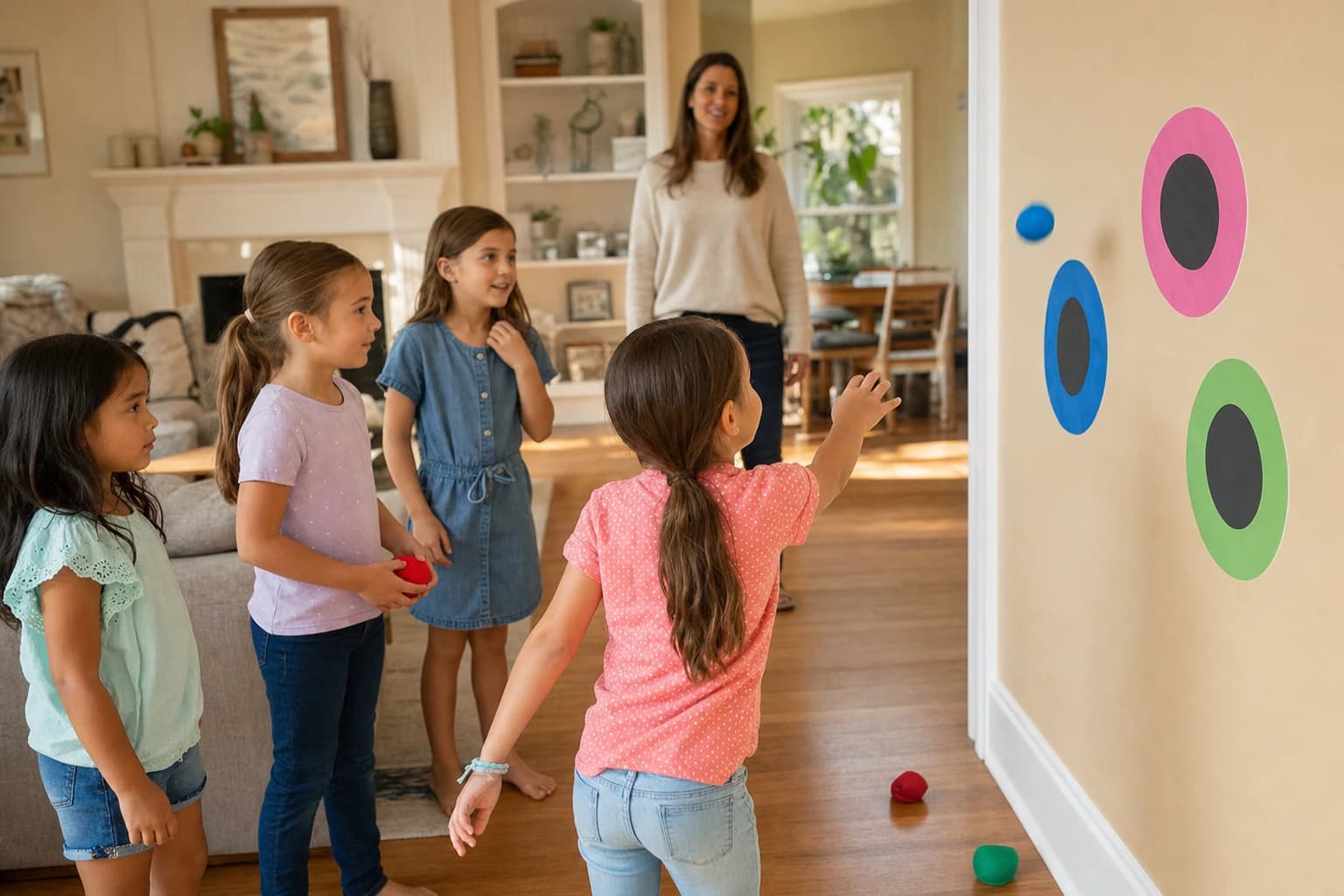
Quick Answer: A Simple 60–90 Minute Living Room Party Plan
For 6-year-olds, plan games in blocks of 5 to 12 minutes. Children this age usually understand simple rules, but long explanations and elimination games can cause frustration. Keep everyone moving, let eliminated players become helpers, and switch activities before the group becomes restless.
If you want more options after choosing a schedule, you can also browse these indoor birthday party games for kids ages 6–10. For a very tight space, the ideas in indoor games for 10 people in a small room are useful because they avoid running.
| Party length | Best flow | Why it works |
|---|---|---|
| 60 minutes | 10 min arrival game, 25 min active games, 10 min cake or snack, 10 min calm game, 5 min goodbye activity | Good for a small group or a party after school when children tire quickly. |
| 75 minutes | 10 min arrival, 30 min active games, 15 min cake or snack, 15 min calm games, 5 min pickup | The most balanced option for 6 to 10 children in one living room. |
| 90 minutes | 15 min arrival, 35 min active games, 20 min food, 15 min calm games, 5 min group ending | Best when guests arrive at different times or when you want space for presents. |
Before the Games: Set Up the Living Room in 10 Minutes
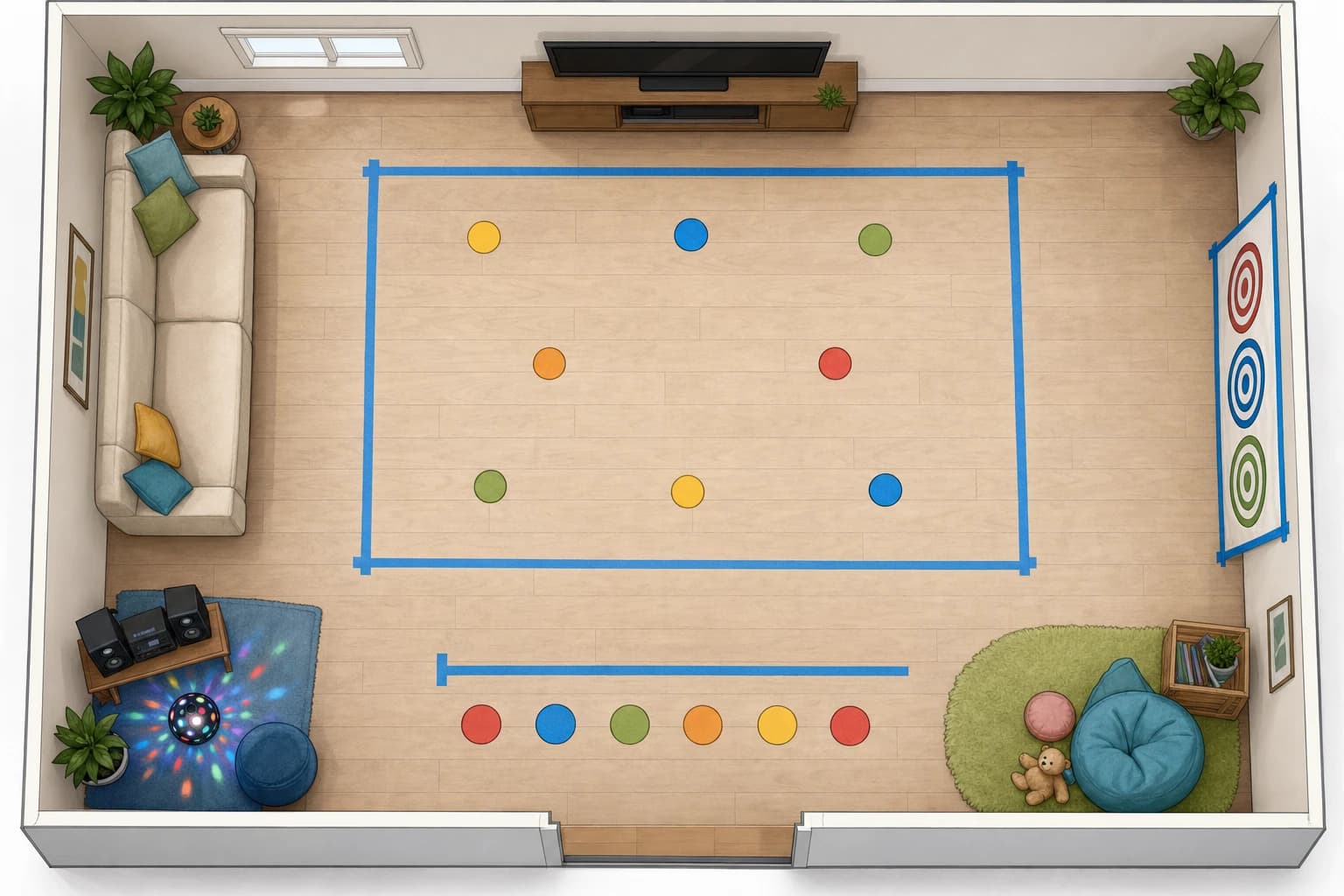
You do not need a large room, but you do need clear edges. Move sharp-cornered coffee tables, fragile lamps, and breakable decorations out of the play area. Push chairs against the wall to make a parent seating line, not an obstacle course. Mark a playing rectangle with painter’s tape if the floor allows it, or use cushions as soft boundary markers.
For safety, choose supplies that match the children’s age and supervise any small pieces. The U.S. Consumer Product Safety Commission toy safety guidance advises families to pay attention to age labels and choking hazards. At a 6-year-old party, avoid tiny prize pieces, broken balloon fragments, and games that involve putting objects in mouths.
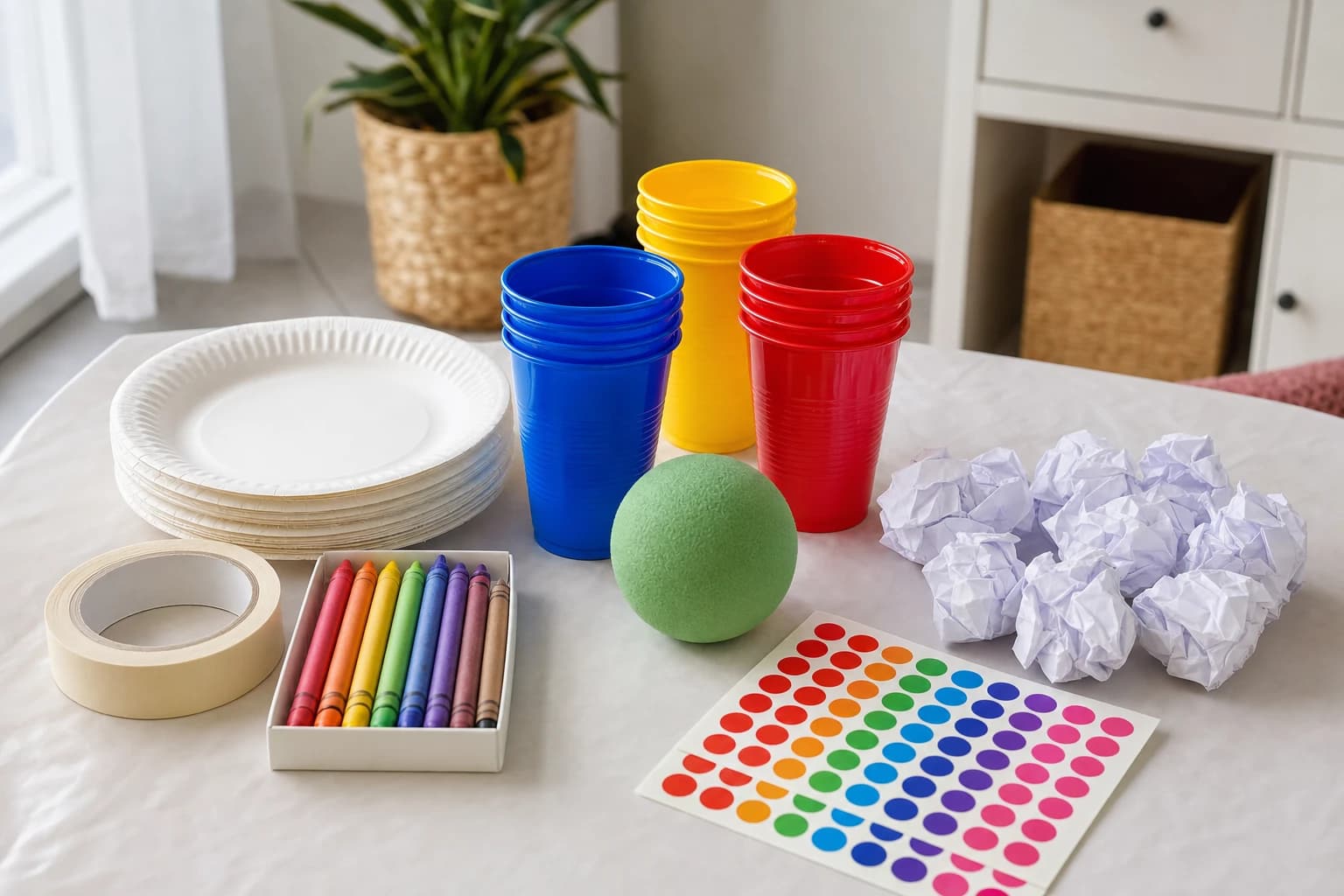
Basic supplies for most of the games
- Painter’s tape or masking tape for boundaries and targets
- 12 sheets of paper or cardstock
- 6 to 12 paper plates
- 1 soft foam ball, beach ball, or inflated balloon
- Music player with a pause button you can reach quickly
- 10 small household objects for a memory tray
- Plastic cups, clean socks, or crumpled paper balls for tossing games
- Stickers, stamps, or paper wristbands for non-candy rewards
Host tip: Put supplies for each game in separate paper bags labeled 1, 2, 3, and 4. When children are waiting, the next game should appear instantly. A long search for tape or music is when the living room starts to unravel.
Arrival Games: Keep Early Guests Busy Without Starting the Party
Arrival games should be quiet, flexible, and easy for one child or a small group. Do not begin the most exciting game until most guests have arrived, or late children may feel left out.
1. Birthday Badge Design
Best for: the first 10 minutes. Supplies: paper circles, crayons, tape, stickers. Setup: Put a small art station on a low table or on the floor away from the main play area.
- Give each child a paper circle and ask them to draw a badge for the party team. It can show a cake, animal, superhero symbol, star, or the birthday child’s favorite color.
- Tape the badge to the child’s shirt or let them hold it for a group photo later.
- If a child finishes quickly, ask them to make one extra badge for a grown-up helper or stuffed animal referee.
This works because it gives shy children something to do with their hands. It also avoids the awkward feeling of standing in the room while everyone waits.
2. Guess What Is in the Party Bag
Best for: 6 to 12 children as they arrive. Supplies: a cloth bag and 6 safe objects such as a spoon, toy car, pine cone, sock, crayon box, or plastic cup.
- Put one object in the bag at a time.
- Each child reaches in without looking and describes what they feel.
- The group gets three guesses before the item is revealed.
- After the reveal, switch to a new object.
Keep turns short. If you have 10 or more children, let them guess in pairs so no one waits too long.
High-Energy Games That Work in a Small Living Room
The goal is not to exhaust the children. It is to give them safe, joyful movement without sprinting, pushing, or sliding into furniture. Explain the boundary first, then the winning condition. For this age, rules should fit into 30 seconds.
3. Musical Statues With Silly Poses
Time: 8 to 10 minutes. Supplies: music. Difficulty: easy. Best group size: 6 to 12.
- Everyone dances inside the taped boundary while music plays. Walking feet only, no running.
- When the music stops, children freeze in a silly pose: robot, starfish, flamingo, birthday candle, or sleepy cat.
- Instead of sending children out, choose one frozen statue to name the next pose.
- Restart the music after 5 seconds.
Living room variation: If space is very tight, make it a standing dance game. Children dance in their own spot and may only move arms, shoulders, knees, and faces.
4. Delivery Relay Without Running
Time: 10 minutes. Supplies: 2 paper plates, 10 clean socks or soft blocks, 2 baskets or bowls. Best group size: 6 to 10.
- Make two lines. Place a basket of soft items at the start and an empty bowl about 8 feet away.
- The first child on each team carries one item on a paper plate to the bowl using walking feet.
- If the item falls, the child picks it up, returns to the start, and tries again.
- After delivery, the child walks back and hands the plate to the next player.
- Play until each child has delivered one item. If the group wants another round, switch to balancing the plate on one hand.
For 11 or 12 children: Use three teams instead of two. Smaller teams mean shorter waiting and fewer accidental bumps.
5. Balloon Keep-Up Team Challenge
Time: 6 to 8 minutes. Supplies: 1 balloon or 1 lightweight beach ball. Best group size: 6 to 12.
- Children stand in a circle with feet planted or with a one-step rule.
- The goal is to tap the balloon upward and count how many taps the group can make before it touches the floor.
- A child may not tap it twice in a row unless the group has fewer than 6 players.
- After each round, ask the group to beat its own score by 1.
Important: Use a beach ball instead of a balloon if you have very young siblings in the room, a child who dislikes balloon pops, or any concern about latex. Pick up broken balloon pieces immediately.
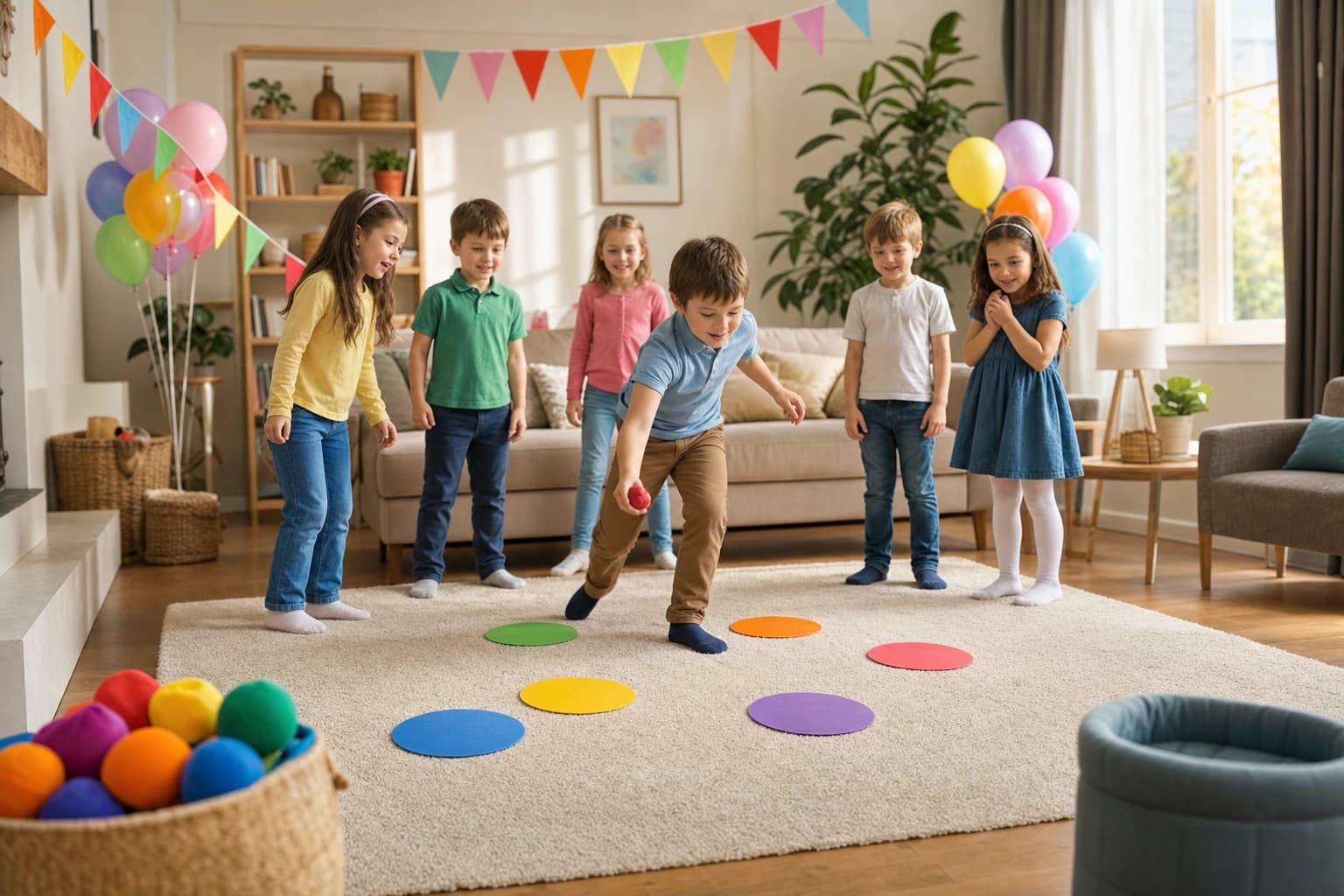
6. Color Corners Mini Game
Time: 8 minutes. Supplies: 4 pieces of colored paper. Best group size: 6 to 12.
- Tape one color to each corner or wall area: red, blue, yellow, and green.
- When music plays, children walk around the middle of the room.
- When music stops, each child chooses a color corner and stands still.
- The host closes their eyes and calls one color. Children in that corner do a quick challenge, such as 5 claps, 3 star jumps in place, or a birthday cheer.
- No one is out. Continue for 6 to 8 rounds.
This gives the fun of chance without disappointment. If a child keeps following a friend, that is fine; the social part is part of the game.
7. Paper Plate Snowball Toss
Time: 10 minutes. Supplies: 6 paper plates, tape, and 12 crumpled paper balls. Best group size: 6 to 10.
- Tape paper plates to a door or wall at child height, sticky tape loops on the back.
- Give each child 2 paper balls.
- Children stand behind a tape line about 5 feet away.
- They toss one at a time, trying to hit any plate.
- After everyone throws, count how many total hits the whole group made.
Make this cooperative rather than competitive: the group tries to reach 10 hits, then 12, then 15. For a smaller room, move the line to 3 feet and require underhand throws only.
Calm-Down Games for After Cake or Before Pickup
After cake, children often become louder for a few minutes, then crash into tiredness. Calm-down games should still feel like games, not like being told to sit still. These options lower the energy level while keeping children engaged.
8. Memory Tray Birthday Challenge
Time: 8 to 10 minutes. Supplies: tray, towel, 10 objects. Best group size: 6 to 12.
- Place 10 safe objects on a tray: spoon, ribbon, toy animal, block, crayon, sock, keychain without sharp parts, cup, sticker sheet, and party hat.
- Let children look for 30 seconds.
- Cover the tray with a towel.
- Children take turns naming one object they remember. No repeats.
- For a second round, secretly remove one object and ask what is missing.
Adaptation: For children who find memory games stressful, let them whisper ideas to a partner before answering.
9. Pass the Parcel Story Version
Time: 10 to 12 minutes. Supplies: a wrapped object or soft toy, music, 8 to 12 action cards. Best group size: 6 to 12.
- Write simple action cards: roar like a lion, make a funny face, say happy birthday in a robot voice, clap a pattern, or choose the next song.
- Children sit in a circle and pass the parcel while music plays.
- When music stops, the child holding it pulls one action card and does it with the whole group.
- Continue until most children have had a turn.
Traditional pass the parcel sometimes uses layered prizes, but you do not need them. The action card is the reward, and the whole group participates.
10. Secret Sound Detective
Time: 6 to 8 minutes. Supplies: household items that make gentle sounds, such as keys, paper, cup, spoon, zipper, or shaker bottle. Best group size: 6 to 10.
- Children close their eyes or turn around.
- The host makes one sound behind a cushion or towel.
- Children raise a hand if they know the sound.
- Take 2 or 3 guesses, then reveal the item.
- Let the birthday child make the final sound if they want to.
This is a good last game because children can play while sitting. It also gives parents a few minutes to collect coats, party bags, or leftover cake.
Game Flow by Group Size: 6, 8–10, or 11–12 Children
The same living room birthday games for kids do not run the same way with every group size. Six children can take individual turns. Twelve children need teams, helpers, and more simultaneous play.
| Group size | Best structure | Adjustments |
|---|---|---|
| 6 children | Use one circle or one line. Let each child take full turns. | Play more rounds of Memory Tray and Delivery Relay. Ask each child to suggest a pose or action. |
| 8 to 10 children | Use pairs or two teams. Keep turns under 20 seconds. | Put a waiting line on the couch or wall. Choose cooperative scores instead of individual winners. |
| 11 to 12 children | Use three small teams or stations. | Set up one active station and one quiet station. Rotate every 7 minutes with an adult or older helper at each station. |
If your living room is narrow, choose no-running party games for 6 year olds indoors: Musical Statues, Color Corners, Secret Sound Detective, Memory Tray, and Pass the Parcel. If you have a wider room, add Delivery Relay and Paper Plate Snowball Toss.
Prize-Free Rewards That Still Feel Special
Prizes can create problems at this age: children compare, someone feels left out, and tiny toys are easy to lose. You can still make games feel rewarding without handing out a prize after every round.
- Sticker scoreboard: Put a large sheet of paper on the wall and add one sticker every time the whole group completes a challenge.
- Birthday team points: The group earns a point for teamwork, quiet listening, or beating its previous score.
- Helper jobs: Let a child be music captain, pose chooser, scorekeeper, or target fixer.
- Cheer cards: Write silly cheers on cards. After a game, draw one and let everyone perform it.
- Final group reward: When the group reaches 10 stickers, they unlock the cake song, a dance round, or choosing the next calm game.
If you do give party favors, give them at the door rather than during games. That keeps attention on playing, not comparing items.
Transitions: What to Say Between Games
Transitions matter as much as the game rules. Six-year-olds respond well to short, repeated phrases. Use the same signal every time so you do not need to raise your voice.
- Start signal: When I say party, you say time. Party! Time!
- Freeze signal: Hands on head, eyes on me.
- Boundary reminder: Walking feet keep the game going.
- Ending line: Last round is the championship round, then we switch.
- Cleanup cue: Everyone picks up 2 paper balls and brings them to the basket.
Do not ask, Who wants to play another game? A few children will shout yes, others will shout no, and the room becomes a debate. Instead say, We are doing one final round, then we are switching to the mystery sound game.
Common Mistakes to Avoid
Choosing too many elimination games
Games where children are out can work with older kids, but many 6-year-olds struggle to watch quietly after being eliminated. If you use an out rule, give those children an immediate job: judge the funniest statue, count team points, or start the next music round.
Explaining every rule before the first round
Give the basic rule, play one practice round, then add a twist. For example, start Balloon Keep-Up with only the tap rule. In round two, add no same player twice in a row.
Letting the room become a race track
Running games may sound fun, but they are poor small space birthday games unless you have a clear open area. Replace speed with balance, teamwork, memory, music, or target practice.
Using candy as the main motivator
Candy rewards can distract children from the game and may not fit every family’s preferences. Stickers, helper roles, and group achievements usually keep the mood fairer.
Skipping the calm ending
Ending on the loudest game makes pickup harder. Save the final 10 minutes for Memory Tray, Secret Sound Detective, or a seated pass game. For younger siblings at the party, these quiet indoor games for preschoolers can help you keep a calm corner available.
FAQ
How many games do I need for a 6-year-old birthday party?
For a 75-minute party, plan 5 to 7 games: 1 arrival activity, 3 active games, and 2 calm games. Keep one extra game ready in case the group moves quickly.
What are the best indoor kids party games with simple supplies?
Musical Statues, Color Corners, Paper Plate Snowball Toss, Memory Tray, and Pass the Parcel are strong choices because they use paper, tape, music, and household objects.
How do I stop children from running in the living room?
Mark a boundary, use a walking-feet rule, and choose games where success depends on balance, freezing, tossing, or teamwork instead of speed. Praise the group when they keep the game safe.
Should every child get a prize after each game?
No. A group sticker chart, helper jobs, action cards, and team challenges can feel rewarding without creating prize comparison. If you use favors, hand them out at pickup.
What if I have 12 children and only one living room?
Use three small teams or two stations. Keep turns short, avoid running games, and choose activities where many children act at the same time, such as Musical Statues, Color Corners, and Pass the Parcel.
Conclusion: Keep It Short, Clear, and Cooperative
The easiest indoor birthday party games for 6-year-olds in a living room are not the most complicated ones. They are games with simple supplies, visible boundaries, quick turns, and no long waiting. Start with an arrival activity, move into active but no-running games, pause for food, and finish with a calm group game.
If you prepare supplies in labeled bags and use the same transition signals throughout the party, the children will know what to do next. That structure is what turns a small living room into a fun, manageable birthday space.