Homework practice can turn into a nightly tug-of-war when a child is tired, distracted, or convinced they already understand the topic. Games can help, but parents often face a real choice: pull out a physical board game or open a learning app.
This guide compares board games vs digital learning games for kids across the factors that matter at home: attention span, feedback, parent involvement, cost, screen time, social interaction, and subject fit. The goal is not to declare one format the winner for every child. It is to help you choose the right type of game for the homework skill your child needs to practice tonight.
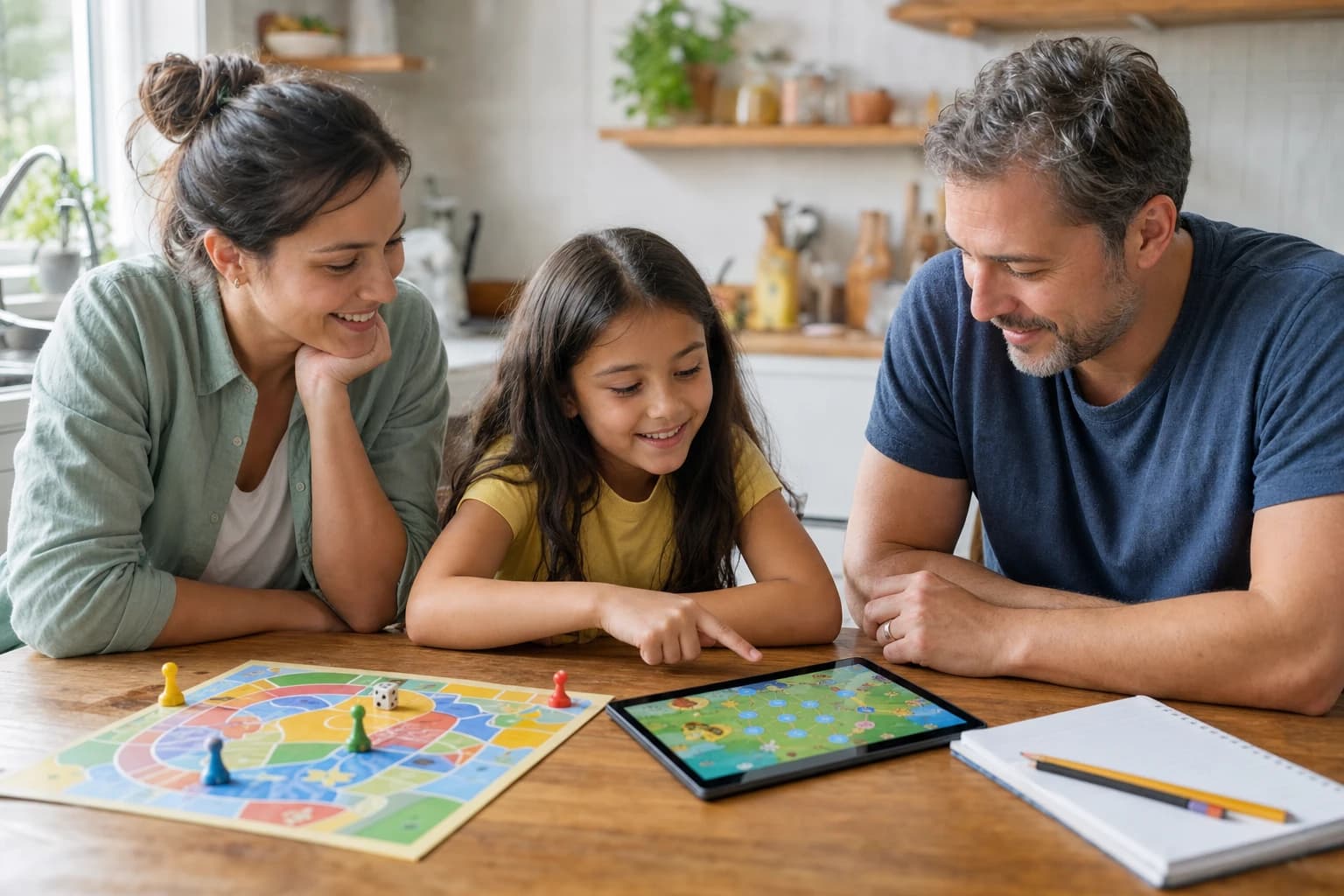
Short answer: both work, but for different homework jobs
Board games are usually stronger when the homework goal is slow thinking, conversation, turn-taking, hands-on problem solving, or family connection. Digital learning games are usually stronger when the homework goal is repeated practice, quick feedback, adaptive difficulty, or independent review.
A child who needs to practice multiplication facts may benefit from a digital game that gives instant correction and adjusts speed. A child who understands the facts but rushes through word problems may benefit more from a board game that forces them to explain choices out loud. A child who melts down after school may need a low-pressure card game before any app or worksheet makes sense.
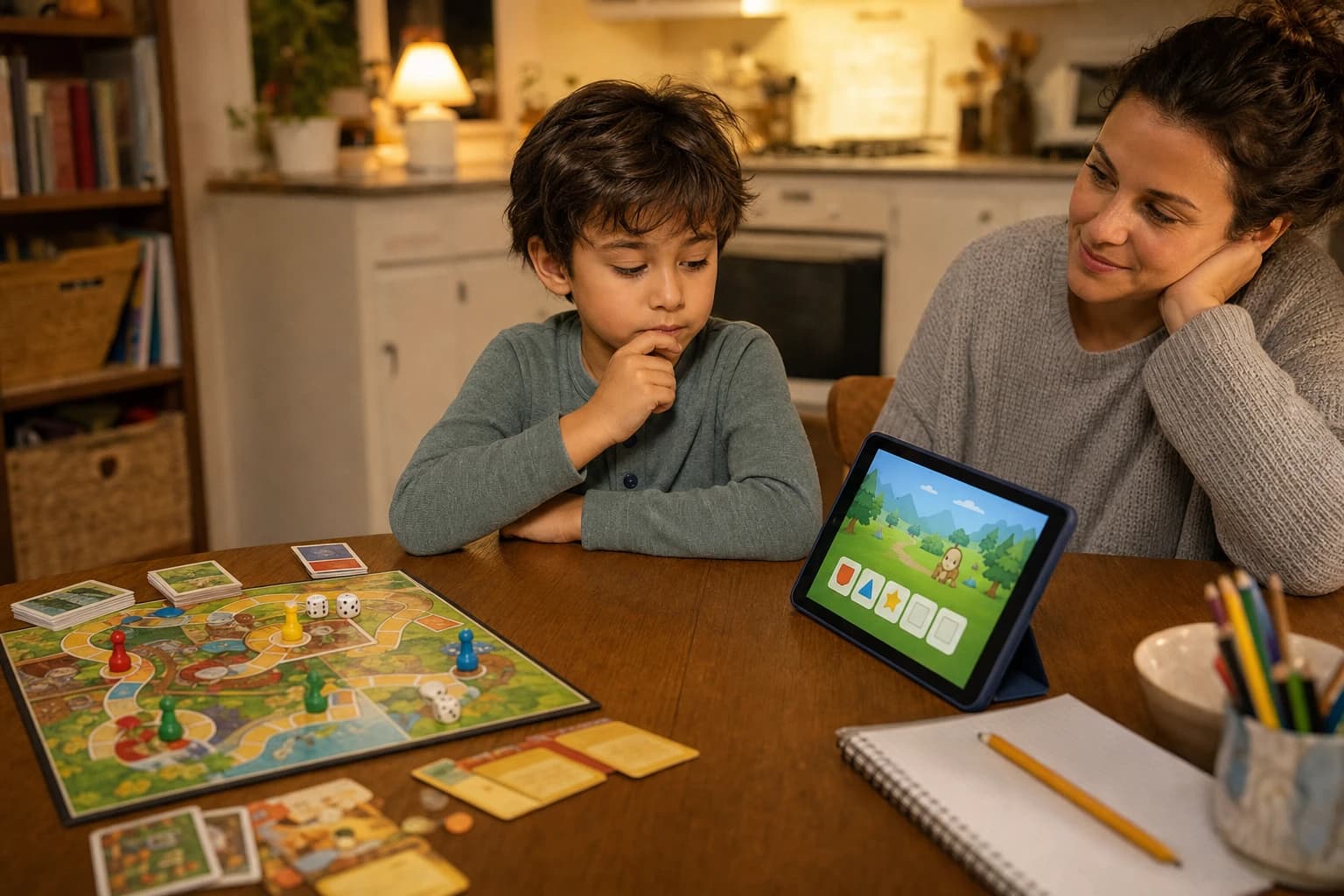
The most useful approach for many families is a simple mix: use digital games for short, focused practice and board games for deeper discussion, confidence, and social learning. The right balance depends on the child, the subject, and the time of day.
Comparison table: board games vs digital learning games for kids
| Decision factor | Board games | Digital learning games | Best choice when... |
|---|---|---|---|
| Attention span | Slower pace, fewer pop-ups, more visible materials | Fast pace can maintain interest but may encourage rushing | Choose board games for children who need to slow down; choose digital for short bursts of practice. |
| Feedback | Feedback comes from a parent, sibling, or answer key | Usually immediate and automatic | Choose digital when your child needs many quick corrections. |
| Parent involvement | Often requires an adult or partner | Can be more independent | Choose board games when you can sit nearby; choose digital when you need supervised independence. |
| Cost | One-time purchase, reusable, no device required | May be free, paid, subscription-based, or require a device | Choose board games for long-term family use; choose apps carefully when the free version is enough. |
| Screen time | No screen exposure | Adds screen time, even when educational | Choose board games on screen-heavy school days. |
| Social interaction | High: talking, explaining, negotiating, waiting | Varies: some are solo, some are collaborative | Choose board games for communication and patience practice. |
| Subject fit | Best for reasoning, language, money, strategy, social skills | Best for facts, phonics drills, typing, language audio, spaced repetition | Match the game to the skill, not just the subject label. |
How board games help with homework practice
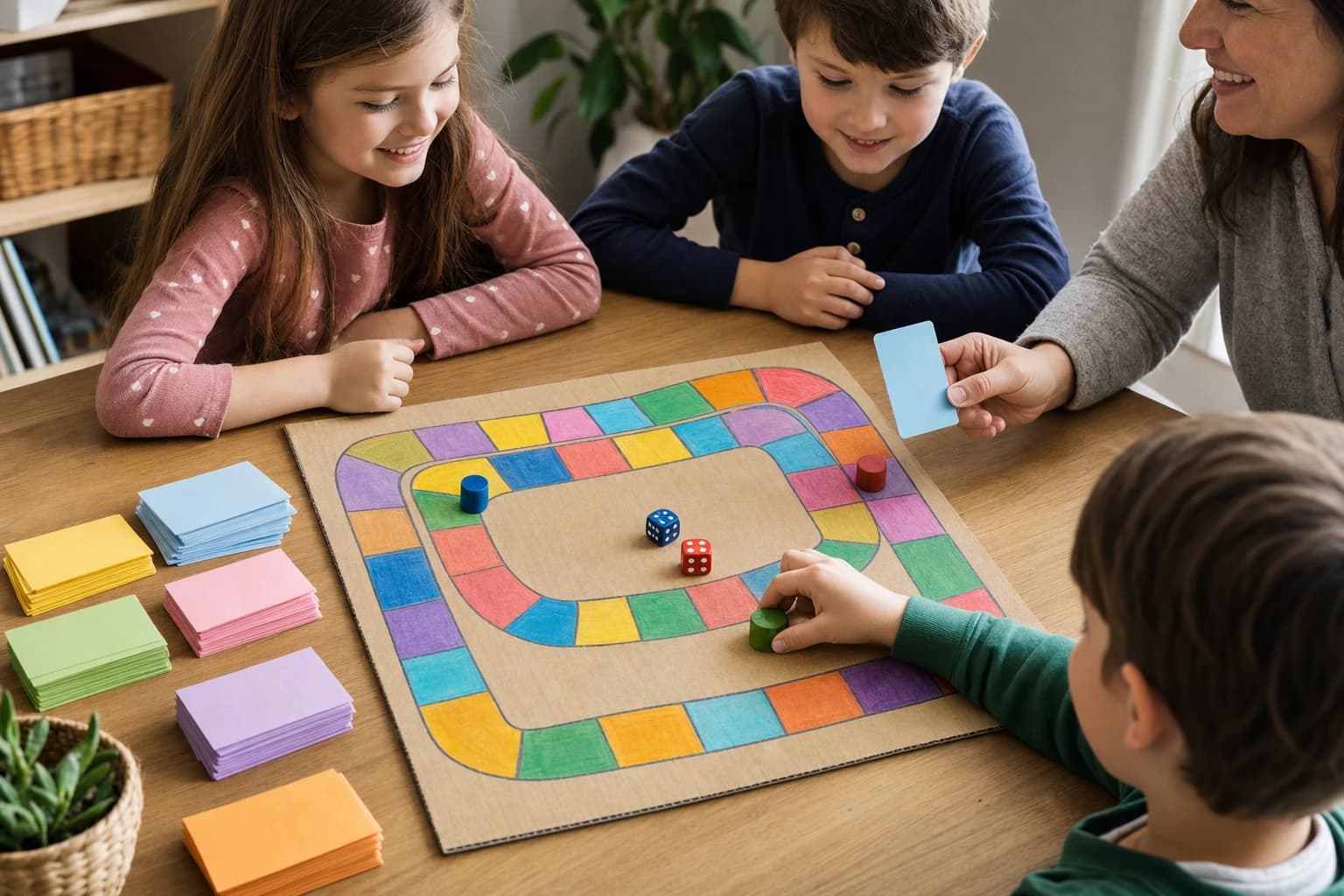
Educational board games and ordinary family games can both support school skills. A game does not need to have the word educational on the box to be useful. Many classic-style games practice counting, planning, reading, probability, memory, flexible thinking, and communication.
The biggest advantage of board games is that they make thinking visible. You can watch how your child counts spaces, groups numbers, reads a card, handles losing a turn, or explains a choice. That gives you information a worksheet may hide. For example, a child may get the right math answer but count on fingers every time. Another child may read a vocabulary card correctly but not understand the meaning in context.
Where board games are especially strong
- Math reasoning: Games with dice, money, tiles, arrays, or scoring help children compare quantities and make plans.
- Reading comprehension: Card prompts, clue games, and story-building games require children to read for meaning, not just pronounce words.
- Executive function: Waiting, remembering rules, planning ahead, and adapting after a bad move are all useful school behaviors.
- Speech and vocabulary: Talking through a move can build precise language: more than, fewer than, before, after, because, first, next.
- Confidence: A game can make practice feel less like a correction session and more like shared family time.
Board games are not perfect. They can move too slowly for a child who needs high-volume practice. They may also become frustrating if the adult turns every move into a lesson. The trick is to keep the game enjoyable while adding small learning prompts.
Parent tip: use one teaching prompt, not ten
Before playing, choose one skill to notice. For a math game, you might ask, How did you know that was 12? For a reading game, you might ask, Which word on the card gave you the clue? Stop there. Too many interruptions can make the game feel like a disguised worksheet.
If your family enjoys cooperative games, they can be especially helpful for children who shut down when they lose. You may also like this related guide to cooperative board games for families, which focuses on shared goals instead of one winner.
How digital learning games help with homework practice
Digital learning games can be powerful when used for a clear, narrow purpose. Their strength is efficient practice. A good app can present many examples, mark answers immediately, repeat missed items, read instructions aloud, or adjust difficulty based on performance.
This is useful for skills that improve with frequent retrieval and quick correction: math facts, spelling patterns, phonics, vocabulary, keyboarding, geography names, foreign language words, and basic grammar. A child can complete 20 focused practice items in a few minutes, which is hard to match with most board games.
Where digital games are especially strong
- Immediate feedback: The child knows right away whether an answer worked.
- Adaptive practice: Some programs make questions easier or harder based on responses.
- Audio support: Useful for phonics, pronunciation, language learning, and children who need directions read aloud.
- Progress visibility: Dashboards can help parents see what was practiced, though they should not replace looking at the actual schoolwork.
- Independent repetition: A child can review while a parent cooks dinner, helps a sibling, or checks a backpack.
The limitation is that not every app labeled educational teaches well. Some games reward speed more than understanding. Others include distracting animations, ads, in-app purchases, or shallow multiple-choice tasks. A screen time learning game should still have a learning target you can describe in one sentence.
Watch for the reward trap
If a child is mostly playing to unlock pets, coins, outfits, or levels, the game may still be fun, but it may not be the best homework practice. Ask, What skill did this game make easier? If the answer is unclear, shorten the session or choose a different activity.
For screen use, the American Academy of Pediatrics recommends that families create a media plan that considers sleep, physical activity, schoolwork, and family routines rather than treating all screen time as identical. Parents can use the AAP resource at HealthyChildren.org Family Media Plan to set household expectations.
Decision chart: which format fits the learning need?
Use this chart when your child has a specific homework challenge. The best choice is the one that targets the missing skill with the least friction.
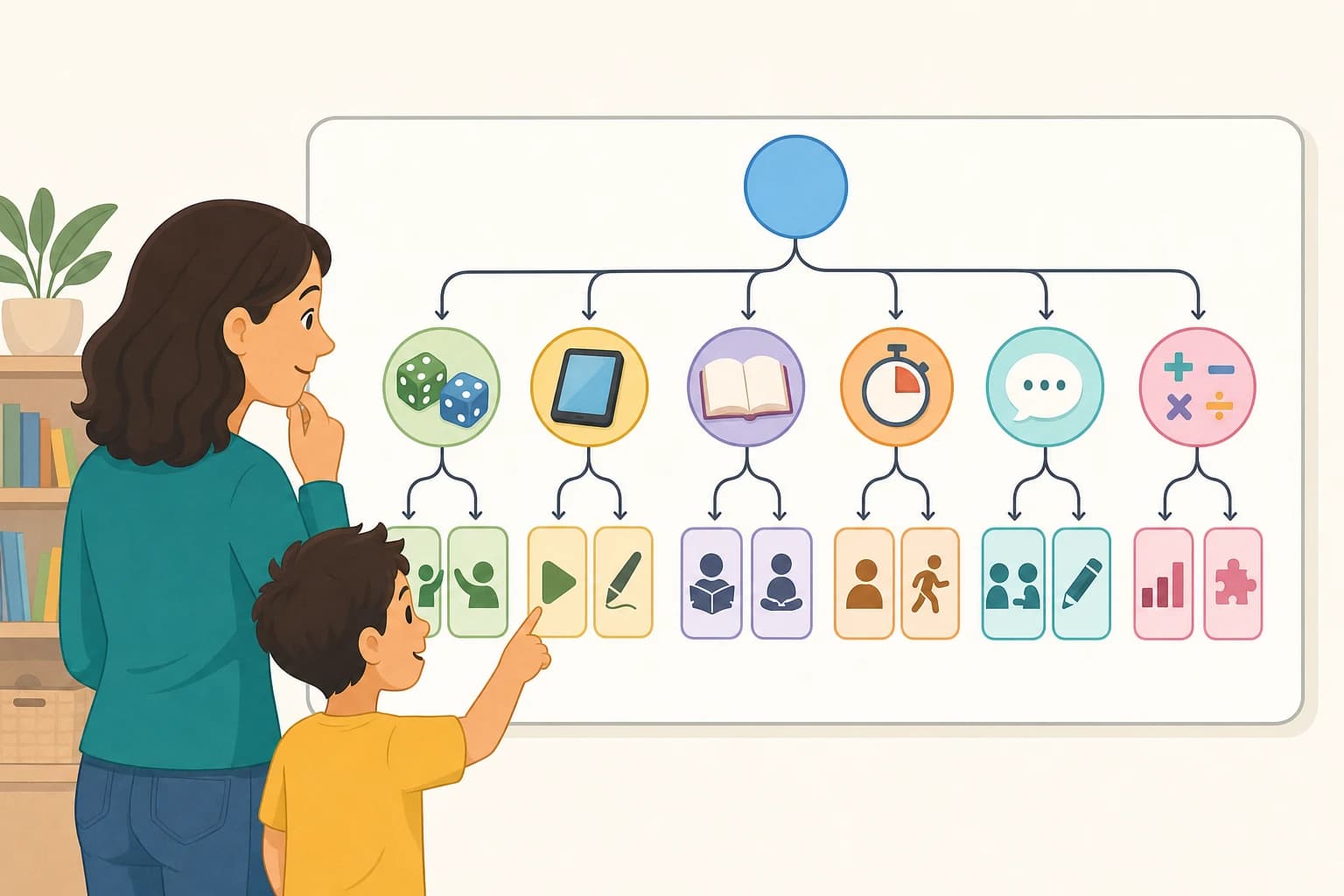
| If your child needs... | Try board games when... | Try digital games when... |
|---|---|---|
| Math fact fluency | Your child knows the facts but needs to explain strategies or reduce anxiety. | Your child needs fast, repeated practice with instant correction. |
| Word problem practice | Your child rushes, misses details, or needs to talk through steps. | The program shows worked examples and not just final-answer checks. |
| Spelling practice | Your child benefits from tiles, letter cards, or saying sounds aloud. | The app gives audio, repeated retrieval, and review of missed words. |
| Reading fluency | Your child needs expression, discussion, and comprehension checks. | The tool provides read-aloud support, recording, or timed repeated reading without pressure. |
| Vocabulary | Your child needs to use words in sentences and conversation. | The game uses images, audio, spaced review, and examples in context. |
| Science or social studies review | Your child needs discussion, sorting, timelines, or cause-and-effect thinking. | Your child needs quick recall of terms, labels, locations, or definitions. |
| Motivation after a hard day | Your child needs connection, movement, laughter, or a break from screens. | Your child is willing to do a short, calm session and the app does not escalate frustration. |
A simple homework game plan for parents
You do not need a shelf full of supplies or a paid subscription to use learning games well. A small routine is more important than a perfect product.
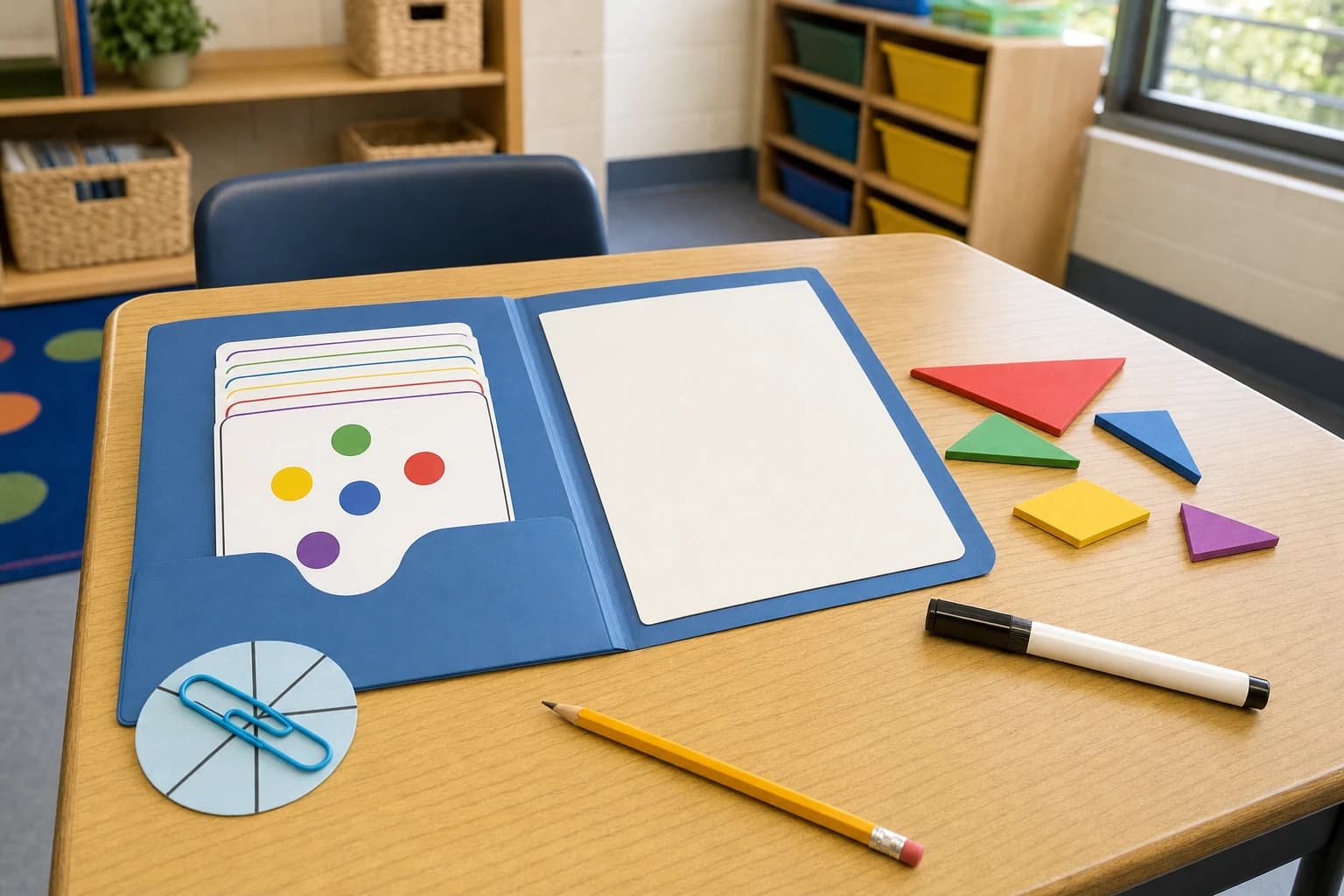
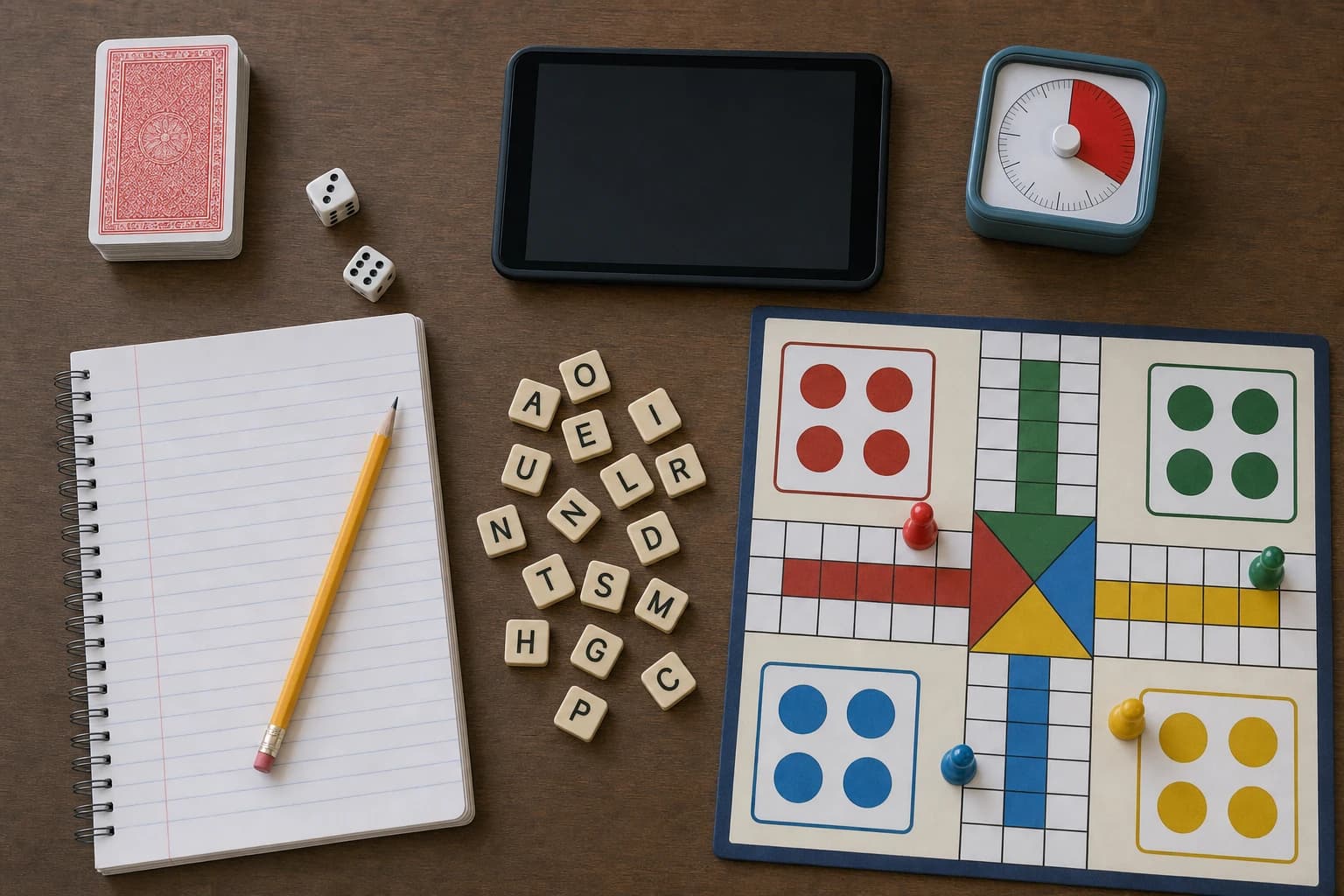
Basic materials
- One standard deck of cards
- Two dice
- Paper or small whiteboard
- Pencil or dry-erase marker
- One age-appropriate board or card game your child already likes
- One carefully chosen learning app or school-approved digital platform
- A timer set for 10 to 15 minutes
Step-by-step: choose the right homework practice game
- Name the exact skill. Do not start with math or reading. Start with a smaller target: multiplying by 6, reading vowel teams, using commas in a list, identifying state capitals, or explaining evidence from a paragraph.
- Check the energy level. If your child is tired, hungry, or upset, choose a short board or card activity first. If your child is alert but needs repetition, a digital game may work well.
- Pick one format for 10 to 15 minutes. Short sessions are easier to repeat and easier to stop before frustration builds.
- Stay nearby for the first round. Even digital games need a quick adult check. Confirm that the game is practicing the intended skill and that your child understands mistakes.
- Ask one reflection question. Try, What got easier? or Which problem tricked you? This helps connect the game to homework.
- Stop while it is still going well. Ending after a successful round makes it more likely your child will agree to play again tomorrow.
Teachers use similar principles when they select classroom games: the activity needs a specific purpose, a manageable time frame, and clear rules. For more school-style ideas, see educational indoor classroom games for grades 3–5 and this guide to a classroom math scavenger hunt.
Cost and value: what parents should consider
Cost is not just the price on the box or app store listing. It includes time, setup, device access, replay value, sibling use, and whether the game still works without internet.
A board game may cost more upfront than a free app, but it can be reused for years and shared by siblings. A deck of cards and dice can support dozens of homemade homework practice games. For example, two dice can practice addition, subtraction, multiplication, comparing numbers, probability language, and mental math. Letter tiles or homemade word cards can support spelling, vocabulary, and sentence building.
Digital games can be inexpensive, especially when schools provide access. However, parents should check whether the free version includes ads, limited practice, data collection, or pressure to upgrade. A paid app can be worthwhile if it clearly matches a recurring homework need, avoids distractions, and provides enough practice to justify the cost. If the child uses it twice and forgets it, it was not a bargain.
Quick value test
Before buying any educational board game or app, answer three questions: What exact skill does it practice? Can my child use it more than once? Will I be able to tell whether the practice helped? If you cannot answer those questions, wait before spending money.
Screen time: when digital learning games help and when to switch off
Educational screen time is still screen time. That does not make it bad, but it does mean it should fit into the whole day. A child who has already used a school laptop, watched videos, and played online games may not benefit from another 30 minutes on a tablet, even if the app is academic.
Digital learning games work best when the session is short, purposeful, and calm. A reasonable home rule is to decide the stopping point before the game begins: one lesson, one review set, one level, or one timer. Avoid letting the app decide the ending through endless streaks or bonus rounds.
Switch to a board game or paper-based game when your child shows signs of screen fatigue: rubbing eyes, tapping randomly, getting angry at mistakes, ignoring instructions, or asking only about rewards. A physical game can reset the pace and bring the parent back into the learning loop.
Subject-by-subject recommendations
Math
Use digital games for fact fluency, timed review, and immediate correction. Use board games for place value, money, fractions, probability, and strategy. A simple card game can become math practice: flip two cards and multiply them, make the largest two-digit number, or compare sums. For fractions, physical pieces or drawn models often make more sense than tapping answers on a screen.
Reading
Use digital tools for phonics sounds, read-aloud support, and repeated fluency practice. Use board and card games for comprehension, vocabulary, storytelling, and discussion. If your child can decode words but struggles to explain meaning, a physical discussion game may be more useful than another solo app.
Spelling and writing
Digital games are helpful for hearing words, repeating missed items, and typing practice. Board games and letter tiles are helpful for building words, noticing patterns, and rearranging sentences. For writing homework, be cautious with games that only ask for single-word answers. Writing improves when children organize ideas, choose precise words, and revise.
Science and social studies
Digital games can help with maps, labels, vocabulary, and quick review. Board games can support timelines, sorting, classification, cause and effect, and debate. If the homework asks your child to explain why something happened, choose a format that encourages speaking or writing in full thoughts.
Common mistakes to avoid
- Choosing by label alone. Educational does not automatically mean effective. Look at the actual task.
- Practicing too long. A focused 10-minute game is often better than a dragged-out 40-minute session.
- Letting speed replace understanding. Fast answers are only useful when the child understands the concept.
- Using games as a bribe every time. If the game becomes only a reward, it may lose value as practice.
- Ignoring frustration signals. Tears, guessing, and arguing are signs to simplify, switch formats, or stop.
- Turning board games into lectures. Keep the play experience intact. Teach lightly.
So, which works better?
For most families, the better question is not whether educational board games vs apps win overall. The better question is which format fits the homework problem in front of you.
Choose board games when your child needs conversation, reasoning, hands-on materials, social practice, reduced screen time, or emotional connection. Choose digital learning games when your child needs independent repetition, fast feedback, audio support, adaptive review, or efficient practice of facts and patterns.
If you are unsure, start with the format that removes the biggest barrier. If the barrier is boredom with repetition, try a digital game for 10 minutes. If the barrier is rushing, frustration, or too much screen time, try a board or card game. The best homework practice games are not the flashiest. They are the ones your child can use calmly, repeatedly, and with a clear learning purpose.
FAQ
Are board games better than learning apps for young children?
Board games are often a good fit for young children because they support talking, counting, turn-taking, and hands-on learning. Learning apps can still help with specific skills such as letter sounds or number recognition, especially when a parent stays nearby and sessions are short.
How long should a homework learning game session last?
For many elementary-age children, 10 to 15 minutes is a practical starting point. Short sessions make it easier to stay focused and stop before the game becomes frustrating. The exact time should depend on the child, the homework load, and the difficulty of the skill.
Can regular board games count as educational?
Yes, if they practice a real skill. A regular card game may support mental math, memory, flexible thinking, or planning. A word game may support vocabulary and spelling. The key is to connect the game to a specific learning goal instead of assuming all play is academic practice.
What should I look for in a digital learning game?
Look for a clear skill target, age-appropriate instructions, immediate feedback, limited distractions, and a stopping point. Be cautious with games that rely heavily on ads, rewards, upgrades, or speed without helping your child understand mistakes.
Should I replace worksheets with games?
Not always. Games are best used to reinforce, preview, or review skills. If a teacher assigns written homework, your child may still need to complete it. A short game before or after the worksheet can make practice less stressful and reveal what your child understands.
Final takeaway
Board games and digital learning games are both useful tools for homework practice, but they are not interchangeable. Board games bring conversation, patience, and visible thinking. Digital games bring speed, feedback, and repetition. Match the format to the learning need, keep sessions short, and pay attention to whether your child is actually understanding more than before.