By: PLAYATME Education Games Editorial Team. Last updated: August 16, 2026.
Editor note: This guide was written for elementary teachers and homeschool educators who need independent, low-noise activities that students can start without interrupting instruction. The recommendations below are selected using clear classroom-practical criteria: low noise, quick setup, independent use, simple cleanup, and meaningful learning value. This article does not claim that every activity was classroom-tested in a specific school; it is a practical planning guide you can adapt to your own routines.
Early finishers can be a gift or a classroom management challenge. The student is done, the rest of the class still needs time, and you need something worthwhile that does not turn into whispering, wandering, pencil tapping, or repeated questions.
This guide focuses on quiet desk games for early finishers that students can keep in a desk, two-pocket folder, table basket, or pencil pouch. Each option is designed for low noise, simple setup, and minimal teacher supervision, while still giving students useful practice with logic, vocabulary, math, visual reasoning, or problem solving.
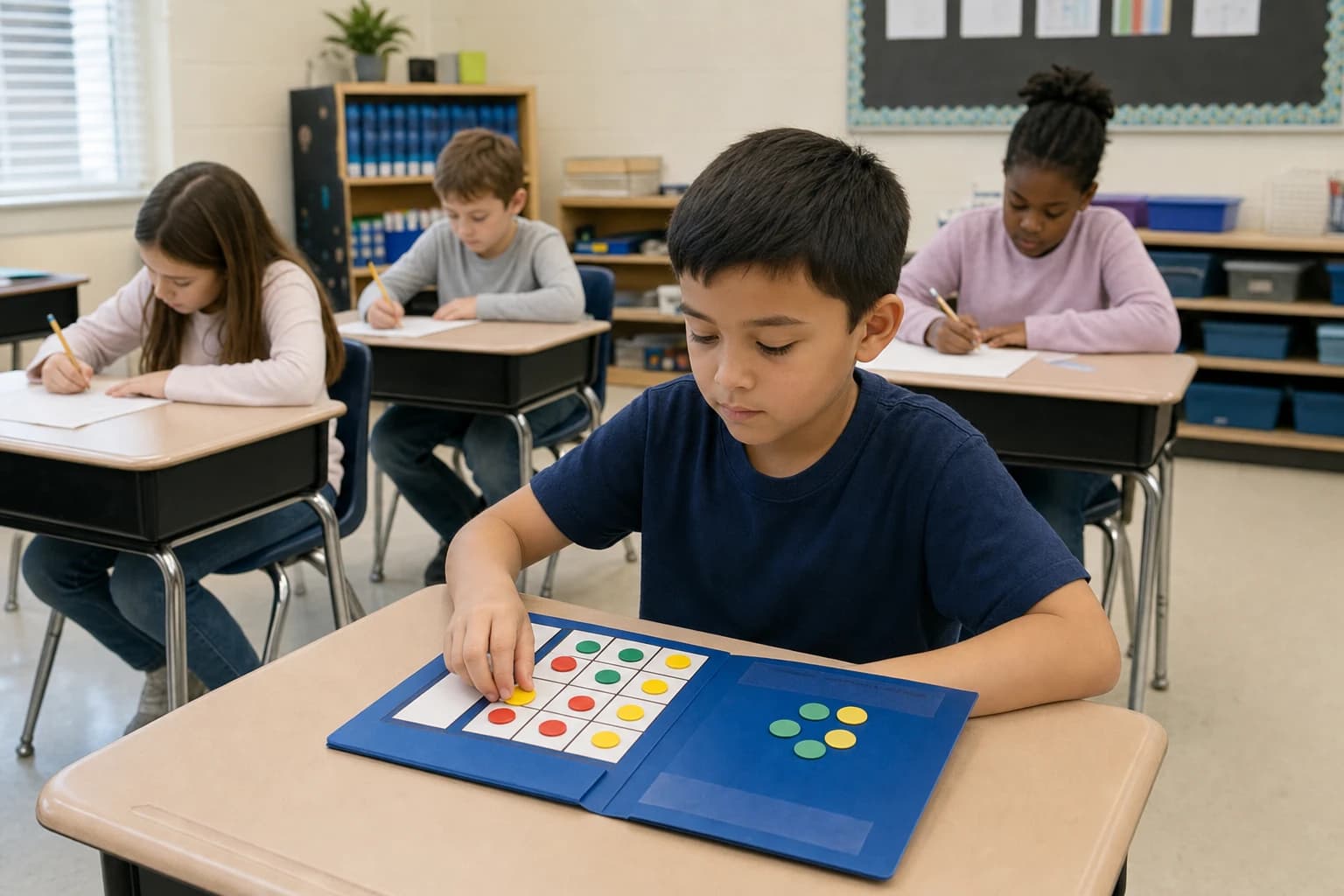
How These Quiet Desk Games Were Chosen
The games in this guide were chosen because they meet 5 practical classroom filters:
- Noise: Level 0 silent or Level 1 whisper only. No dice clattering, card slapping, racing, or calling out.
- Setup speed: Students can begin in 60 seconds or less after the folder routine is taught.
- Cleanup speed: Materials can return to a folder, pouch, or desk in 30 seconds or less.
- Independence: Each folder should include at least 3 solo choices, even if you also offer partner games.
- Learning value: Each activity supports a skill such as spelling, math fluency, spatial reasoning, classification, logic, or executive function.
Clear routines matter as much as the activity itself. The Institute of Education Sciences practice guide on reducing behavior problems in elementary classrooms recommends teaching and reinforcing classroom expectations and routines explicitly; early finisher folders work best when they are treated as a routine, not a free-for-all. See the guide at IES What Works Clearinghouse.
What Makes a Desk Game Work for Early Finishers?
A strong early finisher activity has a different job from an indoor recess game. It should not need the teacher to explain a long rule set, judge winners, manage shared supplies, or reset the room. The best activities are short, repeatable, and contained.
Use these criteria before adding a game to your early finisher system:
- Fits in a folder or desk: Use flat cards, laminated half-sheets, a small pencil pouch, or no more than 12 manipulatives per pouch.
- Starts in under 1 minute: Students should be able to begin without asking, “What do I do?”
- Stops quickly: If the class moves on, the student can put it away in 30 seconds or less.
- Quiet by design: Avoid games that require dice, timers, shouting answers, speed slapping, or frequent movement.
- Has a learning purpose: The activity can support spelling, math facts, strategy, spatial thinking, reading, or planning.
- Allows independent play: Partner versions are useful, but every folder should include enough solo choices for silent work periods.
If you teach younger students, you may also want a separate set of simpler options. PLAYATME has a related guide to quiet classroom games for early finishers in kindergarten to 2nd grade with more early-primary choices.
Recommended Starter Set
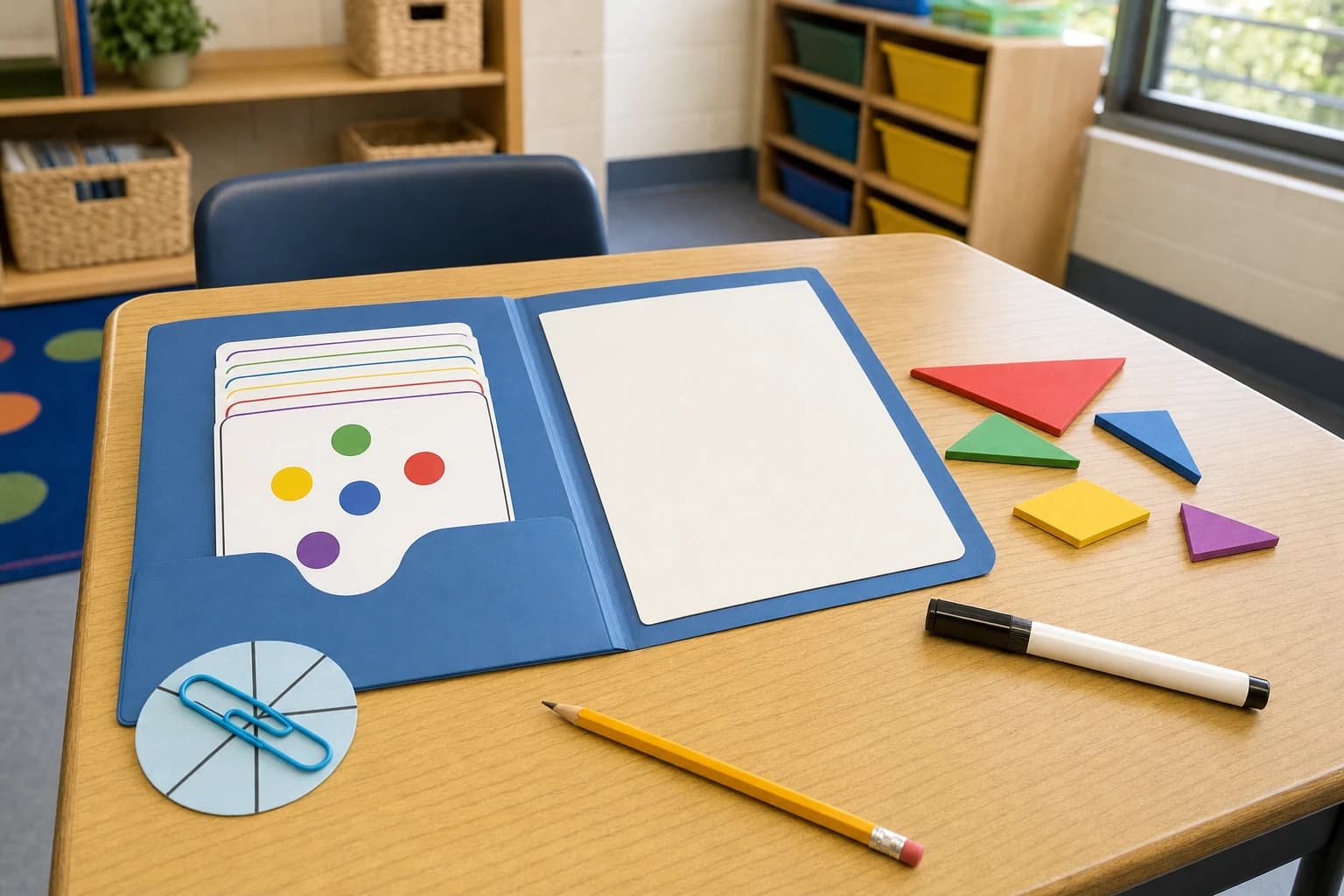
If you only have 20 minutes to prepare, start with 5 activities: 1 word ladder card, 1 math fact path, 1 mystery number card, 1 dot grid, and 1 tangram or pattern block card. Put them in a two-pocket folder with 3 blank response sheets, 1 dry-erase sleeve, 1 paper clip, and 1 pencil. That is enough for a simple, quiet first week.
Quick Comparison: Best Quiet Desk Games for Early Finishers
| Game | Best Grades | Setup Time | Noise Level | Solo or Partner | Main Skill |
|---|---|---|---|---|---|
| Mini logic puzzles | 2 to 5 | 2 minutes to print and file | Level 0 silent | Solo | Deductive reasoning |
| Dot grid boxes | 2 to 5 | 1 minute | Level 1 whisper | Partner | Strategy, planning |
| Tangram task cards | 1 to 5 | 5 minutes to bag pieces | Level 0 or 1 | Solo or partner | Spatial reasoning |
| Word ladder cards | 2 to 5 | 2 minutes | Level 0 silent | Solo | Spelling, phonics, vocabulary |
| Letter grid word hunt | 2 to 5 | 1 minute | Level 0 silent | Solo or partner | Vocabulary, pattern spotting |
| Math fact path | 1 to 5 | 5 minutes to prepare cards | Level 0 silent | Solo | Fact fluency |
| Paper clip spinner games | 1 to 5 | 3 minutes | Level 1 low | Solo or partner | Math, probability, turn taking |
| Mini Sudoku or KenKen-style puzzles | 3 to 5 | 2 minutes | Level 0 silent | Solo | Logic, number sense |
| Category card sort | 1 to 5 | 5 minutes | Level 0 or 1 | Solo or partner | Classification, vocabulary |
| Roll-and-write without dice | 2 to 5 | 3 minutes | Level 1 low | Solo | Number operations, choice making |
15 Quiet Desk Games That Fit in a Folder or Desk
1. Mini Logic Puzzles
Logic puzzles are excellent independent games because students can work silently and use clues to check progress without a partner. Use simple grid puzzles, clue puzzles, or elimination puzzles with 3 to 5 categories.
Printable-style example: Three students, Mia, Jay, and Noor, each chose one snack: apple, crackers, or yogurt. Clue 1: Mia did not choose yogurt. Clue 2: Jay chose a crunchy snack. Clue 3: Noor did not choose crackers. Students fill a 3 by 3 grid and write the final matches.
Best for: grades 2 to 5. Setup: print half-sheet puzzles and keep answer keys in a teacher folder or on the back in tiny print. Noise: Level 0 silent. Play: solo.
2. Dot Grid Boxes
This classic pencil-and-paper game works well when the class rule is whisper-level partnership. Students take turns drawing one line between two dots. When a student completes a box, they put their initials inside and take another turn. The winner has the most boxes when the grid is full.
For early finishers, use small grids: 5 by 5 dots for quick play or 7 by 7 dots for a longer challenge. Larger grids can take too long and may create unfinished papers everywhere.
Best for: grades 2 to 5. Setup: copy dot grids onto quarter sheets or laminate one board. Noise: Level 1 whisper. Play: partner.
3. Tangram Task Cards
Tangrams are compact, reusable, and genuinely challenging. Place one tangram set in a zip pouch with 6 to 10 silhouette cards. Students use all 7 pieces to build the target shape. For grades 1 and 2, include colored outline cards that show piece placement. For grades 3 to 5, use black silhouettes only.
Best for: grades 1 to 5. Setup: 5 minutes per pouch if pieces are already cut or purchased. Noise: very quiet, especially with foam pieces. Play: solo or partner.
4. Word Ladder Cards
Word ladders ask students to change one word into another by changing one letter at a time, usually with clues. This feels like a puzzle, but it practices phonics, spelling patterns, and vocabulary.
Sample word ladder card for grades 2 to 3:
- Start: cat
- Change 1 letter to mean a small bed: cot
- Change 1 letter to mean a small mark: dot
- Change 1 letter to name an animal: dog
Challenge word ladder for grades 4 to 5: cold to warm in 4 steps. Clue path: cold, cord, word, worm, warm. Ask students to write one sentence using the final word.
Best for: grades 2 to 5. Setup: 2 minutes once cards are printed. Noise: Level 0 silent. Play: solo.
5. Letter Grid Word Hunt
Give students a 4 by 4 or 5 by 5 grid of letters and ask them to make as many words as possible. Add limits to keep it focused: words must have at least 3 letters, proper nouns do not count, and letters that touch side-to-side or diagonally can be connected.
To prevent arguments, make this a personal challenge rather than a competition. Students can try to beat their own previous total, find 8 words, or find one word with 6 or more letters.
Best for: grades 2 to 5. Setup: 1 minute with printed grids. Noise: Level 0 silent. Play: solo, or partner if students compare lists quietly.
6. Math Fact Path
Create a small path of 20 spaces. Each space has a math fact or expression. Students solve a space, then move a paper marker to the next one. No dice are needed. The goal is simply to finish the path accurately.
Make separate versions for addition within 20, subtraction within 100, multiplication facts, division facts, fractions, or decimal comparisons. The official Common Core State Standards for Mathematics can help teachers match practice tasks to grade-level expectations, if your school uses or references those standards.
Best for: grades 1 to 5. Setup: 5 minutes to create or print one path. Noise: Level 0 silent. Play: solo.
7. Paper Clip Spinner Games
Paper clip spinners are quieter than dice. Students place a paper clip around a pencil point, flick the clip, and use the result. A spinner can choose a number, operation, fraction, prefix, suffix, story prompt, or shape.
Sample math spinner prompt for grades 3 to 5: Divide a circle into 8 sections labeled 2, 3, 4, 5, 6, 7, 8, and 9. Spin twice. Multiply the two numbers. Write the equation. If the product is even, shade one square on your board. If the product is odd, circle one square. Stop after 10 spins and count how many even products you made.
Sample math spinner prompt for grades 1 to 2: Use a 6-section spinner labeled 1, 2, 3, 4, 5, and 6. Spin once. Add 10. Write the equation, such as 10 + 4 = 14. Stop after 6 equations.
Best for: grades 1 to 5. Setup: 3 minutes per spinner sheet. Noise: Level 1 low. Play: solo or partner.
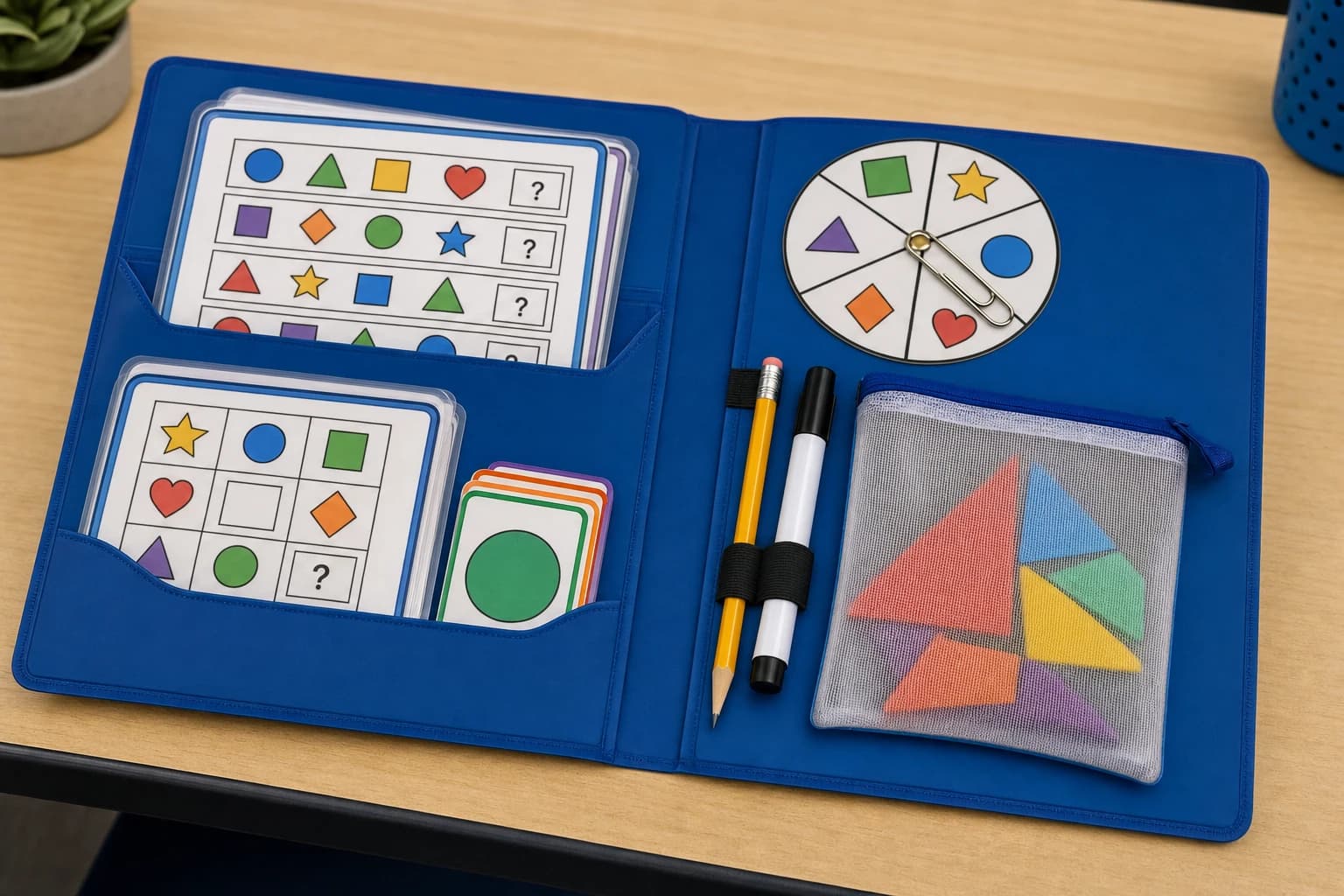
8. Mini Sudoku and Number Logic Puzzles
Use 4 by 4 Sudoku for beginners and 6 by 6 grids for students ready for more challenge. The goal is to place numbers so each row, column, and box has the required digits without repeats. Keep the puzzles small; full 9 by 9 Sudoku can be too long for a 5-minute early finisher window.
Best for: grades 3 to 5. Setup: 2 minutes to print and file. Noise: Level 0 silent. Play: solo.
9. Category Card Sort
Card sorts are quiet classroom games when the cards are small and the categories are clear. Students might sort animal cards by habitat, words by part of speech, shapes by attributes, or science vocabulary by topic. Add 1 or 2 oddball cards so students have to justify their thinking in writing.
Direction strip: Sort all 18 cards. Name each group. Choose 1 card that could fit in more than one group. Write one sentence explaining why.
Best for: grades 1 to 5. Setup: 5 minutes to cut and bag one set. Noise: Level 0 or 1. Play: solo or partner.
10. Roll-and-Write Without Dice
Many roll-and-write games are useful, but dice can be noisy and distracting. Replace dice with numbered cards or a paper spinner. Students draw or spin values, then fill in a small game sheet. For example, they can build the largest 3-digit number, create equations, shade arrays, or make a target number using three operations.
Best for: grades 2 to 5. Setup: 3 minutes. Noise: Level 1 low. Play: solo.
11. Pattern Block Picture Challenges
If you already have pattern blocks, make desk-size challenge mats. Students use 6 to 12 pieces to cover or create a design. To keep it desk-friendly, store only a small set of blocks in each pouch instead of giving students a full tub.
Grades 1 to 2: use outline mats with visible block shapes. Grades 3 to 4: use a silhouette and ask students to record how many triangles, rhombuses, trapezoids, and hexagons they used.
Best for: grades 1 to 4. Setup: 5 minutes per pouch. Noise: very quiet with foam or plastic pieces handled carefully. Play: solo or partner.
12. Silent Tic-Tac-Toe Variations
Regular tic-tac-toe gets stale quickly, but small variations can add thinking. Try 4-in-a-row on a 5 by 5 grid, math tic-tac-toe where students must solve a space before marking it, or vocabulary tic-tac-toe where each square requires a synonym, antonym, or sentence.
Direction strip: Choose a square. Solve it. Partner checks silently with a thumbs-up. Mark X or O. First to 4 in a row wins.
Best for: grades 1 to 5. Setup: 1 minute. Noise: Level 1 whisper. Play: partner.
13. Mystery Number Cards
Each card describes a number through clues. Students solve the mystery number and then write a new clue card when finished.
Full mystery number card for grades 2 to 3:
- I am a 2-digit number.
- I am even.
- I am greater than 40 and less than 60.
- My ones digit is 6.
- My tens digit is 5 less than my ones digit.
- Answer: 46.
Challenge version for grades 4 to 5: I am a 3-digit number. I am divisible by 5. My hundreds digit is the product of 2 and 3. My tens digit is half my hundreds digit. My ones digit is 0. Answer: 630.
Best for: grades 1 to 4. Setup: 2 minutes. Noise: Level 0 silent. Play: solo.
14. Mini Map Grid Games
Give students a small coordinate grid with objects placed on it. They answer prompts such as, “Move from B2 to B5, then one square east. What is there?” Older students can write their own coordinate clues for a partner to solve later.
Grades 2 to 3: use letter-number grids from A1 to D4. Grades 4 to 5: use the first quadrant and ordered pairs such as (2, 3).
Best for: grades 2 to 5. Setup: 3 minutes. Noise: silent for solo play, whisper quiet for exchanging clues. Play: solo or partner.
15. One-Page Strategy Mazes
Not all mazes are equal. Choose mazes that require planning, not just tracing. Number mazes, operation mazes, and path-choice mazes work especially well. Example: students can only move through multiples of 4, words with long vowel sounds, or fractions equivalent to one half.
Best for: grades 1 to 5. Setup: 1 to 2 minutes. Noise: Level 0 silent. Play: solo.
Early Finisher Folder Checklist
Use this checklist to build a folder that students can manage without repeated teacher help.
- 1 two-pocket folder per student or table group
- 5 total activities: 2 literacy, 2 math, and 1 logic or spatial activity
- At least 3 Level 0 solo activities
- No more than 1 partner activity during the first week
- 3 laminated half-sheet boards or dry-erase sleeve pages
- 5 blank response sheets or 1 early finisher notebook
- 1 paper clip for spinner activities
- 1 pencil or dry-erase marker
- 1 small cloth square or felt eraser if using dry-erase sleeves
- 1 zip pouch for cards, tangrams, or pattern blocks
- Direction strip on every activity with 3 to 4 steps
- Noise label on every activity: Level 0, Level 1, or teacher-only approval
- Time label on every activity: 5 minutes, 10 minutes, or keep going
Sample 5-Activity Folder Setups by Grade Band
Grades 1 to 2 Starter Folder
Keep the directions visual and the pieces limited. A good first folder for grades 1 and 2 includes:
- 1 picture-based category sort: 12 cards, such as animals sorted by land, water, or air.
- 1 mystery number card set: 8 cards using numbers within 100.
- 1 simple math path: 20 spaces with addition within 20 or tens plus ones.
- 1 tangram or pattern block card: outline version with 6 to 7 pieces.
- 1 dot grid: 5 by 5 dots for quiet partner time only.
Teacher direction to post: Finish work. Check name. Choose a Level 0 card unless the teacher says partners are open. Put everything away when the timer or transition signal starts.
Grades 3 to 5 Starter Folder
Older students can handle more text, more strategy, and more open-ended extension tasks. A strong folder for grades 3 to 5 includes:
- 1 logic puzzle: 3 by 3 or 4 by 4 grid with 4 to 6 clues.
- 1 word ladder: 4 to 6 steps with vocabulary or spelling clues.
- 1 multiplication or fraction spinner: 8-section spinner plus 10-response recording box.
- 1 coordinate grid card: 6 by 6 grid or first-quadrant ordered pairs.
- 1 mini Sudoku: 4 by 4 for most students, 6 by 6 for advanced puzzlers.
Extension rule: When students finish a card, they write one new card for a classmate. The new card must include an answer key on the back.
How to Build an Early Finisher Desk Game Folder
A folder system works better than a large game shelf because students do not need to leave their seat. It also makes expectations clear: finish work, choose one folder activity, clean up fast.
Materials
- 1 two-pocket folder per student or table group
- 3 to 5 laminated half-sheet game boards, ideally 5.5 by 8.5 inches
- 1 dry-erase marker and 1 small felt eraser or cloth square
- 1 paper clip and pencil for spinner games
- 1 small zip pouch for cards or tangram pieces
- 5 to 10 blank response sheets, or a designated early finisher notebook
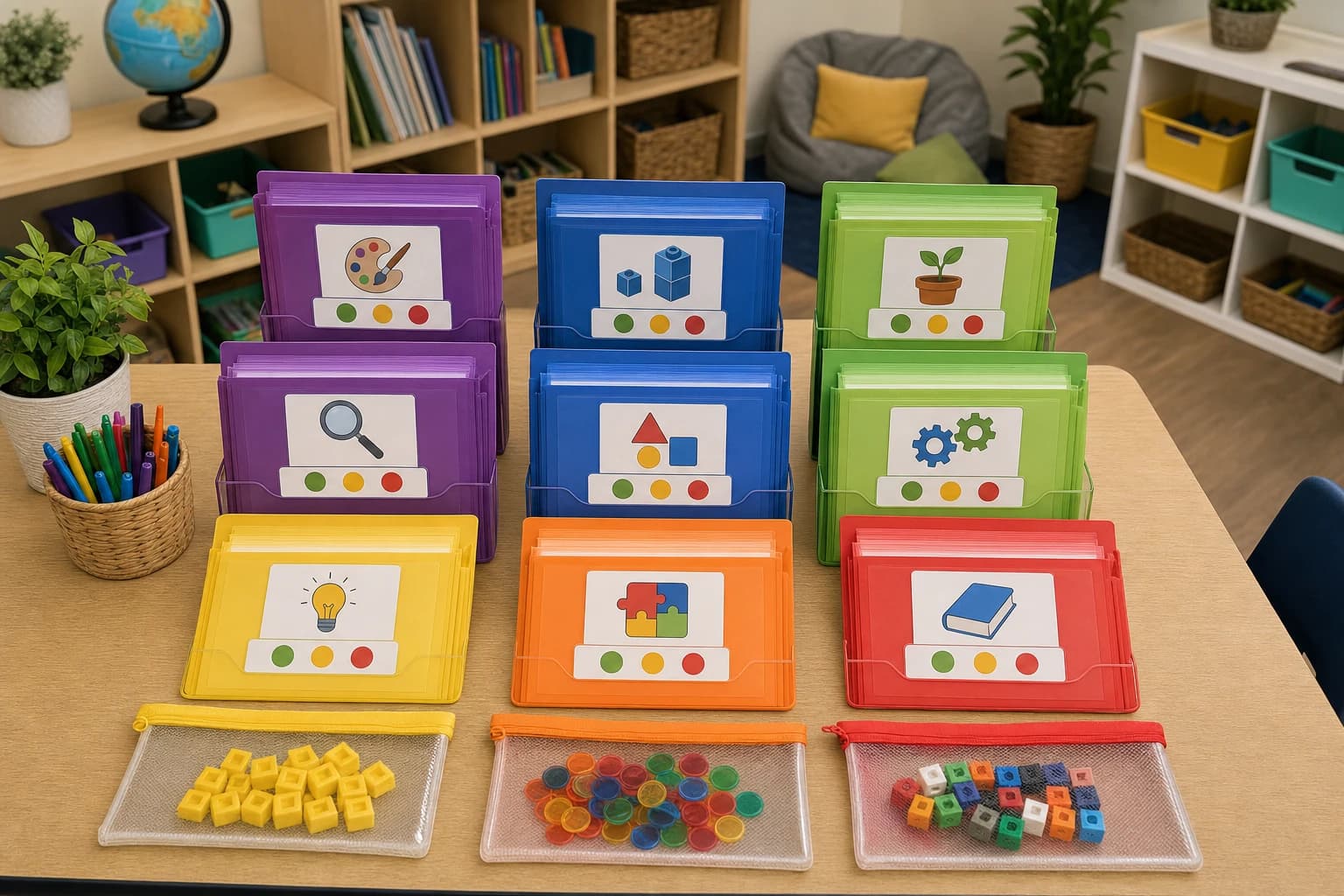
- Optional: color-coded labels for grade level, subject, or difficulty
Setup Steps
- Choose only 5 activities at first. Too many choices slow students down. Start with 2 literacy games, 2 math games, and 1 logic or spatial game.
- Label each activity with a time estimate. Use 5 minutes, 10 minutes, or keep going. This helps students choose appropriately when the class is almost ready to move on.
- Add a clear direction strip. Put 3 or 4 steps at the top of each card. Example: Spin twice. Multiply. Cover the answer. Repeat until 6 spaces are covered.
- Separate solo and partner cards. Use an S or P icon. During silent work, only solo cards are allowed. During quiet partner time, students may choose partner cards.
- Create a finished-work rule. A simple rule works best: classwork complete, name on paper, work checked, then folder.
- Teach cleanup once, explicitly. Practice returning markers, cards, and pieces before using the folders for real. Time the cleanup for 30 seconds so students understand the expectation.
Teacher Tip: Use a Noise Rating Students Can Understand
Instead of saying “be quiet,” label each activity with a level. Level 0 means silent solo work. Level 1 means whisper to one partner only. Level 2 means indoor conversation and should usually be saved for indoor recess or game time, not early finisher work.
Sample Weekly Rotation Plan
You do not need to change every activity each week. A simple rotation keeps the folder fresh without creating a Sunday-night printing project.
| Week | Keep | Swap In | Teacher Check |
|---|---|---|---|
| Week 1 | All 5 starter activities | None | Watch noise level and cleanup time |
| Week 2 | 3 strongest activities | 1 new word game and 1 new math card | Remove activities that cause questions |
| Week 3 | Best 4 activities | 1 student-created puzzle with answer key | Check that answer keys are accurate |
| Week 4 | Best 3 activities | 2 challenge cards | Decide what becomes next month’s folder |
Matching Games to Grade Levels
For grades 1 and 2, choose games with picture supports, fewer written directions, and obvious stopping points. Tangrams, pattern block cards, mystery numbers, simple word ladders, and 4 by 4 grids work well. Avoid activities that depend on long reading passages unless you can provide audio, a partner reader, or teacher support.
For grades 3 to 5, students can usually manage more open-ended challenges. Logic grids, coordinate games, number mazes, word hunts, and multi-step math spinners are better fits. Older students also enjoy designing a puzzle for a classmate, which turns an early finisher activity into a creation task without adding noise.
If you need fast whole-class fillers for transitions rather than individual desk work, see these no-equipment classroom games for 2nd to 5th grade transitions. They solve a different problem, but they pair well with a desk-game routine.
Common Mistakes to Avoid
Choosing Games That Are Quiet Only in Theory
Some games look calm but become noisy because they involve speed, competition, or pieces that scatter. Anything with slapping, racing, loud counting, or many tiny pieces should be saved for another time. For supply ideas that are better suited to indoor recess, compare this guide with affordable classroom game supplies for indoor recess.
Giving Early Finishers More Work Disguised as Fun
Students notice when every early finisher choice is just another worksheet. A good desk game can still support learning, but it should feel different from the assignment they just completed. Logic puzzles, spatial challenges, and word games create that difference.
Using Partner Games Before Expectations Are Set
Partner games can work beautifully, but not on day one. Teach solo choices first. Add partner games after students can prove they can start, play, and clean up without interrupting classmates.
Making the System Too Hard to Maintain
If a game takes longer to reset than it takes to play, it will not last. Keep extra copies in one folder, use dry-erase sleeves when possible, and avoid anything that requires daily sorting by the teacher.
Best Picks by Classroom Need
- Quietest option: mini logic puzzles, word ladders, and Sudoku-style grids.
- Best for grades 1 to 2: tangram outline cards, pattern block mats, picture sorts, and mystery numbers within 100.
- Best for grades 3 to 5: logic grids, coordinate clues, 6-step word ladders, and multiplication or fraction spinners.
- Best for mixed skill levels: tangram cards and pattern block picture challenges, because students can work at different levels with the same materials.
- Best for math practice: math fact paths, spinner games, mystery number cards, and number mazes.
- Best for vocabulary: letter grid word hunts, word ladders, and category card sorts.
- Best partner choice: dot grid boxes or silent tic-tac-toe variations, because the rules are short and turns are clear.
- Best no-prep backup: dot grids, word hunts, and one-page mazes.
For days when students need movement instead of desk work, keep a separate plan. These indoor PE games for elementary students in small spaces are better for active time than for independent early finisher work.
FAQ
What are the best quiet desk games for early finishers who finish in only 5 minutes?
Choose games with tiny rounds: dot grids, 4 by 4 Sudoku, mystery number cards, word ladders, and 10-space math fact paths. Avoid games with long setup or no clear stopping point.
Should early finisher games be graded?
Usually, no. If students think every game will be graded, the activity may create more questions and stress. You can occasionally review notebooks or puzzle sheets for effort, but the main purpose is meaningful independent engagement.
How many early finisher activities should I offer at once?
Start with 5 choices. That is enough variety without overwhelming students. Rotate 1 or 2 choices every 1 to 2 weeks instead of replacing the entire system.
Can first graders use independent desk games?
Yes, if the directions are visual and the materials are simple. Tangrams with outline cards, pattern blocks, picture sorts, simple number paths, and basic word-building cards are more appropriate than text-heavy puzzles.
How do I stop early finisher games from distracting students who are still working?
Use solo games during independent work time, require Level 0 noise, and keep materials inside the desk or folder. Save partner games for times when most students have finished or when the class routine allows quiet collaboration.
What should I do if students rush their classwork to play the games?
Use a finished-work rule: name on paper, directions followed, work checked, then folder. If rushing continues, limit that student to a short reflection, correction check, or teacher-approved Level 0 card until the routine improves.
Conclusion
The best elementary school desk activities for early finishers are not the flashiest games. They are the ones students can take out, understand, play quietly, and put away without slowing down the rest of the class.
Start small with a folder of 5 reliable options: one logic puzzle, one word game, one math path, one spatial challenge, and one carefully managed partner game. Once students know the routine, you can rotate in new early finisher activities without rebuilding your system from scratch.