Early finishers can be a gift or a management challenge. In kindergarten, first grade, and second grade, a child who finishes ten minutes early may need something purposeful to do while others are still writing, counting, reading, or getting help. The best quiet classroom games for early finishers are simple enough to teach once, quiet enough for seatwork time, and flexible enough to reuse all year.
This guide organizes 18 games into independent, partner, and small-group options. Each one is designed for low noise, limited movement, and easy cleanup. You will also find a setup routine, a quick comparison table, common mistakes to avoid, and adaptations for different K–2 learners.
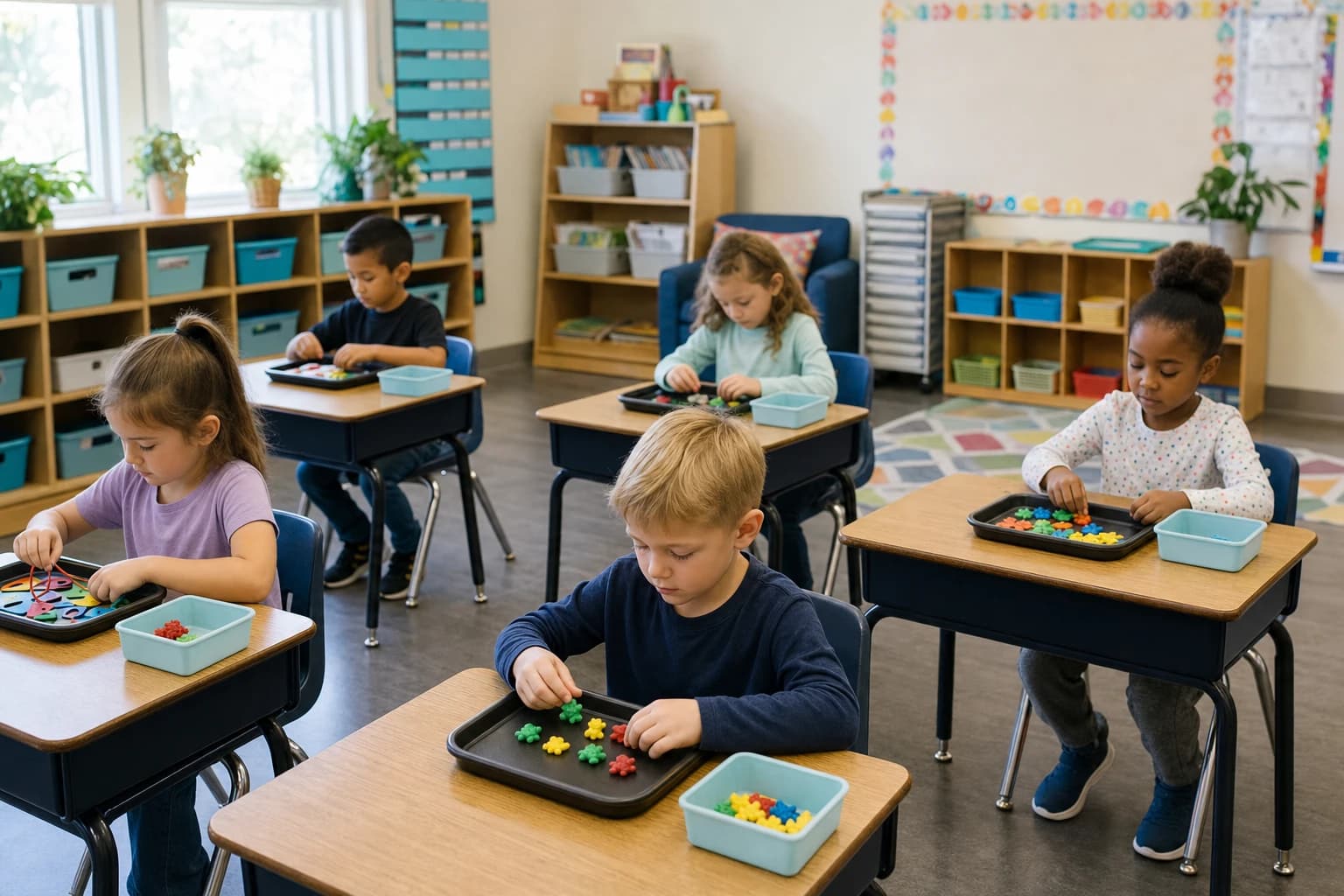
What makes an early-finisher game classroom-friendly?
A good early-finisher activity is not just quiet. It also needs to be predictable. Young students should know where to get it, where to play it, what voice level to use, and what to do if a piece is missing. If those routines are unclear, even a calm game can interrupt your small group, conference, or lesson cleanup.
For K–2 classrooms, aim for games that meet these four conditions:
- Low voice requirement: whisper, gesture, or silent play only.
- Short play time: playable in 5 to 12 minutes without needing a full lesson period.
- Simple materials: one folder, tray, bag, or small bin per game.
- Clear finish point: students can complete a round, record a score, or reset the materials quickly.
Play is also an appropriate way for young children to practice language, problem-solving, and self-regulation. The National Association for the Education of Young Children notes that play supports learning across multiple developmental areas when it is meaningful and well supported. You can read more from NAEYC here: NAEYC resources on play.
If you teach older students too, you may want a separate set of games with more academic challenge. For grades 3–5, see educational indoor classroom games for grades 3–5.
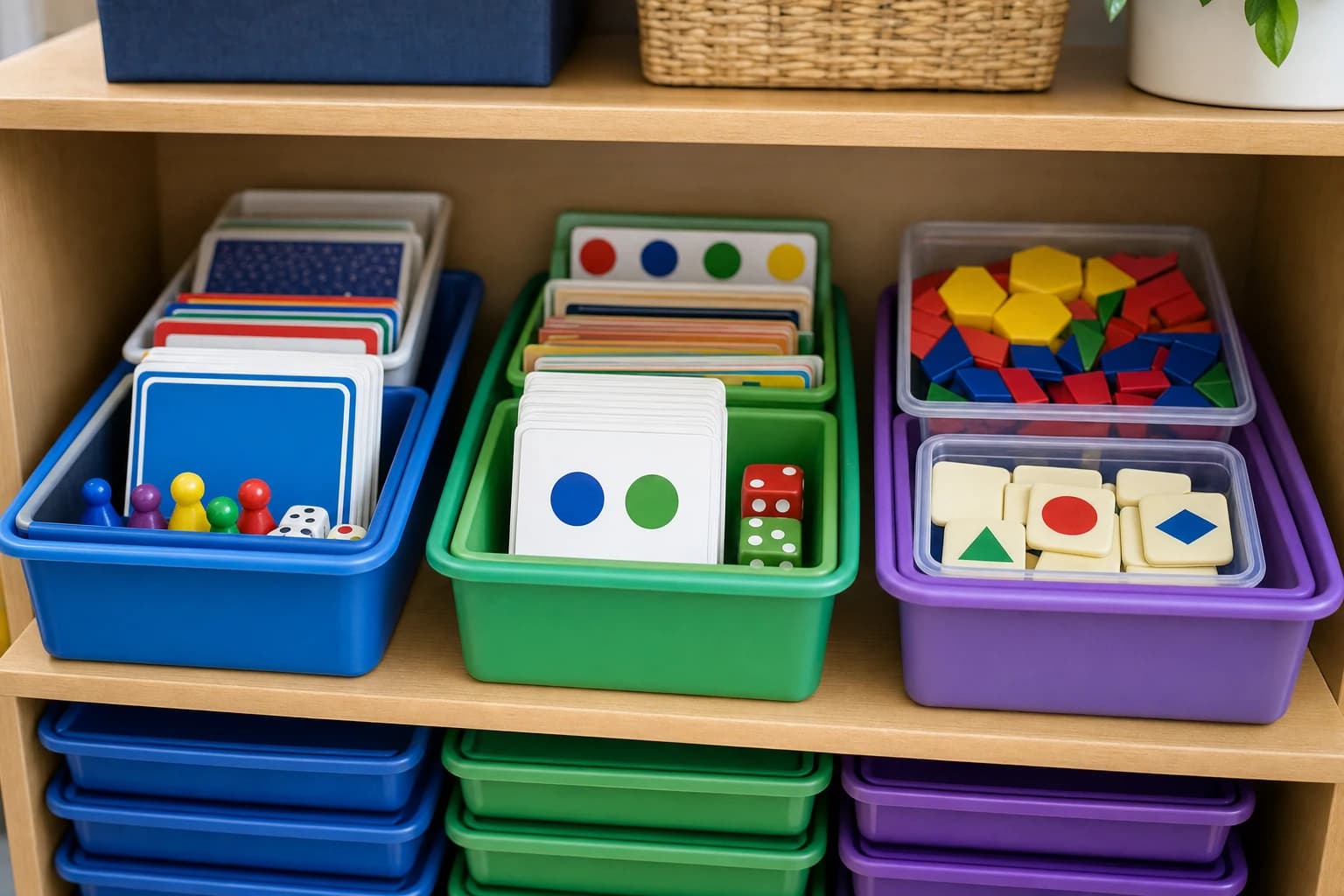
Simple materials and storage system
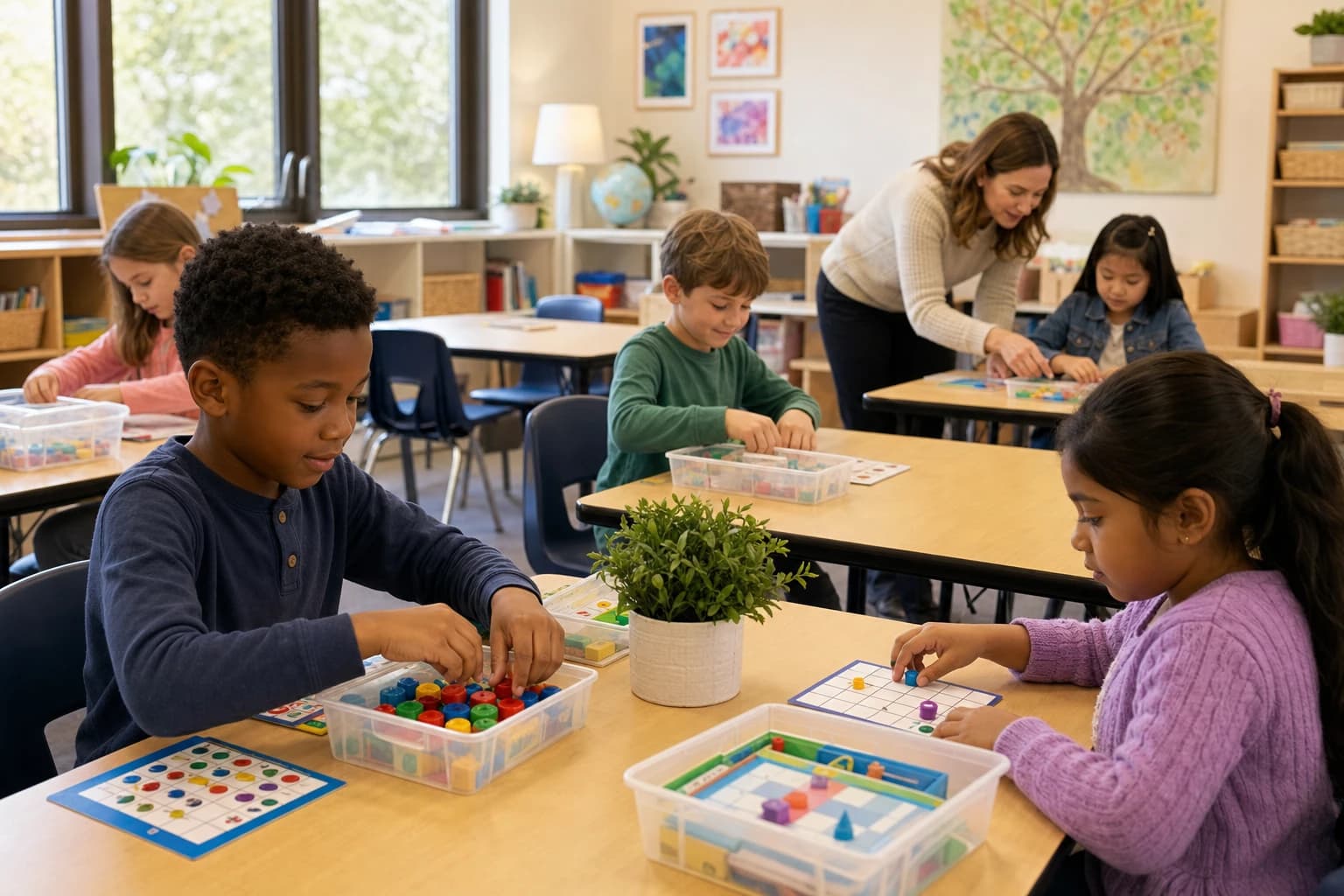
You do not need a large game closet. A small set of reusable materials can cover most early finisher activities K–2 students enjoy.
Basic materials list
- 6 to 10 plastic zipper pouches or photo boxes
- Index cards, half sheets, or laminated task cards
- Dry-erase sleeves or page protectors
- Mini dry-erase markers and small erasers
- Dice with dots, dice with numbers, or paper dice templates
- Dominoes, pattern blocks, linking cubes, letter tiles, and number cards
- Small sand timer or visual timer, optional
- One-page recording sheets, optional for accountability
Label each game with three pieces of information: number of players, voice level, and cleanup rule. For example: 1 player, silent, return all 24 cards to the pouch. That one label prevents many interruptions.
Teach the routine once, then reuse it all year
Before introducing several games, teach the early-finisher routine as its own mini-lesson. Keep it short and practice it when no one is rushing.
- Finish the assigned work. Students check that their name is on the paper and the required parts are complete.
- Choose from the approved area. Use one shelf, one basket, or one menu board. Avoid open-ended wandering.
- Play in the assigned spot. Independent games stay at the desk. Partner games use a partner spot. Small-group games use a table or carpet square only if you allow it.
- Use the voice level. Silent means no talking. Whisper means only the partner can hear.
- Reset before returning. Cards face the same way, lids closed, pieces counted if needed.
- Switch only when a round is finished. This prevents students from sampling five games in five minutes.
Practice the wrong way and the right way for getting a game, asking to join, and cleaning up. Young students often need to see exactly what quiet looks like: hands busy, bodies still, and voices off or very low.
Quick comparison of the 18 games
| Game | Best for | Players | Materials | Noise level |
|---|---|---|---|---|
| Picture Sort Mats | Vocabulary and categories | 1 | Picture cards, mats | Silent |
| Pattern Block Challenge | Spatial reasoning | 1 | Pattern blocks, cards | Silent |
| Domino Match-Up | Counting and number matching | 1 | Dominoes, number cards | Silent |
| Letter Tile Build | Phonics and spelling | 1 | Letter tiles, word cards | Silent |
| Ten-Frame Cover | Number sense | 1 | Ten-frame cards, counters | Silent |
| Silent Puzzle Swap | Logic and persistence | 1 | Small puzzles | Silent |
| Roll and Write Race | Math fluency | 2 | Dice, recording sheet | Whisper |
| Sight Word Tic-Tac-Toe | Word recognition | 2 | Grid, word cards | Whisper |
| Memory Match Mini | Memory and matching | 2 | 12 to 20 cards | Whisper |
| Guess My Shape | Geometry language | 2 | Shape cards | Whisper |
| Partner Build and Copy | Visual discrimination | 2 | Cubes or blocks | Whisper |
| Number Line Hop on Paper | Addition and subtraction | 2 | Paper number line, cards | Whisper |
| Quiet Card Sort Relay | Sorting and cooperation | 3–4 | Cards, sorting mats | Low voice |
| Tabletop I Spy | Observation and vocabulary | 3–4 | Picture mat or tray | Low voice |
| Story Sequence Cards | Oral language | 3–4 | Sequence cards | Low voice |
| Quiet Math Market | Counting and exchange | 3–4 | Price cards, counters | Low voice |
| Category Captain | Vocabulary and flexible thinking | 3–4 | Category cards | Low voice |
| Build a Pattern Chain | Patterns and teamwork | 3–4 | Blocks or tiles | Low voice |
Independent quiet classroom games for early finishers
Independent games are the easiest place to start because they do not require partner matching or turn-taking. They are ideal during writing conferences, reading groups, tests, or any time you need the room especially calm.
1. Picture Sort Mats
Give students 12 to 20 picture cards and two or three sorting mats. Examples include animals and not animals, beginning sound /m/ and not /m/, living and nonliving, or foods by color. Kindergarten students can sort by obvious attributes, while second graders can sort by phonics patterns or science vocabulary. Add a blank card that says my rule for students who are ready to create their own category.
2. Pattern Block Challenge
Place 6 to 12 pattern blocks in a pouch with a challenge card. A card might say, Make a flower using 2 hexagons, 4 triangles, and 2 trapezoids. For younger students, use picture outlines. For first and second grade, use written constraints so they practice reading directions and planning.
3. Domino Match-Up
Students choose a domino, count the dots, and match it to a number card or addition sentence. A domino with 3 dots and 4 dots can match 7, 3 + 4, or one more than 6. This is quiet, tactile, and easy to reset. Use only a small set of dominoes so cleanup stays manageable.
4. Letter Tile Build
Put 8 to 12 letter tiles in a bag with picture or word cards. Students build CVC words, names, spelling words, or word families. To keep it independent, include a small answer strip or picture support. This works well as one of your regular quiet games for kindergarten classroom literacy centers.
5. Ten-Frame Cover
Students draw a number card and cover that amount on a ten-frame with counters. First graders can use two ten-frames for teen numbers. Second graders can use ten-frames to show addition facts, such as 8 + 5, by filling one ten-frame and part of another.
6. Silent Puzzle Swap
Use mini puzzles with 12 to 24 pieces, self-correcting letter puzzles, number-order puzzles, or cut-apart sentence puzzles. The key is to store one puzzle per pouch and add a finished picture if the puzzle is not self-explanatory. When finished, students raise a hand signal or simply return it and choose another approved independent game.
Partner games that stay quiet
Partner games add social practice, but they need very clear rules. Use them only after students can handle independent choices. Teach a partner voice as only your partner can hear you, not across-the-table talking.
7. Roll and Write Race
Two students share one die and each has a small recording sheet. They roll, write the number, and color a box. Kindergarten students can race to fill six boxes. First and second graders can add two dice, compare sums, or write one more and one less. Keep the word race light: the real goal is finishing a neat sheet without shouting.
8. Sight Word Tic-Tac-Toe
Instead of X and O, students place sight word cards on a 3-by-3 grid. To claim a space, the student reads the word quietly. If reading aloud would disturb others, have students trace the word with a finger and whisper it to the partner. Swap in letter names, digraphs, math facts, or vocabulary pictures.
9. Memory Match Mini
Use only 6 to 10 pairs, not a full deck. Students turn over two cards, keep matches, and reset the game when finished. Matching options include uppercase and lowercase letters, number and ten-frame, rhyming pictures, shape and shape name, or word and picture. Fewer cards mean less frustration and faster cleanup.
10. Guess My Shape
One student chooses a shape card and the partner asks yes-or-no questions: Does it have corners? Does it have four sides? Is it flat? This is a strong low noise classroom activity because it builds math language without needing many pieces. For second grade, include 3D shapes such as cube, cone, cylinder, and sphere.
11. Partner Build and Copy
Student A builds a small design behind a folder using 5 to 10 linking cubes. Student B builds what they think is the same design based on a quick look or quiet description. Then they compare and switch roles. To make it calmer, allow one silent look for five seconds instead of verbal directions.
12. Number Line Hop on Paper
Give partners a laminated number line from 0 to 20 and a small counter. One student draws a card such as start at 6, hop forward 3. The partner moves the counter and says or writes the landing number. Use backward hops for subtraction and number lines to 100 for second grade.
For more small-space options beyond the school day, you may also like indoor games for 10 people in a small room.
Small-group early finisher activities K–2 students can handle
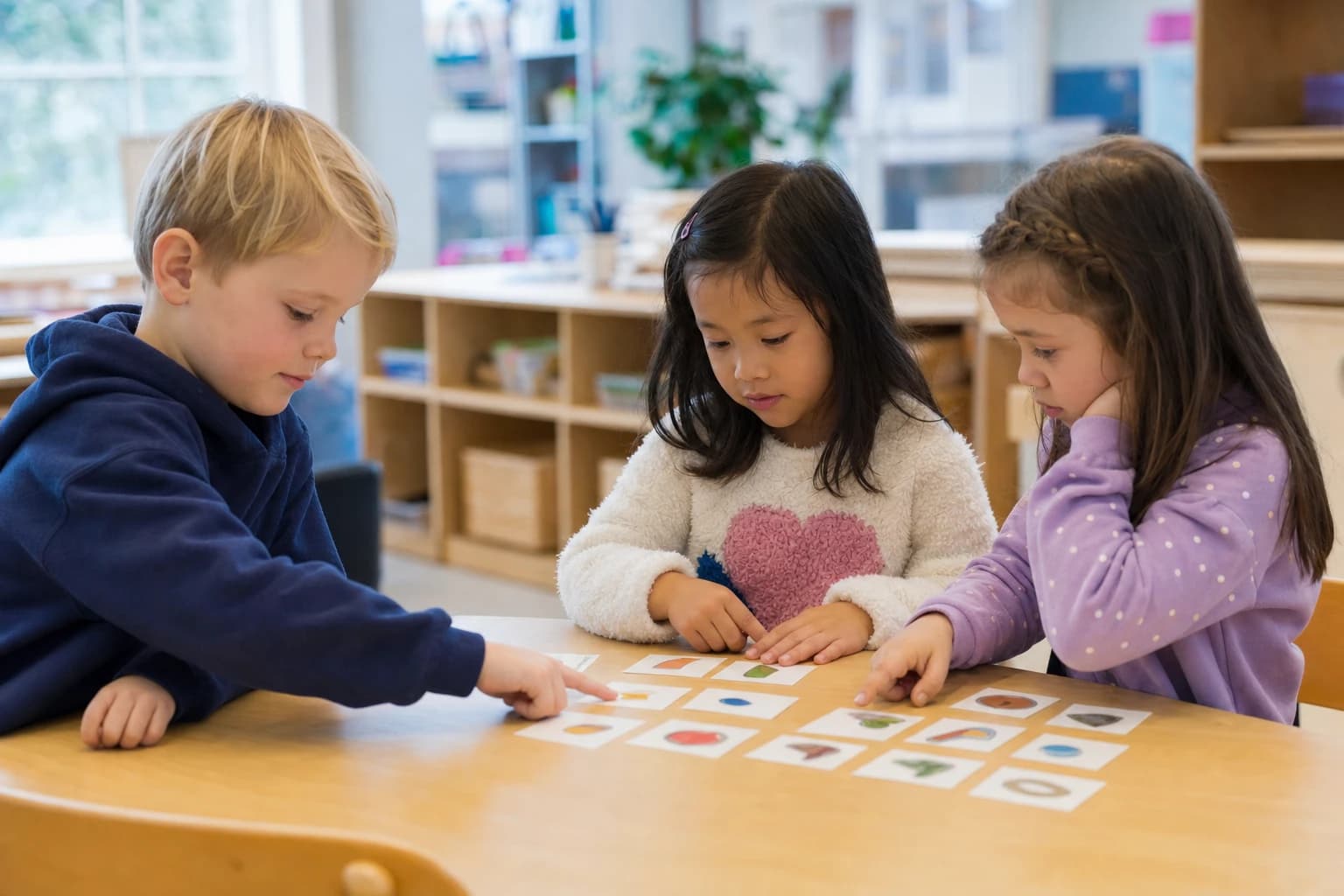
Small-group games are useful when several students finish at the same time. Keep groups to three or four students. Larger groups often become louder, and one child usually ends up waiting too long for a turn.
13. Quiet Card Sort Relay
Place a stack of 24 cards in the center with sorting mats around it. Students take turns placing one card on a mat. There is no running and no timed pressure; the word relay simply means one turn at a time. Try sorting nouns and verbs, even and odd numbers, short and long vowel words, or needs and wants.
14. Tabletop I Spy
Use a detailed picture mat, a tray of classroom objects, or a printed scene. One student says, I spy something that begins with /s/ or I spy something with three corners. Others point instead of shouting. This keeps the game quiet and lets students practice vocabulary, phonemic awareness, and visual attention.
15. Story Sequence Cards
Give the group 3, 4, or 6 picture cards that tell a simple story. Students work together to put them in order, then one student quietly retells the story using first, next, then, and last. Kindergarten may need three-card sets. Second grade can add a written sentence for each card.
16. Quiet Math Market
Create simple item cards with prices from 1 to 10 cents or 1 to 20 cubes. One student is the shopkeeper and others choose an item and pay with counters. This is pretend play with math boundaries. Keep prices whole and materials limited: 8 item cards, 20 counters, and one small tray are enough.
17. Category Captain
One student draws a category card, such as animals, things you read, words with ch, or numbers greater than 20. The group takes turns adding examples. Students can pass by placing a finger on the table rather than saying anything. After one round, a new captain draws a new category.
18. Build a Pattern Chain
Students use blocks, cubes, or colored tiles to build one shared pattern chain. The first student starts with AB, AAB, ABC, or another pattern shown on a card. Each student adds the next piece. If someone notices an error, they use a quiet signal, such as tapping the card, and the group fixes it together.
How to choose the right game for the moment
Not every quiet game fits every part of the day. Use a simple decision rule so students do not need to ask permission repeatedly.
- During assessments or teacher conferences: independent silent games only.
- During regular seatwork: independent or partner games, depending on your class routine.
- During center rotation cleanup: partner or small-group games at a table.
- During indoor recess: small-group games can work, but you may want a different menu with more choice. For younger children at home or preschool, see quiet indoor games for preschoolers on rainy days.
A visual menu helps. Make three columns labeled 1 player, 2 players, and 3–4 players. Clip available games under each column. If a game is too noisy that week, remove it temporarily instead of giving repeated reminders.
Common mistakes to avoid
Offering too many choices at once
Young students may spend more time choosing than playing. Start with three independent games and one partner game. Add more only when students can use the first set responsibly.
Using games with too many loose pieces
A 100-piece building set may be fun, but it is rarely ideal for a five-minute early-finisher window. Use small portions: 10 cubes, 12 cards, or one mini puzzle. If cleanup takes longer than play, the game is too big for this purpose.
Skipping the reset rule
Every game needs a clear ending. Students should know whether to shuffle cards, stack mats, erase boards, or count pieces. Add a picture label inside each pouch for nonreaders.
Letting partner games become social time
Some students can handle quiet games with a friend; others cannot yet. If a pair gets loud, move them back to independent games for a few days. Frame it as practice, not punishment.
Choosing games that require constant adult checking
Independent classroom games should include self-checking features when possible: matching backs, answer strips, color codes, or obvious puzzle fits. If students need you after every turn, the activity will not solve the early-finisher problem.
FAQ: Quiet early-finisher games for K–2
How many early-finisher games should I put out at one time?
For most K–2 classrooms, start with 4 to 6 choices total. A small menu is easier to teach, monitor, and reset. Rotate new games in when students show they can handle the routine.
Should early finishers always play academic games?
No. Some games can review reading or math, while others can build logic, fine motor skills, visual discrimination, or cooperation. The activity should be purposeful, but it does not always need to look like a worksheet.
What if the same students finish early every day?
Offer a mix of extension and practice. For example, a second grader who finishes math quickly might use a challenge pattern, a harder number line card, or a logic puzzle rather than repeating the same basic fact game daily.
How do I keep kindergarten partner games from getting noisy?
Teach partner games after students master independent games. Use very short rounds, model whisper voices, and limit partners to two students. If whispering is still difficult, switch that game to a silent pointing or matching version.
Are worksheets better because they are quieter?
Worksheets can be useful, but they are not the only quiet option. Hands-on games can keep students engaged while practicing academic and social skills. The key is a predictable routine and materials that students can manage without interrupting instruction.
Conclusion
Quiet classroom games for early finishers work best when they are treated as a routine, not a reward bin with random extras. Start small, label clearly, and separate games by independent, partner, and small-group use. When students know the expectations, these low noise classroom activities can give fast finishers something meaningful to do while the rest of the class gets the time and support they need.
Choose three games from the independent list first, teach the routine carefully, and add partner or small-group options only when the class is ready. A calm early-finisher system is built one simple, reusable game at a time.