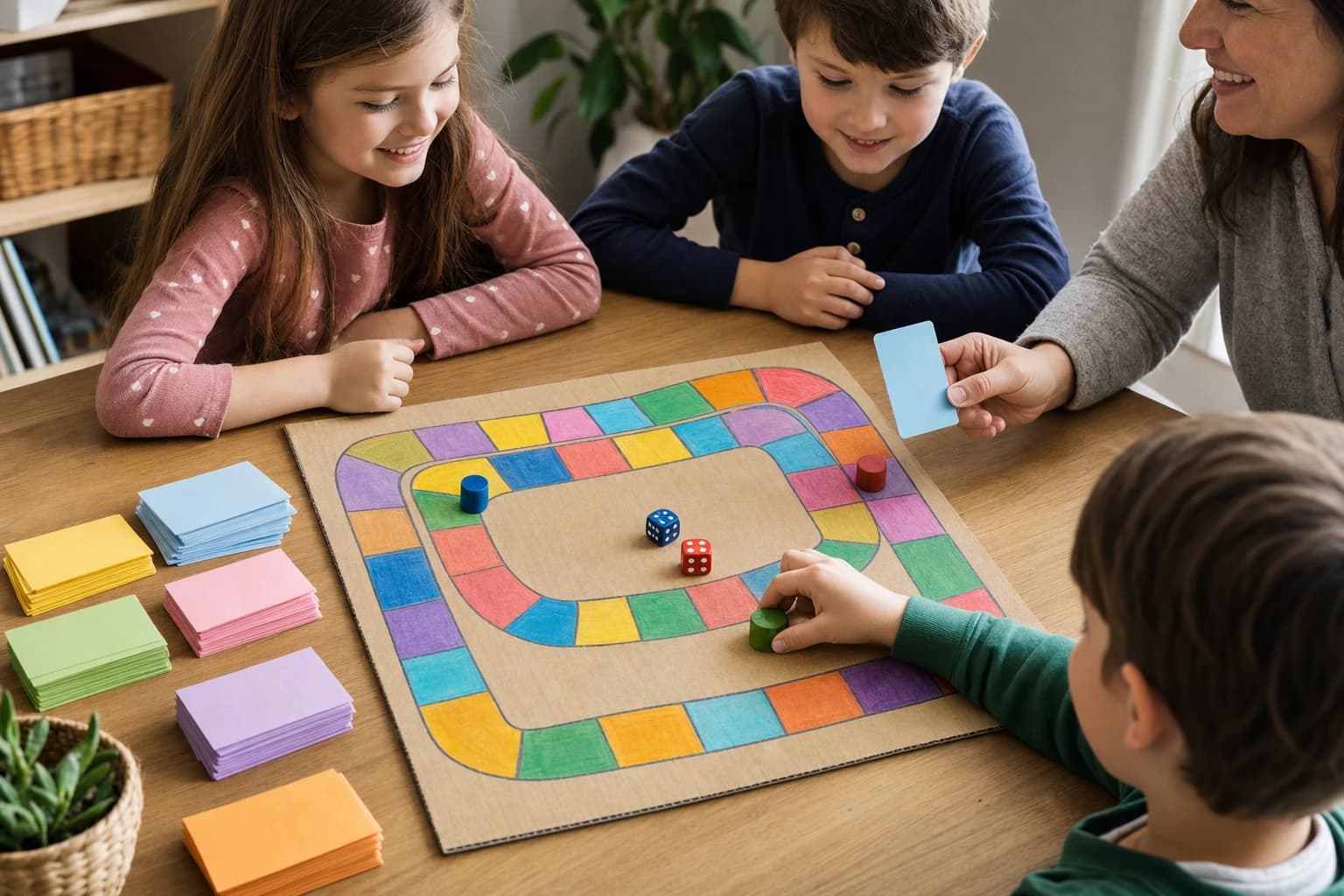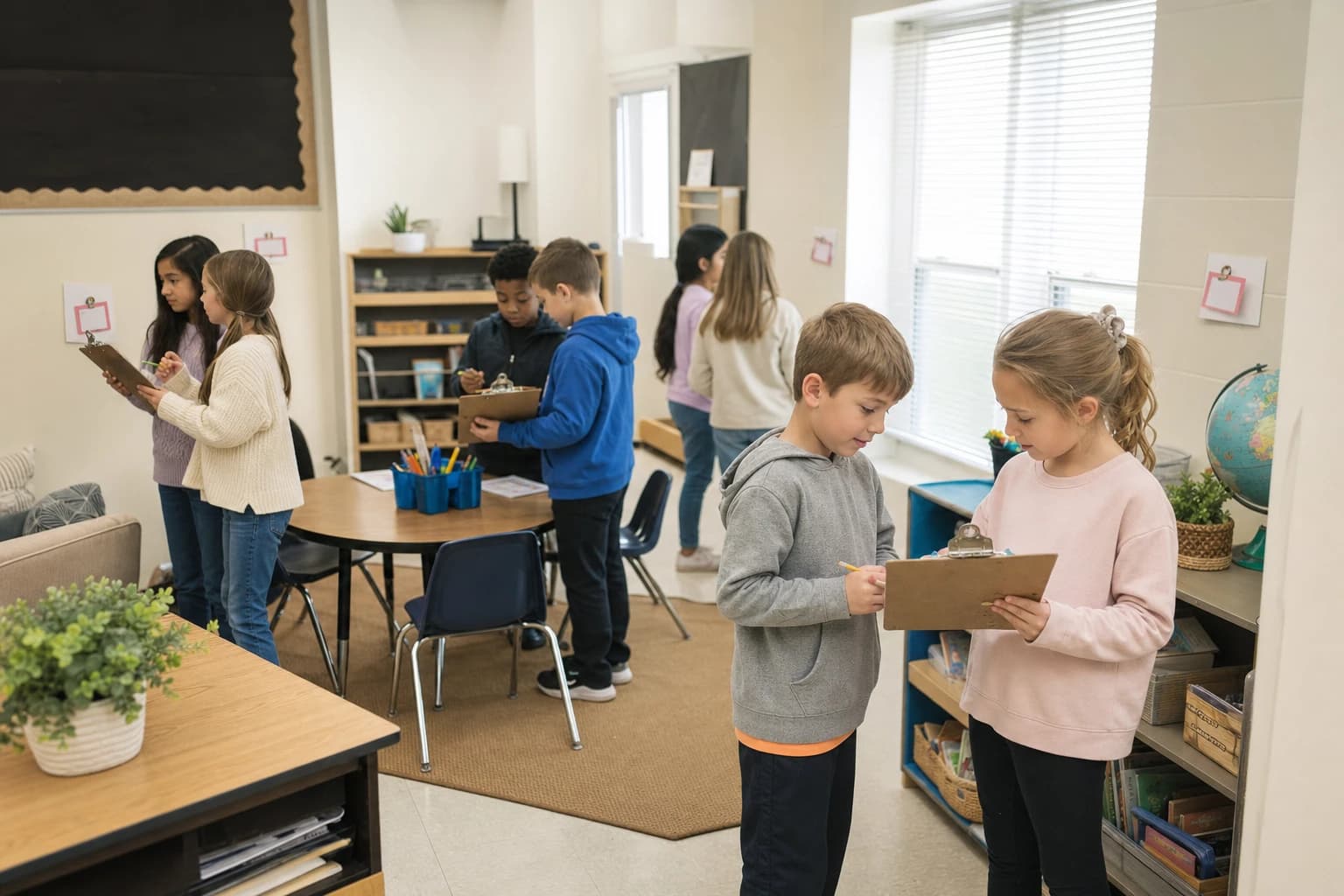

Transitions can eat up a surprising amount of class time: lining up, waiting for a restroom group to return, switching from math to reading, or filling the last four minutes before dismissal. The best no equipment classroom games for elementary students are short, clear, and easy to stop the moment you need attention again.
This guide is built for grades 2 to 5. Each game includes noise level, time needed, best class size, and whether students can play from their seats, so you can choose one quickly without hunting for supplies.

Quick chooser: pick a game by noise level and time
For classroom transitions, the goal is not to start a full lesson or a long competition. A good transition game should have one main rule, take five minutes or less, and work even if a few students are still getting settled.
| Need right now | Best noise level | Try these games | Works from seats? |
|---|---|---|---|
| Class is too loud and needs to reset | Silent | Mirror Leader, Secret Pattern, Silent Categories | Yes |
| You have 2 minutes before the next group returns | Quiet | Number Fingers, Last Letter Line, Odd One Out | Yes |
| Students need a thinking break | Low to medium | 20 Questions, One-Word Story, Categories Countdown | Yes |
| Students have been sitting too long | Low movement | Stand/Sit True-False, Human Clock, Desk Island | Usually |
| You are lining up or waiting at the door | Quiet | Invisible Ball, Beat the Count, Silent Line-Up | No |
For more academic-style options that still avoid worksheets, see Educational Indoor Classroom Games for Grades 3–5. If you need small-space ideas beyond school, Indoor Games for 8-Year-Olds With No Equipment also has useful overlap.
How to run transition games without losing control
Materials: none. These elementary school games use no materials, no paper, no cards, and no devices.
Best ages: 2nd, 3rd, 4th, and 5th grade. For younger 2nd graders, keep rules to one step. For older 5th graders, add challenge by using vocabulary, math facts, or stricter time limits.
- Name the boundary first. Say, “You may play from your seat,” or “You may stand behind your chair only.” This prevents a quiet game from turning into a wandering game.
- Set the time limit before starting. Use clear wording such as, “We are playing for three rounds,” or “We stop when I raise my hand.”
- Teach the stop signal. A raised hand, countdown from five, or silent finger signal works better than trying to talk over the game.
- Choose participation over elimination. During transitions, avoid games where students sit out for several minutes. If a student misses, have them switch roles, become a judge, or rejoin next round.
- Keep movement safe and inclusive. The CDC notes that school-day physical activity can include classroom activity, but it does not have to be intense or disruptive. Simple standing, stretching, and controlled movement can be enough for a short break. See the CDC overview of school physical activity at cdc.gov.

25 no-equipment classroom transition games
The games below are grouped loosely from quietest to most active. Use the labels as a fast decision tool, not as rigid rules. A confident class may handle “medium” games quietly; an excited class may need silent options first.
1. Mirror Leader
Noise: silent. Time: 2–4 minutes. Class size: 6–30. From seats: yes.
Students silently copy your slow movements: tap shoulders, raise eyebrows, make tiny circles with wrists, or stretch hands upward. After one round, choose a student leader. Keep movements small enough for desks and chairs. This is useful after recess or lunch because it lowers the volume without requiring a lecture.
2. Secret Pattern
Noise: silent. Time: 2–3 minutes. Class size: any. From seats: yes.
Create a silent pattern with hands: clap silently, tap head, cross arms, thumbs up. Students copy and try to predict the next move. For 4th and 5th grade, use longer repeating patterns such as A-B-B-C. End by asking one student to explain the pattern in a sentence.
3. Silent Categories
Noise: silent to whisper. Time: 3–5 minutes. Class size: 10–30. From seats: yes.
Call a category such as “animals with four legs,” “things that are blue,” or “multiples of 5.” Students show one finger when they have an answer. Point to a few students to whisper or say their answer. Repeat with faster categories.
4. Statue Switch
Noise: silent. Time: 2 minutes. Class size: any. From seats: yes.
Students freeze like statues. When you say “switch,” they silently change to a new statue pose. Add themes: weather, sports, book characters, punctuation marks, or emotions. This gives movement without running.
5. Number Fingers
Noise: silent. Time: 1–3 minutes. Class size: any. From seats: yes.
Ask quick questions with number answers from 0 to 10. Students answer with fingers held at chest level. Examples: “How many syllables in banana?” “What is 3 plus 4?” “How many sides on a hexagon?” It is fast, quiet, and easy to connect to review.
6. Invisible Ball
Noise: silent to low. Time: 2–4 minutes. Class size: 8–30. From seats: yes or line.
Students pretend to pass an invisible ball. The “ball” can become heavy, tiny, sticky, bouncy, or hot. The receiver must react before passing it on. This works especially well while waiting in line because hands stay controlled and no object can roll away.
7. Alphabet Eyes
Noise: silent. Time: 2–3 minutes. Class size: any. From seats: yes.
Students look around the room and silently find something beginning with A, then B, then C. When time ends, invite three students to share the hardest letter they reached. For an added rule, objects must be visible from the student’s seat.
8. Would You Rather: Fingers Edition
Noise: low. Time: 2–5 minutes. Class size: any. From seats: yes.
Give two choices. Students hold up one finger for option one or two fingers for option two. Try school-safe prompts: “Would you rather read outside or read in a blanket fort?” “Would you rather have art every day or music every day?” Let one student explain their choice in one sentence.
9. Last Letter Line
Noise: low. Time: 3–5 minutes. Class size: 8–30. From seats: yes.
Start with a word, such as “planet.” The next student says a word beginning with the last letter: turtle, elephant, tiger. Use a theme to make it academic: science words, adjectives, book titles, or geography.
10. Odd One Out
Noise: low. Time: 2–4 minutes. Class size: any. From seats: yes.
Say three items: “triangle, square, apple.” Students show thumbs up when they know the odd one out. Ask for the answer and the reason. The reasoning matters more than the answer, so accept creative explanations if they make sense.
11. Teacher Says
Noise: low. Time: 2–5 minutes. Class size: any. From seats: yes.
This is a classroom version of Simon Says. Use small actions: “Teacher says touch your elbow,” “Teacher says blink twice,” “Fold your hands.” If students move when you did not say “Teacher says,” they do not sit out; they simply reset and keep playing.
12. Word Chain Whisper
Noise: whisper. Time: 3–5 minutes. Class size: 6–25. From seats: yes.
One student says a word quietly. The next student says a related word: ocean, wave, surf, sand, castle. If the connection is unclear, the student explains it in five words or fewer. This builds vocabulary while staying calm.
13. Three-Clue Guess
Noise: low. Time: 3–5 minutes. Class size: any. From seats: yes.
Think of a classroom object, animal, book character, or vocabulary word. Give three clues, one at a time. Students put a thumb to their chest when they think they know it. This prevents blurting and lets more students think.
14. Quick Compliment Circle
Noise: low. Time: 3–5 minutes. Class size: 8–25. From seats: yes.
Students give short, specific compliments around the room: “I liked how Maya shared the scissors,” or “Eli helped our table clean up.” Keep the sentence frame visible verbally: “I noticed ___.” Skip anyone who looks uncomfortable and return later if they want a turn.
15. 20 Questions: Classroom Version
Noise: medium. Time: 5 minutes. Class size: any. From seats: yes.
Choose a word connected to the current unit. Students ask yes-or-no questions only. Limit the class to 10 questions for a true transition version. Good categories include animals, states, polygons, story characters, and science tools.
16. One-Word Story
Noise: medium. Time: 3–5 minutes. Class size: 6–30. From seats: yes.
Each student adds exactly one word to a class story. Start with “Yesterday” or “The dragon.” If the story gets silly, set a genre: mystery, realistic fiction, adventure, or informational report. Stop after one lap or when the sentence becomes complete.
17. Fortunately, Unfortunately
Noise: medium. Time: 4–5 minutes. Class size: 8–25. From seats: yes.
Students alternate sentence starters. One says, “Fortunately, the class found a map.” The next says, “Unfortunately, the map was upside down.” This encourages listening because each sentence must connect to the one before it.
18. Beat the Count
Noise: low to medium. Time: 1–3 minutes. Class size: any. From seats: yes or line.
The class counts from 1 to 20, but only one person may speak at a time. If two students speak together, restart at 1. For a quieter version, students raise a hand before saying a number. It is simple, but it builds patience quickly.
19. Categories Countdown
Noise: medium. Time: 3–5 minutes. Class size: any. From seats: yes.
Give a category and a number: “Name seven foods that start with S” or “Name five nouns you might find in a park.” Students answer one at a time until the class reaches the number. Avoid turning it into a speed-shouting contest by requiring raised hands.
20. Synonym Sprint, No Running
Noise: medium. Time: 3–5 minutes. Class size: 8–30. From seats: yes.
Say a common word such as big, happy, said, cold, or fast. Students take turns giving synonyms. If a student is stuck, they may say “pass” and rejoin on the next word. For 5th grade, try antonyms or shades of meaning.

21. Stand/Sit True-False
Noise: low. Time: 2–5 minutes. Class size: any. From seats: partly.
Say a statement. Students stand for true and sit for false. Use review facts: “A square is always a rectangle,” “The word quickly is an adverb,” or “Plants need light.” Students who prefer not to stand can show thumbs up or thumbs down.
22. Human Clock
Noise: low. Time: 2–4 minutes. Class size: any. From seats: yes.
Students use their arms as clock hands. Call times such as 3:00, 6:30, 9:15, or 12:45. For older students, ask elapsed-time questions: “Show the time 15 minutes after 2:30.” Keep arms close to the body.
23. Silent Line-Up Challenge
Noise: silent. Time: 3–5 minutes. Class size: 8–30. From seats: no.
Students line up silently by birthday month, first-name alphabet, shoe color from light to dark, or number of letters in their name. If space is tight, have only one table group play at a time. This is ideal before leaving the room.
24. Four Corners, Imaginary Version
Noise: low to medium. Time: 3–5 minutes. Class size: 10–30. From seats: optional.
Instead of walking to corners, students choose with fingers 1, 2, 3, or 4. Ask questions with four options: favorite season, best reading spot, preferred math tool, or which character made the wisest choice. If the room allows movement, students may walk calmly to labeled corners you name aloud.
25. Desk Island Directions
Noise: low. Time: 2–4 minutes. Class size: any. From seats: yes.
Students imagine their desk area is an island. Give tiny direction challenges: “Point north,” “Make a bridge with your hands,” “Show a mountain with your elbows,” “Freeze like a lighthouse.” This gives a playful movement break while keeping every student in a personal space.
If your room is very small or you need no-running indoor options for mixed ages, you may also like Indoor Games for 10 People in a Small Room. For outdoor breaks, No-Equipment Tag Games for Elementary School Recess covers higher-energy choices better suited to open space.
Common mistakes to avoid
- Starting with a complicated game. During a transition, students are already shifting attention. One rule is usually enough.
- Letting the game decide the schedule. If the next lesson is ready, stop the game. Do not wait for a perfect ending.
- Using elimination too often. Eliminated students often become side conversations. Let students reset instead.
- Choosing movement when the room is crowded. Use seated versions when backpacks, chairs, or tables reduce space.
- Ignoring volume labels. “Quick” does not always mean “quiet.” If the hallway next door is testing, choose silent games only.
Simple adaptations for different learners
Offer more than one way to respond: fingers, thumbs, eye gaze, whispering to a partner, standing, or staying seated. For students who need processing time, say the prompt twice and wait three quiet seconds before taking answers. For students who are easily overstimulated, choose predictable games such as Number Fingers, Teacher Says, or Human Clock instead of open-ended story games.
FAQ: no-equipment classroom games for elementary transitions
What is the best game for a noisy class?
Start with a silent copying game such as Mirror Leader or Secret Pattern. Students do not need to talk, and you can slow your movements to bring the room’s energy down.
How long should a classroom transition game last?
Most transition games work best in 2 to 5 minutes. If it takes longer than one minute to explain, save it for a planned indoor recess or morning meeting.
Can these games work for both 2nd and 5th grade?
Yes, but adjust the thinking level. A 2nd grade category might be “animals,” while a 5th grade category might be “organisms in a food chain” or “words with Greek roots.”
What if students get too competitive?
Remove points and use class challenges instead. For example, “Can we reach 20 without two people talking at once?” is usually calmer than team scoring.
Are movement games safe in a classroom?
They can be, if movement is controlled and space is clear. Avoid running, chasing, jumping near desks, or blindfold-style games. Always provide a seated option.
Conclusion
The most useful classroom transition games are not the flashiest ones. They are the games you can explain in one sentence, stop in five seconds, and adapt for the space you actually have. Keep a short list of silent, seated, low-noise, and movement choices, and you will be able to match the game to the moment instead of forcing one activity to fit every transition.
Start with three dependable options: Mirror Leader for calming down, Number Fingers for quick review, and Stand/Sit True-False when students need to move. Once students know the routines, these quick classroom games can turn awkward waiting time into something focused, social, and manageable.