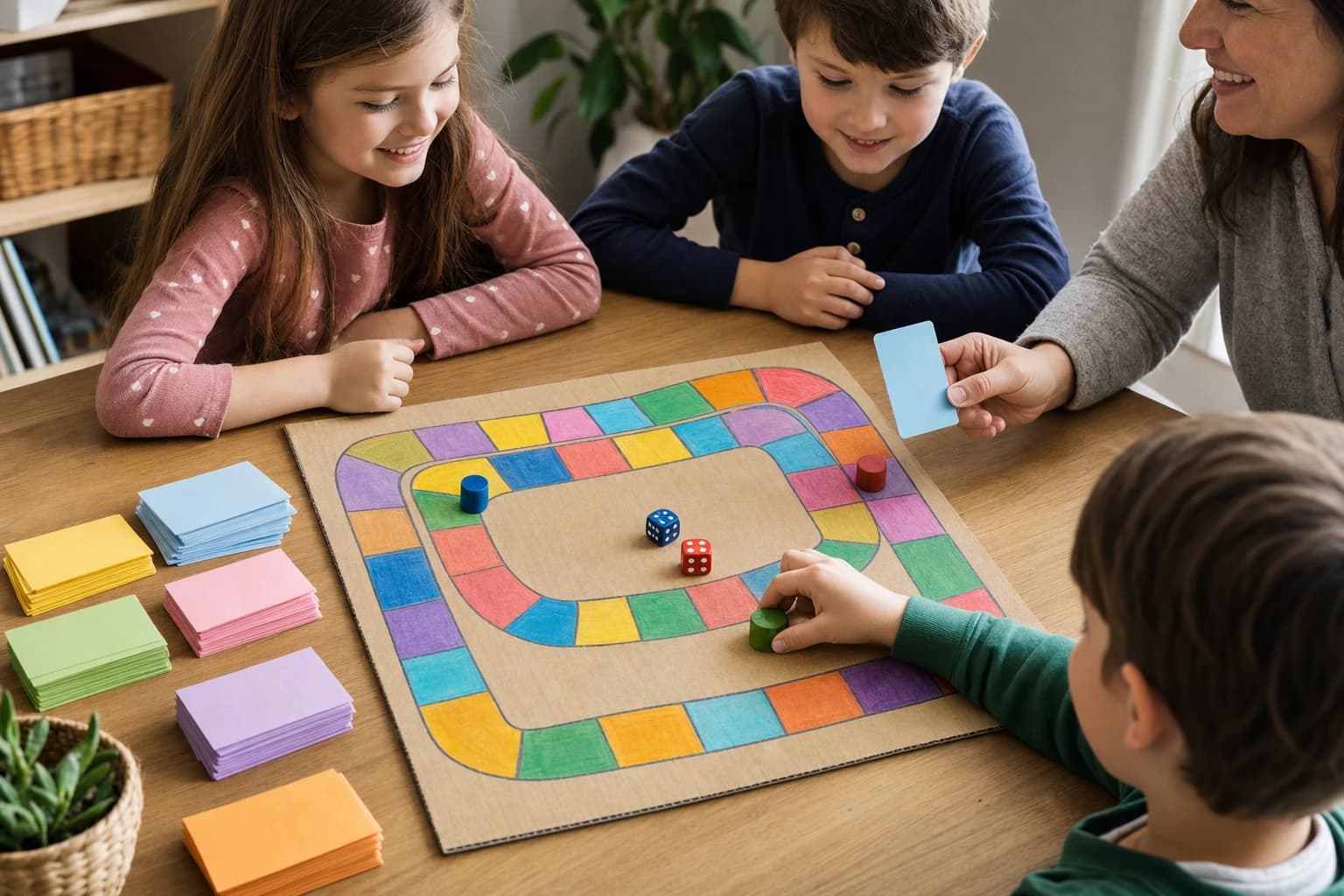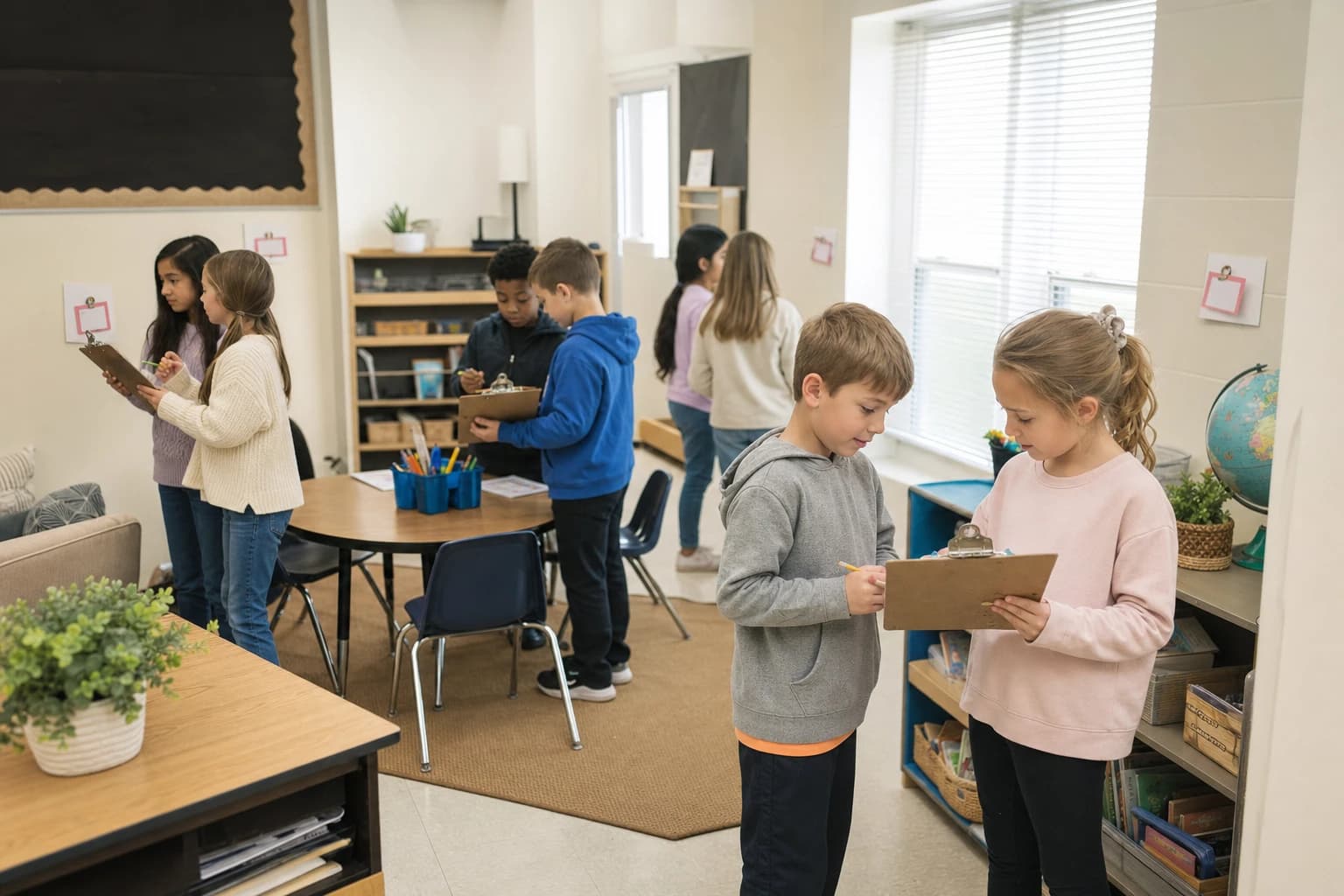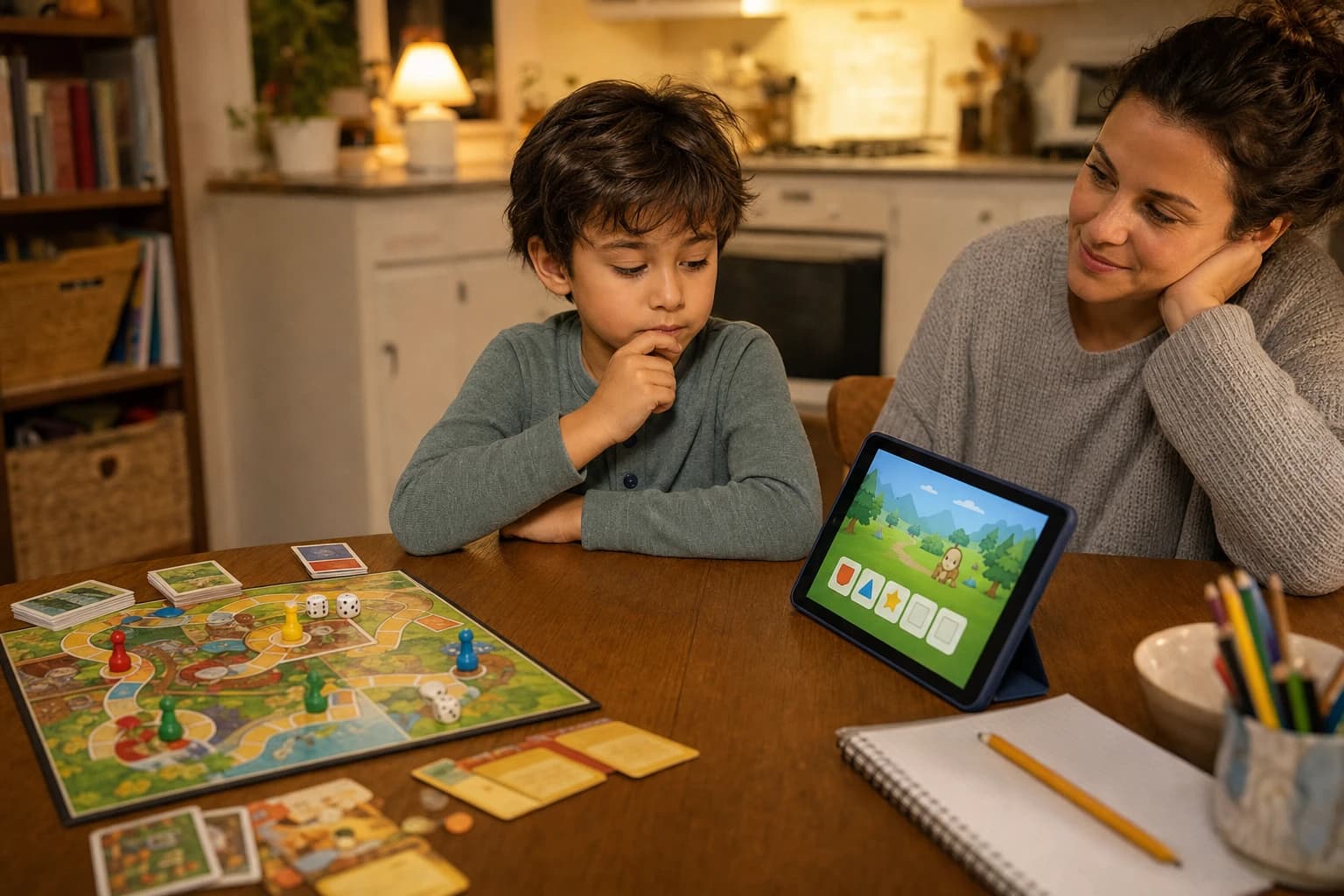
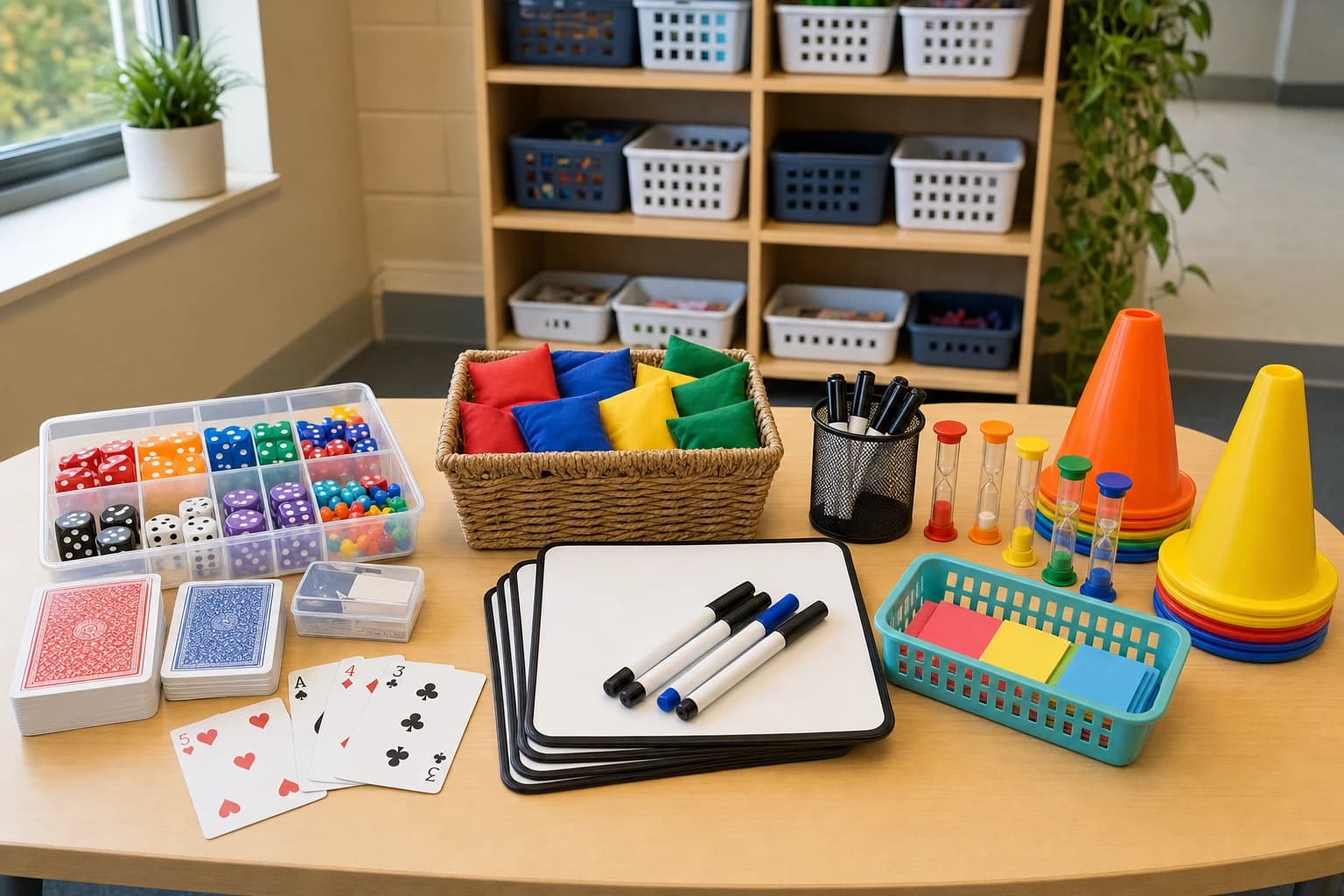
Indoor recess gets hard when the class has energy, the room is crowded, and the only available supplies are a half-complete board game and a dried-out marker. The best classroom game supplies for indoor recess are not the fanciest ones. They are the items that work for many games, reset quickly, survive daily handling, and fit into one or two labeled bins.
This guide focuses on practical indoor recess supplies teachers can use again and again: playing cards, dice, beanbags, cones, timers, mini whiteboards, simple building materials, and cooperative board games. You will also find quantities to buy, storage tips, safety notes, and a starter kit plan for classrooms that need affordable school games for kids without creating more cleanup work.
The quick answer: the most useful indoor recess supply kit
If you are building from scratch, start with supplies that can support quiet games, movement games, partner challenges, and whole-class activities. A classroom does not need a closet full of toys to run indoor recess well. It needs flexible materials in enough quantity that students are not waiting too long for a turn.
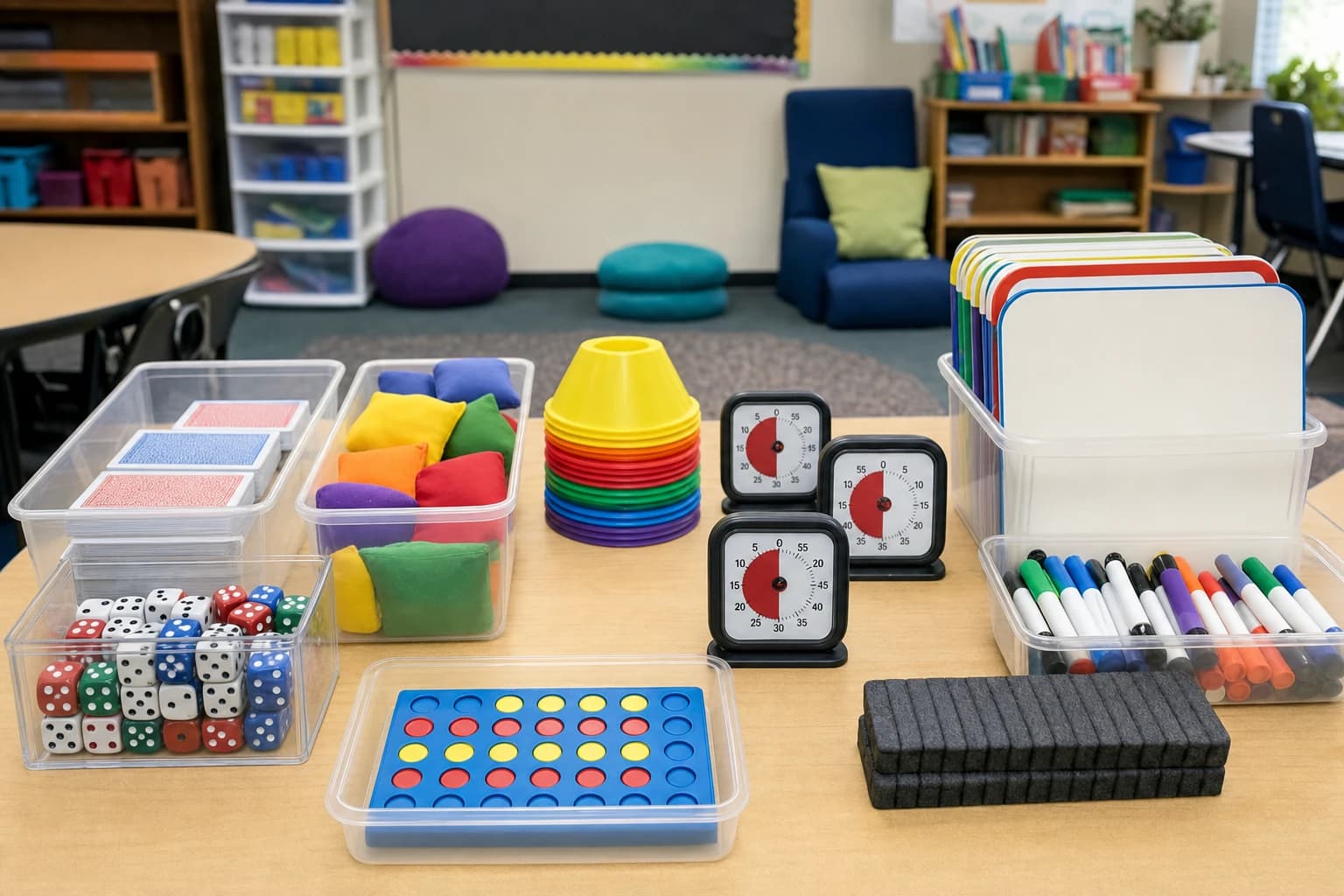
Starter kit for one elementary classroom
- 2 decks of standard playing cards, plus 1 extra deck if you often split into groups.
- 24 standard six-sided dice or 12 large foam dice for younger students.
- 12 mini whiteboards with low-odor dry-erase markers and erasers.
- 6 to 10 beanbags for tossing, relay, and target games.
- 10 to 12 soft cones or spot markers for boundaries, teams, and stations.
- 2 visual timers or sand timers for turn-taking and station rotations.
- 1 set of index cards for student-made prompts, drawing games, and vocabulary games.
- 3 to 5 cooperative or quick-play board/card games with simple rules and short rounds.
- 2 clear bins: one for quiet tabletop games and one for movement supplies.
For a very tight budget, choose cards, dice, index cards, and timers first. Those four categories create the most game options for the least storage space. If your class needs more movement, add beanbags and cones next. If you already have many paper-based activities, mini whiteboards are a strong upgrade because they reduce copying and make games easy to replay.
Indoor recess should still feel like a break, not another worksheet. The Centers for Disease Control and Prevention notes that recess can give students opportunities for physical activity and social interaction during the school day; its school recess resources are a useful reference when setting expectations for safe, inclusive play (CDC: Recess in Schools). In the classroom, that means choosing supplies that allow choice, cooperation, conversation, and reasonable movement without turning the room into a gym.
Comparison table: which classroom games materials are worth buying first?
The table below compares common teacher game supplies by versatility, management needs, durability, and storage. The best choice depends on grade level, class size, and whether your recess plan is mostly quiet, active, or mixed.
| Supply | Best use case | Games it unlocks | Recommended classroom quantity | Durability and storage notes |
|---|---|---|---|---|
| Playing cards | Math games, matching games, partner games, quick fillers | War variations, make-10, memory, sorting races, probability games | 2 to 4 decks | Buy standard-size cards, keep each deck in a zipper pouch, and retire incomplete decks to a spare-parts bag. |
| Dice | Fast games with numbers, movement prompts, turn-taking | Roll-and-add, target number, story dice, dice fitness, partner challenges | 12 to 24 dice | Foam dice are quieter; standard dice store compactly. Use small containers so sets do not scatter. |
| Mini whiteboards | Quiet games, drawing games, team answers, scorekeeping | Pictionary-style clues, word ladders, mental math, category races | 8 to 12 boards | Check marker caps daily. Store boards vertically if possible so edges do not warp. |
| Beanbags | Low-risk tossing, target games, balance challenges | Beanbag tic-tac-toe, toss to a word, partner pass, station challenges | 6 to 10 beanbags | Choose fabric or vinyl that can be wiped down. Avoid very small beanbags for younger children. |
| Cones or spot markers | Boundaries, stations, team spaces, movement paths | Obstacle paths, relay turns, floor board games, line-up challenges | 10 to 12 markers | Flat spots are easier in small rooms; cones are more visible but need a taller bin. |
| Timers | Turn limits, cleanup signals, station rotation | Minute challenges, quiet building rounds, team rotations, board game turns | 2 timers | Visual timers help students manage time without repeated teacher reminders. |
| Index cards | DIY game prompts, vocabulary, charades, categories | Charades, taboo-style clues, quiz cards, scavenger prompts, memory sets | 1 pack of 100 | Use colored rubber bands or envelopes to separate sets by game. |
| Cooperative board games | Small groups that need structure and social practice | Team puzzle games, shared goal games, mystery-solving, matching games | 3 to 5 games | Choose short play times and pieces that are easy to inventory before cleanup. |
Best affordable supplies by classroom use case
For quiet tabletop games: cards, dice, and mini whiteboards
When the class needs calm, the strongest supplies are the ones that create many small-group games with almost no setup. Cards and dice are especially useful because they give students a random prompt. That randomness keeps repeat games from feeling stale.
A deck of cards can become a math game, a matching game, a memory game, or a strategy game. For younger students, remove face cards and use aces as 1. For older students, use face cards as 11, 12, and 13 or assign them special actions. A simple indoor recess game is Closest to 50: each student draws five cards, arranges them into two two-digit numbers plus a leftover card, and tries to make a total closest to 50. It feels like a game, but it also practices flexible number sense.
Dice are just as adaptable. Students can roll two dice and add, subtract, multiply, or create a story prompt from the numbers. For indoor recess, foam dice are often better in primary classrooms because they are quieter and easier to see from a distance. Standard dice are cheaper and store in less space, so they work well for grades 3 and up if noise expectations are clear.
Mini whiteboards are not only for academic review. They work for drawing clues, secret answers, team names, quick scoreboards, and quiet challenges. If you are choosing between a large class set and a smaller game set, 8 to 12 boards are enough for pairs or small groups during recess. Keep one marker clipped or rubber-banded to each board to reduce the common problem of boards outlasting the markers.
For movement without chaos: beanbags, cones, and floor spots
Not every indoor recess needs to be silent. Students often need a safe way to move, especially when weather cancels outdoor play for multiple days. Beanbags and cones give movement a structure. They tell students where to stand, where to toss, and when a turn is over.
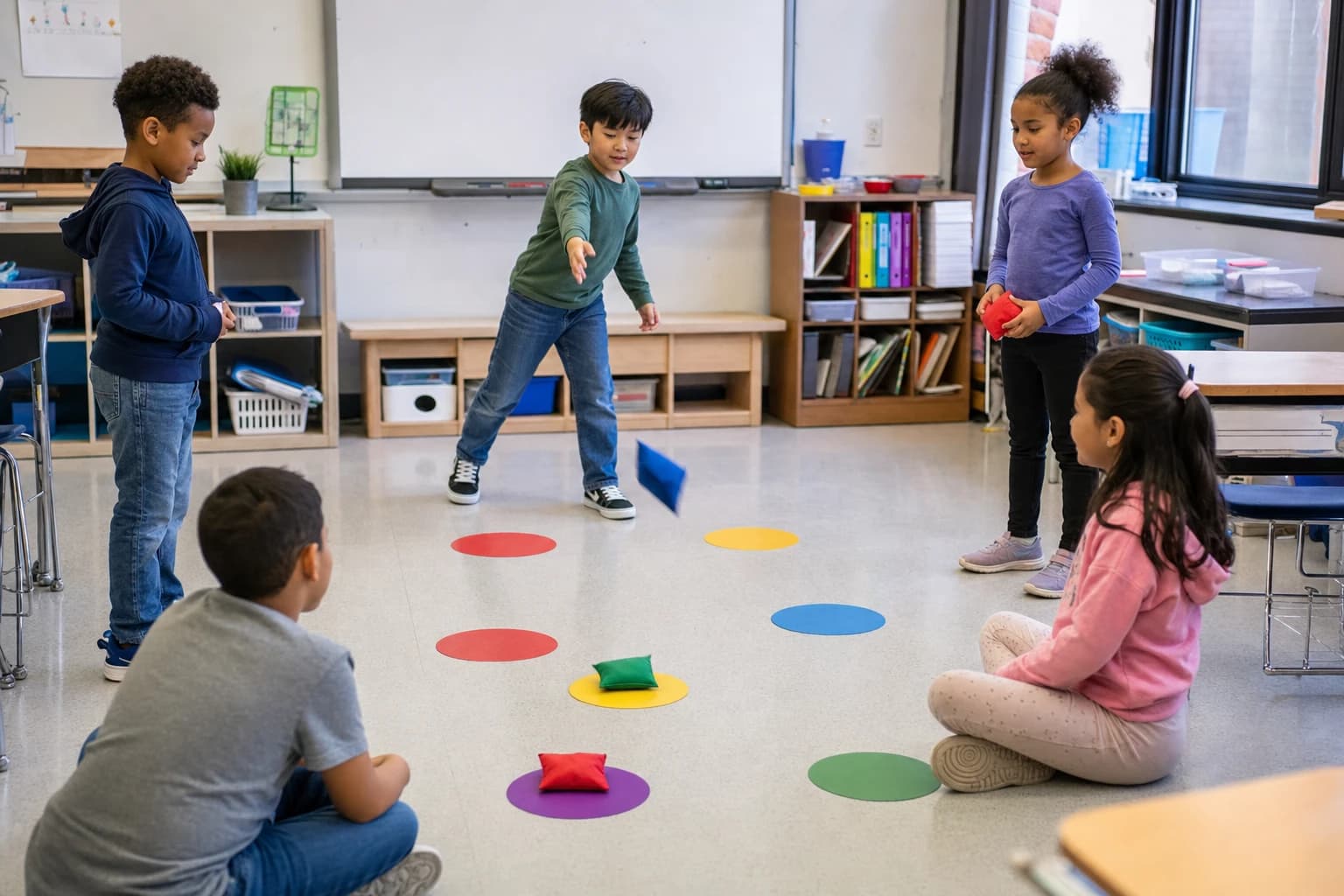
Beanbags are more classroom-friendly than balls because they do not roll far after a miss. They can be used for target toss, balance walks, partner passes, syllable toss, or answer-choice games. For example, place four paper signs on the floor labeled A, B, C, and D. Read a trivia question, riddle, or math problem, and students toss a beanbag to the answer they choose. This works as a team game without students running around the room.
Cones and spot markers are useful even if you never run relays. They create boundaries for stations, mark a waiting line, show where materials return, or turn the floor into a simple game board. In a crowded classroom, flat floor spots are easier than tall cones because students are less likely to knock them over. In a multipurpose room or wide hallway, cones are more visible.
If you need full game ideas for active recess in tight spaces, the PLAYATME guide to 20 indoor PE games for elementary students in a small gym or classroom pairs well with these supplies.
For fast transitions: timers, task cards, and simple rules
Indoor recess can fall apart at the beginning and end. Students take too long choosing, games run past cleanup time, or one group argues because turns are unclear. Timers are inexpensive, but they solve a real management problem: they make time visible.
Use a 3-minute timer for quick turns, a 5-minute timer for stations, and a 10-minute timer for cleanup warnings or short board games. A visual timer is easier for students who are not watching the clock. Sand timers are simple and durable, but they only work if students can see them from where they are playing.
Task cards are another affordable tool. A pack of index cards can become a month of indoor recess prompts. Write one challenge per card: build the tallest card tower, draw an animal using only triangles, create a handshake with four silent moves, list 10 foods that start with S, or invent a beanbag target game with three rules. Lamination is helpful but not required. A card box or envelope system works fine if students are taught to return cards before choosing a new one.
For social play: cooperative board games and team challenges
Board games can be excellent indoor recess supplies, but only if they match the classroom environment. A game that takes 60 minutes, has dozens of tiny pieces, or requires an adult to explain every turn is not ideal for a 15- to 25-minute recess block. Look for games with short rounds, clear visual rules, and a natural stopping point.
Cooperative board games are especially useful because students work toward a shared goal instead of knocking each other out. That can reduce arguments for groups that struggle with losing gracefully. Good classroom choices usually have three features: a game can be played by 2 to 5 students, the full game takes no more than 20 minutes, and the pieces can be counted quickly before the lid closes.
For more game-specific family and classroom-friendly suggestions, see PLAYATME’s guide to the best cooperative board games for families. Not every family game is right for a classroom, but the cooperative format is worth considering for indoor recess bins.
How to build an indoor recess game kit on a budget
You do not need to buy everything at once. A better approach is to build a small, reliable kit, teach students how to use it, and add supplies only when you know what the class actually chooses.
Materials for a practical starter kit
- 1 medium clear bin for tabletop supplies
- 1 medium clear bin for movement supplies
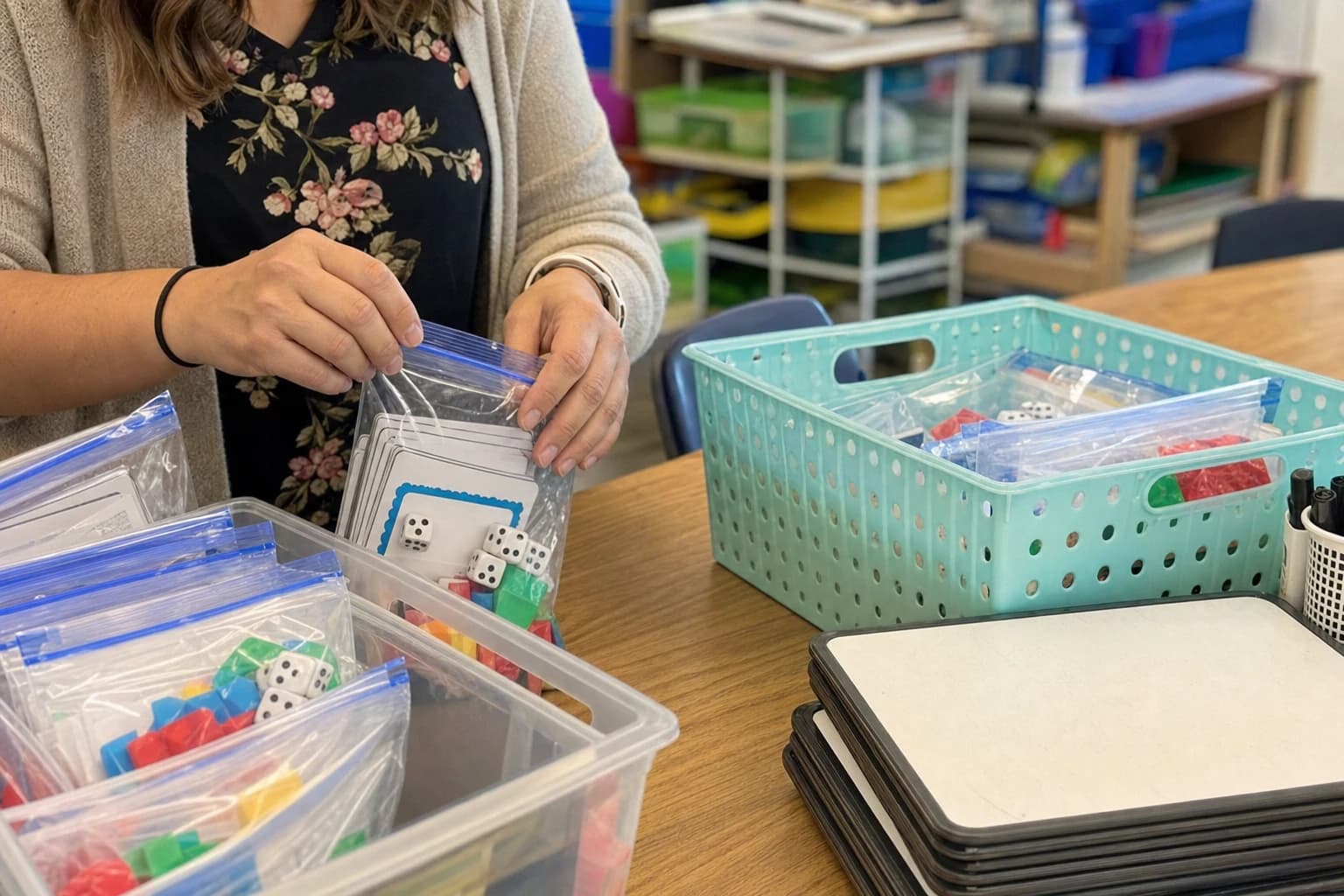
- 6 to 10 zipper pouches or small containers
- 2 decks of cards
- 12 dice
- 1 pack of index cards
- 8 mini whiteboards and markers
- 6 beanbags
- 10 floor spots or cones
- 2 timers
- Printed or handwritten game direction cards
- Masking tape and a permanent marker for labels
Step-by-step setup
- Choose 8 to 10 core games first. Do not introduce every material on the same day. Start with two card games, two dice games, two whiteboard games, two beanbag games, and one cooperative board game. Students handle supplies better when the choices are clear.
- Make one direction card per game. Each card should include number of players, materials, setup, how to win or finish, and cleanup. Keep wording short. For example: 2 players. Take 10 cards each. Flip one card at a time. Higher number takes both. Tie means flip again. Return all cards to the pouch.
- Label every container by supply, not by game. A pouch labeled Dice: 6 is easier to check than a pouch labeled Math Game. If six dice should be inside, students can verify the count.
- Create a checkout routine. One student from each group takes a supply pouch and returns it before choosing another. This prevents the common problem of three games mixing into one pile.
- Teach a 2-minute cleanup rehearsal. Practice cleaning up when no one is upset about stopping. Set a timer for 2 minutes, have students return materials, and check bins. This rehearsal saves time later.
- Rotate choices every two weeks. Keep the core supplies the same, but change the prompt cards. Dice can be math one week, storytelling the next, and movement prompts after that. Rotation makes inexpensive supplies feel new.
Simple game ideas for each supply
Card games that do not need special boards
- Make 10 or Make 20: Students flip cards and race calmly to find combinations that total the target number.
- Memory Match: Use pairs from two decks or student-made cards. Start with 12 cards for younger students and increase as attention improves.
- Place Value Build: Students draw three cards and build the largest or smallest three-digit number. Older students can add decimals.
- Category Sort: Sort cards by color, suit, odd/even, prime/composite, or student-created rules.
Dice games for pairs and small groups
- Target Number: Roll three dice and use any operations to reach a target such as 12, 24, or 50.
- Roll a Story: Assign each number a character, setting, problem, or object. Students roll and tell a 60-second story.
- Race to 100: Students add each roll to a running total. For a shorter version, race to 30.
- Dice Movement Menu: One die shows the movement, the other shows repetitions. Keep movements classroom-safe: toe taps, wall push-ups, chair squats, or arm circles.
Whiteboard games for quiet recess
- Silent Sketch: One student draws a clue while the partner guesses without shouting.
- Word Ladder: Change one letter at a time to move from one word to another, such as cat to dog.
- Emoji Story: Students draw three simple symbols, then use them to tell a short story.
- Secret Number: One student writes a number and gives clues until the group guesses it.
Beanbag and cone games for small spaces
- Beanbag Tic-Tac-Toe: Tape a 3-by-3 grid on the floor or use paper squares. Teams toss beanbags to claim spaces.
- Station Toss: Put a cone beside each target. Students rotate after three tosses, not after a score.
- Balance Delivery: Students carry a beanbag on the back of one hand from one spot to another without running.
- Answer Corners: Use cones to mark answer zones. Students toss, step, or point instead of crowding into corners.
If you need activities for times when supplies are not available, keep a backup list from 25 no-equipment classroom games for 2nd to 5th grade transitions. A no-equipment option is useful when a bin is missing, a guest teacher is covering, or cleanup time is short.
Durability, safety, and storage details that matter
Cheap supplies are not always affordable if they break quickly or create constant management problems. Before buying classroom games materials, think about how they will be handled by 20 to 30 students, not one child at home.
Choose wipeable and countable materials
Wipeable beanbags, plastic dice, laminated cards, and dry-erase boards are easier to maintain than soft paper-only materials. Countable sets also save time. A pouch with 12 dice, a deck with 52 cards, or a board game with a printed piece list can be checked quickly.
For younger students, avoid supplies with tiny loose parts unless they are closely supervised and age-appropriate. The U.S. Consumer Product Safety Commission explains that small parts can be a choking hazard for children under age 3, which is especially relevant for mixed-age rooms, visiting siblings, and preschool settings (CPSC small parts guidance). Elementary classrooms still need sensible storage because small dice, pawns, and tokens disappear easily.
Store by noise level and movement level
One helpful system is to sort supplies into three categories: quiet table, low movement, and teacher permission. Quiet table supplies include cards, dice, drawing prompts, and board games. Low movement supplies include beanbags, cones, and balance challenges. Teacher-permission supplies are anything that changes the room layout, uses floor tape, or involves several groups moving at once.
Use labels students can understand without asking. Green bin: quiet games and blue bin: movement games are clearer than a long list of rules. Add a photo label if students are young or if you have multilingual learners.
Buy fewer types, but enough for groups
A common mistake is buying one of everything. One mini bowling set, one tiny board game, one pack of cards, and one puzzle create competition for access. Indoor recess runs more smoothly when several groups can play at the same time. Two decks of cards are usually more useful than one novelty game. Twelve dice are usually more useful than one oversized die. Six beanbags are usually more useful than one ball.
Common buying mistakes to avoid
Do not choose supplies only because they look fun
A game can look exciting and still be a poor classroom purchase. If it takes 15 minutes to explain, needs batteries, has many tiny pieces, or causes students to crowd around one turn, it may not work well for indoor recess.
Mistake 1: buying games with long play times
Many indoor recess periods are short once coats, snacks, bathroom breaks, and announcements are considered. A 45-minute board game is likely to be abandoned mid-round. Short games are easier to pause and restart without arguments.
Mistake 2: ignoring replacement pieces
Cards bend. Dice vanish. Markers dry out. If a supply depends on one special piece, the whole game may become unusable. Choose supplies that can be replaced individually or adapted when a piece is missing.
Mistake 3: mixing active and quiet games in the same space
A beanbag toss next to a chess game is asking for frustration. Use cones, floor spots, or desk clusters to separate play zones. Even a simple rule such as all tossing faces the whiteboard wall can prevent many conflicts.
Mistake 4: skipping student training
Students need to learn indoor recess routines the same way they learn line-up routines. Show how to choose a game, how to include a classmate, how to solve a turn disagreement, and how to clean up. A supply kit is only as good as the routine around it.
Recommended classroom kits by budget level
Small budget: cards, dice, index cards, and timers
This kit is best for teachers who need affordable school games for kids but have almost no storage. With 2 decks of cards, 12 dice, index cards, and 1 or 2 timers, you can run math games, storytelling games, guessing games, charades, memory, and timed challenges. Add student-created prompt cards to keep choices fresh.
Medium budget: add whiteboards, beanbags, and floor spots
This is the strongest all-purpose setup. Whiteboards support quiet play. Beanbags and floor spots support movement. The same supplies can also be used for academic review, morning meeting, and transitions, which makes them easier to justify than single-purpose toys.
Larger budget: add cooperative games and durable storage
If you can add a few purchased games, focus on cooperative games, quick card games, and strategy games with simple components. Spend part of the budget on storage too. Clear bins, zipper pouches, labels, and replacement markers are not exciting, but they are the reason the supplies last past the first month.
For younger students who need calmer options, PLAYATME’s list of quiet classroom games for early finishers in kindergarten to 2nd grade includes ideas that also work during indoor recess choice time.
FAQ
What are the best classroom game supplies for indoor recess if I can only buy a few things?
Start with 2 decks of cards, 12 dice, a pack of index cards, and 1 timer. Those supplies are inexpensive, compact, and flexible enough for math games, memory games, storytelling, guessing games, and quick challenges.
How many board games should a classroom indoor recess bin have?
For most classrooms, 3 to 5 board or card games are enough if you also have open-ended supplies like dice, cards, and whiteboards. Choose games with short rounds, simple rules, and pieces that students can count during cleanup.
Are balls a good indoor recess supply?
Usually, beanbags are easier to manage than balls in a classroom because they do not bounce or roll far. If you use balls, choose soft foam balls and set clear boundaries about where they can be used.
How do I stop indoor recess supplies from getting lost?
Use small labeled containers with exact counts, such as Dice: 6 or Beanbags: 8. Assign one student per group to return the container, and build in a 2-minute cleanup timer before recess ends.
What supplies work best for both games and learning activities?
Mini whiteboards, dice, playing cards, timers, and index cards are the most versatile. They can be used for indoor recess, math review, spelling practice, morning meeting, and transition games.
Conclusion: build a kit students can actually use
The best indoor recess supplies are simple, durable, and easy to reset. Cards, dice, whiteboards, beanbags, cones, timers, index cards, and a few cooperative games can cover quiet play, movement, teamwork, and quick transitions without filling the classroom with clutter.
Start small, label everything, teach routines, and rotate game prompts instead of constantly buying new materials. A well-organized kit of teacher game supplies gives students real choices and gives teachers a calmer way to handle rainy days, cold weather, and any recess that has to move indoors.