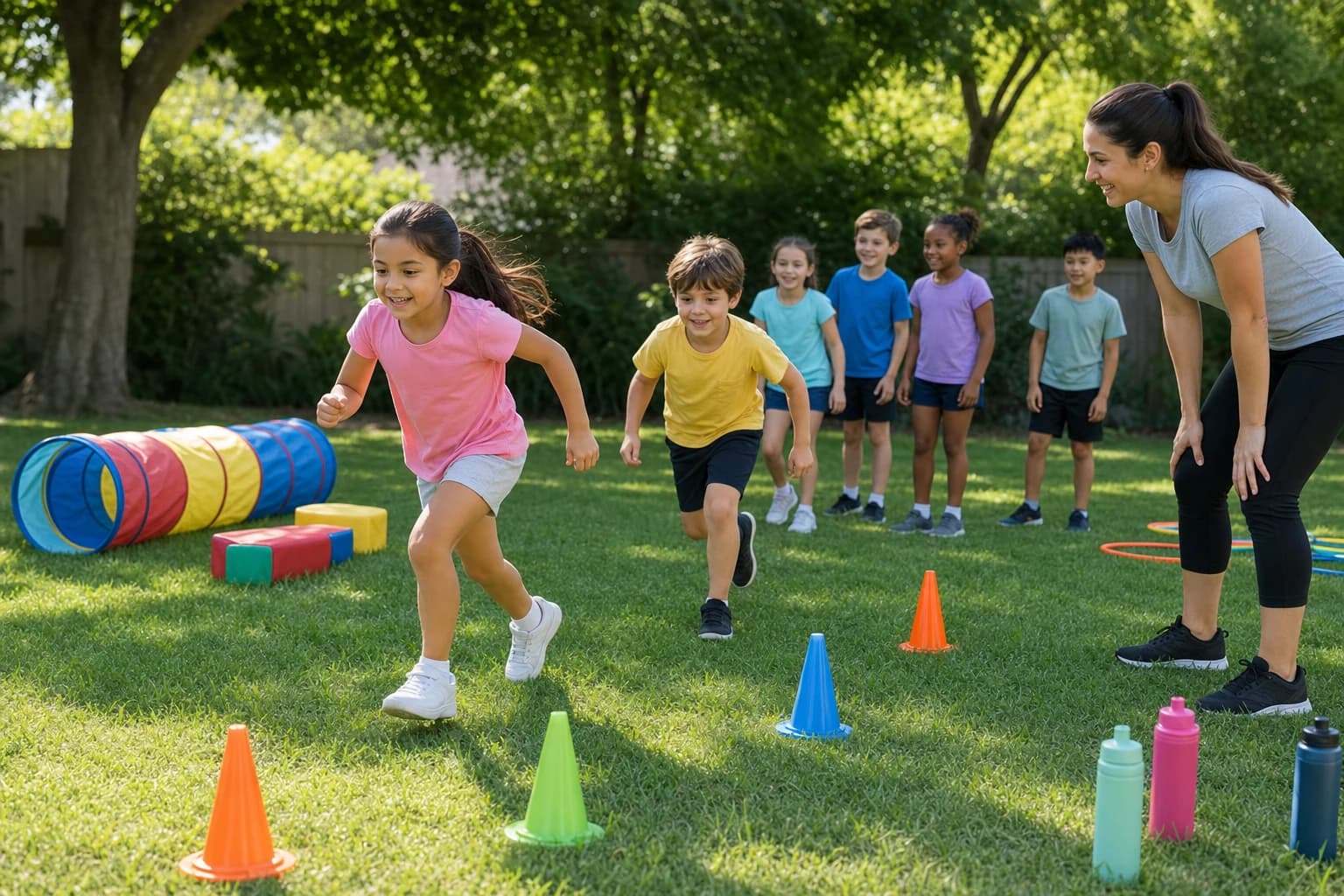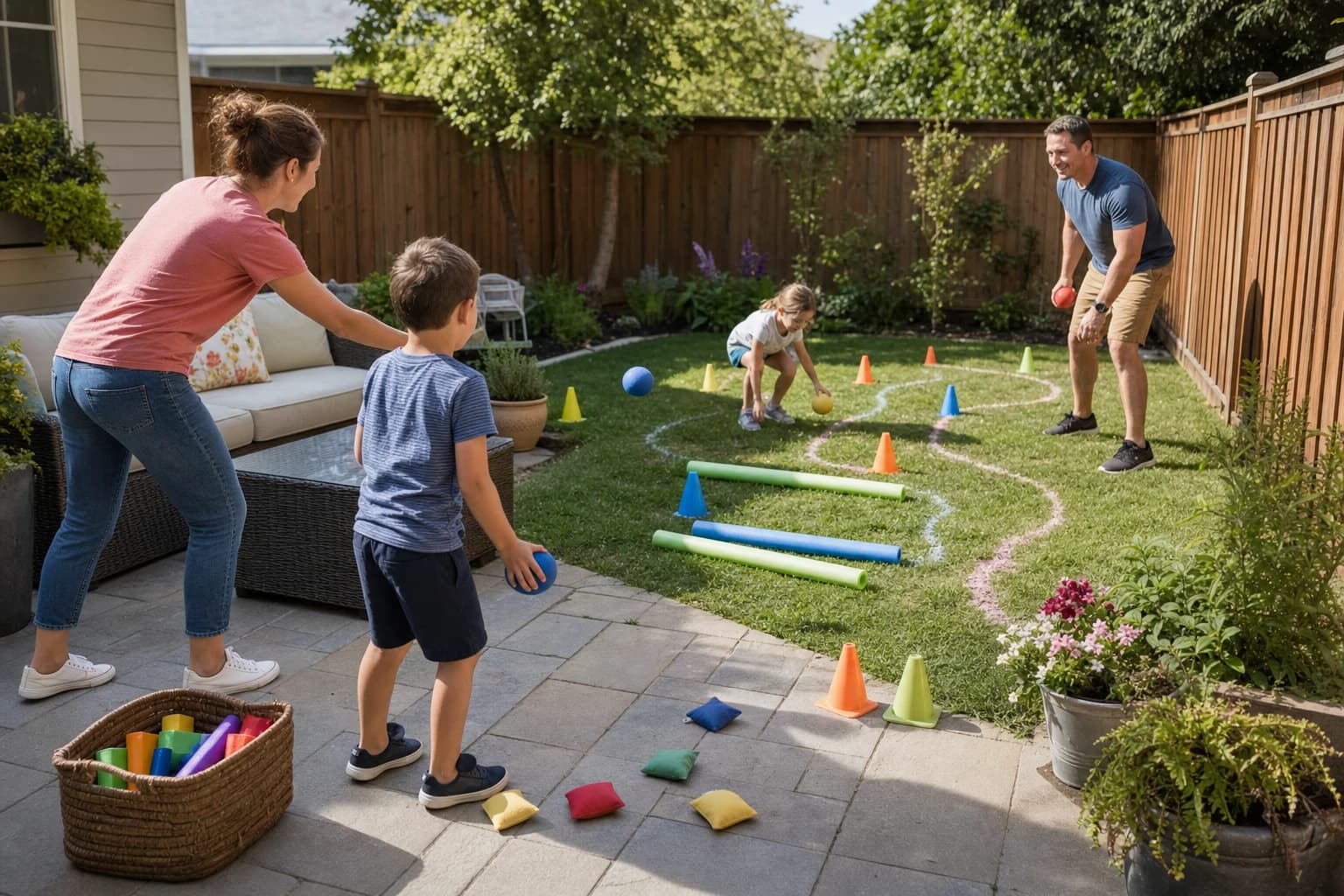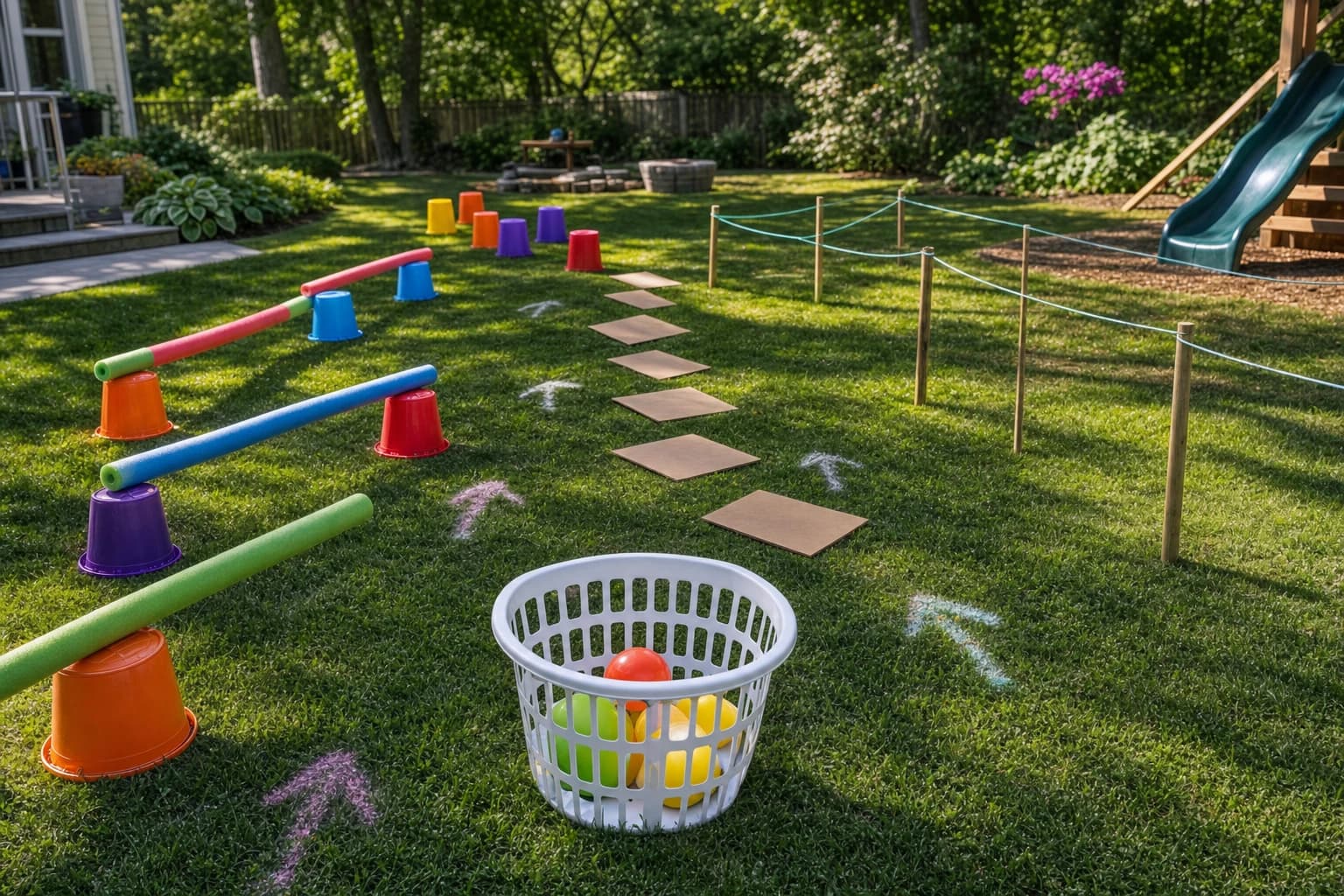
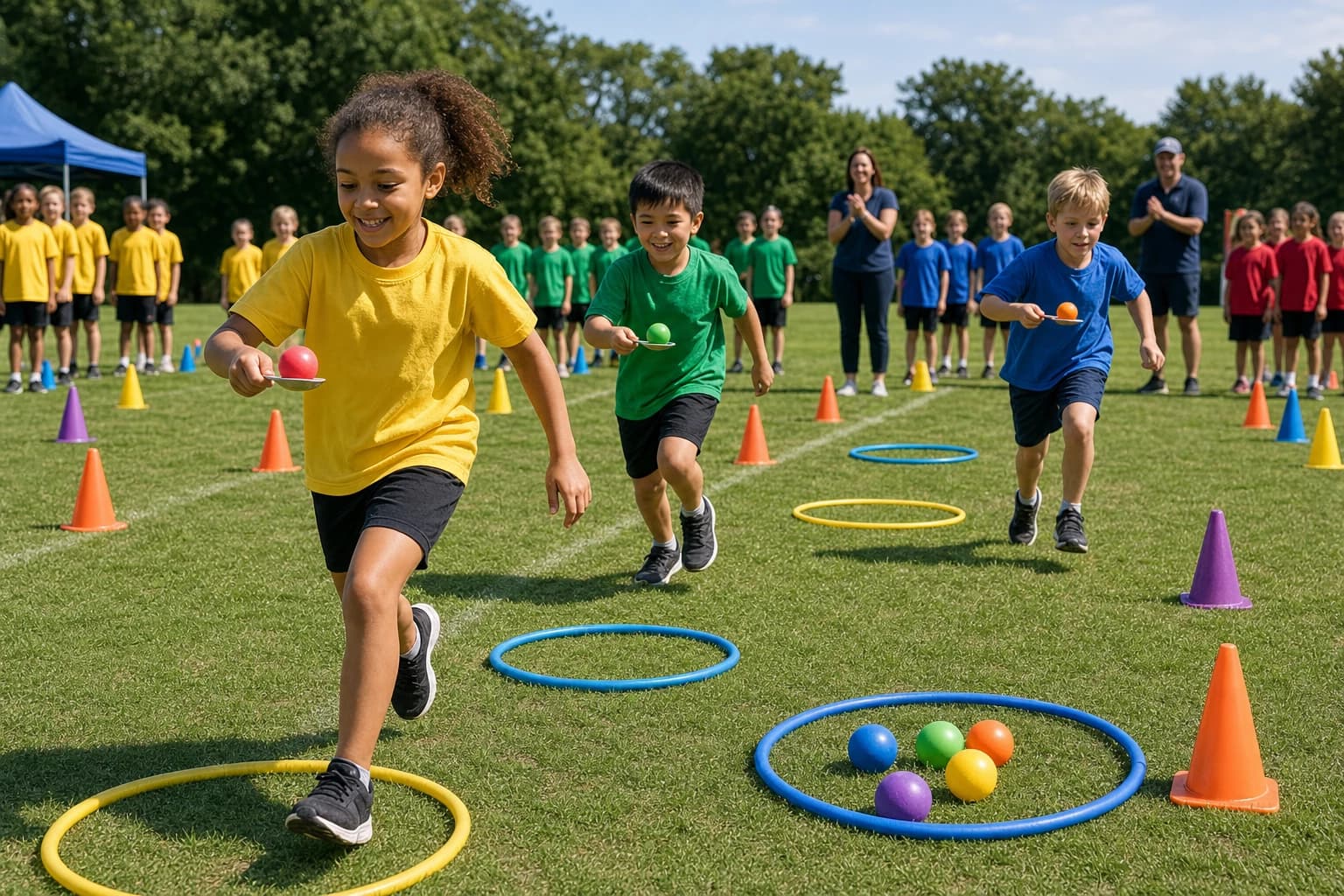
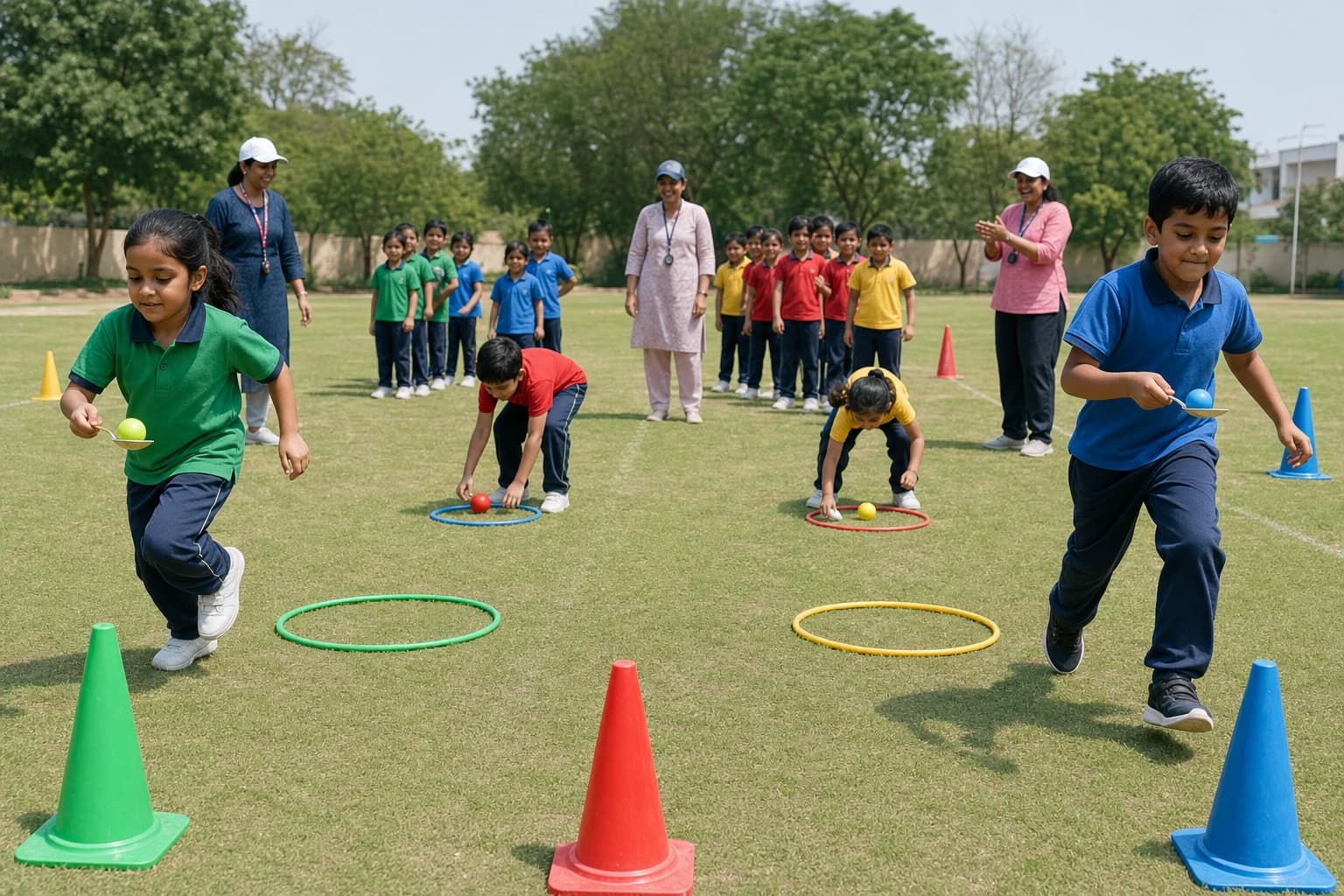
Planning relay races for a school field day or camp activity can get tricky when you have limited equipment, mixed ages, and a lot of children waiting for their turn. These field day relay race ideas use common items: cones, spoons, balls, and hula hoops. Each game includes a simple setup, a text diagram, clear rules, and ways to adapt the race for younger players, older students, and children with different mobility or coordination needs.
The goal is not to make the most complicated course. A good relay is easy to explain, safe to run, and active enough that kids are not standing in a long line for ten minutes. Use these ideas as ready-to-run school field day games, camp relays, PE class stations, or backyard team challenges.
Quick Setup Plan for Field Day Relay Races
Before choosing games, decide how many lanes and stations you can safely manage. For elementary school groups, four to six teams is usually easier to supervise than one large race with long lines. If you have a bigger group, duplicate the same relay in more lanes instead of adding complicated rules.
Basic materials for one relay station
- 8 to 12 cones for lane markers, turning points, and boundaries
- 4 to 6 hula hoops for targets, stations, or stepping zones
- 4 to 6 playground balls, foam balls, or tennis balls depending on the age group
- 4 to 6 spoons, preferably large plastic serving spoons for younger children
- Team markers such as pinnies, wristbands, or colored cones
- Whistle or clear start signal
- Clipboard or phone timer if you are scoring timed rotations
A useful lane length is about 20 to 30 feet for younger children and 40 to 60 feet for older children. If you are using a gym or blacktop, make the lanes shorter and keep the turns wide. If children are running on grass, check for holes, wet patches, and uneven ground before the activity starts.
For safety and activity planning, it is sensible to include water breaks and watch heat conditions during outdoor games. The CDC offers guidance on children’s physical activity and safety considerations for active play; organizers can review it at CDC physical activity guidelines for children.
How to Run Relay Races Without Long Waiting Lines
The biggest problem with many relay races for kids is downtime. One child runs while seven children wait. You can fix that with a few structure changes.
- Use smaller teams. Aim for 4 to 6 players per team when possible. If you have 30 children, run six teams of five rather than three teams of ten.
- Add paired legs. Let two children complete a task together, such as carrying a ball between two hoops. This doubles participation without needing more equipment.
- Run timed rotations. Instead of racing until one team finishes, set a 4-minute timer. Teams count successful trips or completed tasks.
- Create mirror lanes. Put half the team at the start and half at the far cone. Players travel back and forth instead of always returning to the same line.
- Use station relays. Split a race into three quick tasks so the next player can begin as soon as the previous player reaches the first station.
Here is a simple mirror-lane diagram you can adapt for most team relay race ideas:
Mirror lane: Team half A at Start Cone → task zone in the middle → Turn Cone with team half B waiting. After completing the task, the player tags the next teammate at the opposite end.
This setup keeps the line shorter at both ends and is especially helpful for younger children who lose focus while waiting.
1. Spoon-and-Ball Carry Relay
This is a classic, but it works best when the spoon and ball size matches the age group. For preschool and early elementary players, use a large plastic serving spoon and a lightweight foam ball. For older students, use a regular spoon and a table tennis ball or small rubber ball.
Setup
Lane diagram: Start cone → 25-foot carry lane → turn cone → return to start. Place one spoon and one ball at the start of each lane.
How to play
- Each team lines up behind its start cone.
- The first player balances the ball on the spoon and walks or jogs to the turn cone.
- If the ball drops, the player stops, places it back on the spoon, and continues from the drop spot.
- The player returns and hands the spoon and ball to the next teammate.
- The first team to finish, or the team with the most completed trips in a timed round, wins.
Variations
- For younger children: Allow two hands on the spoon handle or use a beanbag instead of a ball.
- For older students: Add cone weaving before the turn cone.
- Inclusive option: Players may walk, roll, or use a mobility device through the lane. The challenge is keeping control of the spoon, not speed alone.
To reduce waiting, make this a paired relay: one player carries the spoon out, and a teammate at the far cone carries it back.
2. Cone Weave Ball Relay
This relay builds movement control without requiring advanced athletic skill. It is one of the easiest outdoor relay games to scale for different ages because you can change the spacing between cones.
Setup
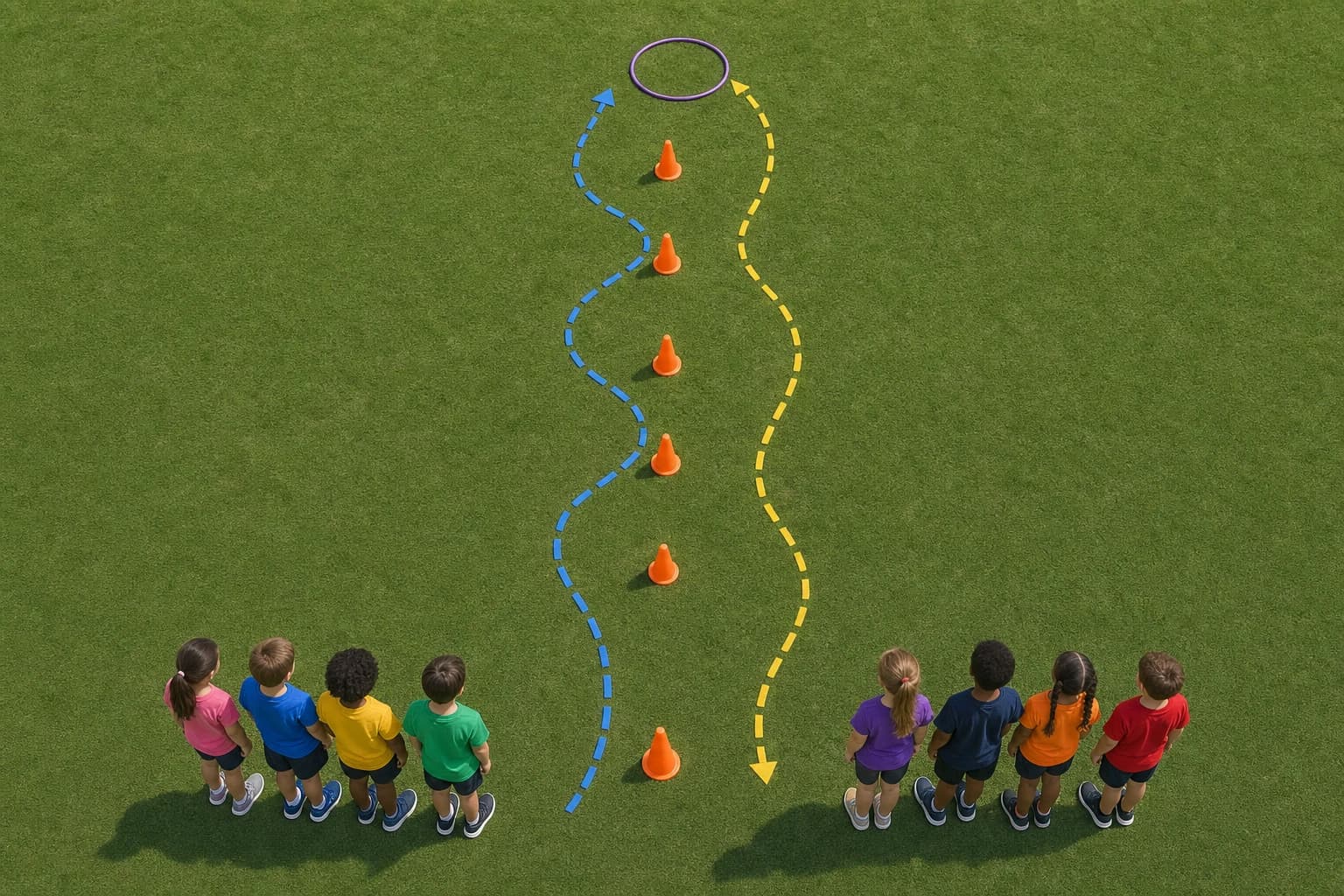
Lane diagram: Start cone → 5 weaving cones spaced 5 feet apart → ball drop hoop → sprint or walk back outside the cones.
Place one ball at each start line and one hula hoop at the far end of each lane.
How to play
- The first player carries or dribbles a ball through the cone weave.
- At the far end, the player places the ball inside the hula hoop.
- The player returns to tag the next teammate.
- The next teammate runs to the hoop, picks up the ball, weaves back through the cones, and hands it off.
- Players alternate placing and retrieving the ball.
Make it work for mixed ages
- Kindergarten to grade 2: carry the ball with two hands.
- Grades 3 to 5: bounce the ball once between cones or roll it with a hand.
- Middle school: dribble with feet or hands, depending on your field space and equipment.
If a lane gets backed up, let the next player start when the runner reaches the third cone instead of waiting for a tag. Use a clear rule such as, “Go when your teammate passes the yellow cone.”
3. Hula Hoop Island Relay
Hula Hoop Island is a good option when you want teamwork instead of a pure running race. Players move across the field by stepping into hoops, sometimes called “islands.” This can be run as a cooperative relay where every team tries to finish, or as a race with careful supervision.
Setup
Lane diagram: Start cone → three hula hoops in a line with 2 to 3 feet between hoops → turn cone → same hoops back to start.
How to play
- The first player steps into each hoop without touching the outside ground.
- At the turn cone, the player walks or jogs back alongside the hoops.
- The next player begins after a hand tag.
- If a player steps outside a hoop, they pause for three seconds, then continue.
Team version
Give each team two hula hoops and ask them to move from the start cone to the finish cone without anyone stepping outside a hoop. Players must pass the back hoop to the front to create the next “island.” This slows the race down and adds communication, making it a strong choice for team-building field day stations.
Inclusive variations
- Place hoops closer together or touching for younger children.
- Use cones as visual markers around each hoop for children who need clearer boundaries.
- Allow a player using a wheelchair or walker to move through hoop “gates” made by two cones instead of stepping into the hoop.
- Make the goal completion rather than elimination. Avoid sending children back to the start for one mistake.
4. Ball Transfer Hoop Relay
This relay is easy to organize for a large group because several players can be active at once. It also reduces collisions because the movement path is clear and one-directional.
Setup
Lane diagram: Start hoop with 6 balls → 30-foot lane → empty finish hoop. Add cones along the sides to mark each lane.
How to play
- Place six balls in the start hoop for each team.
- On the signal, the first player carries one ball to the finish hoop, places it inside, and returns.
- The next player goes immediately after a hand tag.
- When all balls are moved to the finish hoop, teams reverse and bring them back.
- Play for a set time, such as 4 minutes, and count completed transfers.
This is a strong station for younger students because the rules are visible: balls start here, balls move there. For older students, add a rule that the ball must be carried in a specific way, such as overhead, between elbows with a partner, or balanced on a spoon for the final 10 feet.
5. Cone Flip and Sprint Relay
Use this one when you need a fast, high-energy relay that does not require much equipment. It is also useful as a final round because setup and cleanup are quick.
Setup
Lane diagram: Start cone → 20-foot run → cone flip station with 5 cones lying on their sides → return lane.
How to play
- Each team has five cones lying on their sides at the far station.
- The first player runs to the station and stands one cone upright.
- The player returns and tags the next teammate.
- Continue until all five cones are upright.
- For a second round, players run down and knock one cone gently back onto its side.
Control the energy
Because this relay can get loud and fast, use a wide lane and keep the cone station away from spectators. Remind players that cones should be placed or tipped by hand, not kicked. For younger children, reduce the distance and use three cones instead of five.
6. Spoon Pass Team Relay
This option works well when you have limited running space. Instead of sending players far down the field, the challenge is passing a ball along the team using spoons.
Setup
Lane diagram: Team line behind start cone, players spaced arm’s length apart → finish hoop at the end of the line.
How to play
- Every player gets a spoon. The first player has a ball on their spoon.
- Players pass the ball from spoon to spoon without using hands to touch the ball.
- When the ball reaches the last player, they place it in the finish hoop.
- The last player runs or moves to the front of the line, and the team repeats.
- Play until each player has had a turn at the front.
This is one of the better school field day games for children who do not enjoy sprinting, because focus, patience, and teamwork matter as much as speed.
7. Hula Hoop Tunnel Relay
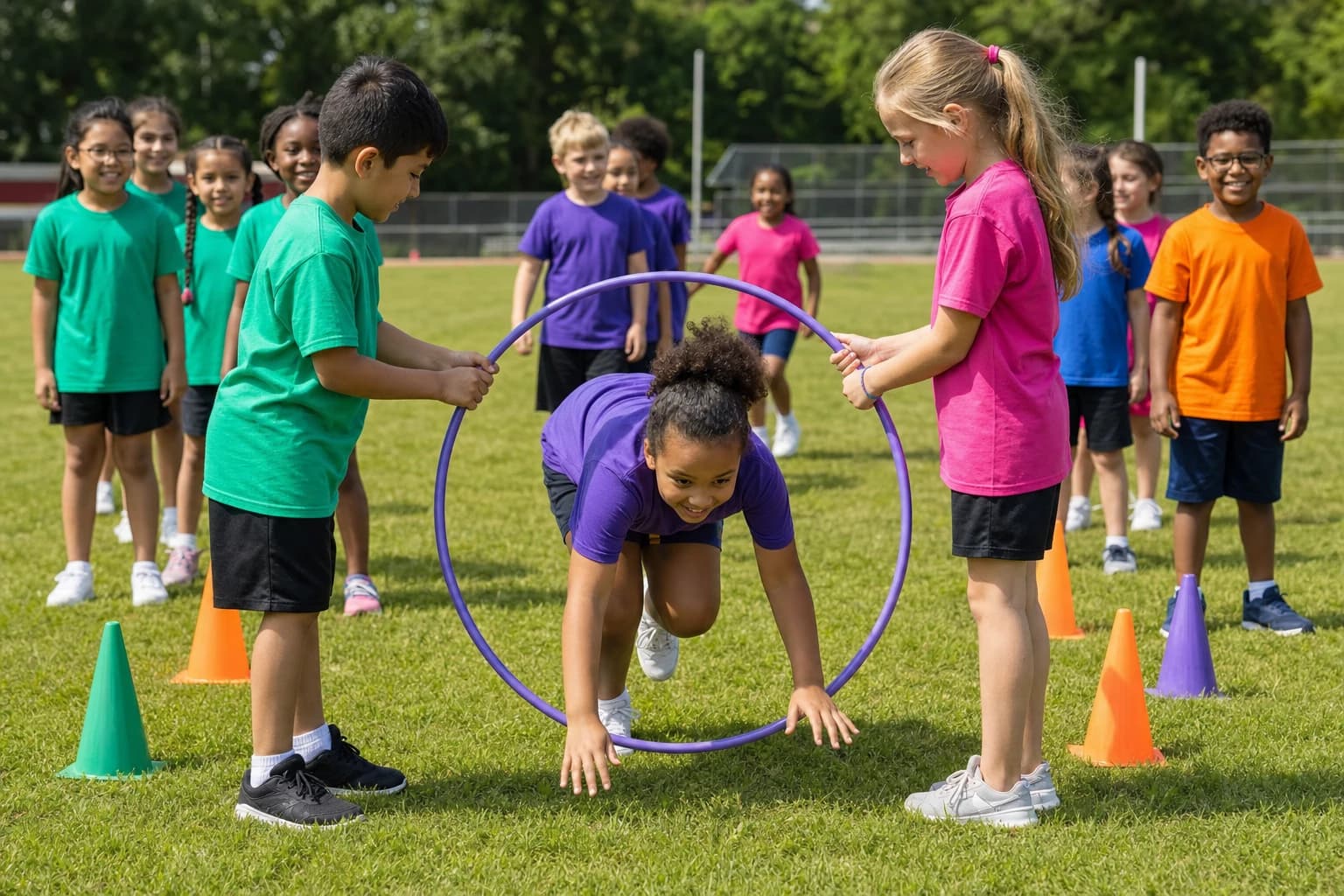
In this relay, the hoop becomes a moving obstacle. It is fun, visual, and easy for spectators to understand.
Setup
Lane diagram: Start cone → hoop tunnel zone at 15 feet → turn cone at 30 feet → return lane.
How to play
- Two adult helpers or two waiting teammates hold a hula hoop upright at the tunnel zone.
- The first runner travels to the hoop, goes through it, continues to the turn cone, and returns.
- On the way back, the player goes through the hoop again, then tags the next teammate.
- After two turns, rotate the hoop holders so everyone participates.
Adaptations
- Hold the hoop higher for taller students and lower for younger children.
- Let players step through, crawl through, or pass a ball through the hoop instead of going through with their body.
- For wheelchair users, make a “gate” with two cones and have the player pass a ball through the hoop held beside the lane.
8. Roll, Chase, and Return Relay
This relay is good for younger groups because rolling a ball is easier to control than throwing. It also teaches children to stay in their lane and retrieve equipment safely.
Setup
Lane diagram: Start cone → roll line at 10 feet → target hoop at 25 feet → retrieval path back to start.
How to play
- The first player stands behind the roll line and rolls the ball toward the hula hoop target.
- If the ball stops inside the hoop, the team earns one point.
- The player retrieves the ball and returns it to the next teammate.
- Play for 3 to 5 minutes and count points instead of racing to finish.
For older children, place the hoop farther away or use a smaller ball. For younger children, make the target a “target zone” with two hoops or a square of cones.
9. Partner Ball Carry Relay
Partner relays are useful when you want more children moving at once. They also discourage one very fast runner from deciding the entire race.
Setup
Lane diagram: Start cone → 30-foot partner lane → turn cone → return lane. One ball per team.
How to play
- Partners hold a ball between their shoulders, backs, elbows, or forearms.
- They move together to the turn cone and back without using hands to grip the ball.
- If the ball drops, they stop, reset at the drop spot, and continue.
- When they return, the next pair begins.
Choose the right carry
| Carry style | Best for | Difficulty | Notes |
|---|---|---|---|
| Forearm carry | Grades 1–3 | Easy | Players face the same direction and trap the ball between forearms. |
| Back-to-back carry | Grades 3–6 | Medium | Players walk sideways or carefully shuffle together. |
| Elbow carry | Older children | Medium | Good for short distances; use a soft ball. |
| Two-hand shared carry | Mixed-ability groups | Easy | Both players keep one or two hands on the ball for stability. |
If you have a wide range of abilities, let each pair choose the carry style that works for them. That keeps the activity inclusive without stopping the relay to create separate rules.
10. Four-Corner Equipment Relay
This is a full-station relay using all four equipment types. It works well as the “main event” for a field day rotation because it feels bigger than a single sprint but still uses simple rules.
Setup
Lane diagram: Start cone → Station 1 spoon carry → Station 2 hula hoop step → Station 3 ball roll target → Station 4 cone stack → finish cone.
Set stations in a rectangle so students move clockwise. Keep enough space between corners so teams do not cross paths.
How to play
- Player 1 carries a ball on a spoon from the start cone to Station 1.
- At Station 2, the player steps through two hula hoops.
- At Station 3, the player rolls the ball into or through a hoop target.
- At Station 4, the player stacks or turns over one cone.
- The player returns to tag the next teammate.
Use a timed format for this relay. For example, give each team 6 minutes and count complete laps. Timed scoring is often calmer than declaring one winner after a chaotic final sprint, and it lets teams keep playing even after mistakes.
Rotation Tips for School Field Day Games
A well-planned rotation matters as much as the games themselves. If groups spend too much time moving between stations, the day feels disorganized even when the activities are good.
- Use station cards. Put one simple instruction card at each station: objective, starting signal, and reset rule.
- Keep rounds short. Three to six minutes is usually enough for one relay round. Add one minute for reset and water.
- Assign student helpers. Older students can reset cones, return balls, or demonstrate the first round.
- Color-code lanes. Match each team to a cone color, hoop color, or pinnie color when possible.
- Practice one “freeze” signal. Teach children that a whistle, raised hand, or call-and-response means stop immediately and look at the leader.
If you are planning more indoor or weather backup activities, PLAYATME also has ideas for indoor birthday party games for kids ages 6–10 and indoor games for 8-year-olds with no equipment. For older groups, several Minute-to-Win-It party games for teens can be adapted into quick relay stations.
Common Mistakes to Avoid
- Making the lane too long. Long distances increase waiting and fatigue. Shorter lanes with more turns or tasks usually work better.
- Using tiny equipment for young children. A regular spoon and small ball may be frustrating for first graders. Start with bigger, easier equipment.
- Letting return paths cross. Use cones to mark a separate return lane whenever possible.
- Eliminating players after mistakes. Field day is more enjoyable when mistakes add a pause or reset, not removal from the game.
- Explaining too much at once. Demonstrate one full turn. Children understand relays faster when they see the route.
Simple Scoring Options
You do not need complicated scoring. Choose one method before the activity starts and explain it in one sentence.
| Scoring method | Best use | How it works |
|---|---|---|
| First team finished | Small groups with equal team sizes | The team that completes all turns first wins. |
| Timed count | Large groups or mixed abilities | Teams count completed trips, transfers, or points in a set time. |
| Cooperative target | Younger children or inclusive events | All teams try to reach a shared goal, such as 50 total ball transfers. |
| Station passport | Field day rotations | Teams earn a stamp or checkmark for completing each station. |
Timed counts and cooperative targets are often easier for mixed-age groups because nobody has to stand out as “last.” They also let you adjust the challenge without stopping the whole event.
FAQ: Field Day Relay Race Ideas
How many kids should be on each relay team?
Four to six children per team is a practical size for most relay races. If teams get larger than that, waiting time increases. For big groups, create more lanes or run two duplicate stations.
What equipment is best for young children?
Use large, lightweight equipment: foam balls, plastic serving spoons, soft cones, and standard hula hoops. Bigger items are easier to control and usually reduce frustration.
How long should a relay station last?
For field day rotations, 3 to 6 minutes of play plus about 1 minute for resetting equipment works well. Short rounds keep energy high and make transitions easier.
How can relay races be more inclusive?
Offer choices in movement and task difficulty. Let children walk instead of run, use wider lanes, replace stepping tasks with cone gates, and score by completed attempts rather than speed only.
What is the easiest relay to set up with limited equipment?
The ball transfer hoop relay is one of the simplest. You need two hoops, several balls, and cones for lane boundaries. The rules are visible and easy for children to follow.
Conclusion
The best field day relay race ideas are simple enough to explain quickly but flexible enough for different ages and abilities. With cones, spoons, balls, and hula hoops, you can build races that focus on balance, teamwork, aiming, movement control, and quick decision-making. Keep teams small, use clear lane diagrams, rotate helpers, and choose scoring that rewards participation as much as speed. A field day runs better when every child knows where to go, what to do, and when their next turn is coming.