Planning outdoor birthday party games for kids ages 8-12 is easiest when the rules are simple, the supplies are cheap, and the game area is safe before anyone starts running. This age group usually wants more challenge than preschool-style games, but they still need clear boundaries, quick turns, and games that do not leave half the party standing around.
This guide gives you backyard birthday games that work with cones, buckets, sponges, chalk, pool noodles, balloons, and other low-cost supplies. Each game includes space needs, setup notes, basic rules, safety reminders, and weather backup ideas so you can plan the party instead of improvising while guests are arriving.
Quick Planning Guide for Outdoor Kids Party Games
For ages 8 to 12, plan on games that last 8 to 15 minutes each. That is long enough to feel satisfying but short enough to prevent arguments, fatigue, or boredom. If you have a two-hour party, choose 4 to 6 main games, plus one quiet activity for kids who need a break.
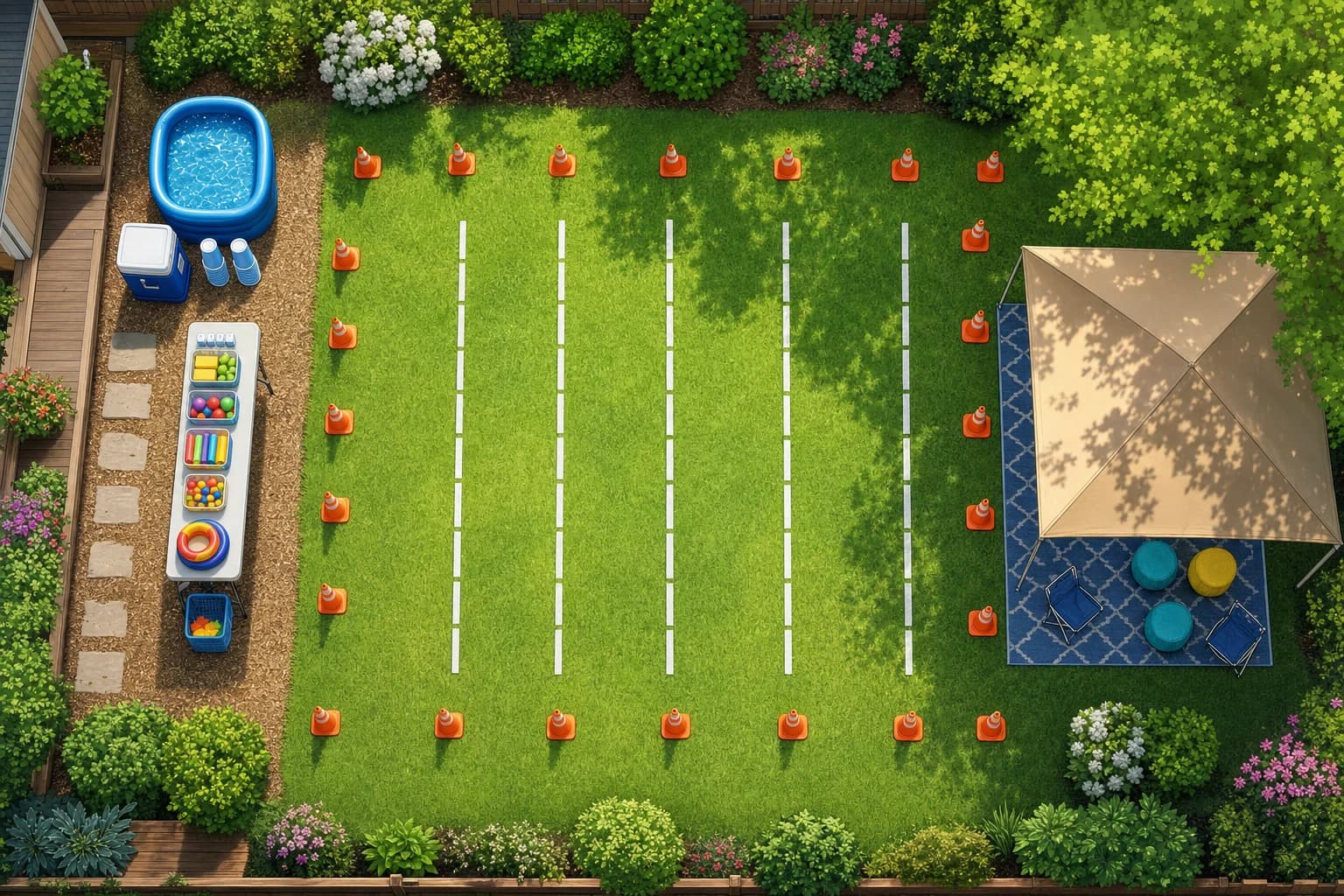
A good backyard setup has three zones: an active running zone, a supplies table, and a reset or water-break area. If the yard is small, choose relay-style games instead of full-field chase games. If the guest list is large, rotate groups through stations or use games where everyone plays at once. For very large parties, you may also like these large group party games for 20 to 50 people.
Basic Supplies List
You do not need specialized party equipment. Most of these games can be run with the following supplies:
- 8 to 12 plastic cones, flat markers, or upside-down cups for boundaries
- Sidewalk chalk for lines, bases, and scoring zones
- 2 to 4 buckets or laundry baskets
- 8 to 12 sponges or small foam balls
- 2 to 6 pool noodles
- Bandanas, pinnies, or colored wristbands for teams
- Stopwatch or phone timer
- Trash bag, towel, and extra water for cleanup
- Optional: balloons, beanbags, hula hoops, jump ropes, and painter’s tape
Game Comparison Table: Space, Supplies, and Best Use
| Game | Best for | Space needed | Low-cost supplies | Energy level |
|---|---|---|---|---|
| Sponge Bucket Relay | Warm weather and mixed ages | 20 by 30 feet | Buckets, sponges, water | Medium-high |
| Pool Noodle Tag | Kids who like chase games | 30 by 40 feet or larger | Pool noodles, cones | High |
| Chalk Territory Challenge | Strategy without hard contact | Driveway or patio | Chalk, beanbags | Medium |
| Backyard Obstacle Dash | Active tweens and team cheering | 25 by 40 feet | Cones, ropes, hoops, boxes | High |
| Balloon Balance Relay | Low-contact silly competition | 15 by 30 feet | Balloons, plates, cones | Medium |
| Kickball Mini Tournament | Sporty groups | Open yard or park field | Kickball, bases | High |
How to Set Up Teams Without Drama
Team balance matters more with party games for tweens because kids quickly notice when one team is stacked. Avoid captain-pick systems, which can embarrass guests. Use one of these simple options instead:
- Color draw: Put equal numbers of colored slips in a bowl. Each child draws a color and joins that team.
- Birthday child split: Let the birthday child choose one friend, then an adult quietly divides the rest by age, size, and energy level.
- Rotate partners: For relay games, change pairs every round so the same kids are not always winning or losing together.
- Skill-balancing rule: If one team wins two rounds in a row, they must swap one volunteer with the other team before the next round.
For ages 8 to 12, teams of 4 to 6 usually work best. Larger teams can create long waiting lines. If you have 14 or more kids, create three teams and run timed rounds so one team is not sitting out for too long.
10 Outdoor Birthday Party Games for Kids Ages 8–12
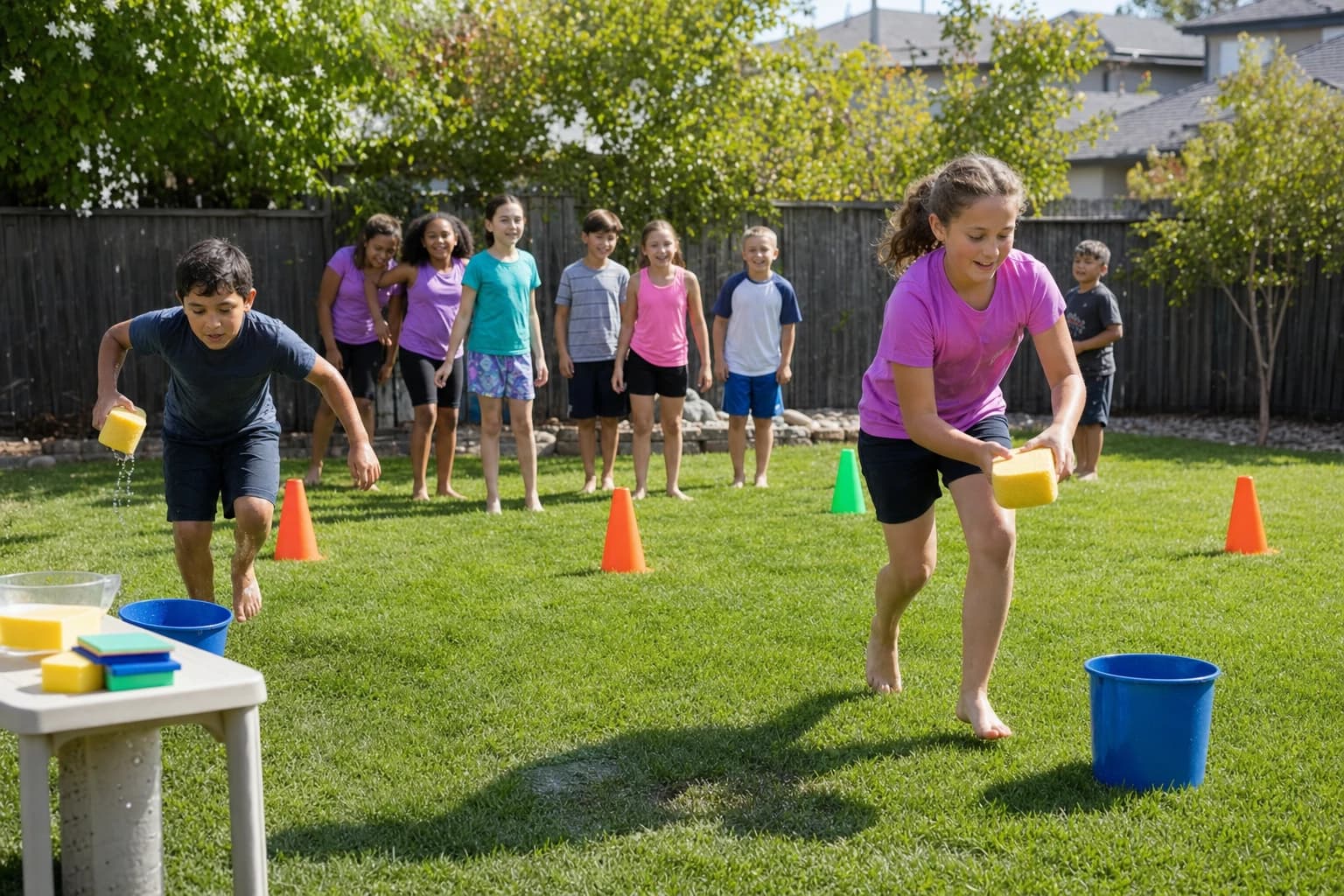
1. Sponge Bucket Relay
Best for: hot days, 8 to 24 kids. Time: 10 minutes. Space: about 20 by 30 feet.
Supplies: two buckets per team, one large sponge per team, water, and cones.
- Place a full bucket at the starting line and an empty bucket 20 to 30 feet away for each team.
- The first player soaks the sponge, runs to the far bucket, squeezes it out, and runs back.
- Continue for 3 minutes. The team with the most water in the far bucket wins.
- For a fairer finish, mark a fill line inside each bucket with painter’s tape.
Safety note: Keep the course on grass if possible. Wet pavement becomes slippery quickly. Do not allow pushing, diving, or throwing soaked sponges at faces.
Weather backup: Move to a garage or covered patio and use dry beanbags instead of wet sponges. Players carry one beanbag at a time to a basket.
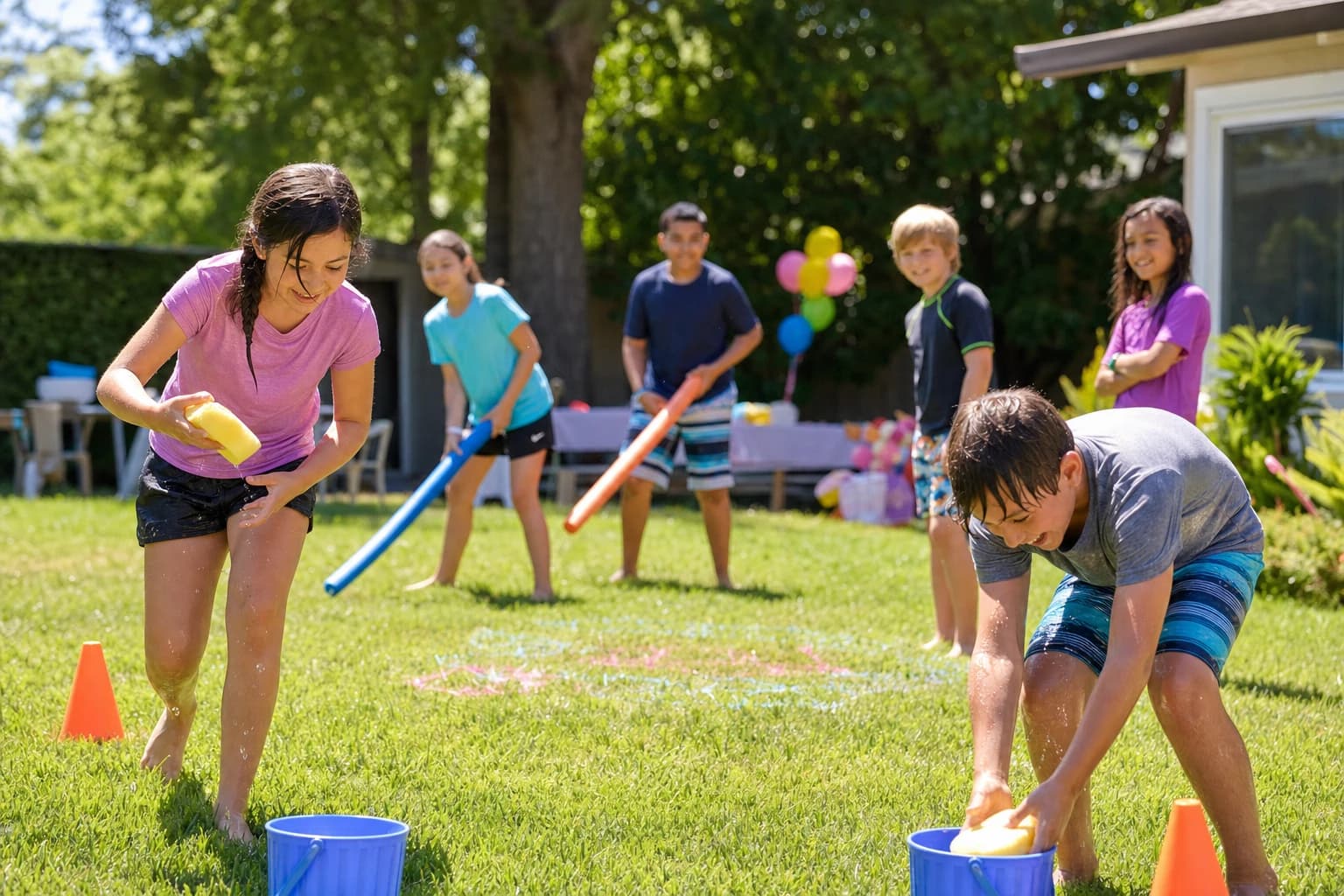
2. Pool Noodle Tag With Safe Zones
Best for: active groups that need clear contact rules. Time: 8 to 12 minutes. Space: 30 by 40 feet or larger.
Supplies: two pool noodles and cones for boundaries.
- Choose two taggers and give each one a pool noodle.
- Taggers may only tap below the shoulders and above the knees.
- Tagged players freeze with one hand raised until another player gives them a gentle high-five.
- Switch taggers every 2 minutes so more kids get a turn.
Safety note: Set a firm no-swinging rule. A pool noodle is soft, but kids can still hit too hard when excited. Remove low branches, toys, hoses, and yard tools from the area before play.
3. Chalk Territory Challenge
Best for: driveways, patios, and kids who like strategy. Time: 12 minutes. Space: any flat paved area.
Supplies: sidewalk chalk and 6 beanbags or rolled socks.
- Draw a large rectangle and divide it into 12 to 16 numbered boxes.
- Each team stands behind a throwing line and tosses beanbags into boxes.
- A team claims a box when a beanbag lands fully inside it.
- After all beanbags are thrown, teams may take one “challenge toss” to steal an opponent’s box.
- The team with the most claimed boxes after 3 rounds wins.
Variation: Add multiplication, trivia, or birthday-themed questions. To claim a box, the team must answer a question correctly after landing in it.
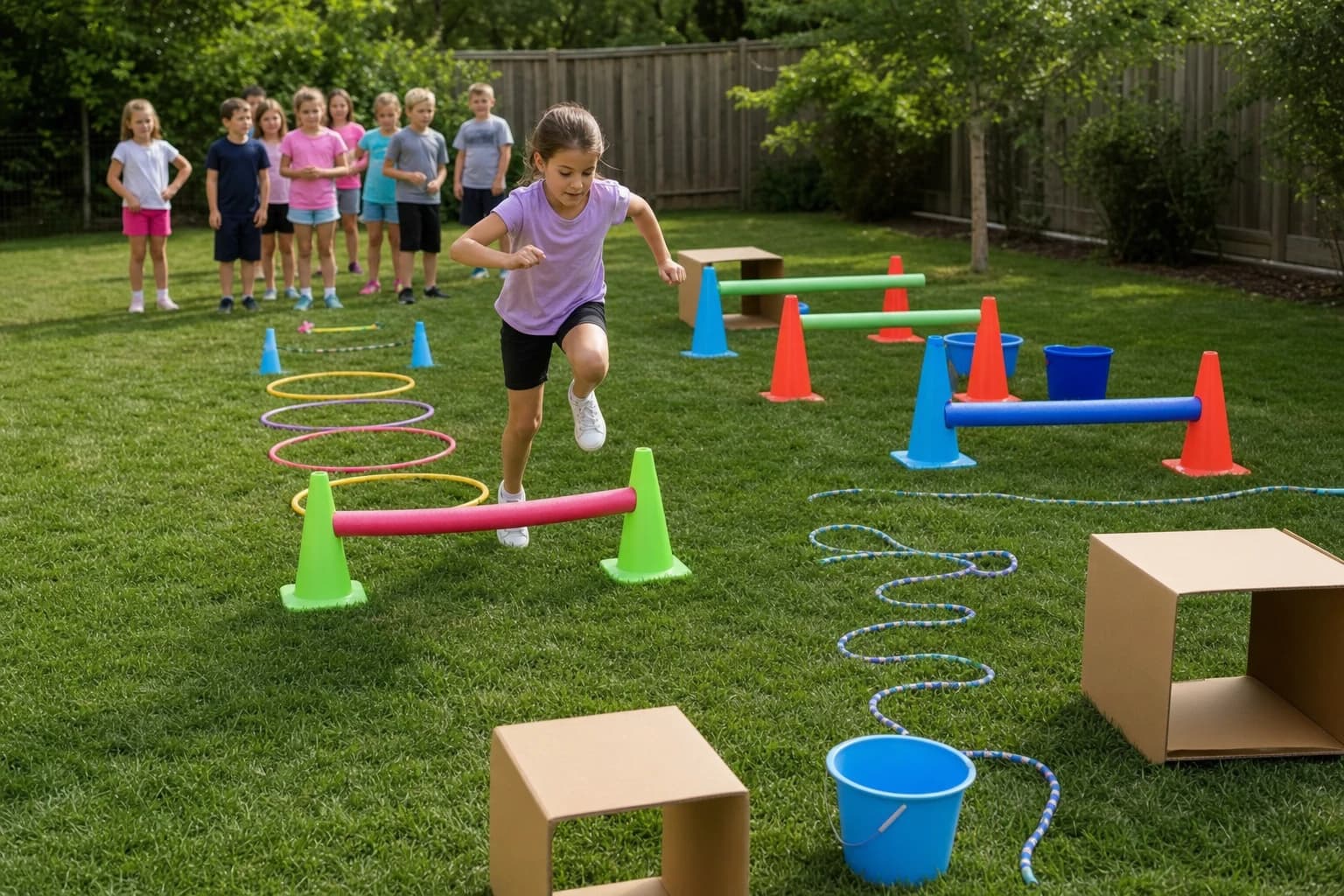
4. Backyard Obstacle Dash
Best for: party games for 8 year olds through tweens because it can be made easier or harder. Time: 15 minutes. Space: 25 by 40 feet.
Supplies: cones, hula hoops, jump ropes, cardboard boxes, pool noodles, and a timer.
- Create 5 short stations: zigzag around cones, step through hoops, crawl under a pool noodle held by two chairs, toss a beanbag into a bucket, and sprint to the finish.
- Walk the group through the course once before timing anyone.
- Run one child at a time or use two identical lanes if you have enough space.
- Score by team total time rather than only fastest individual time.
Safety note: Obstacles should be low, soft, and easy to skip. Do not use hard furniture, slick tarps, or anything that requires jumping from height. The U.S. Consumer Product Safety Commission’s public playground guidance emphasizes age-appropriate equipment, impact-absorbing surfaces, and supervision; those same ideas are useful when creating temporary backyard obstacles. See the CPSC playground safety handbook at cpsc.gov.
5. Balloon Balance Relay
Best for: silly competition without heavy running. Time: 8 minutes. Space: 15 by 30 feet.
Supplies: inflated balloons, paper plates, cones, and a trash bag for broken pieces.
- Give each team one balloon and one paper plate.
- Players must carry the balloon on the plate around a cone and back.
- If the balloon drops, the player stops, replaces it on the plate, and continues from that spot.
- Run until every player has completed one turn.
Safety note: Pick up broken balloon pieces immediately, especially if younger siblings or pets are nearby. The CPSC warns that balloons and small parts can be choking hazards for young children; keep unused and broken balloons away from children under 8 and supervise cleanup. See the CPSC small parts guidance at cpsc.gov.
6. Capture the Flag: Backyard Mini Version
Best for: party games for tweens who want a real challenge. Time: 15 minutes per round. Space: 40 by 50 feet if possible.
Supplies: two bandanas, cones, and a visible center line.
- Divide the yard into two territories and place one bandana at the back of each side.
- Players try to cross into the other territory, grab the flag, and return it to their side.
- If tagged in the other team’s territory, a player walks to a marked “jail” cone.
- A teammate can free one jailed player by reaching the jail and giving a high-five.
- Play 10-minute rounds. If no one captures a flag, count freed teammates and safe returns for points.
Safety note: Use touch tags only, no grabbing shirts or blocking bodies. If your yard has tight corners, make the game a walking-speed strategy version.
7. Mystery Object Scavenger Sprint
Best for: kids who like searching more than racing. Time: 15 to 20 minutes. Space: yard, porch, or park shelter.
Supplies: clue cards, paper bags, pencils, and 10 to 15 small objects.
- Hide safe, non-breakable objects around the play area before guests arrive.
- Give each team a list with clues instead of exact names, such as “something round and blue.”
- Teams collect or write down answers, depending on whether you want objects moved.
- Set a 12-minute timer and award one point per correct find.
This is a strong backup game when the group needs to calm down after running. For a younger group or a more detailed clue setup, see how to set up a backyard scavenger hunt for kids.
8. Four-Corner Field Switch
Best for: small yards and groups of 8 to 20. Time: 10 minutes. Space: 20 by 20 feet.
Supplies: four cones or chalk circles.
- Mark four corners and name them after party themes, colors, animals, or sports teams.
- One caller stands in the middle with eyes closed and counts down from 10.
- Players move quietly to any corner before the countdown ends.
- The caller names one corner. Instead of eliminating those players, they earn a funny challenge, such as five jumping jacks or a birthday chant.
- Switch callers every 3 rounds.
Why it works: Traditional elimination games can leave kids out early. A no-elimination version keeps everyone moving and reduces hurt feelings.
9. Kickball Mini Tournament
Best for: sporty kids and open park spaces. Time: 20 to 30 minutes. Space: open field or large yard.
Supplies: playground ball and four bases.
Use short innings and simple rules: every player kicks once, no sliding, no head throws, and runners stop when the ball returns to the pitcher area. If the game is more casual than competitive, use “one base on an overthrow” to keep scoring under control. For a fuller rule set, use these kickball rules for kids.
Safety note: Use a soft rubber playground ball, not a hard sports ball. Put bases away from fences, trees, and patios.
10. Team Build-a-Challenge
Best for: creative tweens and the end of the party. Time: 15 minutes. Space: flexible.
Supplies: a basket of safe items such as cones, cups, chalk, pool noodles, jump ropes, and beanbags.
- Divide kids into teams of 3 to 5.
- Give each team 5 minutes to invent a mini challenge using only the supply basket.
- Each team explains its rules in 30 seconds.
- Everyone tries each challenge once.
- Vote on categories such as funniest, most creative, and best teamwork rather than only “best game.”
This game works well for 10- to 12-year-olds because they get ownership without needing extra equipment.
Weather Backup Ideas That Still Feel Like a Party
Outdoor kids party games need a backup plan even if the forecast looks good. Decide in advance which games can move under cover and which should be skipped.
- Light rain: Use chalk games only if the surface is safe and not slippery. Move relay games to a covered driveway or garage with walking-only rules.
- Heat: Schedule high-energy games early, add water breaks after every 15 minutes of active play, and provide shade. Water games are fun, but they do not replace drinking water.
- Wind: Skip balloons, paper plates, and lightweight clue cards. Use beanbags, buckets, cones, and chalk instead.
- Thunder or lightning: Move everyone indoors immediately. The National Weather Service uses the simple safety message “When thunder roars, go indoors,” and outdoor play should not continue during thunderstorms. See weather.gov lightning safety.
If rain forces the whole party inside, choose low-mess games with similar energy, such as silent charades, cup stacking relays, or indoor scavenger clues. For younger siblings at the same party, these indoor birthday party games for kids ages 6–10 can help fill gaps.
Safety Checklist Before the First Game
- Walk the yard and remove hoses, garden tools, rocks, loose balls, pet waste, and sharp sticks.
- Mark boundaries with cones or chalk so kids know where not to run.
- Keep the supplies table away from the active play lane.
- Use touch-tag rules only; no tackling, grabbing, blocking, or shoving.
- Check shoes. Bare feet may be fine for quiet grass games, but running games are safer with secure shoes.
- Keep water games away from steps, decks, slick patios, and electrical cords.
- Have one adult lead the game and one adult watch the edges, especially near gates, driveways, pools, or streets.
- Offer an opt-out role, such as scorekeeper or timer, for kids who need a break.
Common Mistakes to Avoid
Choosing too many games: Six well-run games are better than twelve rushed ones. Leave time for cake, presents, bathroom breaks, and unstructured play.
Starting with the wildest game: Begin with a medium-energy game like Chalk Territory Challenge or Balloon Balance Relay. Save high-running games for after everyone understands the boundaries.
Ignoring age spread: Party games for 8 year olds may need shorter distances and simpler scoring, while 11- and 12-year-olds may want strategy, timed rounds, and team challenges. If the group is mixed, use easy rules with optional harder variations.
Letting arguments decide the pace: Announce before the first game that the adult caller’s decision is final and games will restart quickly. Short rounds make disputes less important.
FAQ: Outdoor Birthday Party Games for Ages 8–12
How many outdoor games do I need for a two-hour birthday party?
Plan 4 to 6 organized games. Add one flexible activity, such as chalk drawing or scavenger clues, for early arrivals or kids who want a break.
What are the cheapest backyard birthday games to set up?
Chalk Territory Challenge, Four-Corner Field Switch, scavenger clues, and relay races are usually the cheapest because they use chalk, paper, buckets, cones, or household items.
How do I keep outdoor party games fair for ages 8 to 12?
Use random teams, rotate partners, and score by team effort instead of only individual speed. You can also adjust distances so younger players run shorter legs in relay games.
Are water balloons a good idea for this age group?
They can be fun, but they create cleanup and slipping concerns. If you use balloons, keep them away from younger children, pick up broken pieces immediately, and consider sponge games as a reusable alternative.
What if a child does not want to play running games?
Offer a real role such as timer, scorekeeper, clue reader, judge, or photographer with a parent’s permission. Avoid forcing participation; many kids rejoin once they feel comfortable.
Conclusion
The best outdoor birthday party games for kids ages 8-12 are active but not chaotic, competitive but not discouraging, and simple enough to explain in under a minute. With cones, chalk, buckets, sponges, pool noodles, and a few clear safety rules, you can run a backyard party that feels organized without spending much money.
Choose games based on your space, weather, and group size. Mark boundaries before guests arrive, balance teams quietly, keep water and balloon cleanup under control, and have one indoor or covered backup ready. That preparation is what turns simple outdoor kids party games into a birthday that runs smoothly.