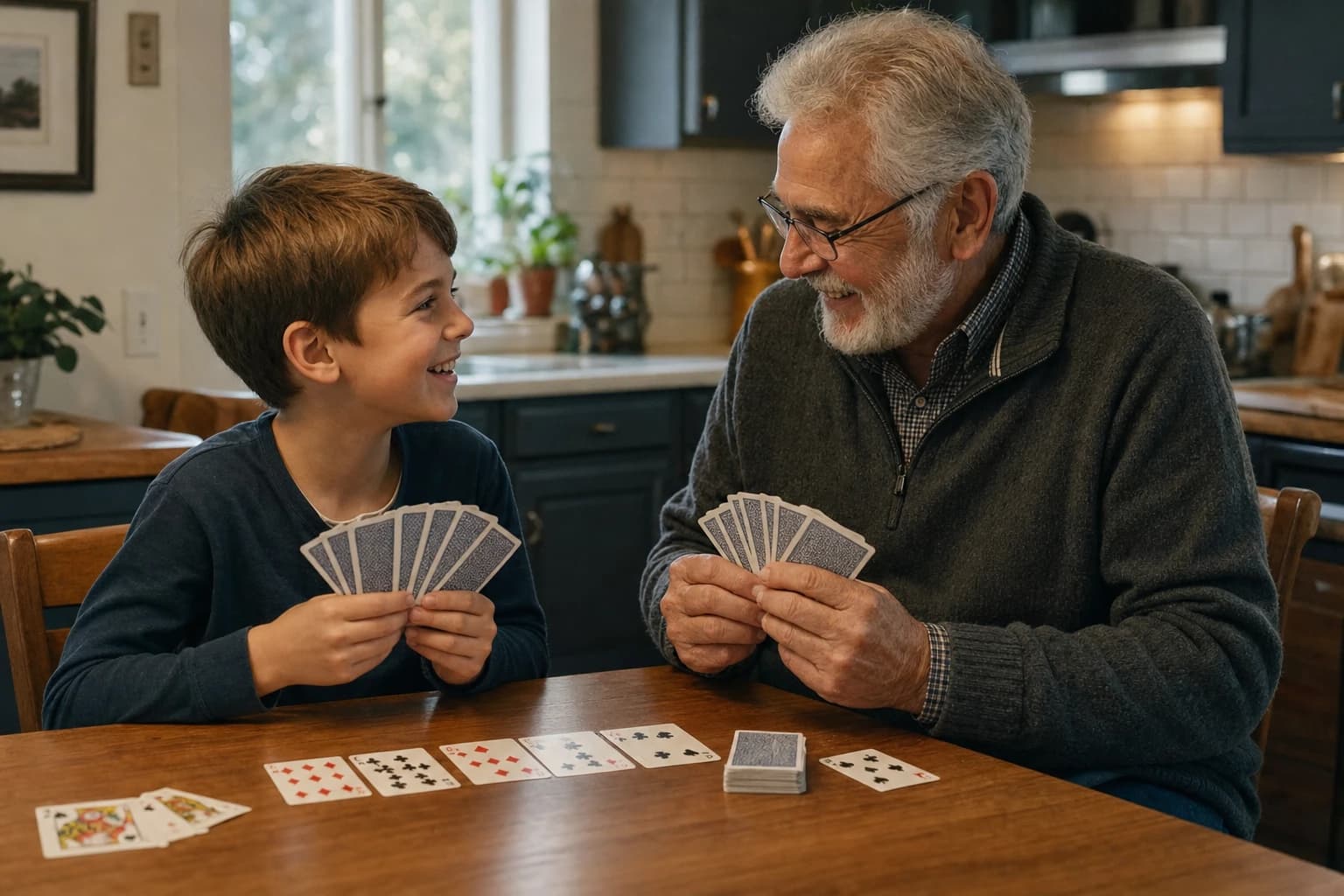
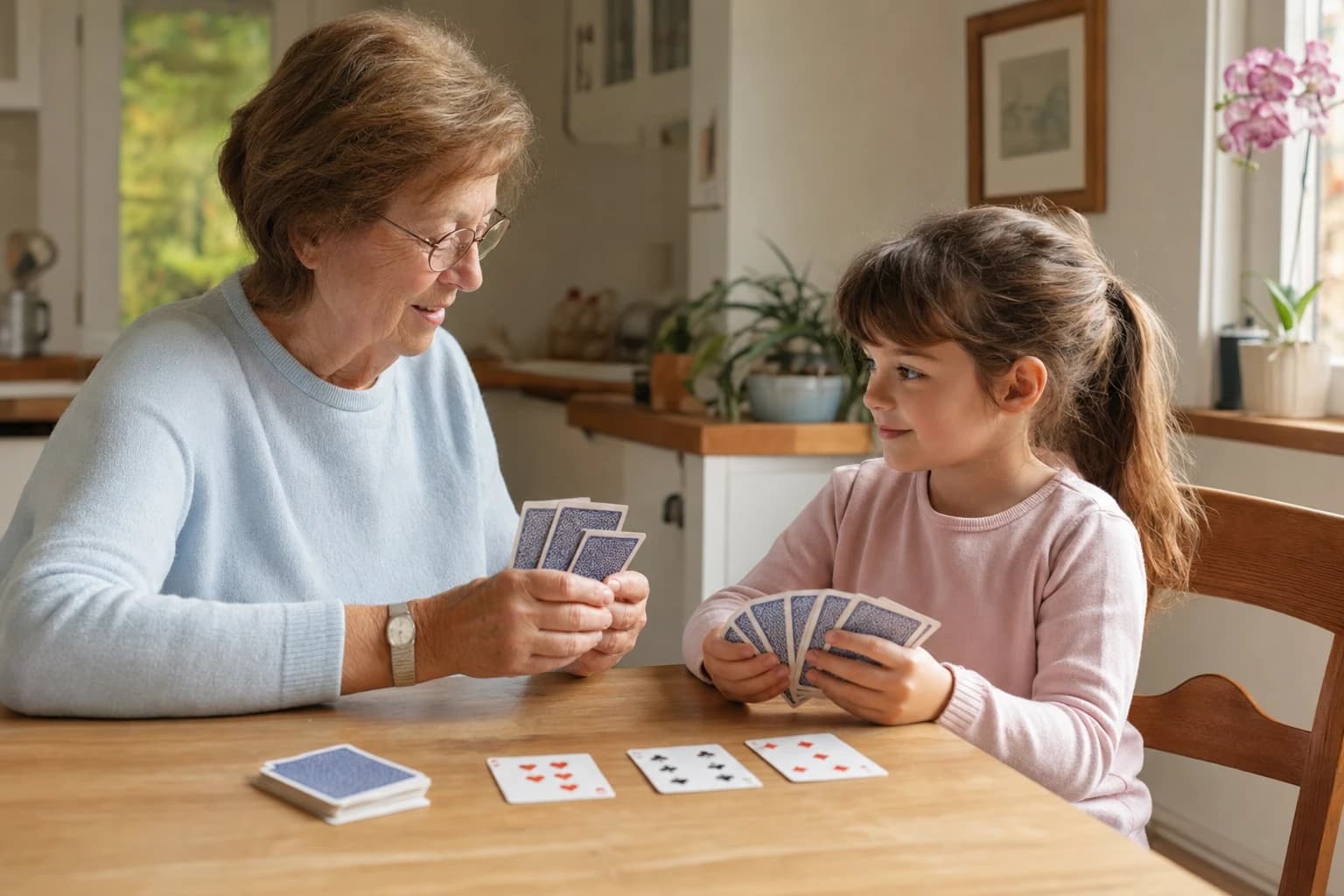
A regular deck of cards is one of the easiest ways to get children and grandparents playing together without screens, batteries, or a big setup. The best choices are games with short turns, visible progress, and rules that can be explained in under two minutes.
This guide covers easy card games for kids and grandparents using one standard 52-card deck. For each game, you’ll find suggested ages, player counts, setup, a simplified rule summary, what skills it practices, and ways to make the game easier or more challenging. Rules for traditional card games can vary by family and region, so treat these as friendly house rules rather than tournament rules.
Quick answer: the best one-deck games to start with
If you are choosing a first game for a mixed-age table, start with Go Fish for young children, War for the simplest possible rules, or Crazy Eights for kids who can match numbers and suits. For a quieter memory-building option, use Concentration with only part of the deck.
For families that enjoy more strategy, Sevens and Rummy are still simple enough for many older children, but they reward planning. If the group includes grandparents with low vision or children who are still learning numbers, use fewer cards, say card names aloud, and keep the playing area uncluttered.
At-a-glance comparison of family card games with one deck
| Game | Best ages | Players | Typical time | Main skill | Easy adjustment |
|---|---|---|---|---|---|
| Go Fish | 4+ | 2–5 | 10–20 minutes | Matching, asking clearly | Use only ranks A–8 |
| War | 4+ | 2 | 5–15 minutes | Number comparison | Play exactly 10 rounds |
| Concentration | 4+ | 1–4 | 5–15 minutes | Memory, focus | Start with 8 pairs |
| Old Maid | 5+ | 2–6 | 10–20 minutes | Pair matching | Keep all cards face up for practice |
| Crazy Eights | 6+ | 2–5 | 10–25 minutes | Suit and rank matching | Let eights be wild but skip penalties |
| Sevens | 7+ | 3–6 | 15–25 minutes | Sequencing | Play with 7 through king only |
| Simple Rummy | 8+ | 2–4 | 20–30 minutes | Sorting, planning | Allow open hands for teaching |
What you need before you play
- One standard 52-card deck. Remove jokers unless a variation specifically uses them.
- A flat playing surface. A kitchen table is ideal; a tray table can work for two players.
- Good lighting. Avoid glare on glossy cards by placing the light slightly behind players, not directly over the cards.
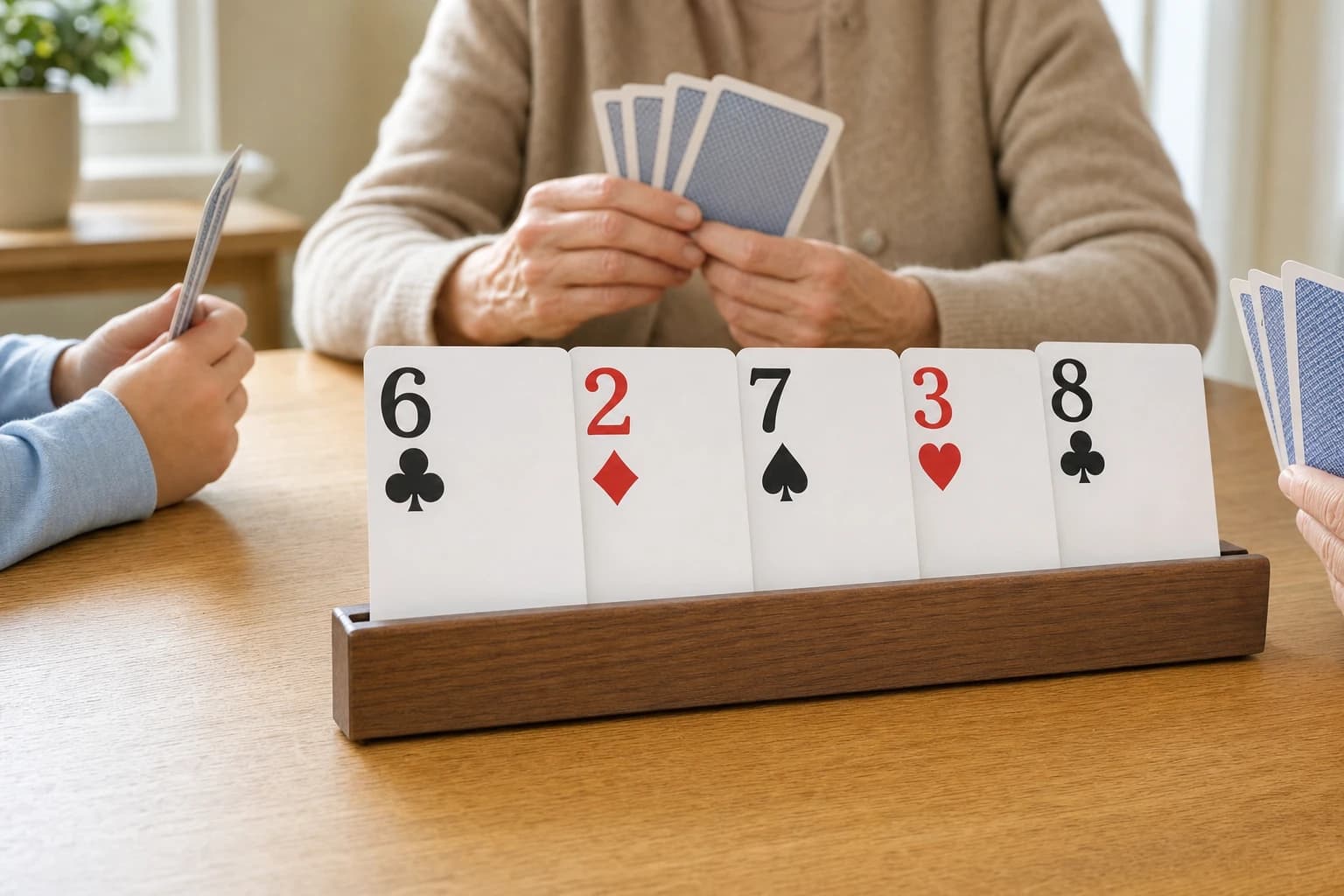
- Optional card holders. These are helpful for small hands, arthritis, or anyone who has trouble fanning cards.
- Paper and pencil. Only needed for Rummy or if you want to track wins over several short rounds.
For more no-fuss indoor options beyond cards, you may also like Indoor Games for 10 People in a Small Room or Quiet Indoor Games for Preschoolers on Rainy Days.
How to teach a card game across generations
- Choose the shortest version first. A five-minute game is better than a long game that loses the table’s attention.
- Deal a practice hand face up. Show what a turn looks like before playing for real.
- Use the same words every turn. For example: “Draw one, play one, say the suit.” Repetition helps younger children and players who process rules more slowly.
- Let the youngest or oldest player go first. This is not required, but it makes the first turn feel friendly instead of competitive.
- Stop before everyone is tired. With kids and grandparents, two short rounds usually work better than one long round.
House rules are normal in family card games. Agree on them before the first deal, especially for wild cards, penalties, and how long the game will last.
1. Go Fish
Best for: ages 4 and up. Players: 2–5. Time: about 10–20 minutes. Difficulty: easy.
Go Fish is one of the friendliest simple card games for children because it uses asking, matching, and memory without requiring speed. A common published version from Bicycle Cards’ Go Fish rules deals 7 cards to each player when there are 2 players, and 5 cards each when there are more players.
Setup and rules
- Remove jokers and shuffle the deck.
- Deal 7 cards each for 2 players, or 5 cards each for 3–5 players.
- Place the rest face down as the “fish pond.”
- On your turn, ask one player for a rank you already hold, such as “Do you have any 6s?”
- If they have that rank, they give you all cards of that rank. If not, they say “Go fish,” and you draw one card from the pond.
- When you collect four cards of the same rank, place the set face up.
- The game ends when all sets are made. The player with the most sets wins.
Skill-building benefits: Go Fish practices matching, memory, polite questioning, and turn-taking. It also helps children learn that “rank” means the number or face on the card, not the suit.
Make it easier: Use only cards ace through 8. That creates 8 possible sets instead of 13, so children have less to remember.
Make it harder: Require players to remember who asked for what. Grandparents can model thinking aloud: “You asked for 9s last turn, so I know you may still be collecting them.”
Low-vision tip: Encourage players to speak the rank clearly when asking. Use a large-print deck if available, or keep hands small by limiting the deck.
2. War
Best for: ages 4 and up. Players: 2. Time: 5–15 minutes if shortened. Difficulty: very easy.
War is the simplest comparison game: bigger card wins. Traditional War can drag on, so for family play it is best to use a timed or round-limited version.
Setup and rules
- Shuffle and deal the entire deck face down into two equal piles of 26 cards.
- Both players turn over the top card at the same time.
- The higher rank wins both cards and places them in a won-card pile. Use ace high or ace low, but decide before starting.
- If both cards are the same rank, each player places one card face down and one card face up. The higher face-up card wins the whole pile.
- For a short game, play exactly 10 rounds. Count won cards at the end.
Skill-building benefits: War helps young children compare values: 9 is greater than 6, queen is greater than 10, and so on. It is also good for children who are not ready to hold a hand of cards.
Make it easier: Remove face cards and aces. Play only 2 through 10 so children compare numbers they recognize.
Make it harder: Turn over two cards and add them. Highest total wins the round. This turns War into a quick mental-math game for older kids.
Low-vision tip: Turn cards into the center of the table and say the values aloud: “Grandpa has 8, Mia has jack.” This keeps everyone included.
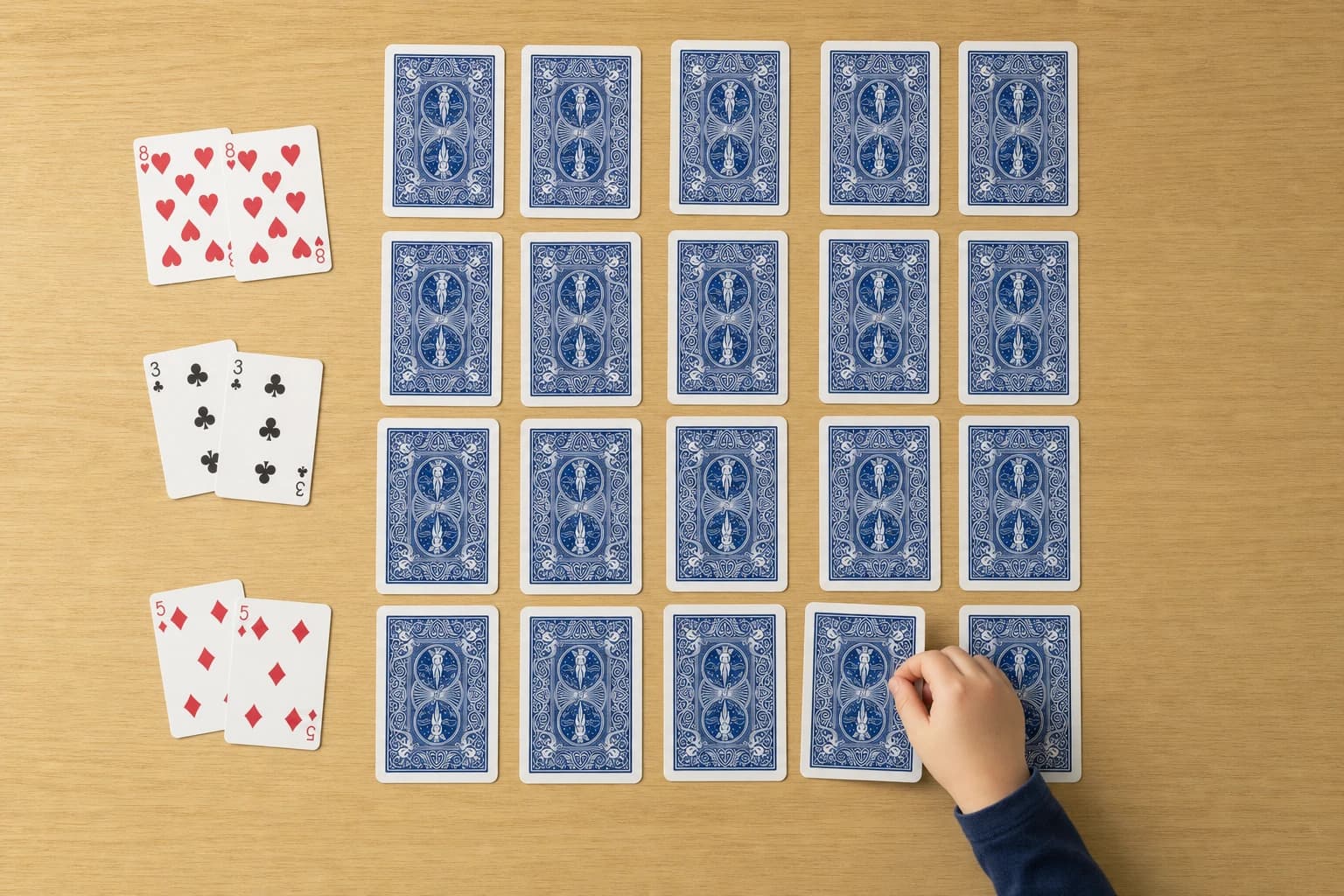
3. Concentration, also called Memory
Best for: ages 4 and up. Players: 1–4. Time: 5–15 minutes. Difficulty: easy, adjustable.
Concentration is a quiet game that works well when children are tired or when a grandparent prefers a slower pace. You do not need to use the full deck.
Setup and rules
- Choose pairs from the deck. For beginners, use 8 pairs, such as two red 2s, two black 2s, two red 3s, and so on.
- Shuffle those cards and place them face down in a neat grid.
- Players take turns flipping over two cards.
- If the cards match by rank, the player keeps the pair and takes another turn.
- If they do not match, turn them face down again in the same spots.
- When all pairs are collected, the player with the most pairs wins.
Skill-building benefits: This game practices visual memory, attention, patience, and spatial language such as “top row” and “bottom left.”
Make it easier: Use 6 pairs in a 3-by-4 grid. Match by color and rank, not exact suit.
Make it harder: Use 13 pairs, one for each rank, or require exact suit-color pairs such as the 5 of hearts with the 5 of diamonds.
Low-vision tip: Leave extra space between rows and columns. A crowded grid is harder to scan and easier to bump.
4. Old Maid with a regular deck
Best for: ages 5 and up. Players: 2–6. Time: 10–20 minutes. Difficulty: easy.
You do not need a special Old Maid deck. With a standard deck, remove one queen before dealing. The remaining unmatched queen becomes the “Old Maid.” If that name feels dated for your family, call it “Odd Queen” instead.
Setup and rules
- Remove one queen from the deck and set it aside. Remove jokers too.
- Deal all cards as evenly as possible. Some players may have one extra card.
- Everyone removes pairs from their hand and places them face up. A pair is two cards of the same rank, such as two 7s.
- On your turn, fan your cards face down and let the player to your left draw one card.
- If the drawn card makes a pair, that player lays the pair down.
- Continue until all pairs are gone. The player holding the unpaired queen at the end is left with the Odd Queen.
Skill-building benefits: Old Maid practices matching, handling cards, and reading facial expressions in a playful way.
Make it easier: Allow children to lay cards on the table and organize them openly during a practice round.
Make it harder: Require pairs to match by color, such as hearts with diamonds and clubs with spades. This leaves more cards in play longer.
Low-vision tip: Use a card holder so the drawing player can choose from a neat fan without seeing faces.
5. Crazy Eights
Best for: ages 6 and up. Players: 2–5. Time: 10–25 minutes. Difficulty: easy to medium.
Crazy Eights is a strong choice for card games for all ages at home because it feels familiar to anyone who has played matching discard games. Bicycle Cards also publishes Crazy Eights rules, though families often simplify penalties for children.
Setup and rules
- Deal 5 cards to each player.
- Place the remaining deck face down as a draw pile.
- Turn one card face up to start the discard pile. If it is an 8, shuffle it back and turn a new card.
- On your turn, play one card that matches the top card by rank or suit. For example, on a 10 of hearts, you may play any 10 or any heart.
- An 8 is wild. When you play an 8, name the new suit.
- If you cannot play, draw one card. If it can be played, play it; otherwise your turn ends.
- The first player to empty their hand wins.
Skill-building benefits: Crazy Eights practices sorting by suit, matching ranks, flexible thinking, and planning one or two turns ahead.
Make it easier: Do not use scoring. Simply play until someone runs out of cards.
Make it harder: Add a house rule that a player must say “one card” when they have one card left. If they forget, they draw one card.
Low-vision tip: Keep the discard pile squared and announce the current suit after every 8: “The suit is now clubs.”
6. Sevens
Best for: ages 7 and up. Players: 3–6. Time: 15–25 minutes. Difficulty: medium.
Sevens is a sequencing game. Players build each suit outward from the 7, creating a shared layout that everyone can see. It is especially nice for grandparents who enjoy orderly games and children who are learning number order.
Setup and rules
- Deal the whole deck to all players as evenly as possible.
- The player with the 7 of diamonds plays it first. If you prefer, let any 7 start.
- Players take turns adding cards in sequence by suit. On the 7 of diamonds, the 6 of diamonds can go below it and the 8 of diamonds can go above it.
- A new suit can begin only when someone plays that suit’s 7.
- If you cannot play, pass.
- The first player to play all their cards wins.
Skill-building benefits: Sevens practices number order, suit recognition, patience, and planning. Children can see the whole game grow on the table.
Make it easier: Use only 7 through king in each suit. This reduces the deck to 28 cards and removes the lower side of the sequence.
Make it harder: Require players to pass only if they truly cannot play. This adds strategy because holding back useful cards may block others.
Low-vision tip: Build each suit in a separate vertical column with plenty of space. Say the card as it is played.
7. Simple Rummy
Best for: ages 8 and up. Players: 2–4. Time: 20–30 minutes. Difficulty: medium.
Rummy is a good next step when children are ready for more decision-making. The goal is to make sets, such as three 9s, or runs, such as 4-5-6 of hearts.
Setup and rules
- Deal 10 cards to each player for 2 players, or 7 cards each for 3–4 players.
- Place the rest face down as the draw pile. Turn one card face up to start the discard pile.
- On your turn, draw one card from either pile.
- If you can, place a set or run face up on the table. A valid set has at least 3 cards of the same rank. A valid run has at least 3 cards in order in the same suit.
- Discard one card to end your turn.
- The first player to use all cards in their hand wins the round.
Skill-building benefits: Rummy supports sorting, pattern recognition, planning, and flexible problem-solving. It is also a good game for conversation because turns are not rushed.
Make it easier: Play one open-hand teaching round where everyone’s cards are visible and older players explain possible moves.
Make it harder: Keep score by adding the values of cards left in other players’ hands. For a child-friendly version, count each card as 1 point instead of using card values.
Low-vision tip: Sort cards by suit first, then by rank. A card holder or a slotted pool noodle cut to length can help players see their hand without gripping cards tightly.
Low-vision and comfort tips for grandparents
- Use high-contrast or large-index cards if your family owns them. They are still standard decks if they have the same 52 cards.
- Reduce hand size. Games like Go Fish and Crazy Eights are easier when players hold 5 cards instead of 7 or more.
- Announce important cards. Say “8 of spades, suit changed to hearts” or “pair of queens” as cards are played.
- Avoid speed games unless everyone wants them. Fast slap-style games can be fun, but they may frustrate players with slower reaction time or hand pain.
- Use a discard tray or clear center spot. This prevents piles from spreading and keeps the game state easy to read.
Common mistakes to avoid
- Starting with too many rules. Teach the basic version first. Add scoring, penalties, or special cards later.
- Letting one player “coach” every turn. Help is useful, but children and grandparents both deserve time to think.
- Playing a game that is too long. Use a timer or fixed number of rounds for War, Rummy, and Crazy Eights.
- Forgetting physical comfort. Card holders, clear lighting, and breaks matter more than perfect rules.
- Turning it into gambling. Keep family card games friendly. Use points, tokens with no cash value, or simple “best of three” rounds instead of betting.
If you are planning a larger family gathering, pair a card table with simple group activities such as Christmas Party Games for Families With Kids, Teens, and Adults Together or Indoor Birthday Party Games for Kids Ages 6–10.
FAQ
What is the easiest card game for a child and grandparent to play together?
War is the easiest if the child can compare card values. Go Fish is usually the best first choice if you want conversation, matching, and a little memory practice.
Can preschoolers play with a standard deck?
Yes, but use fewer cards and choose games that do not require holding a large hand. War, Concentration with 6 to 8 pairs, and open-hand Go Fish are good starting points.
What card games work for three generations at one table?
Go Fish, Crazy Eights, Old Maid, Sevens, and simple Rummy all work well with mixed ages. Choose the game based on the youngest player’s patience and the oldest player’s comfort with holding cards.
How can I make card games fair when adults know the rules better?
Use shorter rounds, allow one practice hand, and let children keep cards face up for the first game. Adults can also avoid advanced strategy until everyone understands the flow.
Do we need a special kids’ deck?
No. A standard 52-card deck is enough. A large-print deck or card holder can help, but the games in this guide do not require specialty cards.
Conclusion
The best easy card games for kids and grandparents are the ones that keep turns clear, hands manageable, and everyone involved. Start with Go Fish, War, or Concentration for younger children. Add Crazy Eights, Old Maid, Sevens, or simple Rummy when the group is ready for more choices.
One standard deck can cover a quiet afternoon, a holiday visit, or a quick after-dinner game. Keep the rules simple, speak cards aloud, and adjust the deck size so the game fits the people at the table.