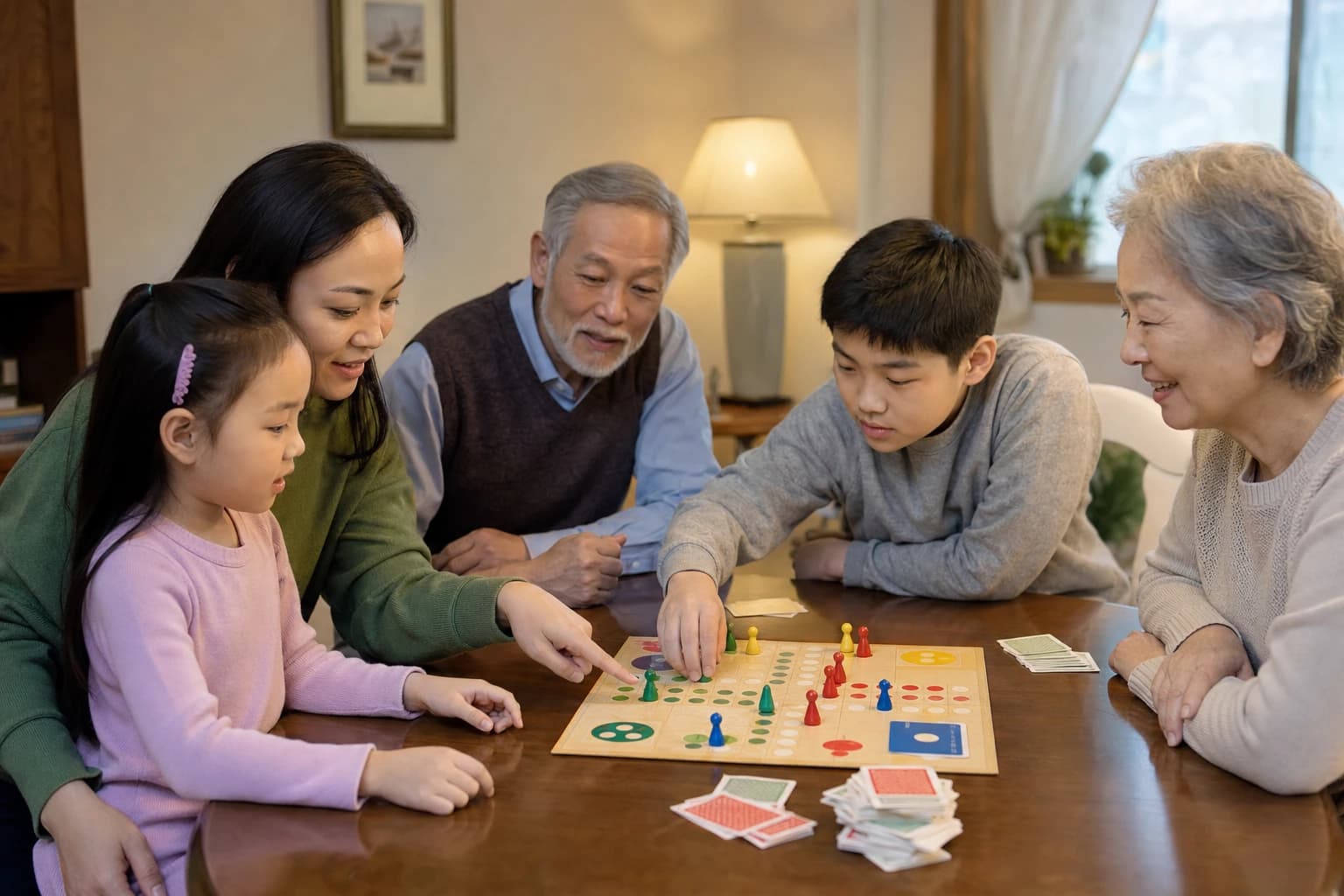
Younger kids often want to sit at the same table as older siblings, parents, and grandparents, even when the game was clearly designed for stronger readers, longer attention spans, or more strategic planning. The answer is not always to buy a new game or let the youngest player lose badly for an hour. With a few thoughtful changes, many classic board games can become workable mixed-age family games.
This guide explains how to adapt board games for younger kids without rewriting the whole rulebook or removing the fun for everyone else. You will learn when to use team play, open hands, shorter goals, helper roles, reduced reading, adjusted scoring, and when it is better not to modify a game at all.
The quick answer: change the access, not the whole game
The best family board game adaptations usually keep the main feeling of the game intact. Instead of changing everything, adjust the parts that block a younger child from participating: reading, counting, long waits, hidden information, too many choices, or a game length that is simply too long.
A useful question is: What is stopping this child from taking a real turn? If the problem is reading, read cards aloud. If the problem is strategy, let them play with an open hand and talk through choices. If the problem is endurance, shorten the goal. If the problem is competition with a much older sibling, make teams.
Developmentally, children grow at different speeds in attention, language, memory, and problem-solving. The National Association for the Education of Young Children notes that developmentally appropriate practice considers both age expectations and the individual child, which is a helpful lens for family game night too: NAEYC developmentally appropriate practice position statement.
Before you adapt: decide what must stay the same
Before changing rules, identify the two or three things that make the game feel like itself. For a word game, that may be building words and choosing where to place them. For a property-trading game, it may be buying spaces and making deals. For a deduction game, it may be asking questions and narrowing possibilities.
Try not to remove the core choice. If every turn becomes automatic, the younger child may be included physically but not mentally. A good adaptation gives them a decision they can understand, even if it is a smaller decision than the adults are making.
Keep the official rules nearby so everyone knows what has been changed. Many publishers make current rule sheets available online; for example, Hasbro maintains an official instruction library at instructions.hasbro.com. You do not need to recite the official rules during play, but it helps to separate the printed game from your temporary house rules.
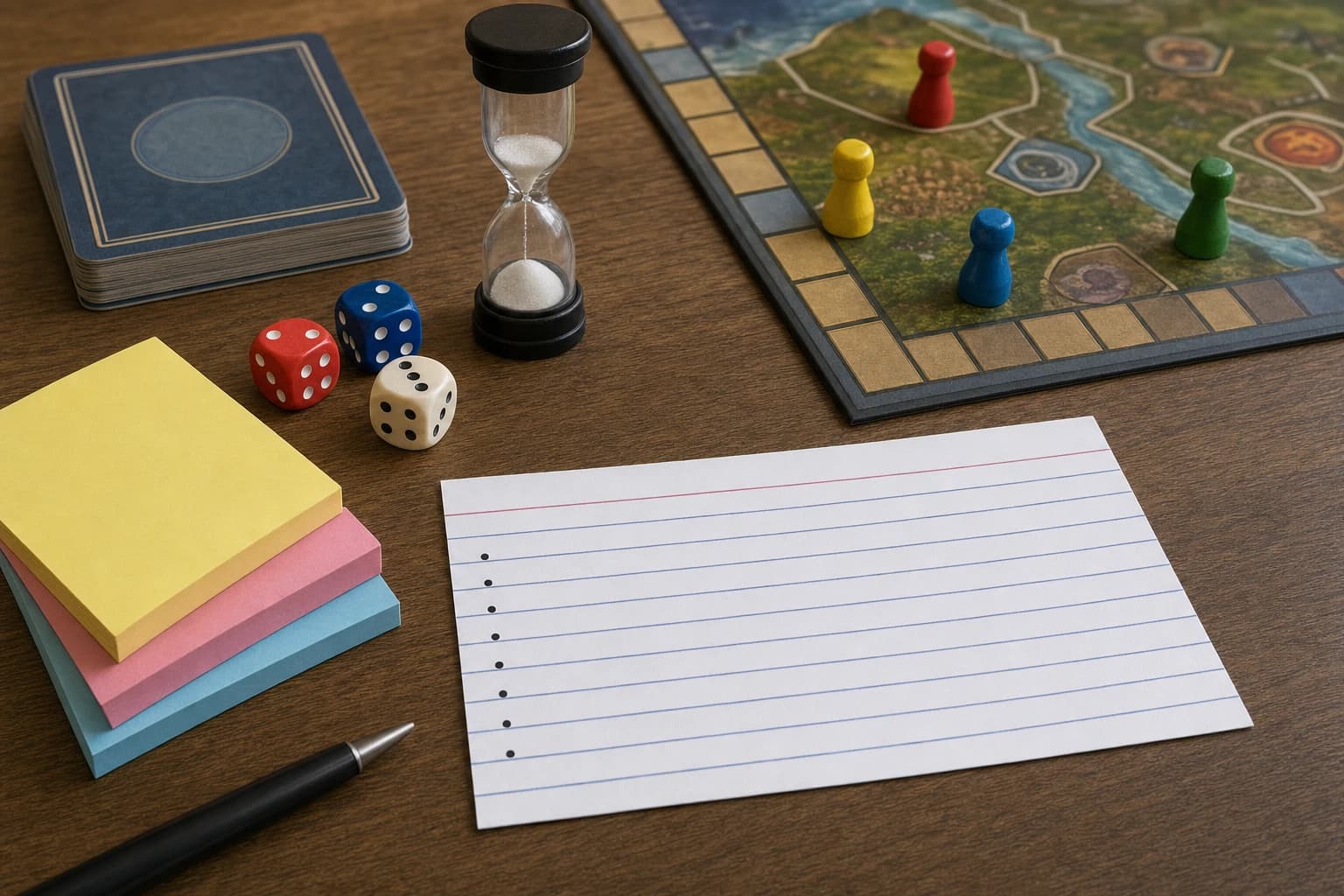
Simple materials that make adaptations easier
- Index cards: Use 1 card to write the temporary house rules for that game.
- Sticky notes: Cover unused spaces, mark a shorter finish line, or label a helper job.
- Small bowl or tray: Hold pieces for a younger child who may knock components around.
- Timer: Set a clear 20-, 30-, or 45-minute limit before the game begins.
- Scratch paper: Let an adult or older sibling handle score math without making it mysterious.
- Card holder or book stand: Helpful for small hands if the game uses cards.
Step-by-step: how to adapt board games for younger kids
-
Start with the youngest child’s real barrier
Do not simplify everything at once. Watch one practice round and name the main obstacle. Is the child waiting too long? Struggling to read? Forgetting what the symbols mean? Unable to plan several turns ahead? Once you identify the barrier, choose one adaptation that targets it.
For example, if a 5-year-old can count spaces but cannot read event cards, the fix is simple: everyone reads cards aloud. You do not need to change movement, scoring, or the goal.
-
Use team play before using a handicap
Team play is often the cleanest way to include younger children with older family members. Pair the younger child with an adult, grandparent, or patient older sibling. The team shares one position, one hand of cards, or one score.
To keep the younger player active, give them the final small decision whenever possible: choose which piece to move, which card to play from two options, which color to collect, or whether the team should take a safe or bold move. The adult teammate can explain choices but should avoid taking every turn for them.
If your family enjoys mixed-age evenings, you may also like How to Plan a 60-Minute Family Game Night for Mixed Ages Without Anyone Getting Bored.
-
Shorten the goal, not the fun part
Many classic games become difficult for younger kids because they last too long, not because the choices are impossible. Set the end point before starting. Use one of these exact options:
- 20-minute game: Best for ages 4 to 6 or late evenings.
- 30-minute game: Good for mixed groups with one younger sibling.
- 45-minute game: Better for older elementary children who can stay engaged.
- First to 5 points, 10 coins, or 3 completed goals: Works well when the game already tracks progress.
When the timer ends, finish the current round so everyone has the same number of turns. Then count whatever the game already counts: points, sets, money, spaces, completed routes, or collected tokens.
-
Make hidden information open when teaching
Hidden cards are exciting for experienced players, but they can overwhelm a younger child who needs help. An open-hand version lets the child place their cards face up. Teammates can talk openly about options.
This works especially well for card-driven board games, tile games, and games with action cards. To keep it fair, decide whether only the younger child has an open hand or whether all teams with an adult helper play open. If older siblings are competitive, making all hands open for one teaching round can prevent complaints.
-
Reduce choices to two or three good options
Younger kids can freeze when a game offers too many legal moves. Instead of saying, “What do you want to do?” try: “You can move here to collect a blue piece, or here to block Dad. Which one do you choose?”
This keeps agency with the child while removing the burden of scanning the entire board. Avoid offering a fake choice where one option is obviously terrible. The goal is to teach decision-making, not trick them.
-
Assign helper roles that matter
If the youngest child is not ready to be a full player, give them a real job instead of a pretend one. Good helper roles include dice roller, card flipper, token banker, train or tile supplier, score marker, turn announcer, or clue reader with adult support.
A helper role works best for 10 to 20 minutes. After that, many children want either a turn or a break. If the game is longer, rotate helper jobs between rounds so the child is not stuck doing one repetitive task.
-
Adjust scoring only after you have adjusted access
Handicaps can help, but they should not be the first tool. If the younger child cannot understand the turn, extra points will not make the game more enjoyable. Once they can participate, use a simple scoring adjustment if needed.
Examples include giving the younger player 3 bonus points at the start, letting them ignore their first 2 penalty cards, or allowing one free redraw per round. Keep the number small and visible. Write it on the house-rule card so it does not feel like adults are changing the game secretly.
-
End with a clean reset
At the end, say which rules were official and which were family adaptations. This matters because older children may later play the regular version with friends. A simple closing line works: “Tonight we played the 30-minute team version. Next time we can try the regular scoring.”
Adaptation methods compared
| Adaptation | Best for | Works especially well with | Watch out for |
|---|---|---|---|
| Team play | Young kids who want full participation | Strategy, route-building, trading, and deduction games | Adults taking over the child’s decisions |
| Open hands | Children who need help understanding cards | Card-driven board games and set-collection games | Removing suspense for players who love secrecy |
| Shorter goal | Kids with limited stamina | Long classics, point games, campaign-style sessions | Ending before the game’s main strategy appears |
| Reduced reading | Pre-readers and early readers | Trivia, event cards, clue cards, word-heavy games | Accidentally giving hints while reading aloud |
| Limited choices | Children overwhelmed by analysis | Abstract strategy, tile placement, route planning | Offering only one meaningful option |
| Adjusted scoring | Kids who understand turns but cannot compete evenly | Point-based and race-style games | Creating resentment if the bonus feels too large |
Practical examples for familiar game types
Word games
For word games, the barrier is often spelling, vocabulary, or score math. Let younger children play on a team and choose between two possible words suggested by the adult. You can also skip advanced scoring for the first game and count only the face value of tiles or cards. If the child is a beginning reader, allow family-approved “kid words” and focus on building confidence with real letters.
Be careful not to remove the word-building challenge entirely. If adults build every word and the child only places the pieces, they are not really playing the word game.
Money and trading games
For property, shop, or money games, use a banker helper and simplify transactions. An adult can handle making change while the child decides whether to buy, save, or trade. If the printed money is distracting, group it into small piles: ones, fives, tens, and larger bills. Ask the younger child to count only the pile they need.
Trading can be tricky with older siblings because persuasive players may dominate. For mixed age board game rules, add one family fairness rule: every trade involving a younger child must be repeated aloud by a neutral adult before the child says yes.
Deduction and mystery games
Deduction games can work well for younger kids if someone helps track information. Use a shared notes sheet for the child’s team. The adult can mark clues, but the child should still ask the question or choose the next place to investigate.
If the game depends heavily on secrecy, avoid full table discussion. Instead, whisper with the child or use a team notebook. That preserves the mystery for everyone else.
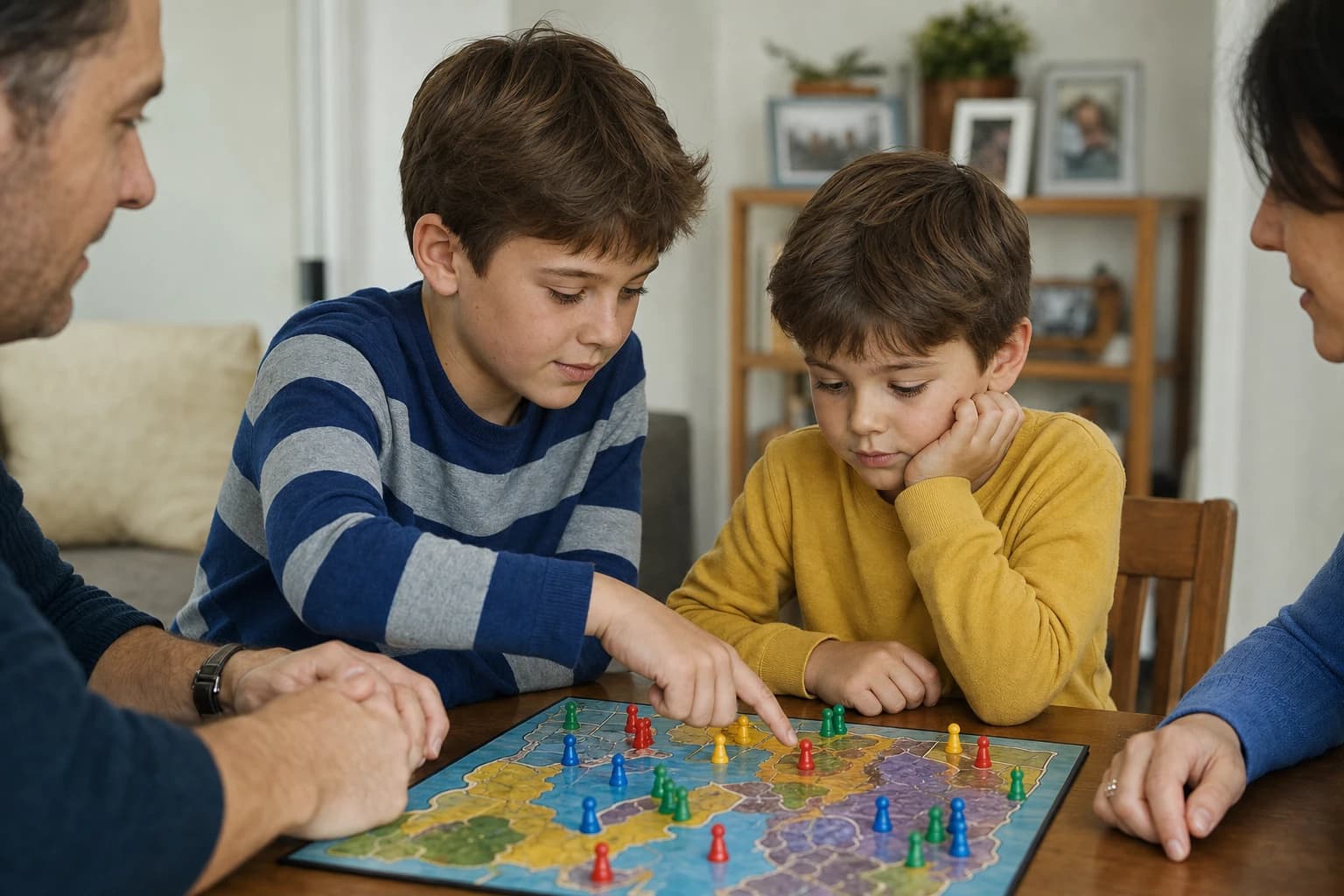
Route-building and map games
For route and map games, limit the first few turns to one region of the board. Put a sticky note near the child’s starting area and say, “For the first 3 turns, we are only looking at this corner.” This reduces visual clutter without changing the entire game.
You can also let the younger child choose colors, collect matching cards, or place pieces while an older teammate handles long-term planning. If your family prefers lower-conflict play, consider games designed around shared goals; Best Cooperative Board Games for Families Who Do Not Like Competitive Game Nights is a helpful next read.
Trivia games
Trivia often has the widest age gap because adults simply know more. Make younger children answer from a kid-friendly category, let them choose between two answers, or allow family teams. Another option is a “teach-back” point: if a child does not know the answer, an older player explains it briefly, and the child earns a token for remembering it later in the game.
Do not pretend that adult trivia is equal for a 6-year-old. It is fairer to change the question format openly than to watch the child guess at topics they have never encountered.
How to keep older siblings from feeling cheated
Board games with younger siblings can become tense when older children feel the rules are being bent against them. The fix is transparency. Announce the adaptation before setup, write it down, and apply it consistently.
Use language that respects older players: “We are playing a 30-minute teaching version so Maya can join. After this, you and I can play the regular version.” This tells the older child the real game still matters.
It also helps to give older siblings a skilled role. They can be the rules coach, score checker, or strategy explainer, but they should not be the boss of the younger child’s turn. If a sibling is too competitive for that role, pair the younger child with an adult instead.
When not to modify a board game
Some games are not good candidates for heavy adaptation. If the game depends on secret information, precise negotiation, complex timing, or a long buildup, changing too much may remove the experience that older players enjoy.
Consider choosing a different game when:
- The younger child cannot make any meaningful decision, even with help.
- The game’s main fun comes from secrecy, and open hands would spoil it.
- The older players have been waiting to play the regular version.
- The game takes more than 60 minutes and the child is already tired.
- The adaptation requires adults to explain every move for the entire game.
In those cases, it is kinder to set up a shorter side game, choose a cooperative title, or let the youngest child be a helper for one round and then move to another activity. For simple shared play across generations, see Best Board Games for Grandparents and Kids to Play Together at Family Game Night.
A sample house-rule card you can copy
Use this format on an index card before your next game night:
Tonight’s version: 30-minute team game. Youngest player plays open hand with an adult partner. Adults may explain choices, but the child makes the final pick between 2 options. Finish the current round when the timer rings. Count normal points, plus 3 starting bonus points for the youngest team.
This card is short enough for everyone to understand and specific enough to prevent arguments. You can change the time, bonus, or team arrangement depending on the game.
Tips for smoother mixed-age game nights
- Play one practice round that does not count. This removes pressure and lets the younger child touch pieces before the real game starts.
- Seat helpers beside, not across from, younger children. It is easier to point, whisper, and share cards without exposing everything to the table.
- Use the same words each turn. A simple rhythm such as “roll, move, choose, collect” helps children remember the sequence.
- Stop before the mood collapses. A good 25-minute game is better than a 50-minute game that ends in tears.
- Keep a few flexible alternatives nearby. Standard-deck card games are useful when a board game is too much; try Easy Card Games Kids Can Play With Grandparents Using One Standard Deck.
FAQ
What is the easiest way to make board games easier for kids?
The easiest first step is team play. Pair the younger child with an adult or patient older sibling, keep the normal turn structure, and let the child make one clear decision each turn.
Should younger kids always get extra points?
No. Extra points help only when the child already understands how to take a turn. Start by reducing reading, shortening the game, or using open hands. Add a small scoring bonus only if the skill gap still makes the game discouraging.
How long should a mixed-age board game last?
For many families, 20 minutes works well for preschool and early elementary players, 30 minutes works for a broad mixed-age group, and 45 minutes is better for older children who can stay engaged. Set the limit before the game begins.
Is it fair for a younger child to play with open cards?
It can be fair if everyone agrees before the game starts. For a teaching round, open cards are a support tool, not a secret advantage. If older siblings object, make all beginner teams play open for that round.
What if adapting the game ruins it for older players?
Choose a different game or play two sessions: a short adapted version first, then the regular version for older players. Not every board game is a good fit for heavy modification.
Can younger children join competitive games without arguments?
Yes, but the expectations need to be clear. Write the mixed age board game rules on one card, explain any bonuses or helper roles before setup, and avoid changing rules mid-game unless everyone agrees.
Conclusion
Learning how to adapt board games for younger kids is mostly about removing barriers while preserving meaningful choices. Use team play when the child wants full involvement, open hands when they need guidance, shorter goals when attention is the problem, and helper roles when they are not ready for a complete game.
The best adaptations are visible, temporary, and respectful of every player at the table. When a change makes the game welcoming without erasing what older family members enjoy, you have found the sweet spot for mixed-age family play.