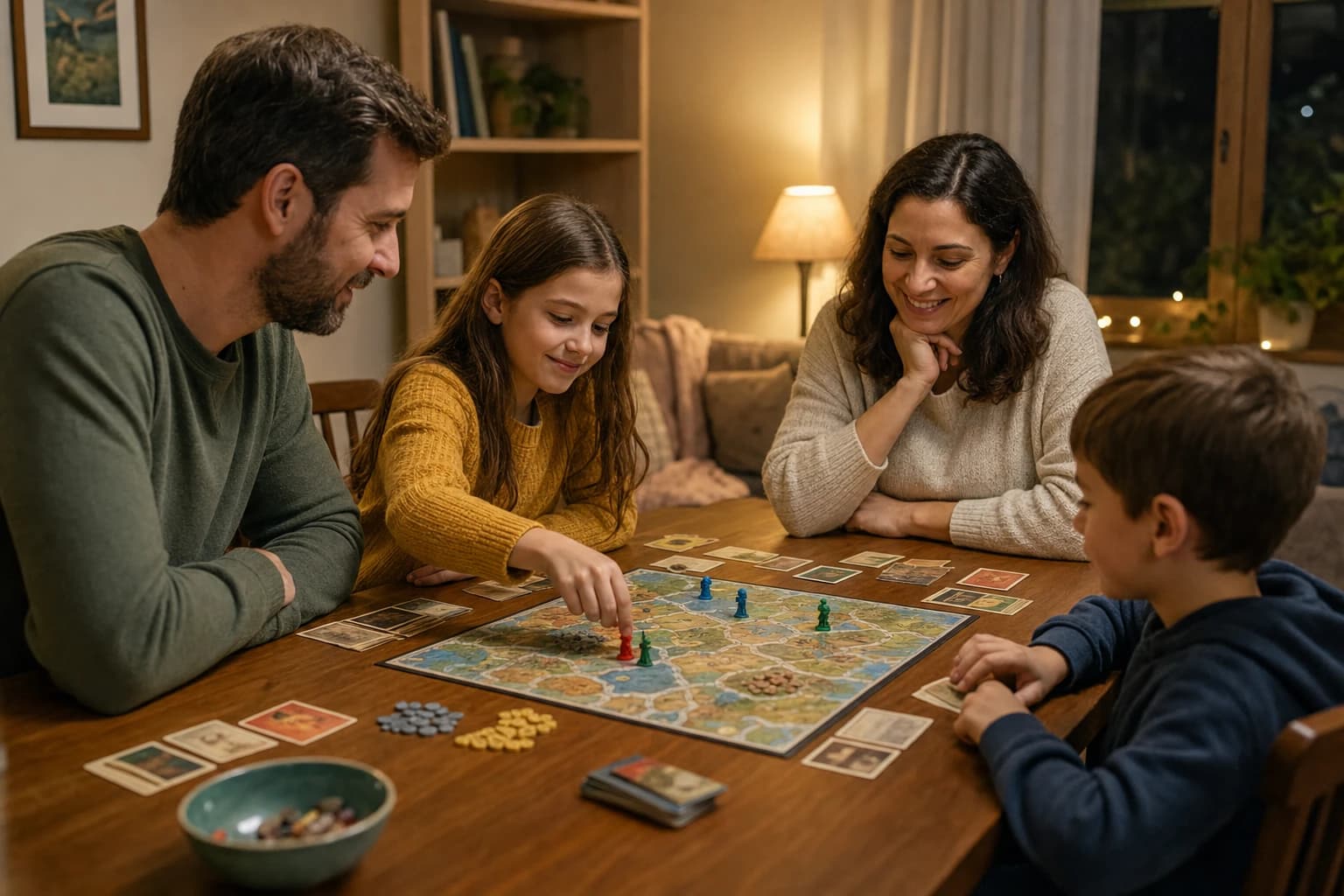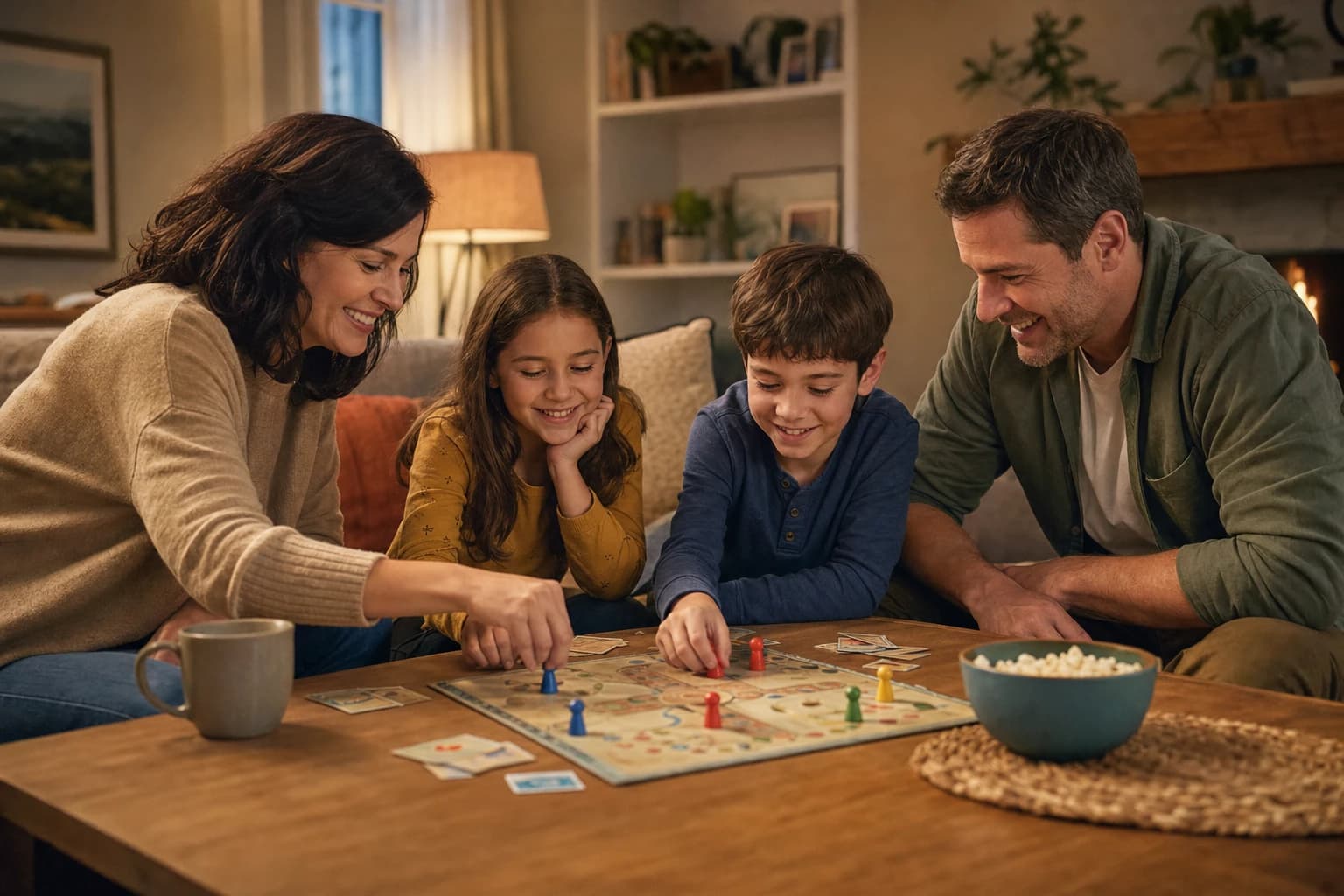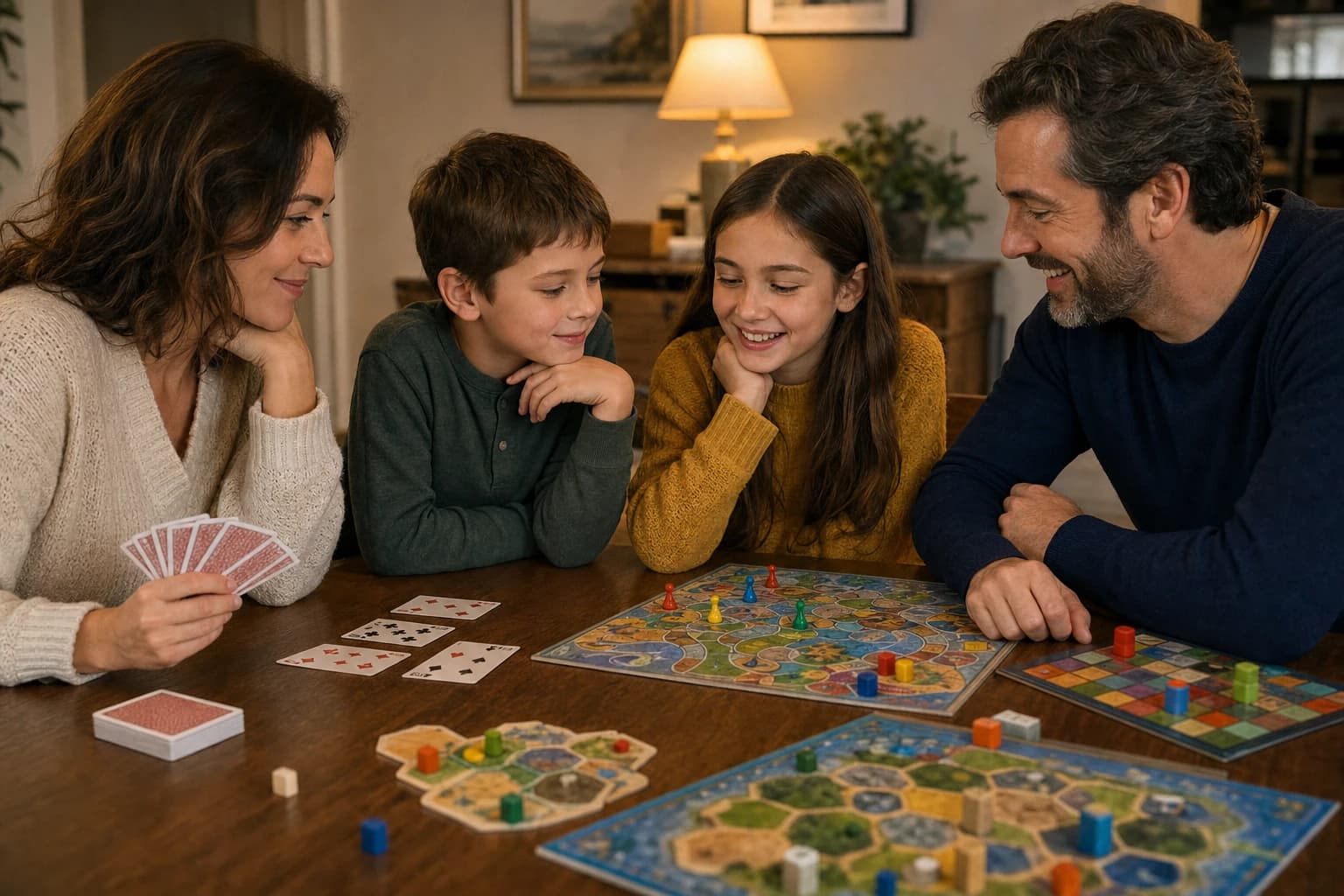
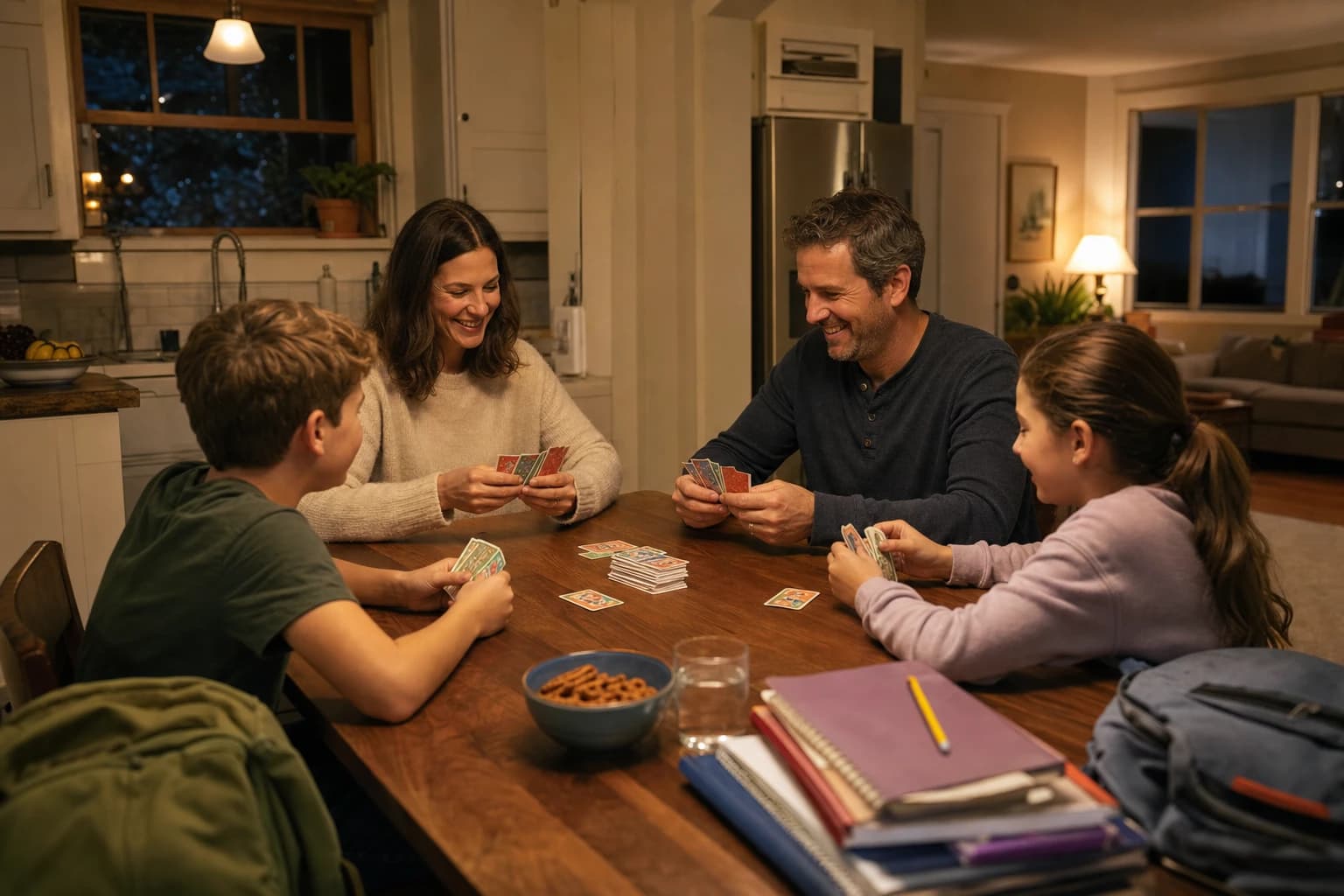
School nights leave very little room for a full board game night. Dinner runs late, homework stretches on, and a “quick game” can become the reason bedtime slips by half an hour. This guide focuses on quick family games under 15 minutes that are realistic for weeknights: fast to explain, easy to set up, simple to clean up, and short enough to play before bedtime without rushing everyone.
The picks below are ranked by practical table time, not only by the time printed on the box. For a busy evening, the best choice is usually the game with the clearest stopping point: one hand, one round, first to five cards, or a 10-minute timer.
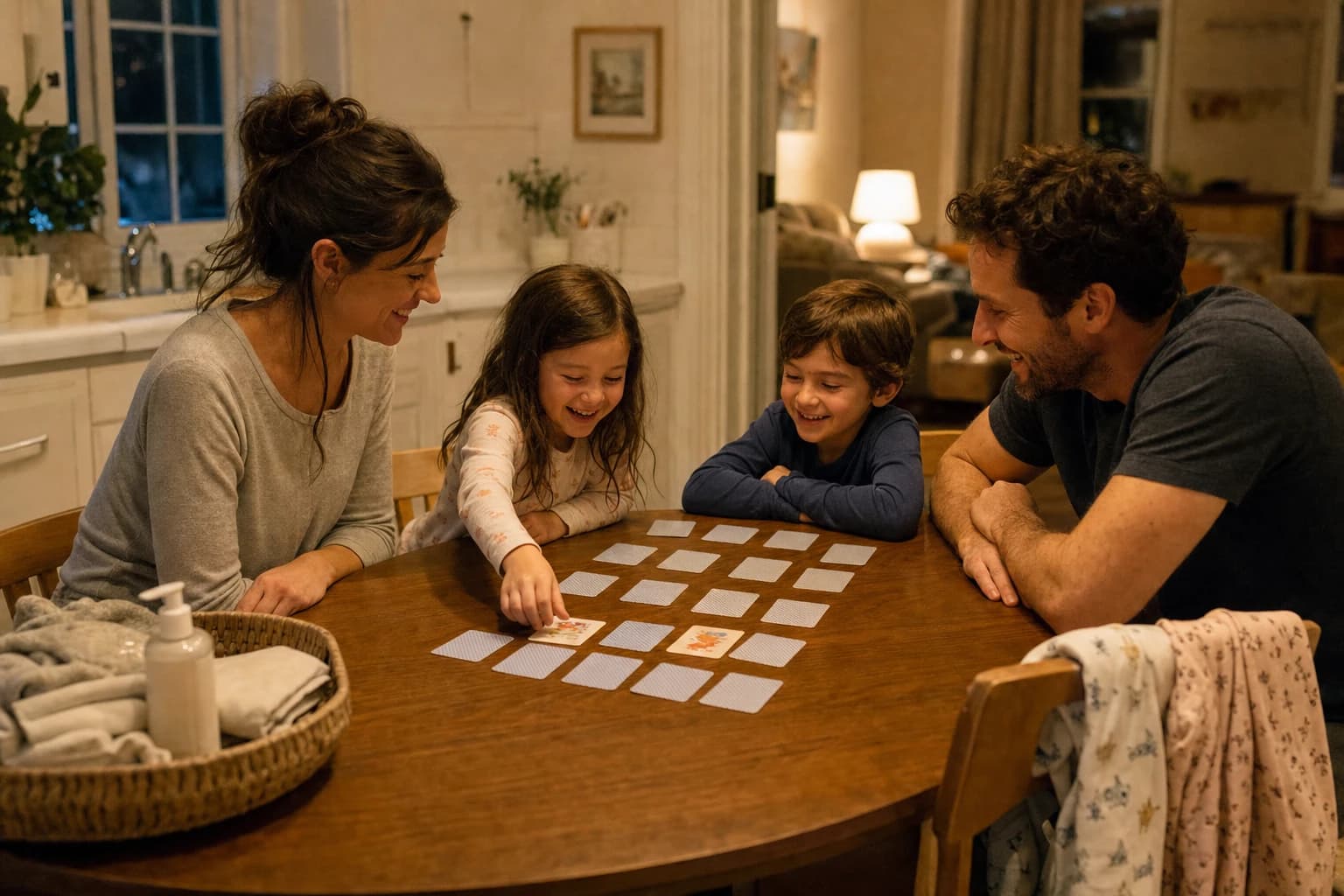
Quick answer: best 15-minute family games by age
If you only have one small window after homework, choose by the youngest player at the table. A game that is perfect for a 10-year-old may drag if a preschooler needs every rule repeated.
- Best for preschoolers: 12-card Memory Match, The Sneaky, Snacky Squirrel Game, Animal Upon Animal, and Hoot Owl Hoot!
- Best for elementary kids: Spot It!, UNO with a short-round rule, Go Fish with a 24-card deck, and Hoot Owl Hoot!
- Best for tweens: Qwixx, Taco Cat Goat Cheese Pizza, Happy Salmon, Sushi Go! with a one-round limit, and Crazy Eights with a 28-card deck.
- Best for mixed ages: Spot It!, Happy Salmon, Hoot Owl Hoot!, UNO short-round, and team Go Fish.
For longer weekend sessions, see How to Plan a 60-Minute Family Game Night for Mixed Ages Without Anyone Getting Bored. This article has a narrower goal: one satisfying play before pajamas, not a full evening event.
How we chose these quick family games
This is an editorial recommendation list, not a paid ranking and not a claim of formal laboratory testing. The list is based on PLAYATME editorial research, official publisher information where available, rule simplicity, component count, common family-use constraints, and practical judgment about what can reasonably fit into a 15-minute school-night window.
For this guide, true table time means setup, a short teach or reminder, one capped game or round, and cleanup. A first play may take longer, especially if children are learning a new rule system. Publisher pages are useful starting points for official ages, player counts, and listed play times, but the house rules below are what make several familiar games reliably shorter.
Play also has value beyond filling time. The American Academy of Pediatrics describes play as important for children’s development and family connection in its clinical report, The Power of Play. On school nights, the goal is not to optimize every minute; it is to protect a small, positive family moment.
Comparison table: quick family games under 15 minutes
| Rank | Game | Best age fit | Weeknight version | True table time | Cleanup | Best reason to choose it |
|---|---|---|---|---|---|---|
| 1 | Spot It! | Elementary and mixed ages | First to 5 cards or 3 mini-rounds | 5 to 10 minutes | Excellent | Instant visual rules and almost no setup |
| 2 | Happy Salmon | Elementary kids, tweens, energetic families | 2 rounds only | 3 to 6 minutes | Excellent | Fast laughter and movement before the bedtime routine |
| 3 | UNO short-round | Elementary and mixed ages | Deal 5 cards, play 1 hand, 10-minute cap | 10 to 15 minutes | Excellent | Familiar, inexpensive, and easy to stop |
| 4 | Hoot Owl Hoot! | Preschool through early elementary | Play 1 cooperative game | 10 to 15 minutes | Good | Cooperative play reduces bedtime arguments |
| 5 | 12-card Memory Match | Preschoolers and early elementary | Use exactly 6 pairs in a 3-by-4 grid | 5 to 8 minutes | Excellent | Quiet, no reading, and easy to scale |
| 6 | The Sneaky, Snacky Squirrel Game | Preschoolers | Use a tray for acorns before starting | 8 to 12 minutes | Good | Color matching and fine-motor practice without reading |
| 7 | Animal Upon Animal | Preschool and early elementary | End after the tower falls twice, then 1 final round | 8 to 12 minutes | Good | Chunky dexterity play with very little explaining |
| 8 | Qwixx | Tweens and adults | One score sheet, no rematch on school nights | 10 to 15 minutes | Excellent | Short game with real decisions for older kids |
| 9 | Taco Cat Goat Cheese Pizza | Older elementary and tweens | Gentle-hands rule, 1 game only | 8 to 15 minutes | Excellent | Silly reaction play for families that like chaos |
| 10 | Sushi Go! one-round | Tweens and adults | Play 1 draft round; remove Pudding for cleaner scoring | 10 to 15 minutes | Excellent | A tiny strategy game when older kids want choices |
| 11 | Go Fish short deck | Preschool through elementary | Use A through 6 only: 24 cards total | 8 to 12 minutes | Excellent | Works with a standard deck and supports younger players |
| 12 | Crazy Eights short deck | Elementary and tweens | Use 2 through 8 only: 28 cards total | 8 to 15 minutes | Excellent | A faster standard-deck alternative to longer shedding games |
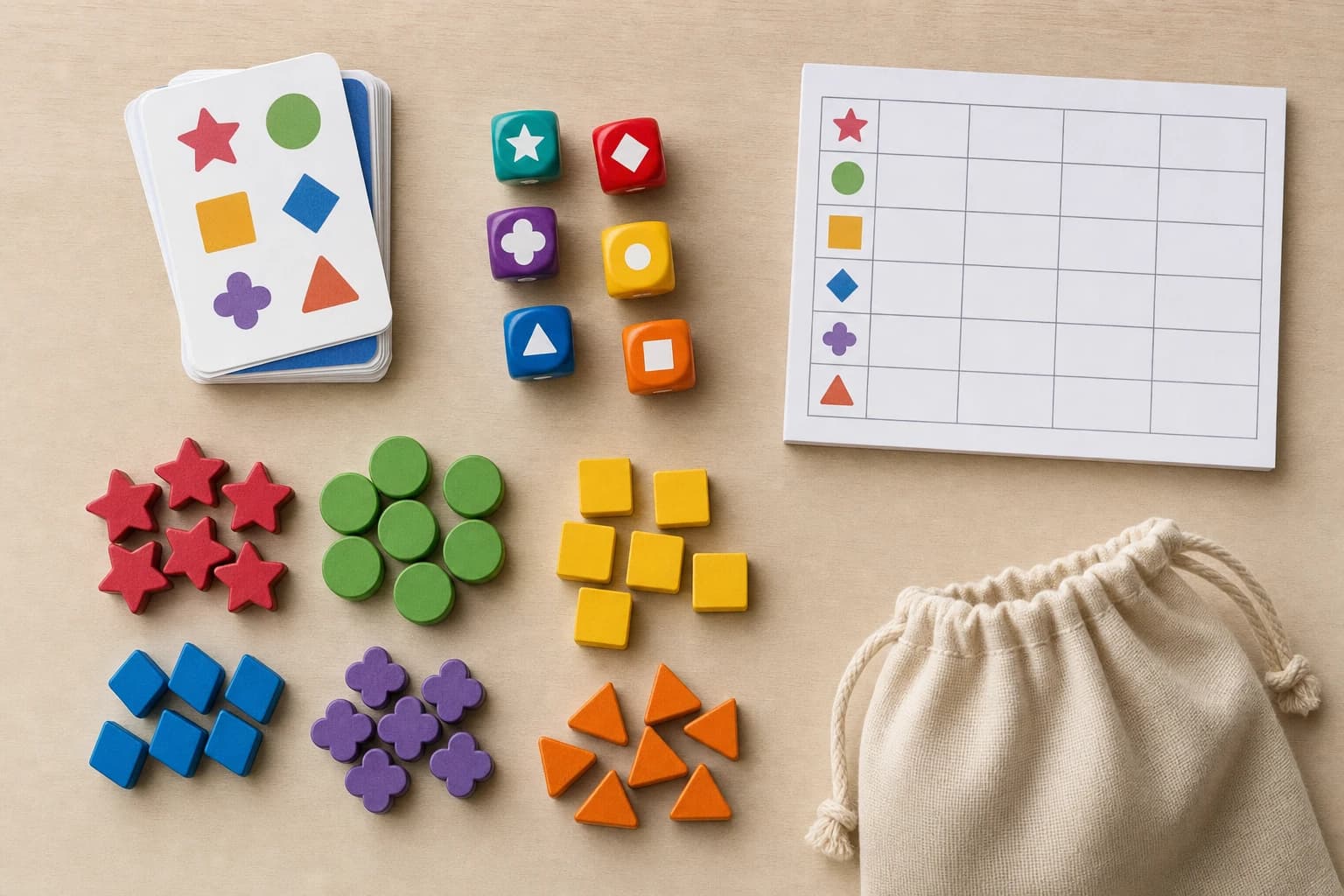
Ranked reviews: the best short family games for school nights
1. Spot It!
Spot It! is one of the strongest quick family games under 15 minutes because the core rule is immediate: every pair of cards has one matching symbol, and players try to spot it first. Zygomatic describes the game on its official Spot It! page.
For a calmer bedtime version, avoid the loudest speed modes and play “first to five cards.” That gives the game a clear finish and keeps a fast child from turning the evening into endless rematches. It is also a good mixed-age pick because visual scanning is not purely reading-based.
2. Happy Salmon
Happy Salmon is extremely short and energetic. Players call out action cards, find a match, perform the action, discard, and keep going. Exploding Kittens lists Happy Salmon on its official product page.
This is best when the family needs a two-minute laugh before bath or pajamas. Set the limit before you start: “Two rounds, then cleanup.” If a younger sibling is asleep or one child gets overstimulated by noise, choose Memory Match or Hoot Owl Hoot! instead.
3. UNO short-round version
UNO is familiar to many families, but a normal hand can run long if draw cards pile up or players keep escaping with one card left. Mattel maintains an official UNO card game page.
To make UNO fit a school night, use exact limits: deal 5 cards per player instead of 7, play one hand only, and set a 10-minute timer. If nobody has gone out when the timer rings, finish the current turn and the player with the fewest cards wins. Do not keep score across hands on a weeknight.
4. Hoot Owl Hoot!
Competitive games can create frustration at the worst time of day. Hoot Owl Hoot! is cooperative, so the group wins or loses together. That makes it a smart choice when one child is sensitive to losing or when siblings have already been bickering since dinner.
The game still includes decisions: which owl should move, how to use color cards, and how to get the owls home before sunrise. If your family likes this style, see Best Cooperative Board Games for Families Who Do Not Like Competitive Game Nights.
5. 12-card Memory Match
Memory often becomes too long because families use too many cards. For a preschool weeknight version, use exactly 6 pairs, for 12 cards total. Lay them in a 3-by-4 grid. That is enough challenge to feel like a real game without dragging past attention span.
You can use picture cards, animal cards, or pairs from a standard deck. For example, use two red 2s, two black 5s, two red 7s, two black 9s, two red queens, and two black aces. For more low-mess ideas, see Quiet Indoor Games for Preschoolers on Rainy Days.
6. The Sneaky, Snacky Squirrel Game
The Sneaky, Snacky Squirrel Game is a good fit for children who are still building color recognition, fine motor skills, and patience with turn-taking. Educational Insights lists the game on its official Sneaky, Snacky Squirrel Game page.
The weeknight risk is not the rules; it is the small pieces. Put the acorns in a shallow bowl or tray before the first turn. At cleanup, give one child the “all acorns back” job and another child the “spinner and boards away” job.
7. Animal Upon Animal
Animal Upon Animal is a dexterity stacking game, which makes it useful when a preschooler wants to play a “real game” but is not ready for reading, hidden information, or multi-step scoring. HABA lists Animal Upon Animal on its official product page.
For bedtime, use one clear house rule: if the tower falls twice, finish after the next full round. That keeps the ending light instead of letting a sleepy child restart endlessly.
8. Qwixx
Qwixx is a roll-and-write dice game for older kids who want real choices in a short time. Gamewright lists Qwixx on its official Qwixx product page.
The teach takes more care than Spot It! because players need to understand rows, crossing off numbers, and locking colors. For a first school-night play, demonstrate the first two rolls openly. Do not over-explain the scoring before players see the dice in action.
9. Taco Cat Goat Cheese Pizza
Taco Cat Goat Cheese Pizza is a fast reaction card game with a funny rhythm: players say the sequence while flipping cards, then slap when the spoken word matches the card. It is better for older elementary kids and tweens than for tired preschoolers because the speed and hand-slapping can become intense.
Use a “gentle hands” rule before starting: hands must stay flat, and no one may slap down hard on another player’s fingers. If the house is already loud, save this one for Friday and choose a calmer matching or dice game instead.
10. Sushi Go! one-round version
Sushi Go! is a compact drafting game with more strategy than most games on this list. Gamewright lists Sushi Go! on its official Sushi Go! product page. A full game can feel too close to the edge of a school-night window, so the quick version is important.
For a 10-to-15-minute play, use the normal hand size for your player count, play one draft round only, and score that round. For cleaner one-round scoring, remove Pudding cards before dealing because Pudding is designed for end-game scoring across rounds. This version is best for tweens who already understand passing cards and comparing set values.
11. Go Fish with a 24-card short deck
Go Fish is a strong standard-deck option because it teaches asking, matching, memory, and turn-taking. To keep it under 15 minutes, do not use all 52 cards. Build a 24-card deck using only A, 2, 3, 4, 5, and 6 in all four suits.
For 2 to 4 players, deal 5 cards to each player. Place the rest as the fishing pile. The game ends when the draw pile is empty or when a 10-minute timer rings; finish the current turn, then count completed books. If playing with a preschooler, pair the child with an older sibling who may give one short hint per turn.
12. Crazy Eights with a 28-card short deck
Crazy Eights is another useful standard-deck game, especially for families who like UNO-style shedding games. To keep it short, use exactly 28 cards: ranks 2, 3, 4, 5, 6, 7, and 8 in all four suits. The 8s stay wild.
Deal 5 cards to each player for 2 to 4 players. Turn one card face up to start the discard pile and keep the rest as the draw pile. If the draw pile runs out once, each player gets one final turn, then the player with the fewest cards wins. This prevents the game from cycling longer than the bedtime window.
Best picks for mixed-age households
Mixed-age families need games that do not punish younger children for slower reading or weaker strategy. The best choices use visual recognition, cooperation, dexterity, or teams.
- Best visual game: Spot It!, because matching symbols is easy to understand but still challenging.
- Best cooperative game: Hoot Owl Hoot!, because older kids can suggest moves without completely taking over.
- Best movement game: Happy Salmon, if noise is acceptable and everyone understands gentle contact.
- Best preschool table game: 12-card Memory Match, because it is quiet and fully adjustable.
- Best team adaptation: UNO or Go Fish with one older child paired with one younger child.
A useful team rule is to let the younger player make the final move while the older partner may give one sentence of advice. For example: “You can play yellow or a 4.” This keeps the younger child involved instead of turning the team into an adult-controlled shortcut. For more one-deck ideas, see Easy Card Games Kids Can Play With Grandparents Using One Standard Deck.
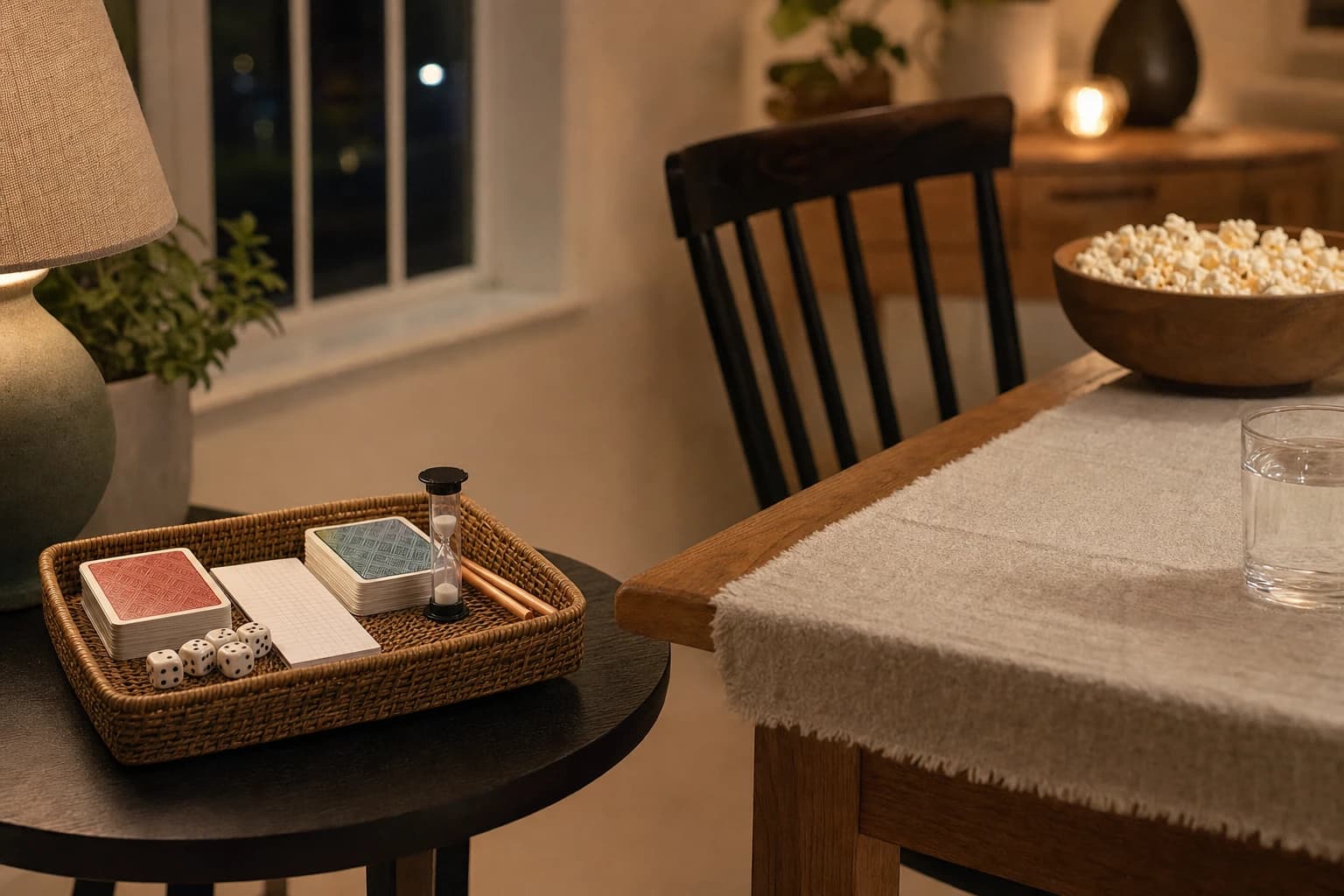
A 15-minute school-night game routine that actually works
Even the best game can run long without a simple routine. Treat weeknight play like a short reset between homework and bedtime, not an open-ended activity.
Materials
- 1 small basket or bin holding 4 to 6 quick games
- 1 timer set to 12 minutes, leaving 3 minutes for cleanup
- 1 clear table space about the size of a placemat per player
- 1 shallow bowl or tray for small pieces
- 1 simple choice rule, such as rotating who picks each night
Steps
- Choose before sitting down. Offer two options only: one calm game and one active game. Do not spend the play window debating.
- State the stopping point. Use a concrete limit: one hand, first to five cards, two rounds, or timer ends after the current turn.
- Teach with one example turn. Show one sample turn, then begin. Avoid reading a full rulebook aloud unless the game is brand new.
- Keep scoring optional. A single winner is enough. Skip tournament scoring, multi-hand totals, and rematches unless bedtime is already protected.
- Clean up immediately. Put cards, dice, and pieces away before anyone leaves the table. Assign one small job per child: cards in box, dice in bag, or pieces in tray.
Weeknight house rules that keep games short
- Use fewer cards. Deal 5 instead of 7 in UNO-style games.
- Use smaller decks. For Go Fish, use 24 cards: A through 6 in all suits. For Crazy Eights, use 28 cards: 2 through 8 in all suits.
- Use fewer pairs. For Memory, start with 6 pairs for preschoolers and 8 pairs for early elementary kids.
- Cap the rounds. Say “best of three” only if each round is under 3 minutes.
- Skip full-game scoring when needed. For Sushi Go!, play one round and remove Pudding. For Qwixx, play one sheet and stop.
- End after a good moment. If everyone laughed and the timer is close, stop there. A positive ending is better than squeezing in one more round.
Common mistakes when choosing family games before bedtime
Choosing a game with a hidden long tail
Some games start quickly but have an unpredictable ending. If the end depends on a rare card draw, repeated reshuffling, or eliminating players one by one, it may not be a good school-night choice. Save those games for weekends.
Picking a game that needs too much adult management
A game may be short on paper but tiring if an adult must constantly calculate, referee, or read every card aloud. For weeknights, choose games where kids can handle most turns after one demonstration.
Ignoring emotional energy
Fast does not always mean calm. Reaction games are fun, but they can make some kids louder and more wound up. If bedtime is close, a cooperative board game, memory match, or simple card game may be a better fit than a slapping or shouting game.
Keeping too many options available
A shelf full of games can create choice overload. A small basket of short family games for weeknights works better. Rotate the basket every few weeks so the choices stay fresh without becoming overwhelming.
Editorial note
This guide was prepared for PLAYATME readers using publisher information, public rules references, and practical editorial judgment about weeknight family play. Before publishing, article images should be original photography or properly licensed images that match the captions and do not include logos or copyrighted game artwork unless permission allows it.
FAQ: quick family games under 15 minutes
What is the best quick family game for a school night?
For most mixed-age families, Spot It! is the safest first choice because it teaches quickly, cleans up fast, and works across a wide age range. If your family prefers cooperative play, Hoot Owl Hoot! is a calmer option.
What quick card games can kids and parents play with a standard deck?
Go Fish and Crazy Eights are the most flexible. For under-15-minute play, use a 24-card Go Fish deck with A through 6 in all suits, or a 28-card Crazy Eights deck with 2 through 8 in all suits. Deal 5 cards per player and use a 10-minute timer.
Is Sushi Go! really under 15 minutes?
A full game can be close to the limit, especially with new players. For a true school-night version, play one round only and remove Pudding cards before dealing so scoring is quick and self-contained.
Are fast reaction games good before bedtime?
Sometimes. Happy Salmon and Taco Cat Goat Cheese Pizza are fun and very short, but they can be noisy and energizing. They are better before bath or pajamas than as the final quiet activity of the night.
How do you stop kids from asking for “one more round”?
Set the limit before the game begins: “Two rounds” or “We stop when the timer rings.” It helps to connect the limit to the routine, not to a parent’s mood: game, cleanup, pajamas, then reading.
What should be in a weeknight game basket?
Include 4 to 6 compact games: one visual matching game, one simple card game, one cooperative game, one dice or roll-and-write game for older kids, and one preschool-friendly option if needed.
Conclusion: choose the game that protects the evening
The best quick family games under 15 minutes are not always the flashiest games on the shelf. They are the ones that start easily, end clearly, and leave everyone feeling better rather than more rushed.
For most households, a strong weeknight mix includes Spot It! for visual speed, Hoot Owl Hoot! for cooperation, Qwixx or Sushi Go! for tweens, short-round UNO for familiarity, and a preschool option like Memory Match, The Sneaky, Snacky Squirrel Game, or Animal Upon Animal. Keep the basket small, set the stopping point before the first turn, and treat cleanup as part of the game.