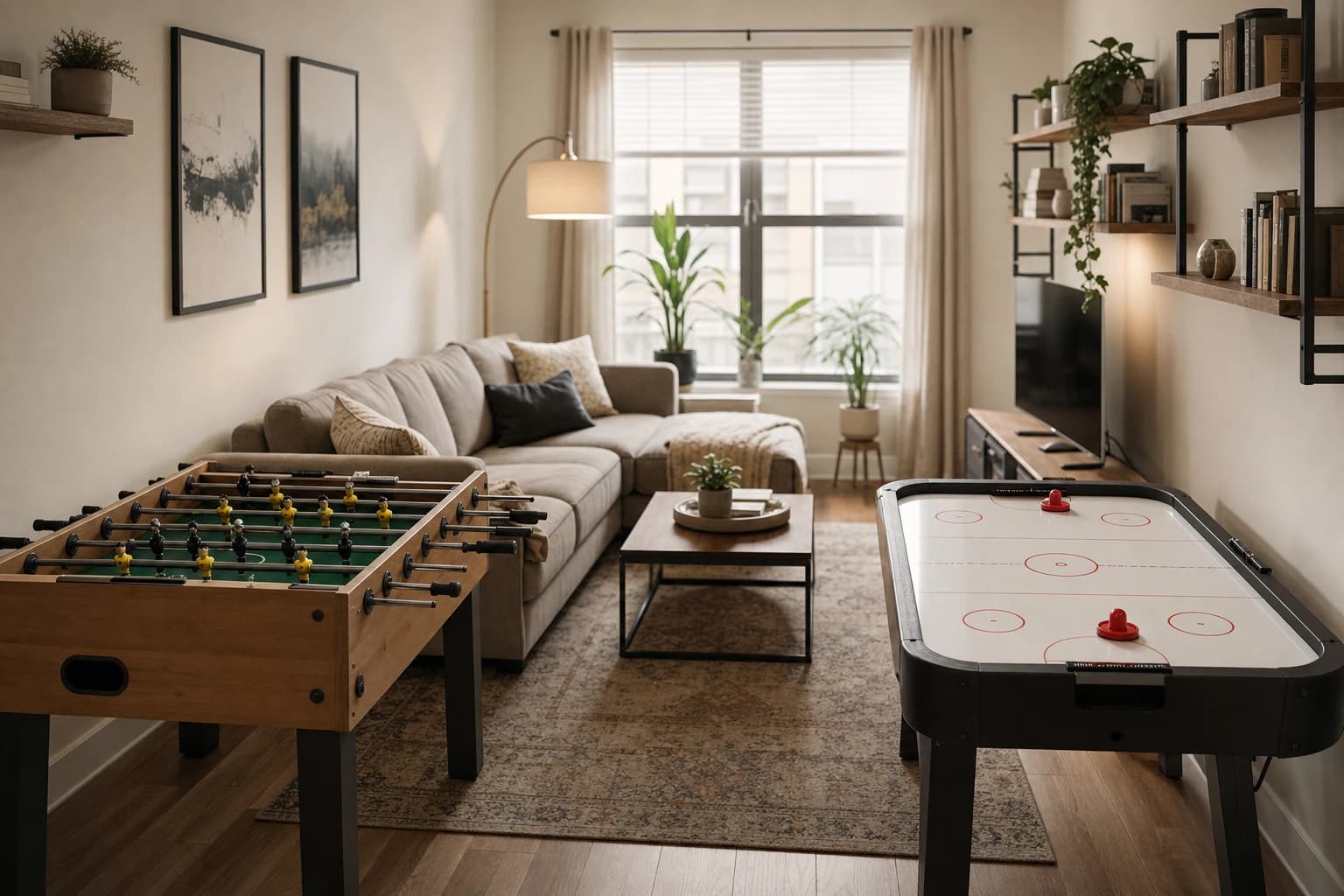
A game table can make a small apartment feel more social, but it can also become a bulky obstacle if you choose the wrong one. The real question is not just whether you prefer soccer-style play or fast puck rallies. It is whether the table fits your floor plan, your noise limits, your storage needs, and the people who live below or beside you.
This guide compares foosball vs air hockey for small apartment living in the practical ways that matter after the box is opened: clearance around the table, sound, electricity, maintenance, learning curve, resale, and how easy it is to play without annoying neighbors.
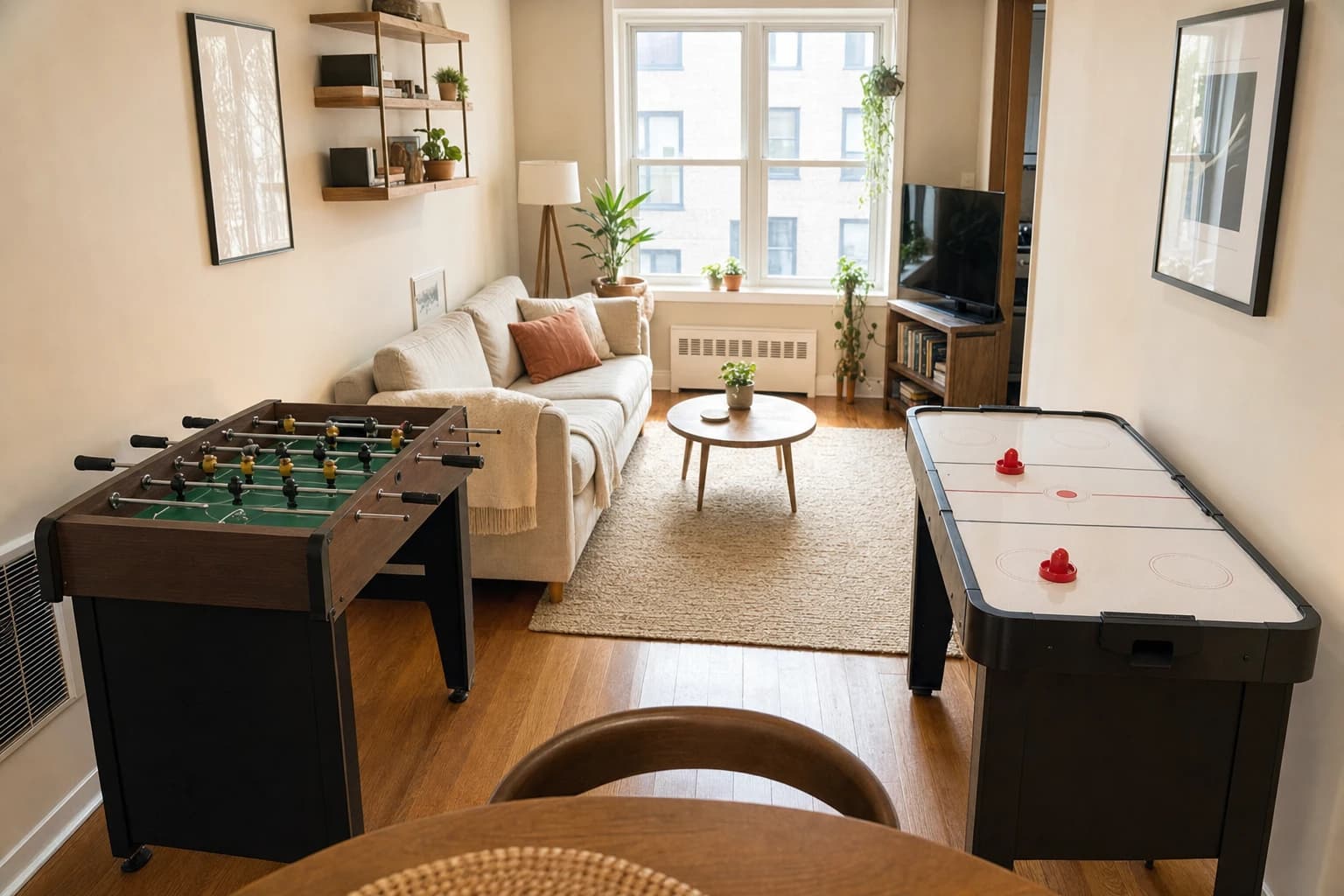
Quick answer: which is better for a small apartment?
For most small apartments, a compact foosball table is usually the better all-around choice. It does not need electricity, it can fit against a wall more easily when not in use, and it has fewer parts that depend on a fan, motor, or smooth airflow. Foosball also works well for quick games with two to four people without needing a perfectly open room.
An air hockey table can be better if you have a longer open space, a nearby outlet, and players who care more about fast arcade-style action than quiet play. It is especially fun for casual guests because the rules are simple and a rally starts immediately. The tradeoff is that air hockey usually creates more continuous sound: fan hum, puck strikes, mallet taps, and the occasional puck bouncing off the table.
If you are choosing the best game table for apartment use, start with your apartment’s weakest point. If your issue is floor space, choose a compact or foldable model. If your issue is noise, foosball usually gives you more ways to soften the sound. If your issue is setup simplicity, both can work, but foosball wins when you do not want another plugged-in device.
Foosball vs air hockey for small apartment living
| Criteria | Foosball table | Air hockey table | Apartment-friendly winner |
|---|---|---|---|
| Usable floor space | Needs side clearance for rods and players. Often easier to place with one short end near a wall. | Needs open space at both ends and enough room for side movement. Longer models can dominate a room. | Foosball, in most layouts |
| Noise | Short bursts: ball impacts, rod movement, goal drops, player reactions. | Fan hum plus puck impacts and mallet strikes during play. | Foosball for quieter households |
| Power needs | No outlet needed for standard tables. | Requires electricity for the blower on most true air hockey tables. | Foosball |
| Maintenance | Clean rods, tighten handles, check bearings, keep balls in good condition. | Keep surface clean, protect air holes, replace pucks/mallet pads, watch blower performance. | Foosball for simplicity |
| Learning curve | Easy to start, harder to become precise. | Very easy for beginners to understand quickly. | Air hockey for instant play |
| Play style | More controlled, tactical, and good for doubles. | Faster, more reaction-based, more arcade-like. | Depends on your group |
| Storage options | Tabletop and foldable versions are common. | Tabletop versions exist, but airflow and stability vary by model. | Foosball |
| Neighbor friendliness | Can be softened with rugs, rubber feet, and controlled play. | Harder to reduce fan noise and puck slap, though pads and rugs help. | Foosball |
| Guest appeal | Great for groups who like longer matches and teamwork. | Excellent for casual guests and short tournament rounds. | Air hockey for quick parties |
Floor space: measure the play zone, not just the table
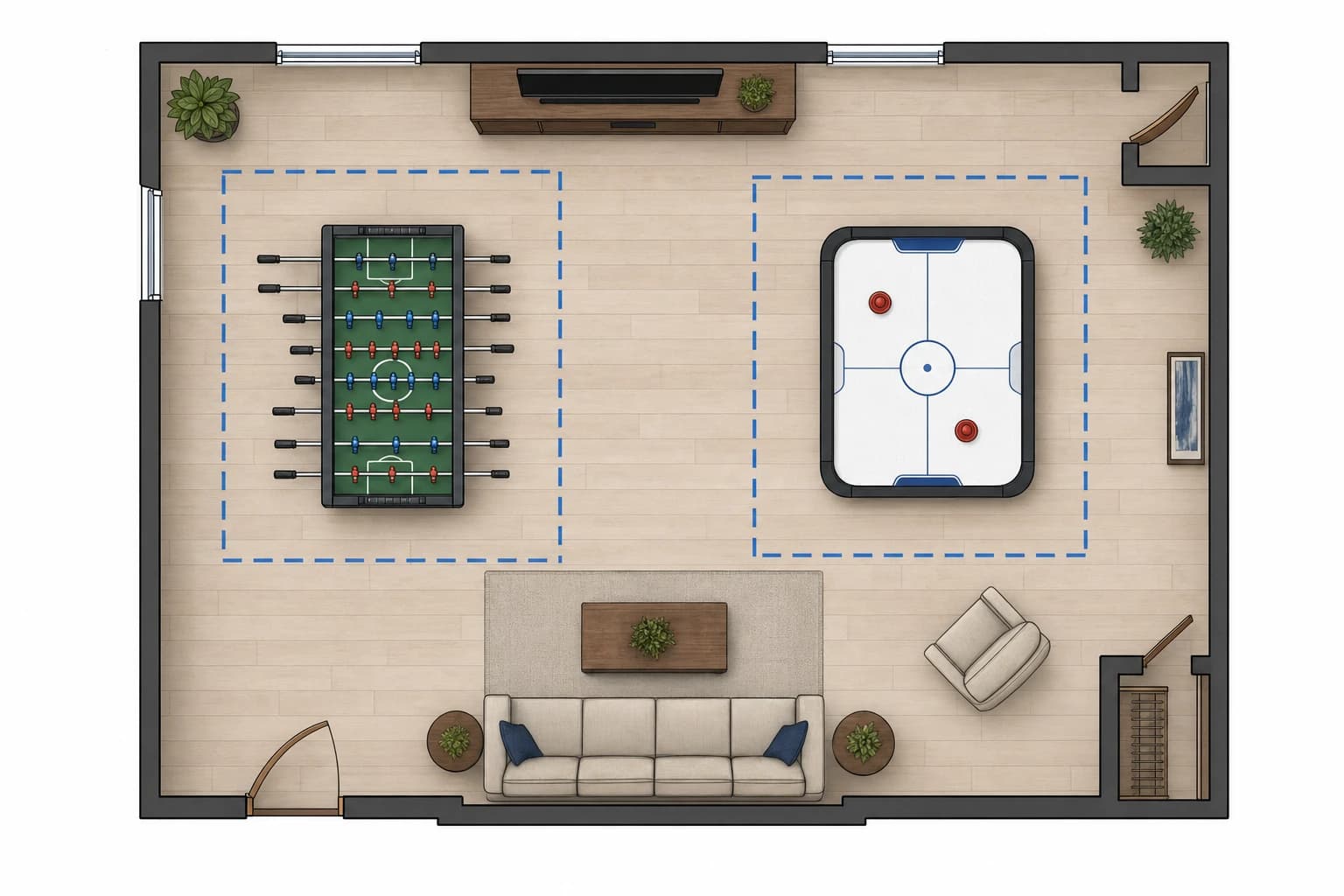
The biggest mistake when buying a small space indoor game table is measuring only the tabletop. The real footprint includes people, rods, elbows, puck movement, and room to walk around furniture.
A full-size foosball table is commonly around 56 inches long and 30 inches wide, but the rods extend beyond the cabinet. You also need room for players to stand on both long sides. In a tight room, this means the practical play zone can feel closer to the size of a small dining table plus aisle space. The International Table Soccer Federation publishes official equipment and rules information for competitive table soccer, and its standards are a useful reminder that regulation-style tables are substantial pieces of furniture, not toys you can casually tuck anywhere: International Table Soccer Federation rules and equipment information.
Air hockey tables vary widely, but the apartment issue is usually length. Even a medium table can become awkward in a narrow living room because players stand at opposite ends and lean forward. A long coffee table, TV stand, sofa, and air hockey table all competing in the same line can make the room feel cramped fast.
Before buying either one, mark the footprint on the floor with painter’s tape. Then add player space. For a compact apartment, use these minimum clearances as a practical starting point:
- Foosball: allow at least 24 inches on each rod side if possible; more is better for adults.
- Air hockey: allow at least 30 inches at each player end so people can lean and move their arms.
- Walkway: keep one clear walking path through the room so the table does not block daily use.
- Doors and closets: check that the table does not stop a closet, balcony door, or sofa bed from opening.
If the taped outline already annoys you after one evening, the real table will annoy you more. In that case, look at tabletop foosball, folding foosball, or no-equipment group games such as indoor games for 10 people in a small room.
Noise: what your neighbors will actually hear
Neither table is silent. The difference is the type of noise.
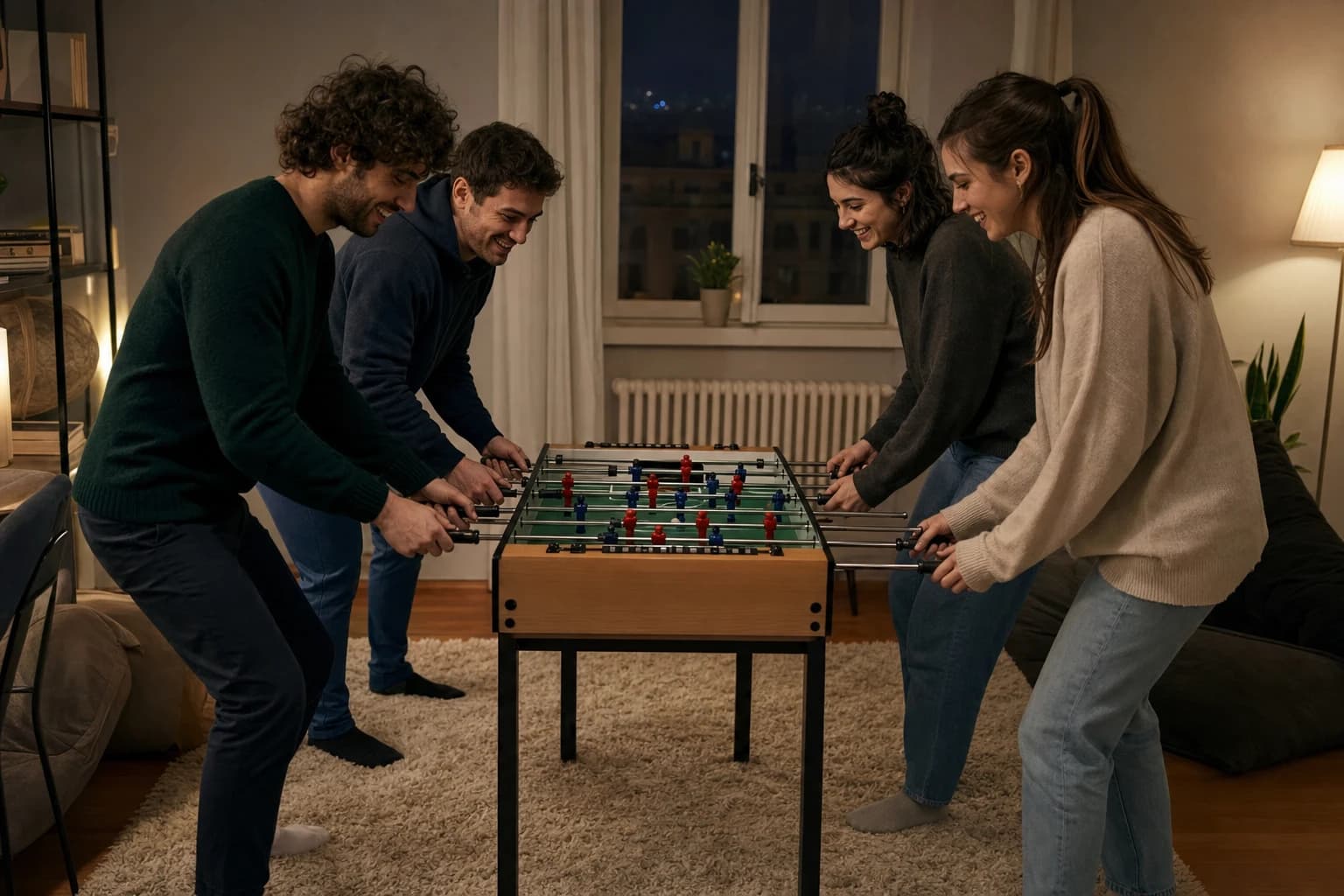
Foosball noise comes in bursts. You hear the ball hit the side wall, rods move, handles stop suddenly, and the ball drop into the goal. Competitive spinning can make the table much louder, and it is also not how formal table soccer is meant to be played. Casual players often spin because it feels powerful, but it reduces control and adds unnecessary clatter.
Air hockey has a more constant sound profile. The blower runs during play, the puck strikes the rail, and mallets hit the puck and table surface. On hard floors, the vibration can travel through the legs into the room below. Air hockey pucks can also leave the surface if players hit too hard, which adds random wall, floor, or furniture noise.
If you live above someone, the floor matters. A thick area rug under the table is one of the simplest upgrades. It does not make the game silent, but it helps reduce vibration and chair-like scraping sounds. Rubber furniture cups or anti-vibration pads under the table legs can also help, especially on laminate, tile, or hardwood.
Neighbor-friendly setup tips
- Place the table away from shared bedroom walls when possible.
- Use a rug that extends beyond all table legs, not just a small mat under the center.
- Add rubber pads under the feet if the table has hard plastic or metal contact points.
- Set house rules: no rod spinning, no slap shots at full force, and no late-night tournament play.
- Store extra balls or pucks in a small container so they are not rolling across the floor.
For households with toddlers or early bedtimes nearby, a table may not always be the best evening activity. Quieter alternatives, such as quiet indoor games for preschoolers on rainy days, can be better when sound control is the main goal.
Power, placement, and cable safety
Foosball has a clear advantage here: a standard foosball table does not need power. You can place it where it fits best, even if the nearest outlet is already used by a lamp, router, or TV.
Air hockey tables with blowers need electricity. That creates three apartment issues. First, the table needs to be near an outlet or you need a safe extension cord setup. Second, cords cannot cross a walkway where guests may trip. Third, the blower noise and airflow stop the moment the table is unplugged, so you cannot use most air hockey tables properly without power.
If you choose air hockey, read the manufacturer’s instructions for your specific model. Electrical requirements, cord guidance, assembly, and cleaning instructions vary. As a general safety reference, the U.S. Consumer Product Safety Commission advises consumers to use extension cords carefully and avoid overloading cords or running them where they can be damaged: CPSC extension cord safety guidance.
In a studio apartment, this can decide the purchase by itself. If the only open floor area is across from the outlet, a foosball table avoids the cord problem completely.
Maintenance: which table is less annoying over time?
Foosball maintenance is mostly mechanical and visible. You wipe the surface, keep the rods clean, tighten loose handles, check the legs, and replace worn balls when they become chipped or too slick. Some tables use bearings or bushings that may need occasional attention. The work is usually simple, and you can still play even if the table is not perfect.
Air hockey maintenance is more sensitive to surface condition. The puck needs a clean, smooth, low-friction surface and consistent airflow. Dust, crumbs, pet hair, and spilled drinks can clog air holes or slow the puck. A table that looks clean can still play poorly if the holes are blocked or the surface is sticky.
Air hockey also has more small consumables: pucks, mallets, felt pads, and sometimes scorekeeping parts. If the blower weakens or fails outside warranty, repair may not be worth it on a budget table. That does not mean air hockey is a bad choice, but it does mean you should think about long-term upkeep before choosing the cheapest model.
Learning curve and who will use it most
Air hockey is easier for brand-new players. Put a mallet in each hand, protect your goal, hit the puck. Most guests understand the basic idea in less than a minute. That makes it a strong choice for casual gatherings, mixed-age groups, and short party rotations.
Foosball is also easy to start, but it rewards coordination. Players need to learn which rod controls which row, how to trap or pass, and how not to spin wildly. This gives foosball more depth for repeated play. Two people can improve over weeks, and four people can play doubles without the game feeling too crowded.
Think about your actual household:
- Two adults who like skill-based games: foosball is likely to stay interesting longer.
- Friends dropping by for short visits: air hockey is faster to explain.
- Kids with limited patience: air hockey may create quicker excitement, but it can also get louder.
- Mixed ages in a small room: foosball gives more control if you set no-spinning rules.
- Game nights with 6–12 adults: either table works as one station, but you will still need sitting and rotation space. For more ideas, see indoor party games for adults without alcohol.
Resale value and moving: do not ignore the exit plan
A game table is fun when it arrives. It is less fun when you move apartments, change furniture, or need the room for a desk. Before buying, ask how you would sell, move, or store it.
Foosball tables often have a broader used-market appeal because they do not depend on a working motor. A buyer can inspect the rods, legs, surface, and players visually. Compact foosball tables are also easier to move than many powered air hockey tables, although heavy full-size models can still require two adults and careful doorway planning.
Air hockey resale depends heavily on whether the blower works well and the surface is undamaged. Scratched tops, dead spots, weak airflow, missing pucks, or broken electronic scoring can reduce appeal. Larger air hockey tables can also be harder for apartment buyers to collect because they need a vehicle and enough space at home.
If you rent, check practical moving details before purchase:
- Measure your apartment door, hallway turn, elevator, and stairwell.
- Confirm whether the legs detach without weakening the table.
- Keep the assembly manual and small tools in a labeled bag.
- Take photos during assembly so disassembly is easier later.
- Avoid gluing parts unless the manufacturer specifically instructs it.
How to choose the right table for your apartment
Use this short process before ordering a foosball table or air hockey table. It takes about 30 minutes and can prevent a bulky mistake.
- Pick the exact room. Do not assume you will “find a place.” Choose the wall, corner, or open area where the table will live.
- Tape the table footprint. Use the dimensions from the specific product listing or manual. Mark the full cabinet size on the floor.
- Add player clearance. For foosball, mark space along both rod sides. For air hockey, mark space at both ends.
- Live with the outline for one day. Walk around it, open doors, sit on the sofa, pull out dining chairs, and check whether the room still works.
- Check noise timing. Decide when games will be allowed. If your best play time is after 10 p.m. and you have downstairs neighbors, choose the quieter option or skip a large table.
- Check power. For air hockey, identify the exact outlet and cord path. If the cord crosses a walkway, reconsider the placement.
- Plan storage and accessories. Balls, pucks, mallets, cleaning cloths, and covers need a home. A small bin under a side table is enough if you plan ahead.
- Think about moving day. If the table cannot fit through your future life, choose a tabletop, folding, or smaller model.
Best choice by apartment situation
- Studio apartment: choose tabletop foosball or a folding foosball table unless you have a clear dedicated wall.
- One-bedroom with downstairs neighbors: foosball is usually easier to quiet with a rug and no-spinning rule.
- Long open living room: air hockey can work well if both ends have clearance and an outlet is nearby.
- Shared apartment with guests: air hockey is easier for quick casual play; foosball is better for repeated game nights.
- Apartment with kids: choose the sturdier table with fewer loose accessories and clearer house rules, not just the flashier one.
- Minimalist room: skip full-size tables and use portable games. You can find more small-apartment indoor game planning tips if floor space is tight.
Common buying mistakes
Buying a table that is technically small but still awkward
A 48-inch table may look compact online, but it can still block a walkway if the room is narrow. Shape matters as much as size. Long rectangles are harder to fit than they appear.
Ignoring table weight
Very light tables can slide during play. Very heavy tables are harder to move, clean around, or resell. In apartments, the best choice is often stable enough for normal play but not so heavy that moving becomes a major project.
Choosing air hockey without checking the fan sound
Some players do not mind blower noise. Others find it tiring in a small room. If possible, watch a video of the exact model with real sound, read the manufacturer’s details, and buy from a seller with a clear return policy.
Forgetting the people who are not playing
A game table affects everyone in the apartment. Someone watching TV, working from home, or sleeping in the next room may hear every goal. If your household has conflicting schedules, choose the quieter option or set specific play windows.
FAQ
Is foosball or air hockey quieter in an apartment?
Foosball is usually easier to make quieter because it has no blower and the sound comes in short bursts. Air hockey adds constant fan noise plus puck and mallet impacts. A rug, rubber pads, and house rules help both.
Can an air hockey table work in a small apartment?
Yes, if you choose a compact model, have clearance at both player ends, and can place it near an outlet without creating a trip hazard. It works best in a long open living room rather than a narrow room full of furniture.
Is a tabletop version worth buying?
A tabletop version can be worth it for renters, studios, and occasional play. It will not feel as solid as a full-size table, but it is easier to store, move, and resell. For many apartments, that tradeoff is sensible.
Which table is better for parties?
Air hockey is better for quick party rounds because new players understand it almost instantly. Foosball is better when guests enjoy doubles, brackets, and skill-based rematches. For larger gatherings, use the table as one activity station instead of the only game.
Do foosball tables damage floors?
They can scratch floors if dragged or if the feet are hard and unpadded. Use a rug or furniture pads under the legs, and lift the table instead of sliding it when rearranging the room.
What is the most apartment-friendly alternative?
If both tables feel too large, consider tabletop foosball, magnetic darts with soft tips, card games, word games, or no-running indoor group games. The best apartment game is one you can set up and put away without disrupting daily life.
Conclusion: the better small-apartment choice
If you want the safest default answer, choose foosball. It is usually more flexible in a small apartment because it does not need power, is easier to quiet, has simpler maintenance, and offers strong replay value for two to four players.
Choose air hockey if your apartment has the right layout: a longer open space, a convenient outlet, tolerant neighbors, and players who prefer fast, simple, arcade-style rallies. It can be the more exciting guest game, but it asks more from your room.
Before buying either one, tape the footprint, add player clearance, check the noise situation, and plan where the accessories will live. The best game table is not the biggest or flashiest option. It is the one your apartment can handle comfortably.