Active play indoors can turn difficult quickly in a small apartment: one child is crashing into the sofa, another is upset about the rules, and the downstairs neighbor may be hearing every jump. The goal is not to stop movement. The goal is to organize active indoor games for kids in a small apartment so they are safer, calmer, and easier to reset.
This guide focuses on the common mistakes parents make when setting up small apartment games for kids, plus better alternatives, a simple setup process, and a pre-game checklist you can reuse on rainy days, after school, or during a playdate.
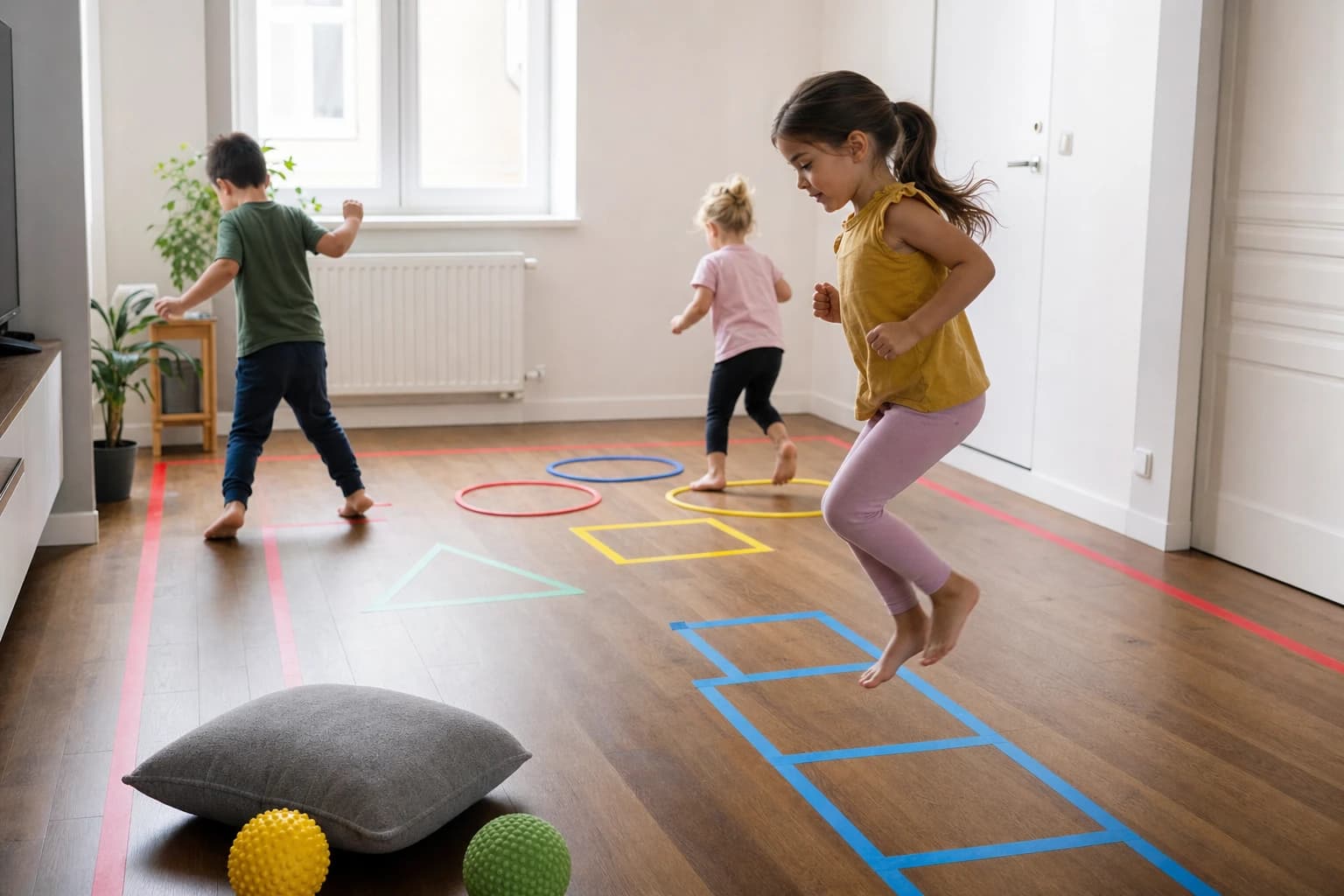
The quick answer: plan the room before you plan the game
The biggest mistake is choosing a high-energy game first and trying to make the apartment fit it afterward. In a small home, start with the space, the floor, the noise level, and the ages of the children. Then choose a game that matches those limits.
For most apartments, the best safe active indoor games are not running games. They are controlled movement games: animal walks, balance paths, freeze poses, beanbag tosses, balloon taps, follow-the-leader challenges, movement dice, and timed obstacle routes with soft boundaries.
Children still get movement, but you avoid the main problems: collisions, hard landings, broken items, neighbor complaints, and arguments over vague rules. The U.S. Centers for Disease Control and Prevention says school-age children need regular physical activity, with aerobic, muscle-strengthening, and bone-strengthening activity included across the week. Indoor games can support movement on days when outdoor play is not practical, but they should still be adapted to the space available. You can read the CDC guidance here: CDC physical activity guidelines for children.
Basic tools and materials for small-space active games
You do not need a large playroom or expensive equipment. A small kit makes indoor movement games for children easier to control and faster to clean up.
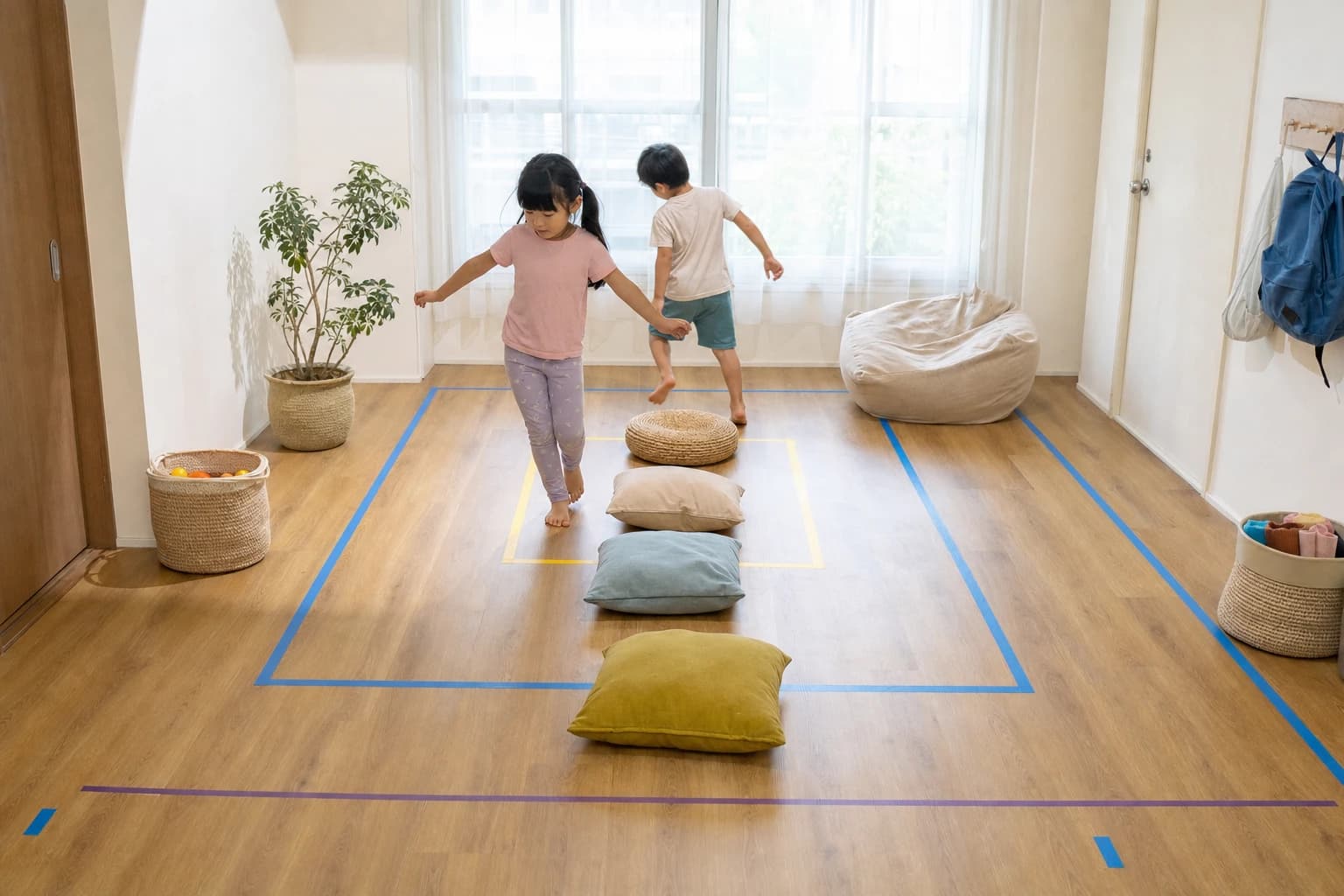
- Painter's tape: Use it to mark start lines, stepping spots, balance paths, and no-go zones. Test a small hidden area first to make sure it does not affect the floor finish.
- A kitchen timer or phone timer: Keep rounds short. Two-minute rounds are often enough for younger children; four- to five-minute rounds work better for older kids.
- Soft objects: Rolled socks, foam balls, beanbags, scarves, or small plush toys are better than hard balls indoors.
- Laundry basket or cardboard box: Use as a target, collection bin, or finish point.
- Cushions or yoga mat: Use only for low balance or landing zones, not for wild jumping.
- Paper rule card: Write the game name, three rules, and the stop signal so everyone can see the same instructions.
A 7-step setup that prevents most apartment game problems
- Choose one play zone. Aim for a clear rectangle or square where children can move without turning sharply into furniture. Even a narrow strip of floor can work for animal walks, stepping games, and target tosses.
- Remove trip hazards. Pick up cords, backpacks, toys, pet bowls, stools, and small rugs that slide. If a rug bunches up during play, roll it away instead of trying to flatten it repeatedly.
- Mark boundaries. Use tape lines or cushions to show where movement starts and stops. Children respond better to visible limits than repeated reminders.
- Set a noise rule before starting. Decide whether the game is a quiet-foot game, a tiptoe game, or a voice-level game. In apartments, this matters as much as the movement rule.
- Explain the game in three rules or fewer. For example: “Walk like a crab to the tape line. Toss one sock into the basket. Walk back on the path.” If the rules take longer than the game, simplify.
- Run one practice round. Make the first round slow and non-scored. Correct unsafe movement before adding speed, points, or teams.
- Plan the cooldown before the final round. End with stretching shapes, slow breathing, clean-up sorting, or a seated guessing game. Without a cooldown, active games often spill into furniture climbing and rough play.
Common mistakes organizing indoor games and what to do instead
The table below shows the mistakes that most often cause noise, clutter, frustration, or unsafe movement in small apartments.
| Mistake | Why it causes problems | Better alternative | Small-apartment setup detail |
|---|---|---|---|
| Starting with running or chasing games | Children accelerate faster than the room allows, especially around corners and furniture. | Use animal walks, freeze dance, balance paths, or relay-style tasks without racing. | Mark a start line and turn-around line with painter's tape; no tag, no chasing. |
| Ignoring downstairs noise | Jumping, stomping, and dropped objects travel through floors. | Choose quiet-foot challenges: slow-motion dance, scarf toss, yoga pose freeze, or sock target toss. | Use a mat for standing activities, not as an invitation to jump from furniture. |
| Leaving furniture half in the way | A half-cleared room creates sharp corners and narrow gaps children try to squeeze through. | Create one clear lane or one clear square instead of many tiny paths. | Push coffee tables completely out of the zone or leave them untouched and play elsewhere. |
| Using rules that are too complicated | Children argue about scoring, turns, and what “counts.” | Use three rules, one goal, and a visible timer. | Write rules on paper: “Move slowly. Stay inside tape. Stop when timer rings.” |
| Mixing ages without adjustments | A 3-year-old and a 9-year-old cannot safely play the exact same speed game. | Give older children harder tasks, not faster movement. | Older child tosses from farther away; younger child stands closer. |
| Skipping the ending routine | Children stay revved up and invent rougher play after the game ends. | Use a five-minute cooldown: slow walk, stretch shapes, water, and clean-up mission. | Announce “two rounds left” before stopping so the transition is not sudden. |
Mistake 1: choosing games that need speed to be fun
Some indoor games only work if children can run, dodge, or chase. Those are usually poor choices in a small apartment. Tag, hallway races, and full-speed obstacle courses quickly become unsafe because children focus on winning instead of controlling their bodies.
Swap speed for precision. A sock toss relay can still feel active if children crab-walk to the line, toss three rolled socks into a basket, then bear-walk back. A freeze dance game can stay lively if the rule is “small feet, big arms,” meaning no stomping but plenty of upper-body movement. If children want a challenge, add balance, memory, or silly movement rather than speed.
For more no-running group ideas, see Indoor Games for 10 People in a Small Room. Many of the same principles work for siblings or playdates in apartments.
Mistake 2: treating noise as an afterthought
Noise control is not only about being considerate to neighbors. It also helps keep children regulated. Stomping and shouting tend to raise the energy level of the whole room.
Before the game starts, choose a specific sound limit. “Be quiet” is too vague. Better rules include:
- “Feet stay soft enough that the floor does not thump.”
- “Voices stay at talking level.”
- “If the basket falls over, the round pauses.”
- “No jumping after 7 p.m.”
Good quiet active games include mirror moves, scarf catching, slow-motion freeze dance, balance line walking, balloon keep-up with open hands, and movement charades. If using balloons, supervise closely and keep broken balloon pieces away from young children.
If you need lower-energy options for younger kids, Quiet Indoor Games for Preschoolers on Rainy Days has ideas that fit apartments and small homes.
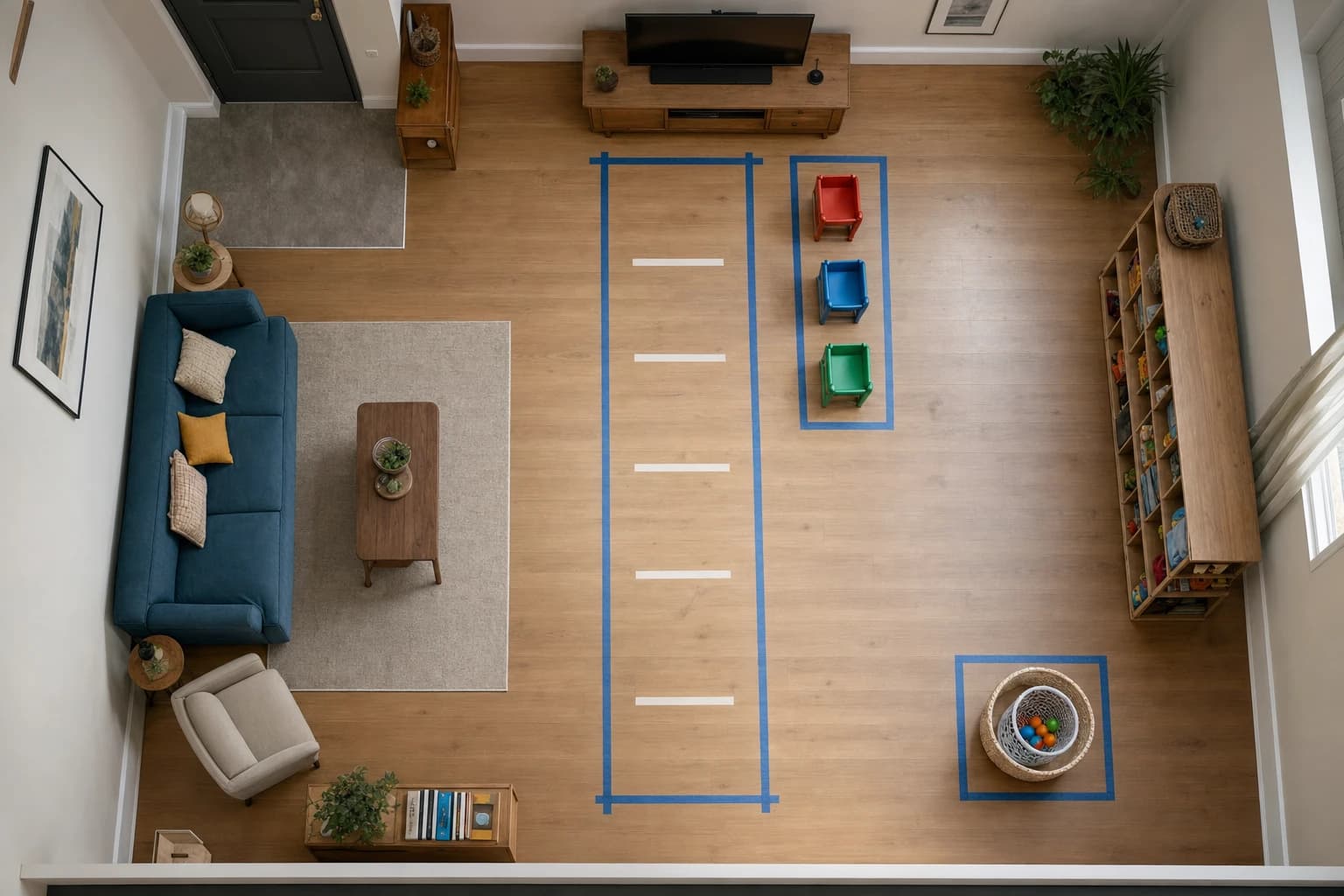
Mistake 3: moving furniture without creating a real layout
Pushing furniture “a little bit” can make the room worse. Children see gaps as tunnels, corners as turning points, and sofas as landing pads. Instead, make one obvious movement zone and one obvious waiting zone.
A simple layout works well:
- Movement zone: the only place where the active part happens.
- Waiting zone: a rug, sofa, or taped spot where the next player stands or sits.
- Target zone: a basket, pillow, or box at the end of the route.
- No-go zone: TV stand, kitchen area, balcony door, glass furniture, and anything breakable.
Do not build an obstacle course that requires children to climb over chairs, jump from cushions, or crawl under unstable furniture. If the route feels too short, add tasks at each stop: five penguin steps, one balance pose, two sock tosses, or one memory question.
Mistake 4: making rules too long or changing them mid-game
Children are more likely to follow rules they can repeat back. If a game needs eight instructions, it is probably not the right game for a small room.
Use this rule format:
- Movement rule: how bodies move, such as walking, crab-walking, tiptoeing, or balancing.
- Boundary rule: where bodies move, such as inside the tape or around the cushions.
- Stop rule: what happens when someone hears “freeze,” a timer, or a clap pattern.
Example: “Bear-walk to the blue tape. Toss one sock into the basket. Freeze when I clap twice.” That is clear enough for most school-age children and easy to adjust for younger siblings.
If you want ideas designed for a specific age, Indoor Games for 8-Year-Olds With No Equipment includes small-space rules and variations.
Mistake 5: expecting different ages to play the same way
Age mismatch is one of the biggest causes of frustration. Older children want challenge and speed. Younger children need repetition and simpler rules. The safest solution is not to make everyone move faster; it is to give each child a version that fits.
Try these adjustments:
- Ages 3 to 5: Use short turns, picture-like instructions, and big obvious boundaries. Avoid elimination games.
- Ages 6 to 8: Add simple scoring, memory sequences, or timed rounds. Keep the movement controlled.
- Ages 9 to 12: Add strategy, accuracy targets, or leadership roles. Let them design one safe variation and explain it.
For a mixed-age group, make older children responsible for harder accuracy tasks. For example, the 5-year-old tosses rolled socks from 3 feet away, while the 10-year-old tosses from 6 feet away while standing on one foot. Both are playing the same game, but the challenge is fairer.
Mistake 6: forgetting clutter control
A small apartment becomes stressful when every game leaves objects scattered across the floor. Active play should have a reset system. Use only one basket of materials at a time, and make cleanup part of the game.
Examples:
- Color rescue: Children move like animals to collect only blue items first, then red items.
- Delivery route: One child carries rolled socks to the basket using penguin steps.
- Timer tidy: Everyone has 90 seconds to return game items before the cooldown begins.
Keep “game props” separate from regular toys. If all toys are available, the room quickly turns into a pile instead of a play zone.
Mistake 7: ending at peak energy
Stopping immediately after the loudest or most exciting round often leads to complaints, bargaining, or rough play. A planned cooldown gives children a landing strip.
A practical cooldown takes about five minutes:
- Minute 1: Slow-motion walk around the play zone.
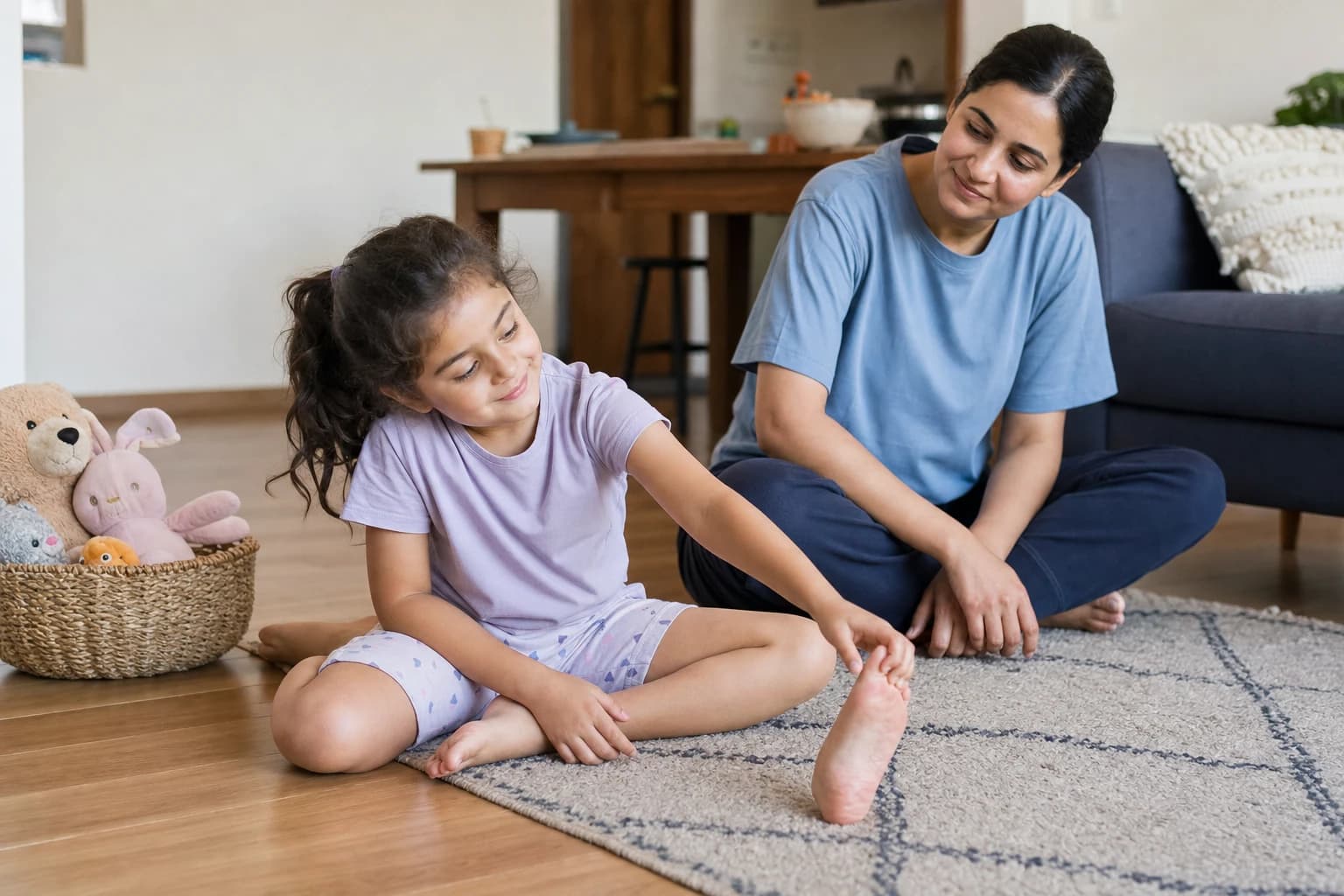
- Minute 2: Three stretch shapes: tall tree, small rock, wide star.
- Minute 3: Quiet breathing or count five slow breaths.
- Minute 4: Put props back in the basket.
- Minute 5: Switch to a seated game, snack, reading, or drawing.
If children resist stopping, announce the ending earlier: “Two rounds left, then cooldown.” This is clearer than suddenly saying the game is over.
Safer small apartment games that still feel active
Here are practical options that avoid running but still allow movement.
- Animal path: Tape three spots on the floor. Children crab-walk to spot one, frog-squat at spot two without jumping, then tiptoe to the finish.
- Sock target toss: Roll six pairs of socks. Children move to a line, toss into a laundry basket, retrieve, and repeat.
- Mirror coach: One child leads slow movements while the other copies. Switch leaders every 60 seconds.
- Freeze statues: Play music at a moderate volume. When it stops, children freeze in a shape you call out: star, pencil, bridge, or flamingo.
- Delivery mission: Move soft items from one box to another using a required movement, such as heel-to-toe walking.
- Balance trail: Use tape lines as a path. Add tasks like “touch the wall gently,” “turn around slowly,” or “balance for three counts.”
For party-style ideas that can be adapted to indoor spaces, see Indoor Birthday Party Games for Kids Ages 6–10.
Pre-game checklist for active indoor games in a small apartment
- Is the floor clear of cords, bags, hard toys, and sliding rugs?
- Are sharp corners, glass items, electronics, and lamps outside the play zone?
- Is the game no-running and no-chasing?
- Have you set a clear noise rule?
- Can every child repeat the three main rules?
- Is there a waiting spot for children who are not taking a turn?
- Are younger and older children given different challenge levels?
- Is there a stop signal everyone understands?
- Do you have a five-minute cooldown planned?
- Are children supervised, especially when using balloons, cushions, or small objects?
FAQ
What are the best active indoor games for kids in a small apartment?
The best options are controlled movement games: animal walks, balance trails, freeze dance, sock toss, scarf catching, mirror moves, and short obstacle routes without climbing or running.
How can I reduce noise during indoor movement games?
Use quiet-foot rules, avoid jumping, choose soft props, keep music moderate, and play on a rug or mat when appropriate. Give children a specific sound rule instead of only saying “be quiet.”
Are balloon games safe indoors?
Balloon games can work for older children with supervision, but broken balloon pieces can be dangerous for young children. Avoid balloons with toddlers and clean up broken pieces immediately.
How long should apartment-friendly active games last?
Short rounds work best. Try 2-minute rounds for preschoolers and 4- to 5-minute rounds for older children, with water breaks or calm turns between games.
What should I do if kids get too wild?
Pause the game, restate the movement rule, and restart with a slower practice round. If the energy stays too high, switch to a cooldown or a seated game instead of arguing through unsafe play.
Conclusion
Organizing active indoor games for kids in a small apartment is less about finding the most exciting game and more about setting the right limits. Clear space, soft props, visible boundaries, short rules, age-based variations, and a planned cooldown make a small home feel more manageable.
Avoid games that depend on running, chasing, jumping, or complicated scoring. Choose movement that is controlled, repeatable, and easy to stop. With a simple checklist and a few reliable game formats, children can move indoors without turning the apartment into a noisy obstacle course.