Rainy weather can turn a normal afternoon into a long stretch of restless energy, especially when children have already had enough screen time. This guide focuses on indoor games for kids on rainy days no screens, no batteries, and no complicated supplies. The games are grouped by energy level, room size, setup time, and cleanup effort so you can choose something that fits the moment instead of digging through a closet while everyone waits.
Most ideas below use items many homes already have: paper, socks, cushions, tape, cups, spoons, books, and a timer. They are designed for children who can follow simple rules, with adaptations for preschoolers, mixed ages, small apartments, and living rooms where running is not a good idea.
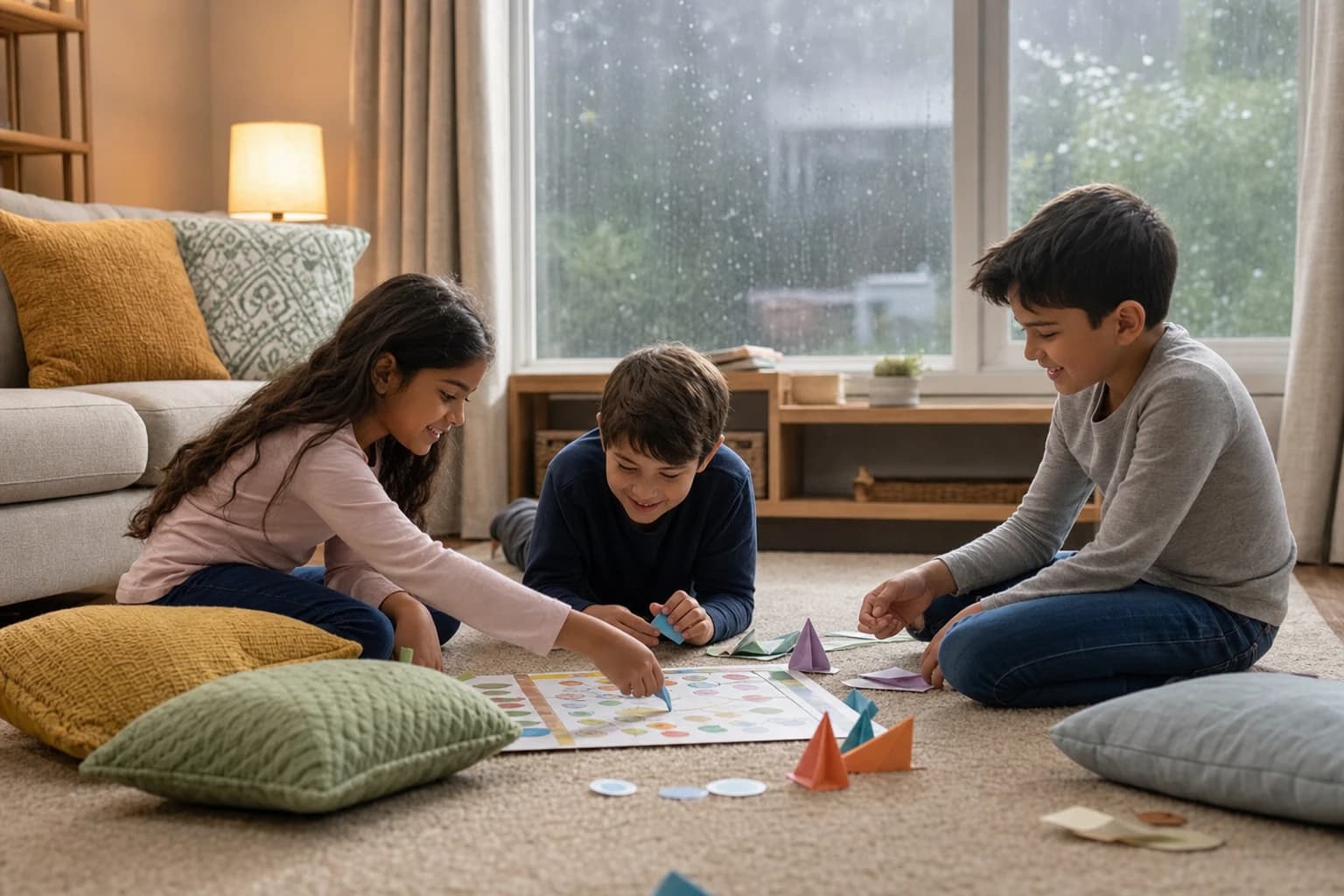
Quick chooser: pick a rainy day game by mood and space
The easiest way to avoid chaos is to choose the game by the room you actually have, not by the game your child requests first. A high-energy game in a narrow hallway can quickly become unsafe, while a quiet thinking game may frustrate a child who needs to move.
| Situation | Best game type | Room needed | Setup time | Cleanup |
|---|---|---|---|---|
| Kids are bouncing off the walls | Animal relay, cushion islands, sock toss | Living room or hallway with breakables removed | 3 to 5 minutes | Low |
| You need a calmer activity before dinner | Story builder, memory tray, drawing telephone | Table or floor space | 2 to 4 minutes | Very low |
| Small apartment or shared walls | Silent statues, paper maze, whisper detective | Small room | 1 to 3 minutes | Very low |
| Mixed ages are playing together | Team scavenger hunt, cooperative tower, charades | Any room | 5 to 8 minutes | Low to medium |
| You have 10 minutes only | Cup stack challenge, sock basketball, freeze pose | Small clear area | 1 minute | Low |
Before you start: a simple setup checklist
You do not need special equipment for good rainy day indoor activities for kids, but a short setup makes the difference between playful and stressful.
- Clear one play zone: Move sharp-edged objects, glass items, loose cords, and small rugs that slide.
- Set a boundary: Use cushions, painter’s tape, chairs, or a rug edge to show where the game happens.
- Choose a noise level: Decide whether the game is active, quiet, or silent before it begins.
- Use a visible timer: A kitchen timer or sand timer keeps turns fair without needing a phone.
- Explain the stop signal: Agree that one clap pattern or the word pause means everyone freezes.
For active play, match the rules to your home and your child’s age. The U.S. Centers for Disease Control and Prevention notes that children and adolescents benefit from regular daily physical activity, including moderate and vigorous movement, but indoor play should still be adjusted for safety and available space. You can read the CDC’s general guidance here: Physical Activity Guidelines for Children.
High-energy indoor games when kids need to move
These screen free indoor games are best when children are restless but outdoor play is not possible. Keep the play area simple, remove hard obstacles, and use soft items only.
1. Cushion Islands
Best for: ages 4 and up. Room: living room. Setup: 3 minutes. Cleanup: 2 minutes.
Place 4 to 8 cushions, folded towels, or pillows on the floor as islands. Children move from island to island without touching the ocean. Start with walking only. Then call out variations: crab walk, tiptoe, giant step, one-foot balance, or slow-motion jump.
- Spread the cushions far enough apart to be interesting but close enough that no one needs a long leap.
- Name one cushion as home base.
- Call out a movement style every 30 seconds.
- If a child touches the floor, they do five star stretches and return to home base instead of being out.
Small-space variation: Use paper plates or towels and make it a balance path rather than a jumping game.
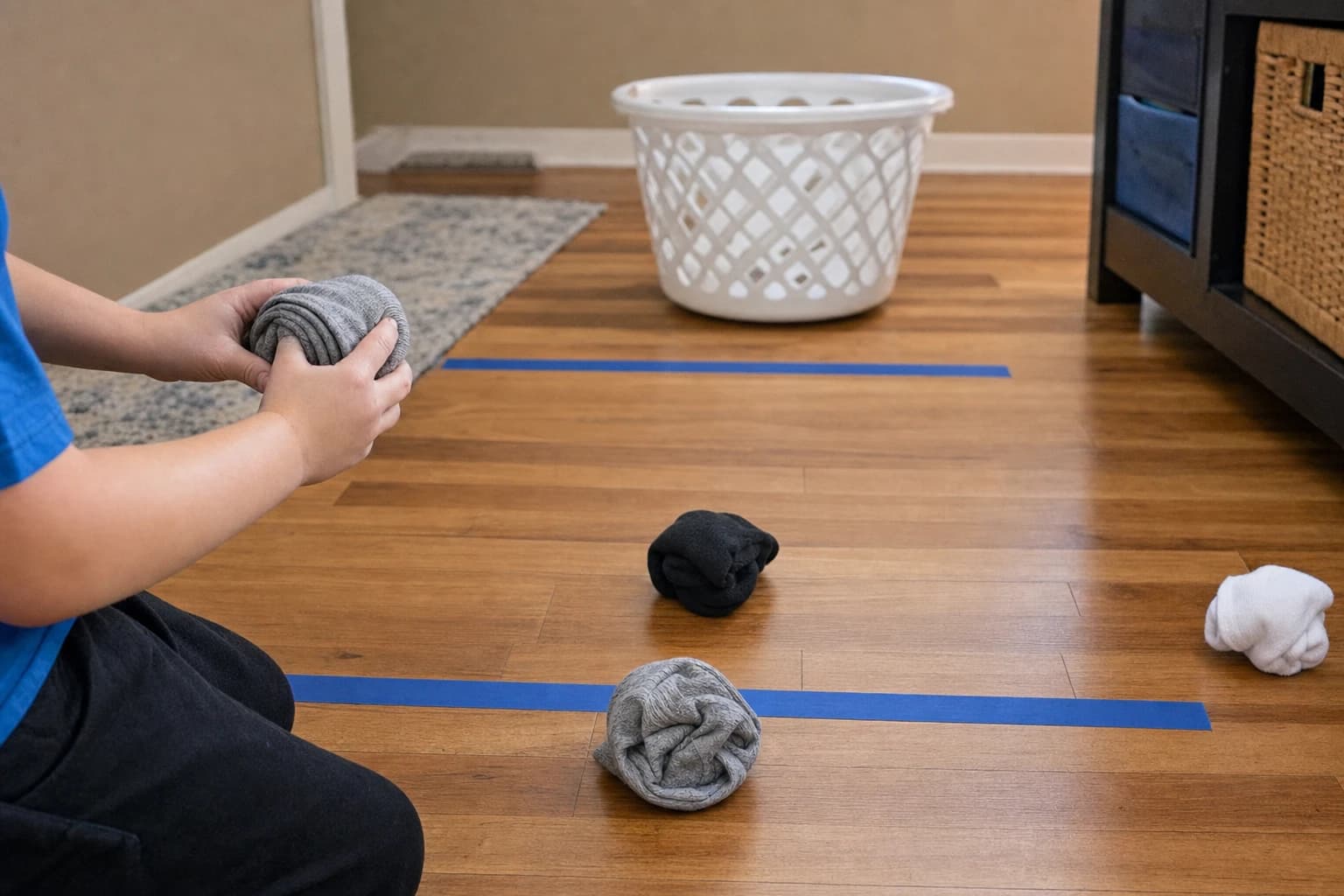
2. Sock Toss Target
Best for: ages 3 and up. Room: hallway, bedroom, or living room. Setup: 2 minutes. Cleanup: 1 minute.
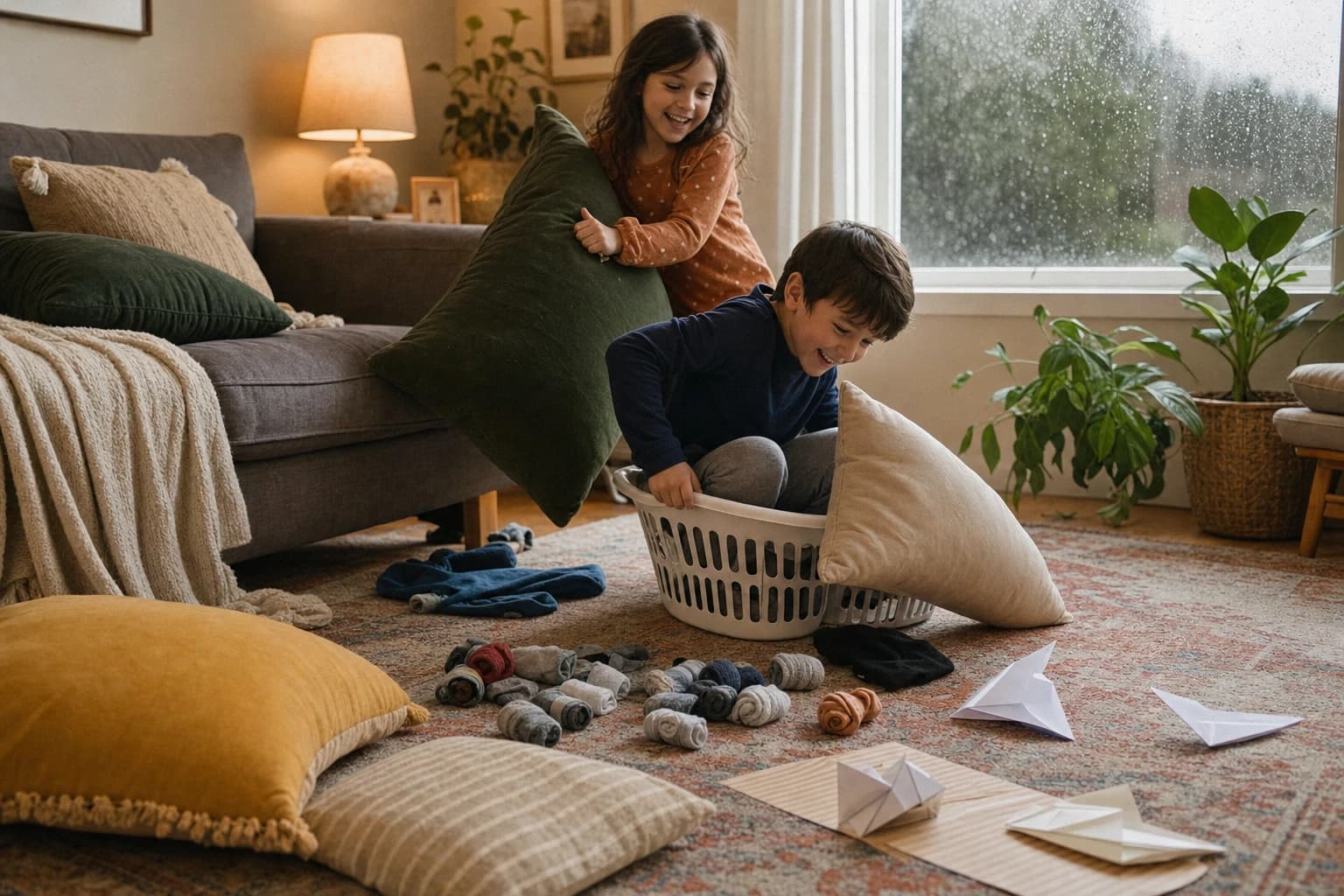
Roll 6 pairs of socks into soft balls. Set out a laundry basket, mixing bowl, or cardboard box as the target. Mark three throwing lines: close, medium, and challenge. Younger children can stand close; older children can try the far line or throw with the non-dominant hand.
To keep this cooperative, give the group a shared goal: land 10 socks in the basket before the timer ends. If you want more ideas for calm group play in tight spaces, see Indoor Games for 10 People in a Small Room.
3. Animal Relay Without Running
Best for: ages 4 to 10. Room: hallway or clear floor. Setup: 2 minutes. Cleanup: none.
Choose two endpoints: a doorway and a chair, or two cushions. Children travel between them using animal movements: bear crawl, frog hop, penguin walk, snake slither, elephant stomp, or turtle crawl. The rule is simple: no running, no crashing, and hands stay away from other players.
For apartments, replace stomping animals with quiet animals: cat crawl, inchworm, flamingo balance, or slow sloth walk. For more small-home safety tips, the article Common Mistakes to Avoid When Organizing Active Indoor Games for Kids in a Small Apartment is a useful companion.
Medium-energy games for small rooms and mixed ages
These easy indoor games at home keep children engaged without needing a large space. They work well when one child wants movement and another prefers thinking or pretending.
4. Color Hunt With a Twist
Best for: ages 3 to 8. Room: any room. Setup: 1 minute. Cleanup: 3 minutes if items are returned right away.
Call out a color and a category, such as blue and soft, red and round, or green and tiny. Children find one safe object that matches and bring it back to the starting point. Add a rule that each item must be returned before the next round. This prevents the game from turning into a room-wide pile.
Older-child variation: Use adjectives instead of colors: something flexible, something heavier than a spoon, something that makes a quiet sound, or something with exactly four corners.
5. Paper Path Maze
Best for: ages 5 and up. Room: hallway or bedroom floor. Setup: 5 minutes. Cleanup: 1 minute.
Place 12 to 20 sheets of scrap paper on the floor in a path. Some pages are safe stepping stones and some are traps. The game leader secretly writes down the correct route, such as left, straight, right, right, straight. Players try to cross by memory. If they step on a trap, they go back to the start and the next player tries.
This is battery free, quiet, and surprisingly absorbing because children start noticing patterns. To make it cooperative, let the group solve the route together instead of competing.
6. Indoor Charades Jar
Best for: ages 5 and up. Room: small floor space. Setup: 5 minutes once, then 30 seconds later. Cleanup: very low.
Write simple prompts on paper slips: brushing teeth, flying a kite, making pancakes, walking in deep snow, being a robot, carrying a very full tray, or looking for a lost shoe. Fold them into a bowl. A player draws one and acts it out without speaking.
For preschoolers, use picture cards or let them whisper the idea to an older child who acts with them. If you need quieter preschool-friendly ideas, visit Quiet Indoor Games for Preschoolers on Rainy Days.
Calm games for after lunch, before bed, or rainy evenings
Calm does not have to mean boring. These games give children something to do with their attention when the home needs to settle down.
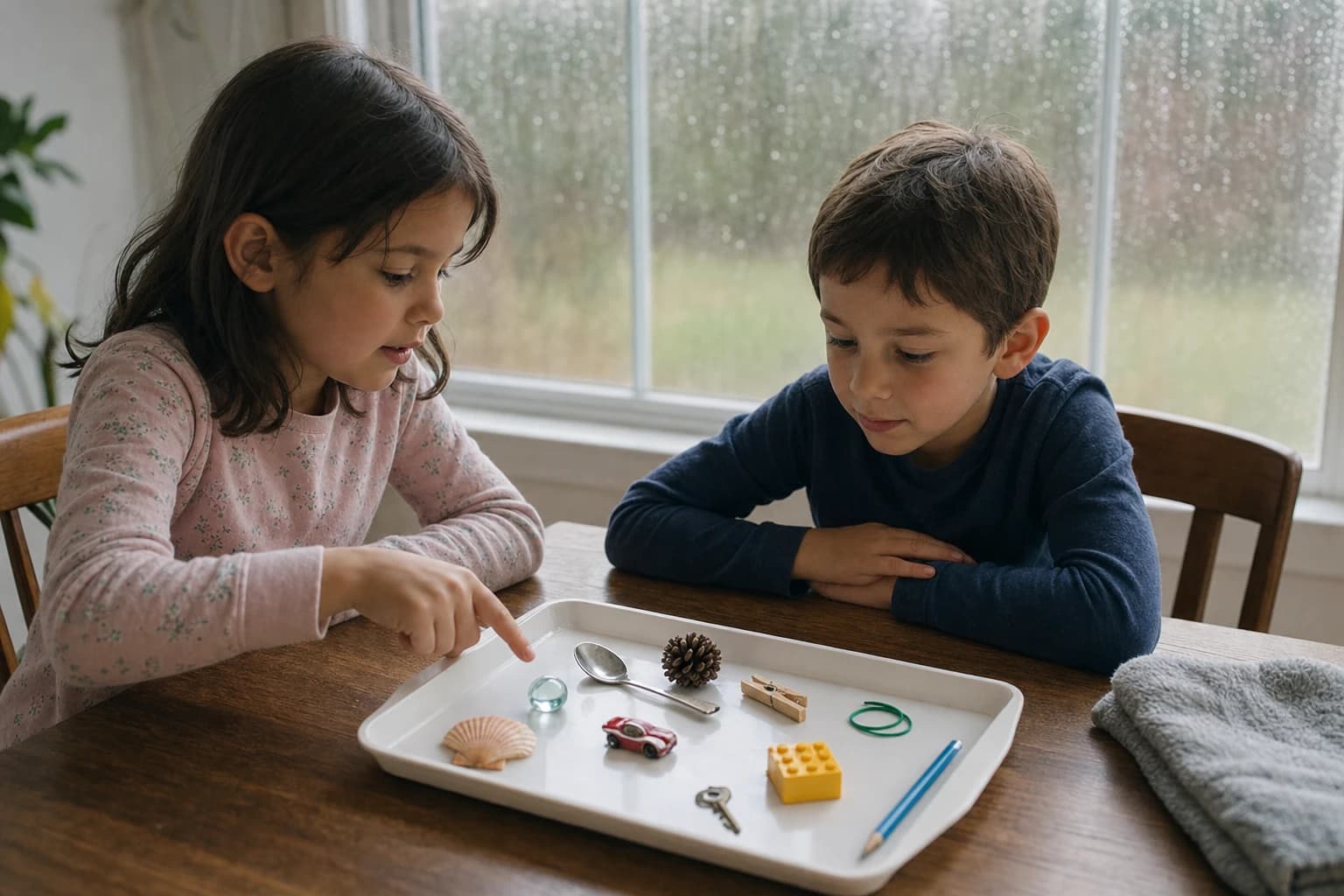
7. Memory Tray
Best for: ages 4 and up. Room: table or floor. Setup: 3 minutes. Cleanup: 2 minutes.
Place 8 household objects on a tray: spoon, key, crayon, toy car, button, sock, pencil, and small cup. Let children study the tray for 30 seconds. Cover it with a towel and remove one object secretly. Uncover the tray and ask what is missing.
Adjust difficulty by changing the number of objects. Use 5 objects for younger children and 12 for older children. A harder version is to move two objects instead of removing one.
8. Story Builder Circle
Best for: ages 5 and up. Room: couch, table, or floor. Setup: none. Cleanup: none.
One person starts a story with a single sentence: The umbrella opened by itself. Each person adds one sentence. Add three rule cards if you want structure: include an animal, include a sound, include a problem to solve. The story ends after each player has added three sentences.
This works especially well for mixed ages because younger children can give short ideas while older children build details. It is also a good transition game when you need the room to become quieter without stopping play abruptly.
9. Drawing Telephone
Best for: ages 6 and up. Room: table. Setup: 2 minutes. Cleanup: recycle paper scraps.
Give each player a strip of paper folded into 4 panels. On panel 1, the player writes a simple phrase, such as a cat baking bread. They pass the paper. The next player draws it on panel 2, folds panel 1 behind, and passes it on. The next player writes what they think the drawing shows. Continue until the strip is full, then unfold and read the results.
If writing is difficult, use only drawings and guesses spoken aloud at the end.
How to build a reusable rainy day game box
A small game box keeps battery free games for children ready before the rain starts. Use a shoebox, basket, or drawer and refill it with ordinary items.
- 10 folded paper slips for charades or scavenger hunt clues
- 6 pairs of clean socks for toss games
- 1 roll of painter’s tape for temporary boundaries
- 1 deck of cards for sorting, memory, and pattern games
- 12 scrap paper sheets for mazes and drawing games
- 1 small notepad and 2 pencils
- 1 lightweight scarf or towel for covering objects in memory games
Keep the box simple. If it becomes too full, children may spend more time dumping it out than playing. For longer school breaks, you can combine several of these ideas into a weekly routine using How to Plan a Winter Break Indoor Game Schedule for Kids.
Common mistakes to avoid
- Starting with too many rules: Give the basic rule first, then add variations after one round.
- Using hard balls indoors: Rolled socks, soft beanbags, or crumpled paper are safer choices for most homes.
- Letting cleanup wait: Add return the item as part of the game, especially during scavenger hunts.
- Ignoring the room below or next door: In apartments, choose crawling, balancing, guessing, or seated games instead of jumping.
- Making every game competitive: Cooperative goals reduce arguments, especially with siblings of different ages.
FAQ
What are the best indoor games for kids on rainy days with no screens?
Good options include sock toss target, cushion islands, memory tray, indoor charades, paper path maze, story builder, and color hunt. Choose active games when children need movement and quiet games when the home needs to settle.
What can kids play indoors without batteries?
Children can play with paper, cushions, socks, cups, cards, pencils, and household objects. Battery free games often work better when the rules are short and the supplies are soft or easy to put away.
How do I keep indoor games safe in a small room?
Clear the floor, remove breakables, avoid running, and use soft objects only. Pick games based on balance, guessing, memory, acting, or careful movement instead of speed.
What indoor games work for different ages together?
Cooperative scavenger hunts, charades, story builder, sock toss, and memory tray can be adjusted easily. Give younger children closer targets or simpler clues, and give older children harder rules or leadership roles.
How long should a rainy day game last?
Most home games work best in short rounds of 5 to 15 minutes. Stop while the game is still going well, or switch from active to calm play before children become overtired.
Conclusion
The best rainy day indoor activities for kids are not the most elaborate ones. They are the games that fit your space, energy level, and cleanup tolerance right now. Keep a few soft supplies ready, choose one clear boundary, and rotate between active, medium-energy, and calm games as the day changes. With a simple plan, screen free indoor games can turn a wet afternoon into a manageable, playful part of family life.