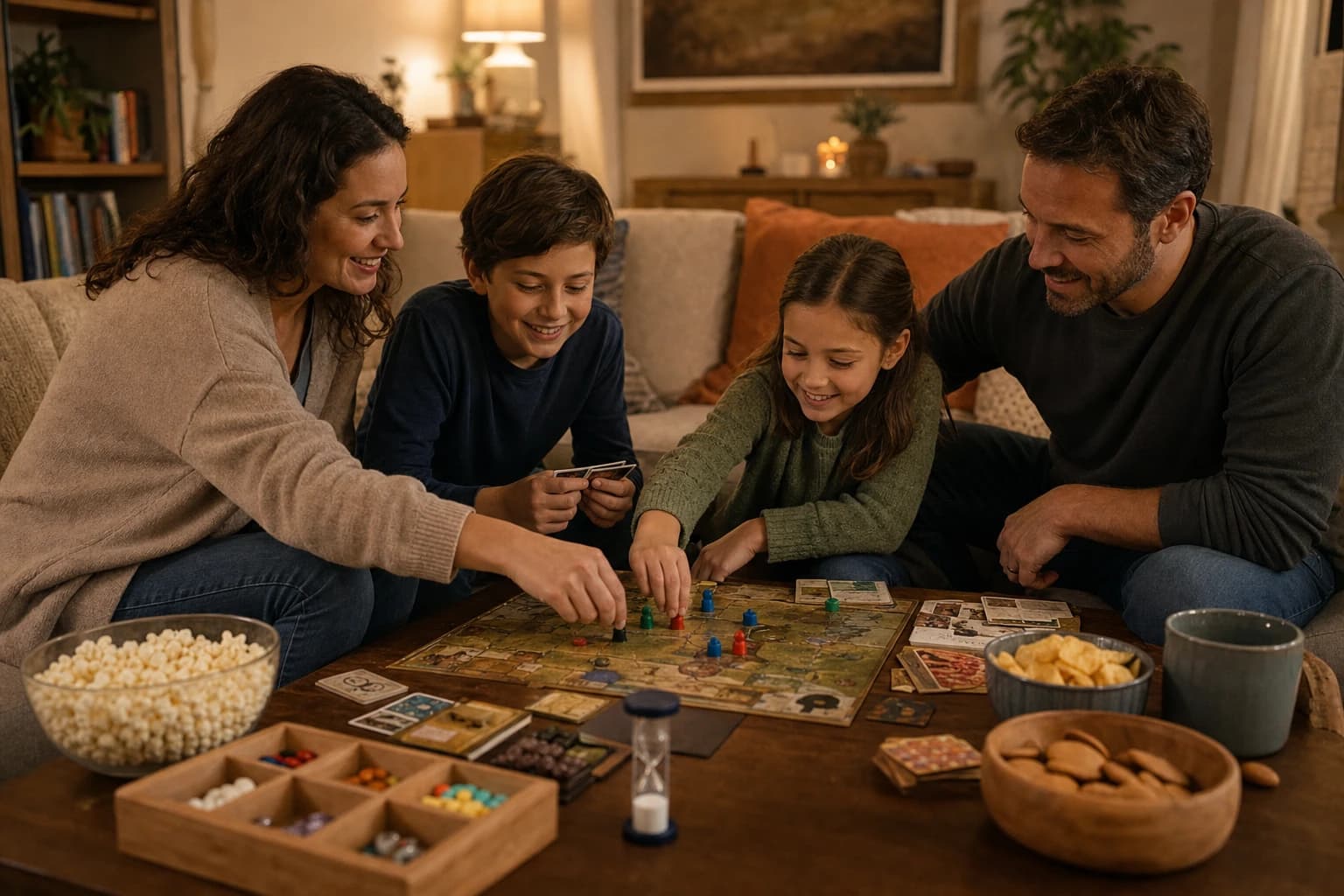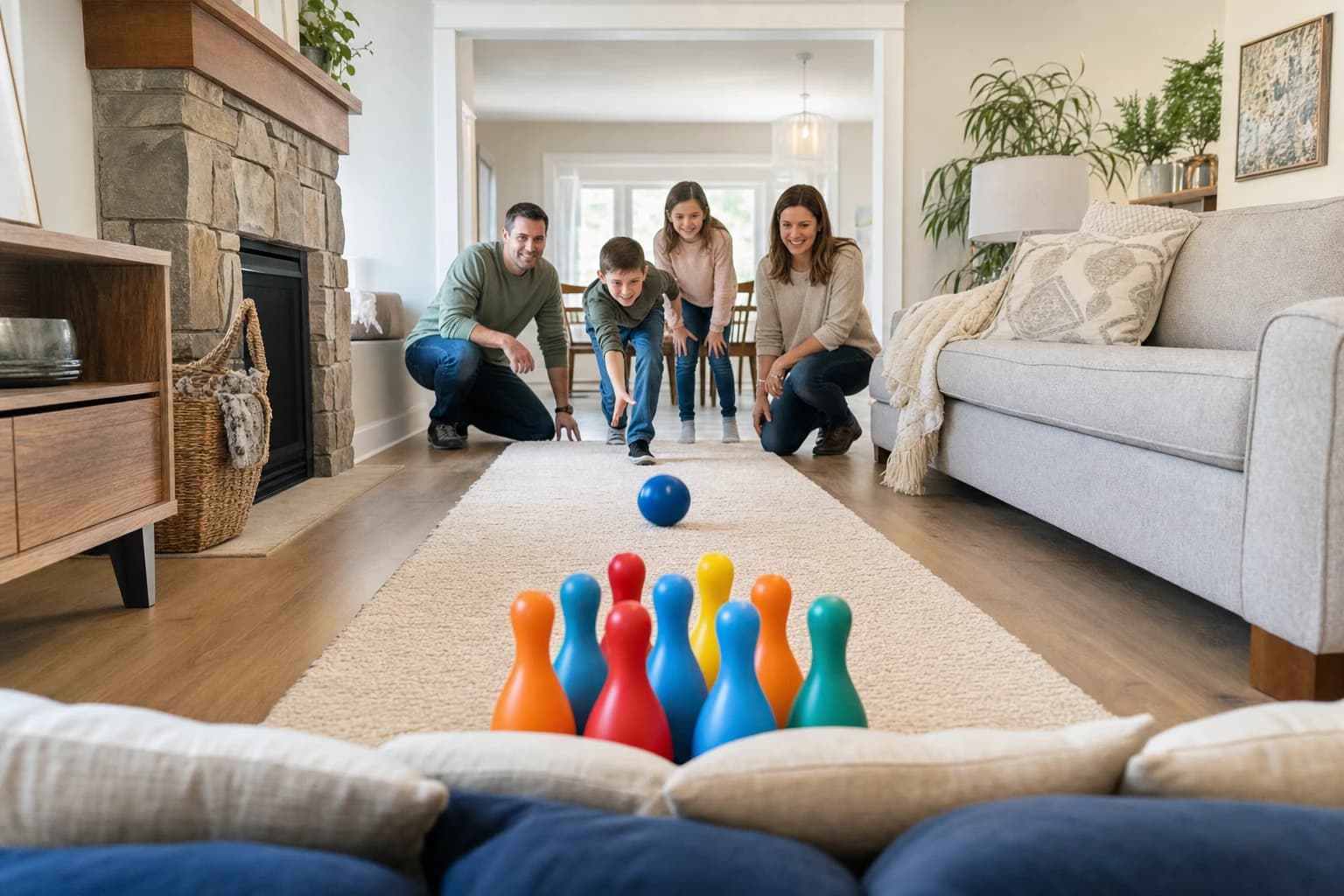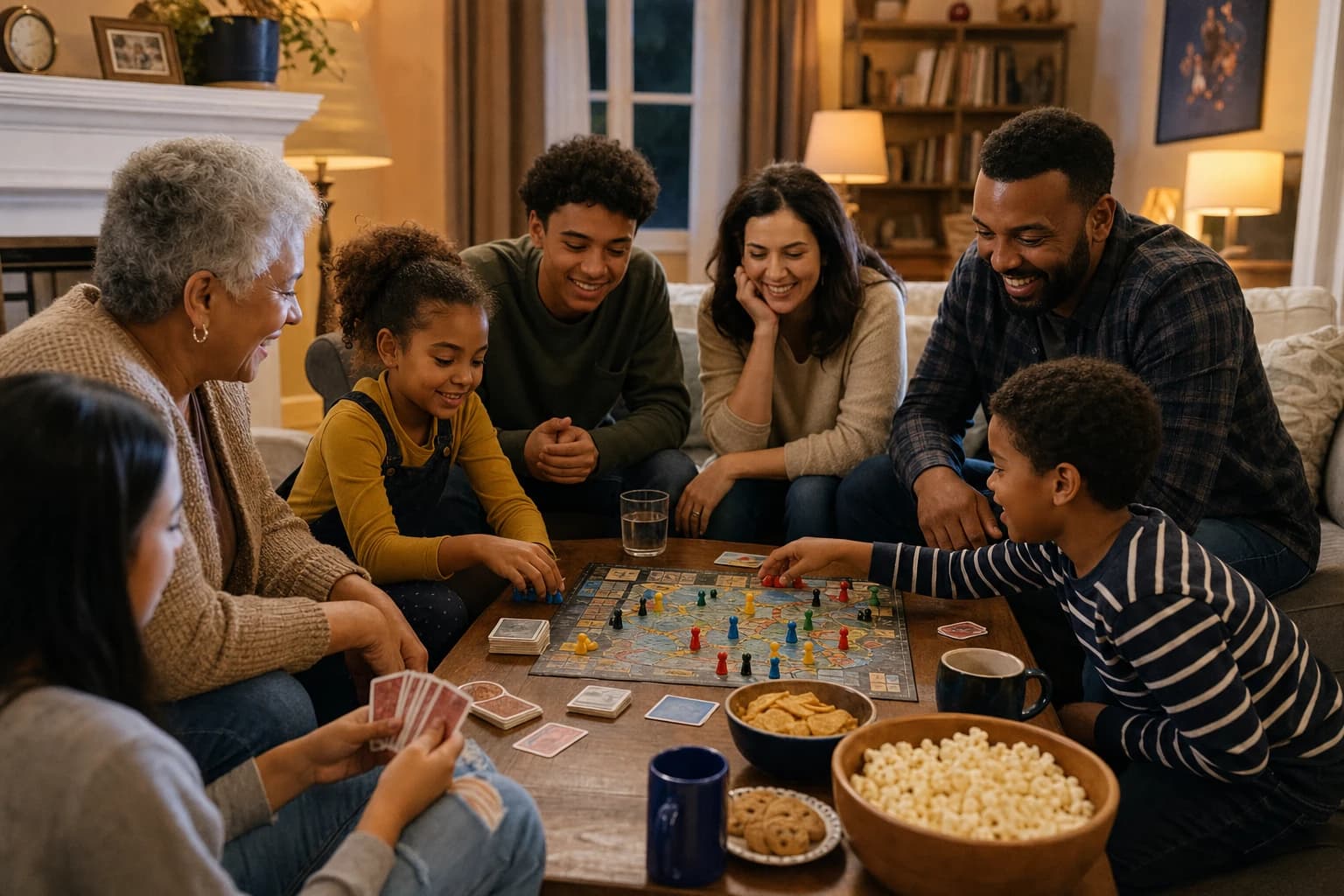
Winter break can feel long when the weather keeps everyone indoors, especially if children have plenty of energy and parents still need the house to function. This winter break indoor game schedule for kids gives you a reusable 7-day plan with three simple blocks each day: an active morning game, a hands-on afternoon challenge, and a calm evening activity.
The plan uses low-cost supplies you probably already have: paper, tape, socks, cups, pillows, cardboard, playing cards, and a timer. You can follow the week exactly or treat it as a menu and swap games based on your space, your child’s age, and the day’s energy level.
The simple structure: active, creative, calm
A good winter indoor routine does not need to fill every minute. In fact, children usually do better when the schedule has room for free play, snacks, reading, chores, and rest. The goal is to give the day a rhythm so you are not inventing entertainment from scratch every morning.
Use this three-block pattern for each day:
- Morning: 20 to 35 minutes of movement. This is the time for safe indoor energy games such as target toss, obstacle paths, balance challenges, or team races without running.
- Afternoon: 30 to 45 minutes of building, solving, or creating. This block works well after lunch when children can focus on a challenge, craft-based game, scavenger hunt, or cooperative mission.
- Evening: 10 to 20 minutes of calm play. Choose quiet games, storytelling, cards, drawing, memory, or guessing games that do not restart the whole house right before bedtime.
If your children are school-age, it is worth remembering that the CDC physical activity guidelines for children recommend 60 minutes or more of daily physical activity for ages 6 to 17. Indoor games will not replace outdoor play every day, but short movement blocks can help children burn energy when sidewalks, yards, or parks are not practical.
Quick safety notes before you start
- Clear the play area before active games. Move hard-edged furniture, cords, glass items, and slippery rugs.
- Use painter’s tape instead of strong tape on floors and walls, and test a small spot first.
- Keep games no-running unless you have a large, open room with a non-slip floor.
- Use crumpled paper balls or rolled socks instead of hard balls indoors.
- Skip balloons if anyone has a latex allergy or if there are children who still put small pieces in their mouths.
Low-cost materials list for the whole week
You do not need to buy a full bin of new toys. Gather supplies once, place them in a laundry basket or box, and reuse them all week.
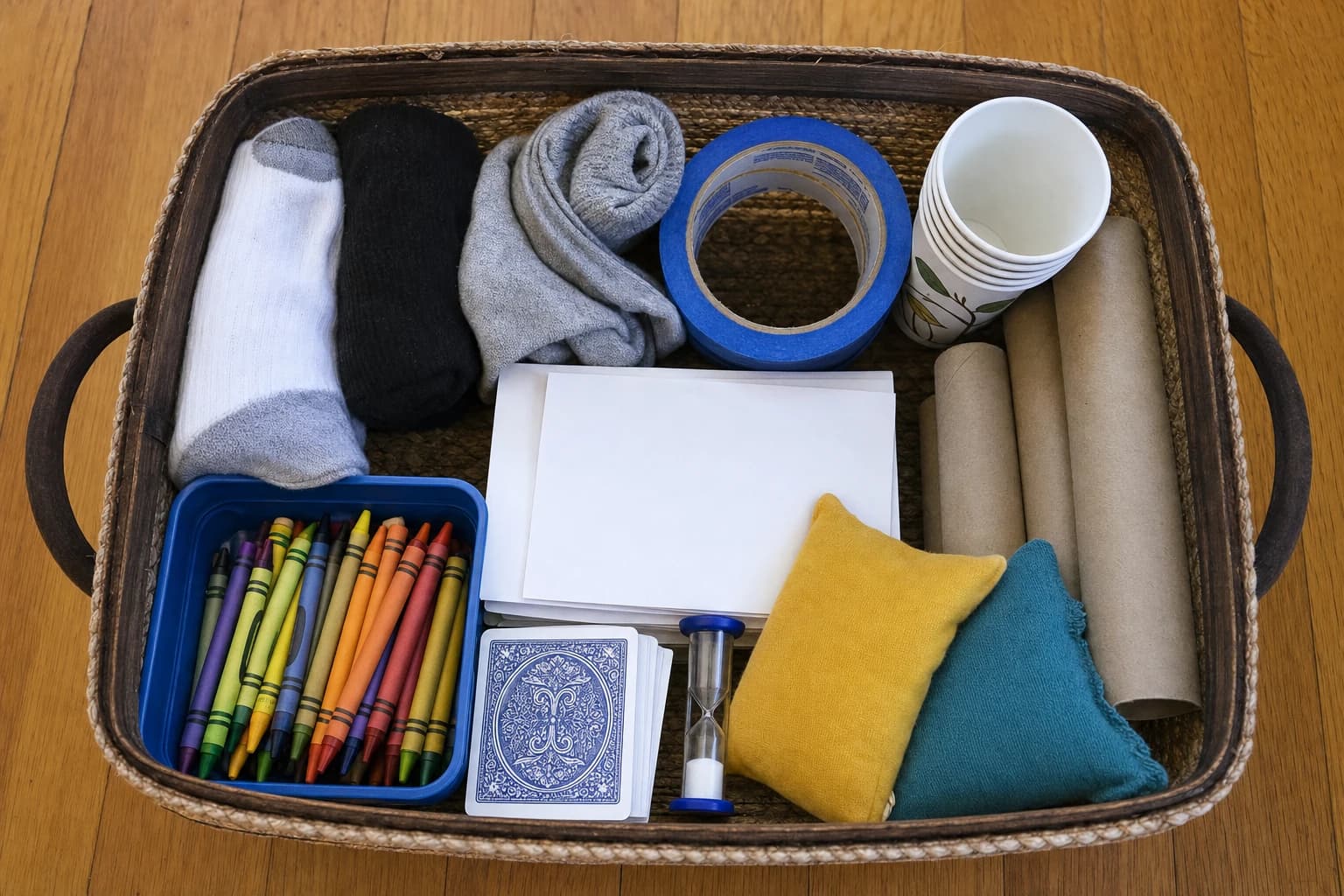
- 1 roll of painter’s tape or masking tape
- 10 sheets of scrap paper or construction paper
- 6 to 10 pairs of clean rolled socks
- 10 plastic or paper cups
- 1 laundry basket or cardboard box
- 1 timer, kitchen timer, or phone timer
- 4 pillows or cushions
- 2 spoons and 2 small soft items, such as cotton balls or pom-poms
- 1 deck of cards or a few dice
- Sticky notes or small slips of paper
- Cardboard tubes, cereal boxes, or shipping boxes
- Crayons, pencils, or washable markers
Prep-ahead setup: 30 minutes once, easier days later
Before the week starts, spend half an hour making the plan visible and removing friction. You do not need a fancy chart. A piece of paper on the fridge is enough.
- Choose your play zone. Pick one main area: living room, hallway, dining area, bedroom, or basement. For active games, aim for a clear rectangle of floor. Even 6 by 8 feet can work if you use no-running rules.
- Create a supply basket. Put all game materials in one container so children are not searching through drawers during every activity.
- Write the 7 days on paper. List morning, afternoon, and evening. Leave a blank line next to each block for changes.
- Make 10 quick challenge cards. Examples: balance for 10 seconds, toss 3 socks into a basket, name 5 winter foods, build a 6-cup tower, invent a silly walk.
- Set a reset rule. At the end of each block, everyone helps clean for 3 minutes before moving on.
This small setup prevents the most common winter break problem: a fun game that turns into a scattered pile of supplies no one wants to clean.
7-day indoor game plan for children
Use this table as your base schedule. The times are suggestions, not strict rules. If a game is going well, extend it. If everyone is cranky, shorten it and move to snack, reading, or independent play.
| Day | Morning movement | Afternoon challenge | Calm evening game | Prep note |
|---|---|---|---|---|
| Day 1 | Cabin Olympics | Indoor mini target course | Winter charades | Tape 3 floor lines and set out socks |
| Day 2 | Detective scavenger hunt | Mystery code mission | Memory tray | Hide 8 to 12 clues before lunch |
| Day 3 | Pillow path challenge | Cardboard build game | Slow stacking contest | Save boxes and tubes |
| Day 4 | Cooperative keep-it-up | Cup tower engineering | Family trivia bowl | Write 15 trivia questions |
| Day 5 | Tiny-space motion games | Drawing relay | Quiet clue games | Use seated or hallway-friendly options |
| Day 6 | Skill stations | Make-your-own board game | Card or dice night | Prepare 4 station signs |
| Day 7 | Kids’ choice replay | Winter break game festival | Award and cleanup hunt | Let children vote for favorites |
Day 1: Cabin Olympics
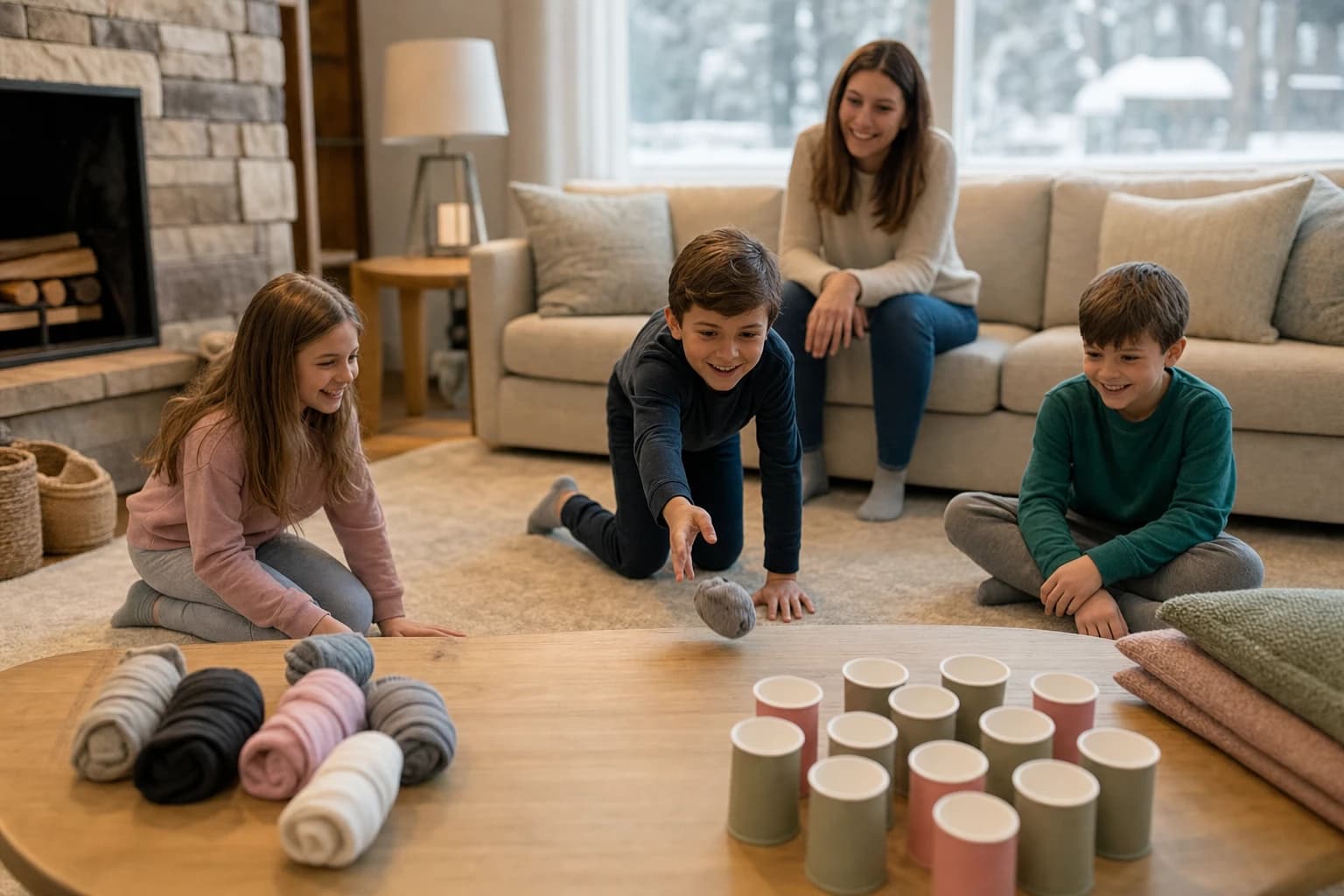
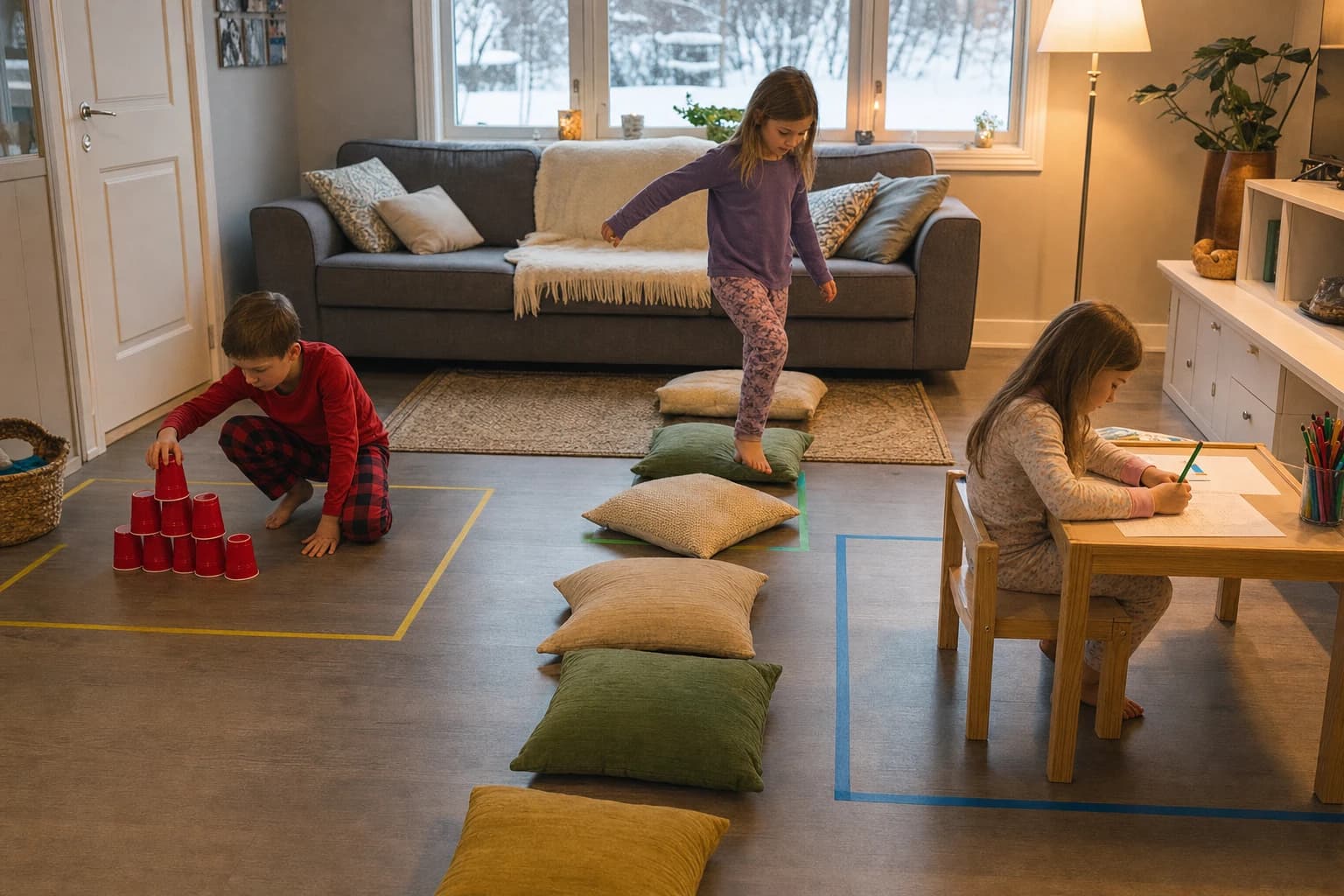
Morning game, 25 minutes: Set up three low-risk events: sock toss, tape-line balance, and pillow island stepping. For sock toss, place a laundry basket 4 feet away for younger children and 7 feet away for older children. Each player gets 6 sock throws. For tape-line balance, place a 6-foot strip of tape on the floor and ask players to walk heel-to-toe without stepping off. For pillow islands, lay 4 pillows on the floor and have children cross the room by stepping only on pillows.
Afternoon game, 35 minutes: Build an indoor target course. Tape paper circles to the floor with point values of 1, 2, and 3. Children roll socks, slide paper discs, or gently toss beanbags if you have them. Add a design round where children create their own target shape.
Evening game, 15 minutes: Play winter charades. Write actions on slips of paper: shoveling snow, sipping cocoa, putting on boots, penguin walking, building a snow fort, carrying firewood. Younger kids can act with sound effects; older kids can play silently.
Day 2: Detective day
Morning game, 20 to 30 minutes: Run a scavenger hunt with 8 to 12 items. Keep clues simple: find something soft, something blue, something that starts with B, something you wear in winter, something round, something smaller than your hand. For siblings, make it cooperative: the team must fill one basket together before the timer ends.
Afternoon game, 30 to 45 minutes: Create a mystery code mission. Assign each letter a number from 1 to 26, then write a short message such as 8-9-4-5 20-8-5 19-15-3-11-19, which spells hide the socks. Older children can write codes for adults to solve. Younger children can match picture clues instead of numbers.
Evening game, 10 minutes: Make a memory tray. Place 10 household items on a tray, let children look for 30 seconds, cover it with a towel, and ask them to name as many as they remember. Use 5 items for preschoolers and 15 for older children.
Day 3: Build and balance day
Morning game, 25 minutes: Make a pillow path challenge. Children move from one side of the room to the other while following a rule: step only on pillows, carry a rolled sock on the back of the hand, or freeze whenever the timer beeps. Keep it turn-based if your room is small.
Afternoon game, 45 minutes: Build a cardboard game. Children can make a marble maze, ramp, ball drop, or miniature golf lane from cereal boxes and paper tubes. If you want a more detailed project, use the guide to make a DIY cardboard marble run indoors and simplify the build for younger kids by using wider ramps and fewer turns.
Evening game, 10 to 15 minutes: Try slow stacking. Give each player 10 cups. The challenge is not speed; it is quiet control. Build the tallest tower possible in 2 minutes, then rebuild using only one hand.
Day 4: Team challenge day
Morning game, 20 minutes: Play cooperative keep-it-up. Use a balloon only if it is safe for your household; otherwise use a crumpled paper ball. The goal is to keep the object in the air or moving across the room for as many taps as possible without arguing over turns. Add rules such as everyone must touch it once before the team scores a point.
Afternoon game, 35 minutes: Build cup towers with mission cards. Give the group 10 cups and a challenge: tallest tower, widest wall, bridge between two books, tower that can hold a spoon, or design that survives a gentle table tap. This is a good family winter game indoors because it encourages cooperation instead of elimination.
Evening game, 15 to 20 minutes: Play family trivia bowl. Write questions that are fair for your household: favorite breakfast, which room has the most lamps, name three relatives, what month is a birthday, or what is the rule for shoes by the door. If you want a longer mixed-age night, the structure in How to Plan a 60-Minute Family Game Night for Mixed Ages can help you balance short turns and team play.
Day 5: Small-space day
This day is designed for apartments, small homes, or days when a child is energetic but the room cannot handle big movement.
Morning game, 20 minutes: Play mirror moves. One child is the leader and moves slowly while the other copies like a reflection. Use motions such as reaching, bending, balancing on one foot, stretching arms wide, or making animal poses. Switch leaders every 60 seconds.
Afternoon game, 30 minutes: Run a drawing relay. Fold a paper into thirds. Player 1 draws a head, folds it so only the neck lines show, Player 2 draws a body, and Player 3 draws legs. Open it for a funny character reveal. Add game rules: name the character, invent a winter job for it, then draw its home.
Evening game, 10 to 15 minutes: Choose a low-mess quiet game. For younger children, ideas from Quiet Indoor Games for Preschoolers on Rainy Days can be adapted for winter evenings. For older children, play twenty questions, alphabet categories, or silent drawing prompts.
Day 6: Skill station day
Morning game, 30 minutes: Set up 4 skill stations and rotate every 5 minutes. Station 1: spoon carry with a cotton ball. Station 2: sock toss into a box. Station 3: cup stack and unstack. Station 4: balance pose on a tape X for 10 seconds. Keep score only if it motivates your child; otherwise use completion stamps or stickers.
Afternoon game, 45 minutes: Make a board game from paper. Draw a path of 20 spaces. Add instructions to 8 spaces: go back 2, trade places, do 5 jumping jacks, name a winter animal, skip ahead 1, draw a card, lose a turn, everyone claps. Use coins as player pieces and dice or numbered cards for movement. Older children can design the rules and test whether the game ends too quickly.
Evening game, 15 minutes: Play a simple card or dice game. War, Go Fish, matching pairs, highest roll, or make-10 dice combinations all work. If your child likes learning games, you may also find useful ideas in Educational Indoor Classroom Games for Grades 3–5, especially for math, spelling, and memory practice without worksheets.
Day 7: Kids’ choice festival
Morning game, 25 minutes: Let children vote for their favorite movement game from the week. Give each child 3 paper tokens and let them place tokens next to the games they want to replay. This gives them control without opening the whole day to debate.
Afternoon game, 45 minutes: Hold a winter break game festival with 3 stations from previous days. For example: sock toss, cup tower, and mystery clues. Keep each station short and use a timer so everyone rotates. If you have more children visiting, no-running games from Indoor Games for 10 People in a Small Room can help you avoid chaos.
Evening game, 15 minutes: Finish with awards and a cleanup hunt. Awards can be silly and noncompetitive: Best Builder, Most Creative Rule, Kindest Teammate, Quietest Cup Stack, Funniest Charade. Then hide 10 cleanup cards around the room, each naming one task: return socks, stack cups, recycle paper scraps, put pillows back, throw away tape pieces.
Age adjustments for mixed-age children
The same 7 day indoor game plan for children can work across ages if you adjust rules instead of replacing the whole activity. Give younger children simpler targets and older children more planning or scoring responsibility.
| Age group | Best adjustment | Example |
|---|---|---|
| Ages 3 to 5 | Use fewer rules, bigger targets, and shorter turns | Three sock tosses from 3 feet away |
| Ages 6 to 8 | Add simple scoring and timed rounds | Score 1 point per cup stacked in 60 seconds |
| Ages 9 to 12 | Add design roles, strategy, or rule-making | Create a cup tower rule card for another team |
| Mixed ages | Use teams and handicaps so everyone contributes | Older child tosses from farther away; younger child tosses closer |
Swap-in options for space and energy level
Some winter days are loud and wiggly. Others are tired, overstimulated, or crowded with visitors. Use these swaps instead of forcing the original plan.
| Situation | Swap this in | Why it helps |
|---|---|---|
| Very small room | Mirror moves, seated toss, memory tray | No running path required |
| High energy | Skill stations with 5-minute rotations | Movement is contained and predictable |
| Low energy | Drawing relay, cards, code messages | Still playful without physical strain |
| Sibling conflict | Cooperative challenge against a timer | Children share a goal instead of competing directly |
| Adult needs to cook or work nearby | Memory tray, cup building, paper board game | Easy to supervise from the same room |
Make the schedule reusable
After the week ends, keep the best games on index cards or slips of paper. Label them active, creative, or calm. The next snow day, sick-but-restless day, or school closure becomes easier because you are choosing from a proven stack instead of starting over.
A helpful rule is to keep each card specific. Instead of writing toss game, write 6 socks, basket 5 feet away, 3 rounds, add 1 point for landing inside. Specific cards are easier for another adult, babysitter, or older child to run.
Common mistakes to avoid
- Planning too many activities. Three game blocks are enough. Children also need unstructured time.
- Starting with messy crafts before the room is ready. Put paper scraps, tape pieces, and markers in one contained area.
- Making every game competitive. Competition can be fun, but too much of it leads to arguments. Mix in team goals and personal challenges.
- Ignoring transitions. Give a 2-minute warning before cleanup. Sudden stops can be harder than the games themselves.
- Using games that do not fit the room. If the space is small, choose turn-taking, seated, or balance activities rather than chase games.
FAQ: winter indoor games for kids at home
How long should each indoor game block be during winter break?
For most families, 20 to 35 minutes works for active games, 30 to 45 minutes for building or challenge games, and 10 to 20 minutes for calm evening games. Shorten the block if children are tired or the game is causing arguments.
What if I have both preschoolers and older kids?
Use the same theme but change the difficulty. A preschooler can toss socks from 3 feet away while an older child tosses from 7 feet away or designs the target layout. Team play also helps mixed ages feel fair.
Do I need to buy supplies for this schedule?
No. The plan is built around low cost indoor activities for winter break using paper, tape, cups, socks, pillows, cardboard, cards, and a timer. If you do buy anything, painter’s tape is usually the most useful add-on because it helps mark safe play areas.
How do I keep indoor games from getting too loud?
Set a clear voice rule before the game starts, such as indoor voices during setup and celebration claps instead of shouting. Put the loudest movement block in the morning and keep the evening block quiet by choosing memory, drawing, cards, or guessing games.
What are good family winter games indoors when relatives visit?
Choose games with short turns and no elimination: charades, cup tower challenges, team scavenger hunts, trivia bowl, and cooperative keep-it-up. Avoid games where players sit out for long periods, especially with younger children.
Conclusion
A winter break indoor game schedule for kids works best when it is simple, flexible, and realistic for your home. You do not need a packed calendar or expensive supplies. A morning movement game, an afternoon challenge, and a calm evening activity can give children structure while still leaving space for rest and free play.
Start with the 7-day plan, adjust the rules for your children’s ages, and keep the favorite games for the next cold day. The more reusable your system becomes, the less winter break feels like a daily scramble.