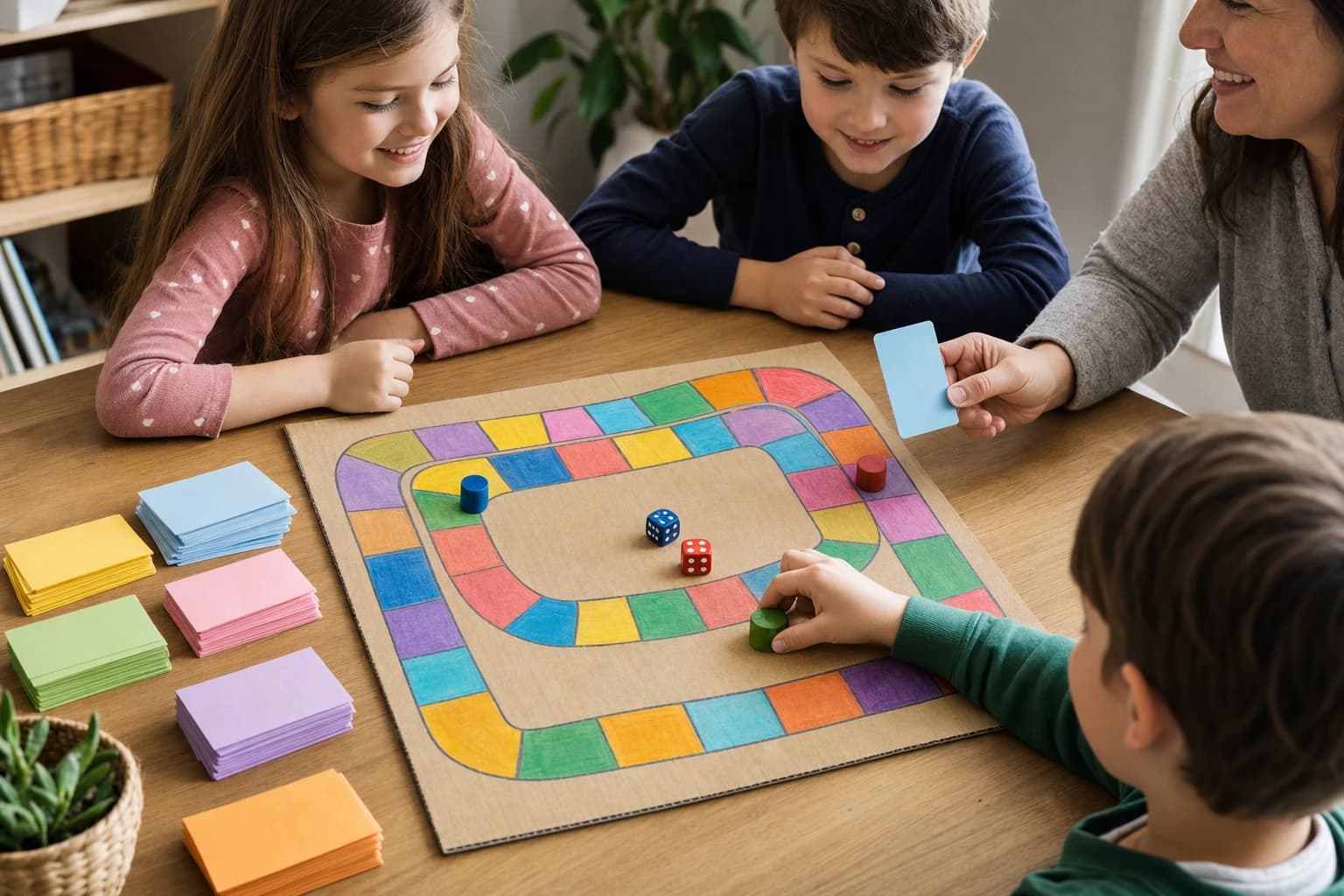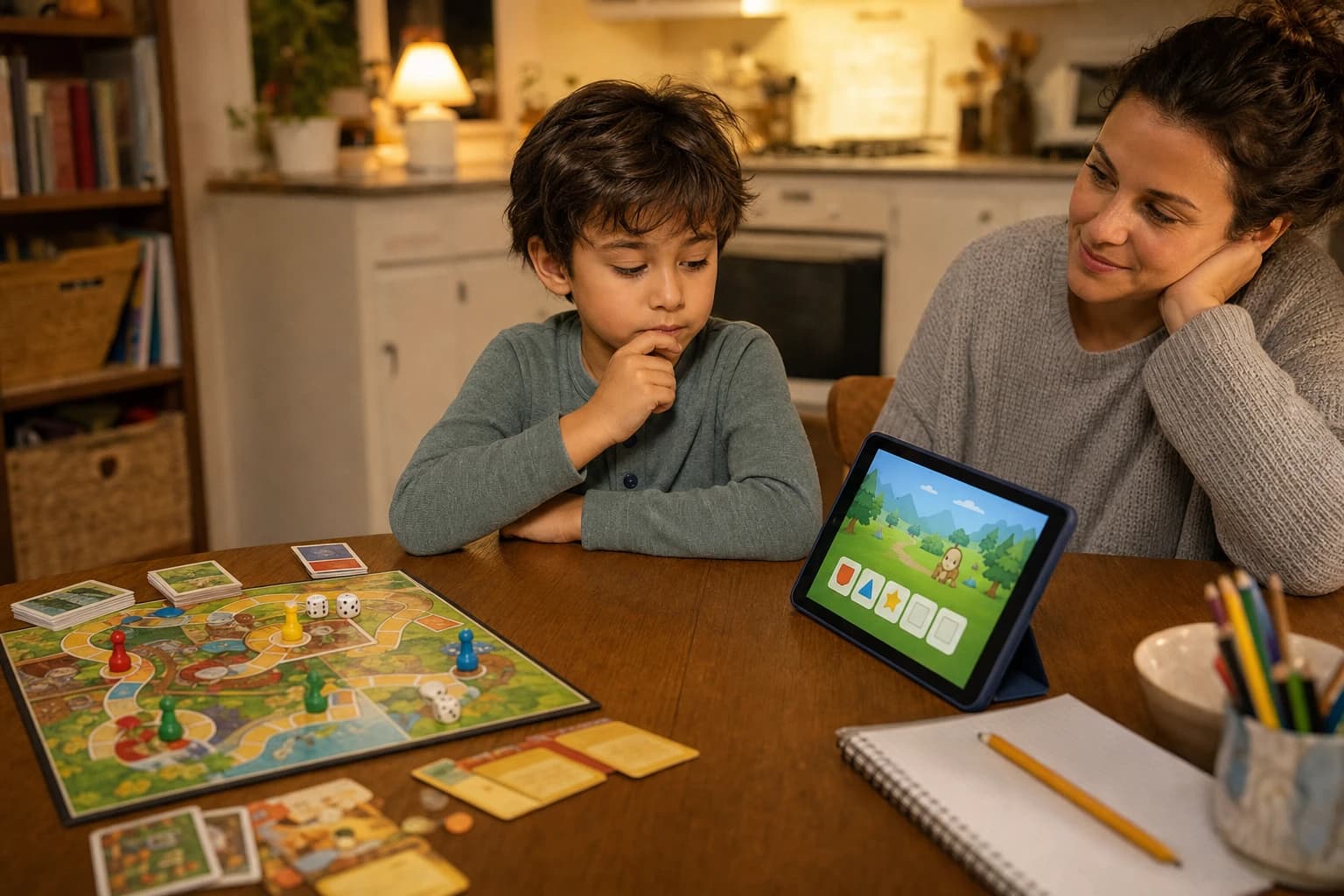
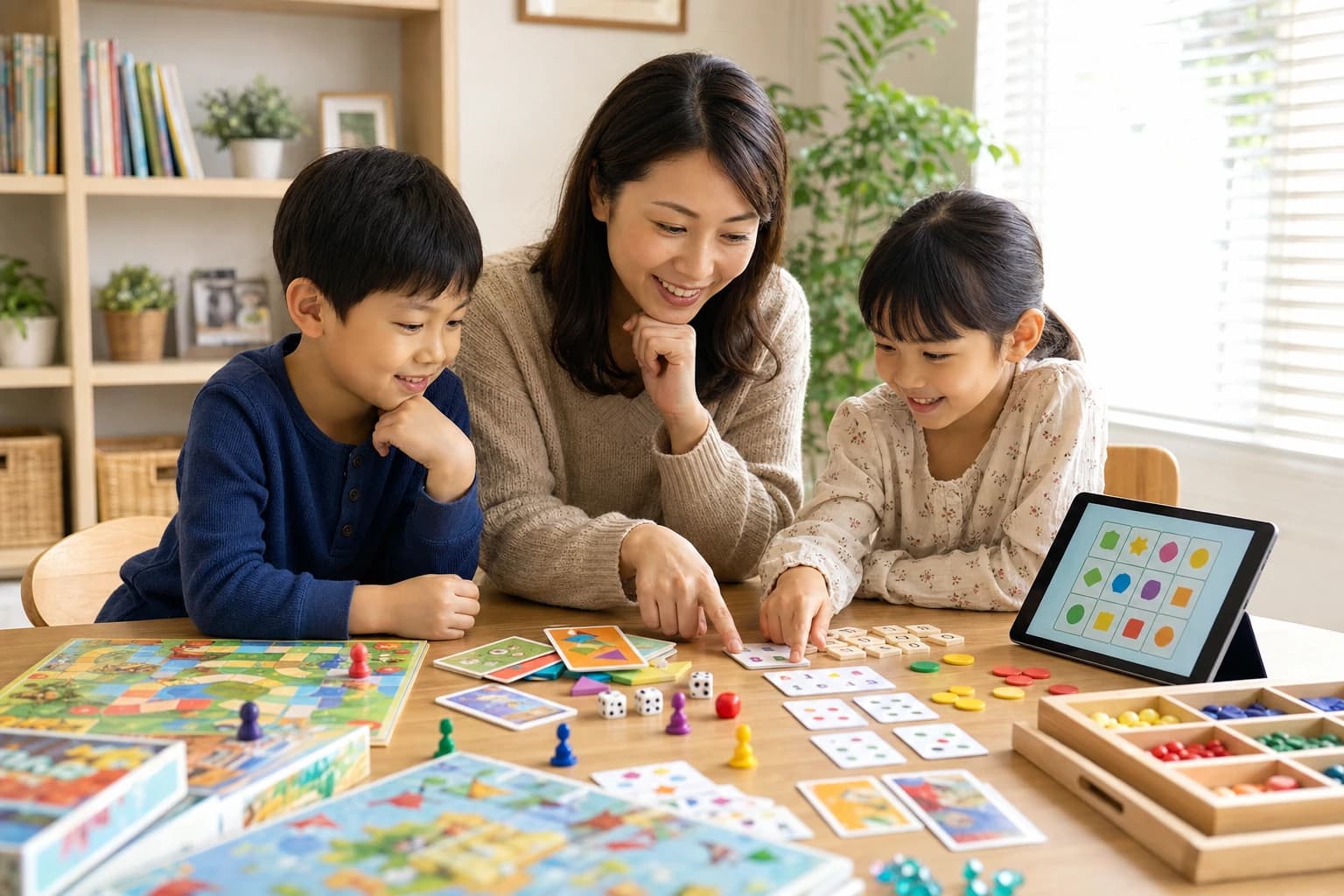
Choosing educational games for 6 to 8 year olds is harder than reading an age label. A game can say “ages 6+” and still be too text-heavy for a first grader, too simple for a confident second grader, or too competitive for a child who shuts down under speed pressure.
At this age, children are often building early reading fluency, number sense, attention, memory, flexible thinking, cooperation, and confidence. The best learning games do not feel like worksheets with prizes attached. They give children a reason to think, choose, explain, test, revise, and try again.
This guide shows the common mistakes parents make, a practical scoring checklist you can use before buying or downloading, and concrete examples for 6-, 7-, and 8-year-olds with different skill needs.
PLAYATME Editorial Note
This guide was prepared by the PLAYATME editorial team for parents, caregivers, and educators comparing children’s games for home or school use. Our review framework looks at reading load, decision quality, independence, feedback, replay value, and social pressure rather than relying only on marketing claims or age labels. We do not claim that any unnamed game in this article has been formally tested in a classroom; the examples below are selection scenarios and design features to look for.
For child development and media-use guidance, this article references the National Association for the Education of Young Children on play, the American Academy of Pediatrics family media plan, and the Harvard Center on the Developing Child on executive function. These sources support the general principle that children benefit from active, meaningful, age-appropriate experiences with room for self-regulation and problem-solving.
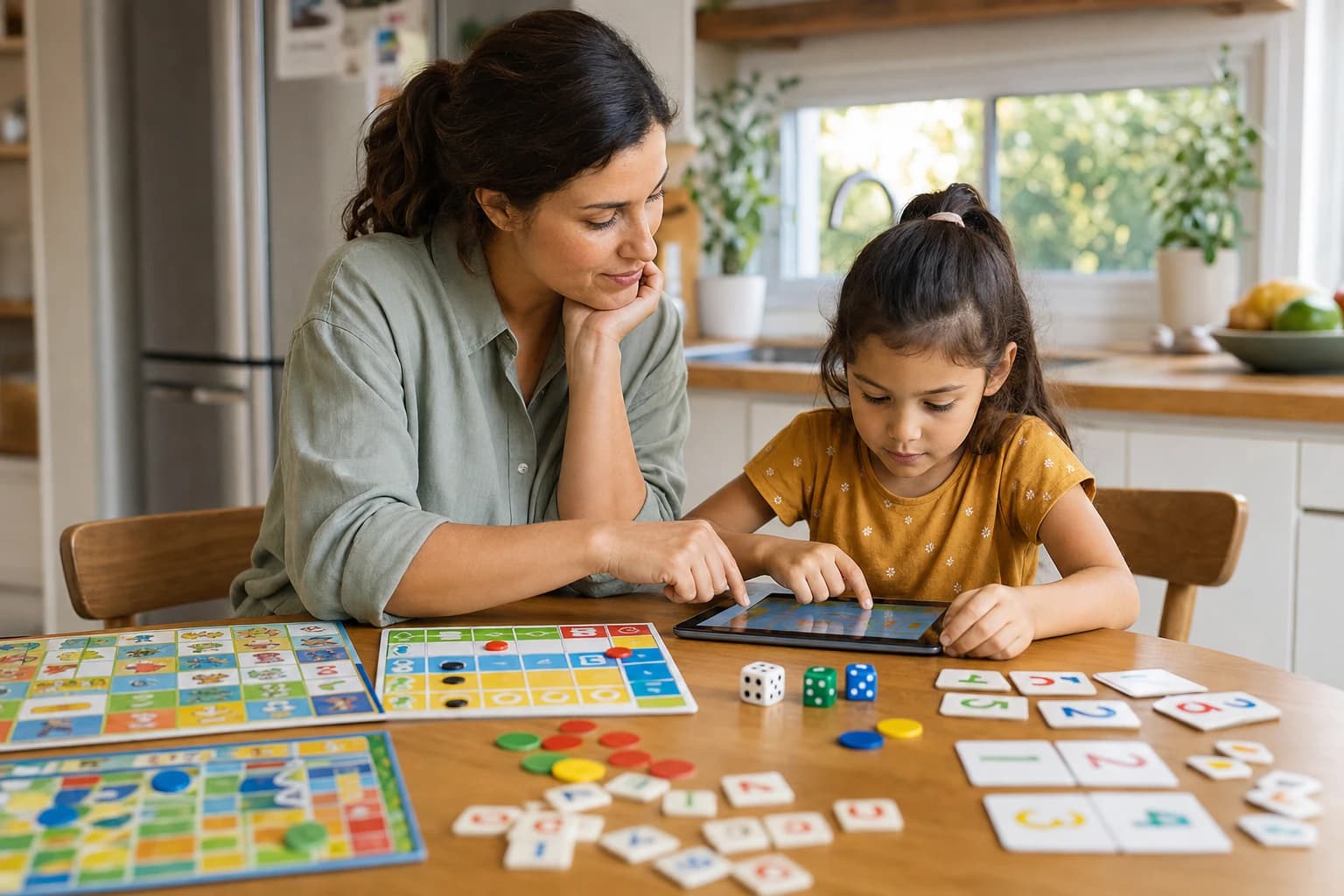
The Short Answer: Match the Game to the Child, Not Just the Grade
The biggest mistake is choosing by age or grade label alone. Two children who are both 7 may differ in reading stamina, math confidence, attention span, fine-motor control, frustration tolerance, and interests.
A strong educational game for ages 6 to 8 usually has these 6 traits:
- A clear goal: the child understands what they are trying to do within 3 to 5 minutes.
- Active decisions: the child sorts, predicts, builds, chooses, compares, explains, remembers, or plans.
- Short rounds: 10 to 20 minutes is a practical target for regular home use.
- Useful feedback: mistakes lead to a hint, retry, model, or natural consequence.
- Adjustable difficulty: the game can be simplified or made harder without buying a new set.
- Low-pressure participation: slower readers and quieter children still get meaningful turns.
The National Association for the Education of Young Children emphasizes that play supports learning when children are engaged, active, and making meaning. That applies to digital games, board games, card games, classroom games, and homemade learning games.
Mistake 1: Choosing a Game That Is Too Academic
Academic practice is not the problem. A game can absolutely support phonics, math facts, spelling, science vocabulary, geography, or logic. The problem is when the activity is basically a worksheet with points, badges, or a timer.
A too-academic game often has repeated question-answer drills, long explanations, and little freedom. Some children tolerate this for 5 minutes, but many 6 to 8 year olds quickly realize the “game” is just a quiz.
What to choose instead
Look for the target skill inside the play action:
- Reading: decoding a word to move a character, matching clue cards to short words, building silly sentences, or choosing between two possible meanings.
- Math: making 10 with counters, comparing two quantities, using coin values in a pretend shop, creating arrays, or choosing the best path on a number board.
- Science: sorting animals by habitat, predicting sink-or-float results, building a stable bridge, or matching cause and effect.
- Executive function: remembering a pattern, switching rules, waiting for a turn, planning 2 moves ahead, or changing strategy after a mistake.
Quick test: remove the stars, coins, or scoreboard. Would the activity still be interesting for at least one round? If not, the game may be depending too much on rewards and not enough on meaningful play.
Mistake 2: Picking Something Too Easy Because It Feels Safe
Easy games can help after a long school day. They can also rebuild confidence for a child who feels behind. But if every round is automatic, the child may stop thinking and simply repeat the same answer pattern.
Signs a game is too easy include finishing a round with no hesitation, winning after random guesses, skipping the instructions because “I already know,” or losing interest after 1 or 2 plays.
The better target: comfortable challenge
A useful game should create small pauses. You want to see the child count, compare, reread, predict, check, or explain. A good rule of thumb is that the child should be successful often enough to stay motivated but still meet 2 to 4 moments per round that require real thinking.
When comparing age-appropriate educational games, look for levels, optional challenge cards, larger numbers, harder word lists, open-ended building, or alternate rules. A game that can grow for 6 months is usually better value than one mastered in a weekend.
Mistake 3: Going Too Hard Too Soon
The opposite mistake is choosing a game that looks impressive but requires skills the child does not yet have. This is common with strategy games labeled for older children: dense text, multi-step scoring, long waiting times, and abstract rules can overwhelm early elementary players.
Reading-heavy games are a frequent mismatch. A child may be bright, curious, and ready for the topic but still use so much energy decoding cards that there is little attention left for strategy or fun.
Warning signs before you buy
- The rulebook has more than 4 pages and few examples or pictures.
- Cards require full paragraphs of reading.
- A turn has more than 3 separate steps.
- A normal round takes more than 30 minutes before anyone feels successful.
- Losing means a child sits out, falls far behind, or cannot recover.
- The game needs constant adult correction instead of built-in feedback.
If an advanced game still looks appealing, start with a training round: use half the cards, skip final scoring, play with open hands, read text aloud, or let everyone talk through choices. The first goal is learning the system, not proving mastery.
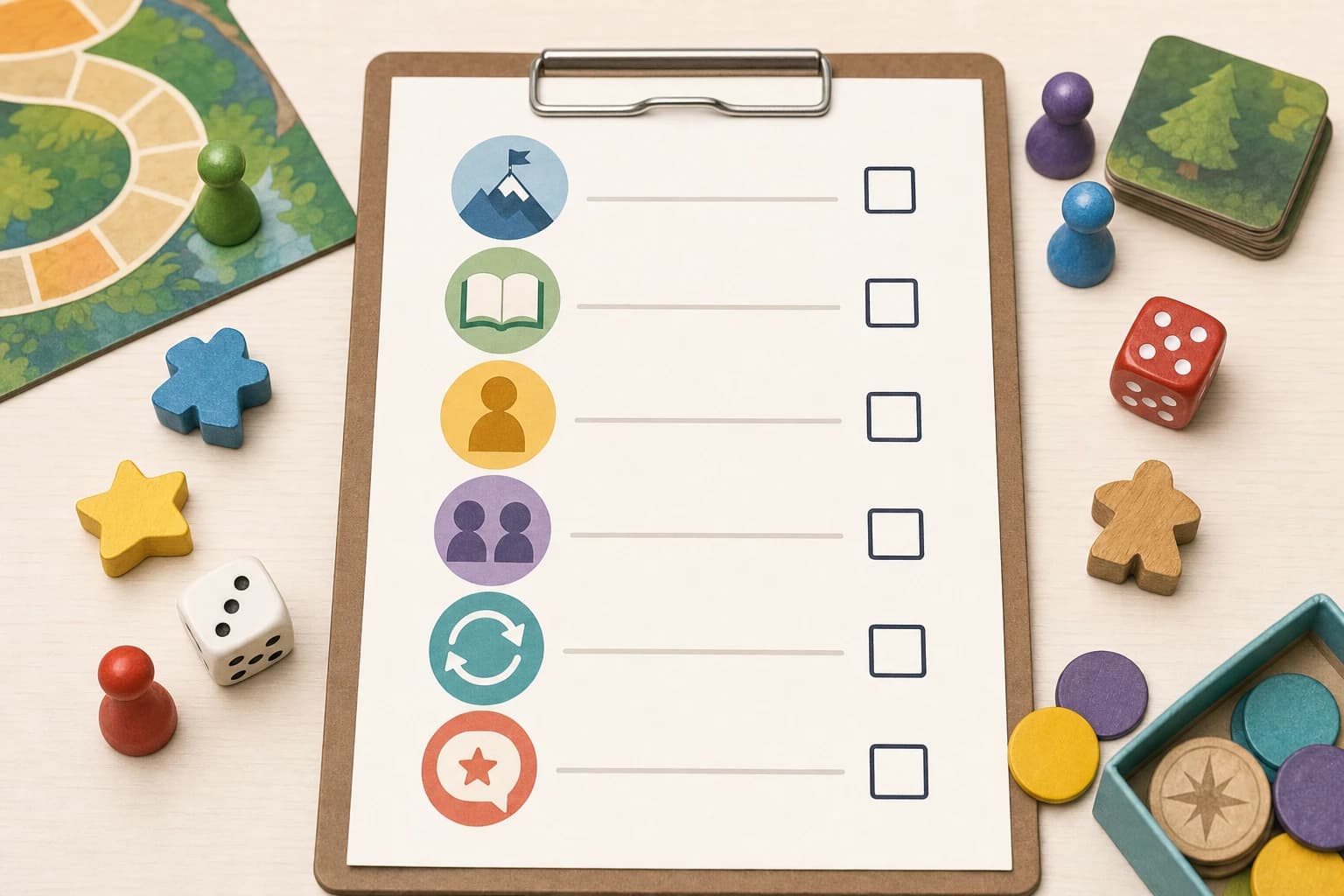
Parent Game Fit Checklist: Score a Game in 6 Minutes
Use this PLAYATME checklist before buying a boxed game, printing an activity, or downloading an app. Score each category from 0 to 2 points. The maximum score is 12.
| Category | 0 Points | 1 Point | 2 Points |
|---|---|---|---|
| Reading load | Too much text for the child to use independently | Some adult reading needed | Short text, icons, pictures, audio, or easy read-aloud support |
| Challenge level | Far too easy or far too hard | Mostly right, but needs adult adjustment | Comfortable challenge with levels, hints, or optional harder rules |
| Independence | Adult must manage nearly every turn | Child can play with reminders | Child can set up or replay with minimal help after 1 practice round |
| Replay value | Same questions or path every time | Some variety | Random cards, multiple strategies, open-ended building, or new combinations |
| Feedback quality | Only wrong/right, punishment, or confusion | Some hints or correction | Clear feedback that helps the child try again or improve a strategy |
| Social pressure | Speed, elimination, public ranking, or winner-takes-all scoring | Competitive but everyone keeps playing | Cooperative, personal-best, team-based, or low-pressure turn-taking |
How to read the score
- 10 to 12 points: strong fit; worth trying if the topic interests your child.
- 7 to 9 points: usable with one planned adaptation, such as removing a timer or reading cards aloud.
- 4 to 6 points: only choose if you have a specific reason and can provide adult support.
- 0 to 3 points: likely mismatch for everyday use.
Mistake 4: Ignoring Independence
Shared play with adults is valuable. However, if a game requires constant adult reading, setup, scoring, correction, and refereeing, it may not work for everyday practice.
For ages 6 to 8, independence does not mean “no adult ever.” It means the child can eventually understand the goal, make choices, recover from small mistakes, and help reset the game.
Features that support independent play
- Visual reminder cards with 3 or fewer steps.
- Color-coded pieces and consistent symbols.
- Self-checking answers, such as puzzle-fit pieces, matching backs, or immediate digital feedback.
- Setup with fewer than 25 loose pieces for many 6-year-olds, or clearly divided trays and bags for larger games.
- Rules an adult can explain in under 5 minutes.
Independent games are useful for quiet time, travel, early finishers, and siblings with different schedules. For low-prep school or home options, see PLAYATME’s quiet classroom games for early finishers in kindergarten to 2nd grade.
Mistake 5: Overvaluing Competition
Competition can be exciting, but many educational games for ages 6 to 8 overuse speed, ranking, and elimination. Fast-answer games often reward the child who already knows the material, while the child who needs a few extra seconds gets less useful practice.
This matters because a spelling race, math-fact duel, or timed reading challenge can make a child conclude “I am bad at this” when the real issue is pressure, processing speed, or reading stamina.
Better competitive and cooperative formats
- Personal-best scoring: the child tries to beat their own previous score by 1 to 3 points.
- Team challenge: players solve a puzzle together before a story event or gentle timer.
- Shared goal: everyone collects clues, builds a path, or rescues characters together.
- No elimination: wrong answers lead to a hint, a retry, or a different role.
For group play ideas with the same low-pressure principle, see cooperative playground games that do not eliminate players.
Mistake 6: Letting Rewards Replace Learning
Digital games often include coins, badges, streaks, animations, and unlocks. These are not automatically bad, but they should support the learning loop rather than replace it.
After a round, listen to what your child talks about. “I found a new strategy,” “I remembered the vowel sound,” or “I changed my plan” suggests learning. “I got 200 coins” or “I need one more prize” may mean the reward system is doing most of the motivating.
The American Academy of Pediatrics encourages families to make intentional media choices through a family media plan. For digital educational games, that means checking for age fit, ad pressure, purchase prompts, endless play loops, and whether the activity still invites thinking after the novelty wears off.
Concrete Game-Fit Scenarios for 6-, 7-, and 8-Year-Olds
Use these examples as patterns, not product recommendations. They describe game types and features to look for.
| Child Scenario | Choose This Type of Game | Avoid This Mismatch |
|---|---|---|
| 6-year-old decoding CVC words like cat, map, and hop | A short phonics path game where reading a 3-letter word lets the child move, collect a picture card, or match a rhyming word | Long sentence cards, silent reading races, or games requiring paragraph comprehension |
| 6-year-old knows numbers to 20 but guesses at addition | A make-10 or number-bond game using 10 counters, 2 dice, or cards numbered 0 to 10 | Timed math-fact apps focused only on speed and streaks |
| 7-year-old reads simple books but avoids writing | A storytelling card game where the child tells 3-sentence stories aloud before writing only 1 favorite sentence | A game that requires copying full paragraphs or spelling every word correctly to score |
| 7-year-old likes movement and struggles to sit for worksheets | A room-sized scavenger game with 12 clue cards, each requiring a count, rhyme, shape, or vocabulary match | A 30-minute seated quiz game with no physical choices |
| 8-year-old loves strategy but avoids writing | A map, maze, coding-logic, or resource-planning game where the child must explain 1 move aloud before taking it | A writing-heavy workbook game disguised with badges |
| 8-year-old knows math facts but makes careless mistakes | A turn-based logic or shopping-budget game where checking work earns an advantage, such as an extra clue or reroll | Pure speed drills that reward finishing before checking |
| Siblings ages 6 and 8 playing together | A cooperative game with roles: the younger child matches or counts, while the older child reads clues or plans the route | Winner-takes-all games where the older child dominates every round |
| Child gets upset when losing | A personal-best or team game with a 10-minute round and a shared target, such as collecting 8 clues together | Elimination, public ranking, or games where one early mistake ruins the whole round |
A Practical Comparison Table for Parents
Use this table when comparing learning games for home, classroom centers, after-school practice, or family game night.
| What to Check | Weak Choice | Better Choice | Quick Parent Test |
|---|---|---|---|
| Learning design | Mostly quiz questions with points | Learning built into choices, sorting, building, explaining, or strategy | Ask: “What does my child do besides answer?” |
| Challenge level | Too easy after one play or too hard to start | Adjustable levels, hints, or optional advanced rules | Try one sample round and watch for thinking, not panic |
| Reading load | Long cards and text-heavy instructions | Short phrases, icons, picture support, or read-aloud options | Can the child take 1 turn without adult reading? |
| Independence | Adult must correct every answer | Self-checking pieces, clear feedback, simple setup | Can the child reset and try again? |
| Social experience | Elimination, public ranking, or speed pressure | Cooperative goals, turn-taking, or personal-best scoring | Does the slowest player still get meaningful turns? |
| Replay value | Same questions in the same order | Randomized cards, open-ended building, multiple strategies | Will it still be interesting after 5 sessions? |
Step-by-Step: How to Choose an Educational Game in 15 Minutes
You do not need a complicated evaluation system. Use this quick process in a store aisle, library, classroom supply room, or app listing.
Tools and materials
- Time: 15 minutes.
- Difficulty: easy.
- Budget: $0 to $25 for many printable, card, dice, and simple board-game options; larger boxed games may cost more.
- Materials: the game box, rule page, sample cards, screenshots, demo video, or app description.
- Optional: 1 sticky note or phone note for the 12-point checklist score.
Simple selection steps
- Name 1 main skill. Pick one target, such as CVC decoding, digraphs, number bonds to 10, doubles facts, coin values, memory, following directions, cooperation, or planning. Be cautious of games that promise to teach everything.
- Check the reading demand. If reading is not the target skill, the child should not need to decode long cards every turn. For many 6-year-olds, look for icons, pictures, audio, or adult read-aloud options.
- Look for decisions. A strong game asks the child to choose, compare, predict, sort, build, explain, or plan. If every move is “answer the next question,” keep looking or plan an adaptation.
- Estimate round length. Aim for 10 to 20 minutes for regular practice. Save 30-minute games for weekends or family game night.
- Check mistake recovery. Better games offer hints, retries, models, or natural consequences. Avoid games where one mistake causes shame, elimination, or a long wait.
- Score it with the checklist. Use the 12-point system above. A score of 10 or higher is a strong sign; 7 to 9 can work with support.
- Plan 1 adaptation before play. Remove the timer, reduce the deck to 20 cards, use smaller numbers, play in teams, or let the child explain answers aloud before scoring.
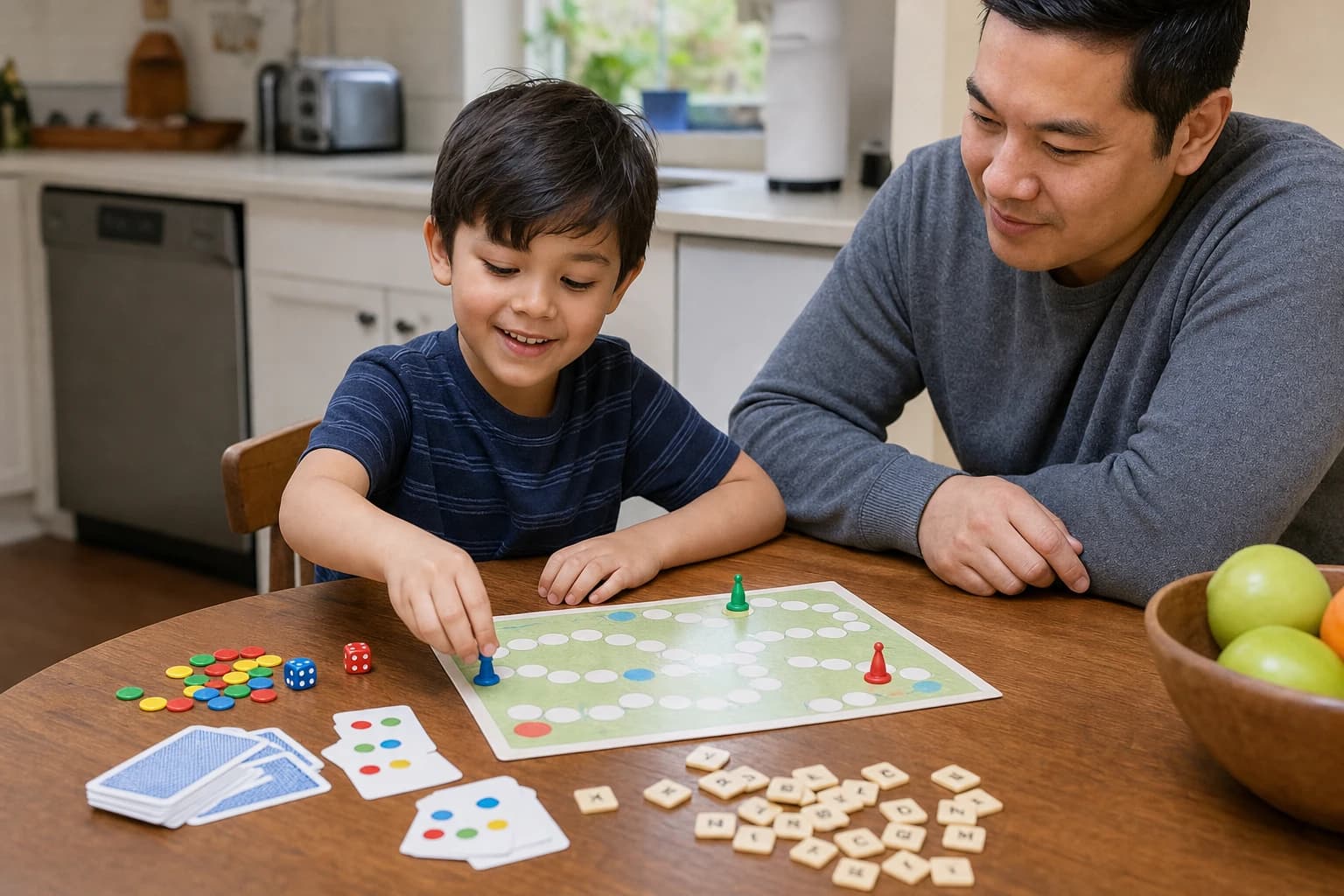
Useful Adaptations for Ages 6, 7, and 8
One game can often work across several ages if you adjust the rules. This is especially useful for siblings, tutoring, homeschool rotations, and mixed-ability classroom groups.
For many 6-year-olds
- Use 10 to 20 cards instead of the full deck for the first round.
- Read instructions aloud once, then use picture reminders.
- Play cooperatively before keeping score.
- Choose games with counting, matching, rhyming, memory, shapes, CVC words, and 1-step directions.
- Stop after 10 minutes if attention drops; a short successful round is better than a long forced one.
For many 7-year-olds
- Add simple strategy by asking, “What is your plan for the next turn?”
- Use slightly longer word lists, digraphs, blends, number combinations to 20, or skip-counting by 2s, 5s, and 10s.
- Encourage explanations: “How did you know?” or “What clue helped?”
- Try games that combine two skills, such as reading clues to solve a math puzzle.
For many 8-year-olds
- Add optional challenges, such as a 2-step rule, a larger target number, or a planning limit of 3 moves.
- Let the child teach the rules to someone else after 2 practice rounds.
- Introduce probability, map reading, coding logic, prefixes, suffixes, arrays, budgeting, or word strategy.
- Use personal-best scoring rather than only adult-versus-child competition.
If you are choosing games for classroom transitions or small spaces, you may also like no-equipment classroom games for elementary students and indoor PE games for elementary students in small spaces.
Red Flags That a Game May Not Be Worth It
- It promises major academic improvement without explaining what children actually practice.
- It relies on constant rewards, streaks, or prizes but uses shallow tasks.
- It has no way to adjust difficulty.
- It requires an adult to manage every turn even after 3 plays.
- It makes slower readers, quieter children, or children with weaker fine-motor speed feel publicly behind.
- It is labeled educational but mostly practices tapping, guessing, or memorizing isolated facts.
- It uses confusing purchase prompts, excessive ads, or pressure to keep playing after the learning task is finished.
What Better Game Features Look Like
When in doubt, choose games with clear rules, short rounds, visible progress, and room for conversation. A strong educational game often makes a child say, “I chose this because,” “What if I try,” “I noticed a pattern,” or “I made a mistake, so now I’ll change my plan.” Those sentences show thinking.
For this age group, many of the best games combine 1 academic skill with 1 play skill. Examples include a spelling game that uses memory, a math game that uses movement, a science game that uses sorting, or a reading game that uses deduction. The combination helps the activity feel like real play rather than disguised homework.
FAQ: Choosing Educational Games for 6 to 8 Year Olds
How many educational games does my child need?
Start with 3 to 5 well-chosen games that cover different needs, such as reading, math, memory, logic, and cooperation. A small set that gets replayed is usually more useful than a shelf full of games your child avoids.
Are digital educational games bad for 6-, 7-, and 8-year-olds?
Not automatically. Digital games can be useful when they are age-appropriate, interactive, and focused on meaningful decisions. Be more cautious with apps that depend on ads, confusing purchases, constant rewards, or endless play loops. The AAP family media plan can help families set boundaries around when and how screens are used.
Should I choose games based on grade level or age?
Use age and grade as rough starting points, then check the actual skills required. Reading load, attention span, frustration tolerance, independence, and interest often matter more than the number printed on the box.
What if my child only wants silly games?
Silly games can still support learning. Look for humor combined with memory, vocabulary, counting, storytelling, flexible thinking, or turn-taking. Enjoyment is not the enemy of learning; it often helps children stay engaged long enough to practice.
How do I know if a game is too hard?
If your child cannot explain the goal, needs help on every move, avoids taking turns, or becomes upset before the game really begins, simplify it. Remove a rule, play cooperatively, shorten the round to 10 minutes, or save the game for later.
What is the best first educational game type for a 6-year-old?
A good first choice is usually a short matching, counting, rhyming, memory, or cooperative path game with picture support and very little reading. Aim for rules you can explain in under 5 minutes and rounds that end in 10 to 15 minutes.
Conclusion: Choose Play That Makes Children Think
Choosing educational games for 6 to 8 year olds is less about finding the most academic-looking product and more about finding the right kind of challenge. Avoid games that are too quiz-like, too easy, too difficult, overly competitive, or impossible to play without constant adult help.
A better game gives children real choices, supports mistakes, fits their current skills, and can grow with them. If your child is thinking, talking, trying again, and asking for another round, the game is probably doing something right.