Elimination games can be exciting for the last few players, but they often leave the fastest, loudest, or most confident children playing while everyone else waits. If you need cooperative playground games for kids that keep the whole group involved, the goal is simple: change the win condition. Instead of last player standing, children work toward a shared target, rejoin quickly, or help the group beat a challenge.
This guide gives you 15 practical no elimination playground games for recess, camps, PE warm-ups, and after-school programs. Each one includes a clear setup, simple rules, and a cooperation-focused modification so students practice communication, fairness, and teamwork without long lines or sit-out time.
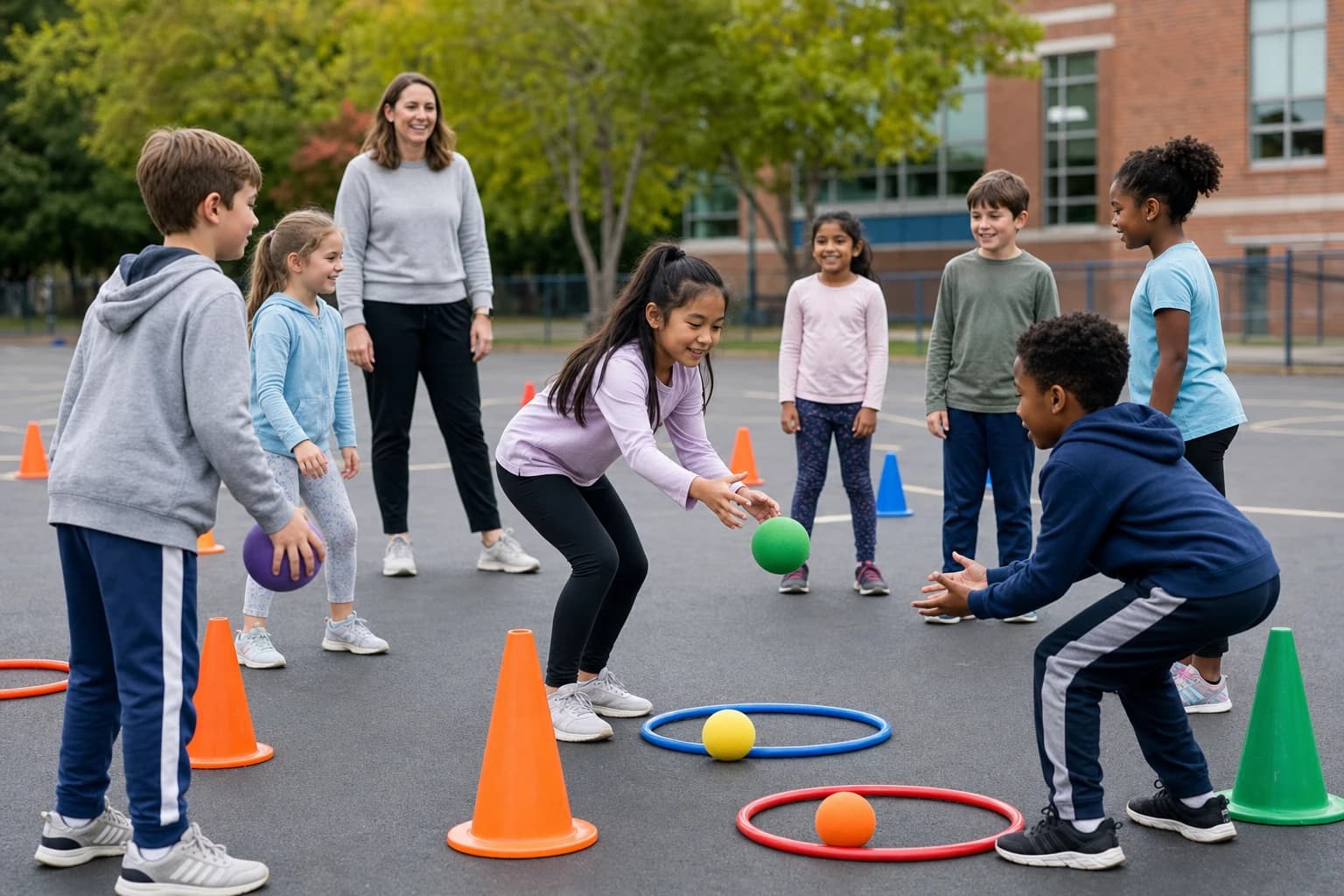
Quick setup guide for inclusive recess games
Most teamwork games for elementary students work better when adults set up the space before explaining the rules. The directions can be short, but the boundaries and equipment should be clear enough that children can start in under two minutes.
Simple materials to keep on hand
- 12 to 20 cones for boundaries, goals, or stations
- 4 to 8 soft foam balls or playground balls
- 6 to 12 hoops, poly spots, or chalk circles
- Beanbags, scarves, or tennis balls for passing challenges
- A stopwatch or phone timer for timed rounds
- Optional: pinnies or colored wristbands for quick teams
How to introduce a no-elimination game
- Name the shared goal first. Say exactly what the group is trying to do, such as move 20 beanbags, make 30 safe passes, or clear the yard before the timer ends.
- Define the play area. Use cones or chalk lines. For 20 to 30 elementary students, a space about the size of half a basketball court often works for running games; smaller games can use a blacktop corner.
- Use short rounds. Start with 3 to 5 minutes. Short rounds let you reset teams, adjust difficulty, and prevent one game from dragging.
- Build in a re-entry rule. If a player is tagged, drops an object, or makes a mistake, they complete a quick helper action and return immediately.
- Debrief in one question. Ask, Which strategy helped the group? This keeps the focus on teamwork rather than blame.
Outdoor play supports children’s daily movement. The CDC physical activity guidelines for children and adolescents recommend that children ages 6 to 17 get 60 minutes or more of moderate-to-vigorous physical activity daily. Recess games are only one part of that, but inclusive rules can help more children stay active during the time they already have.
At-a-glance comparison of the 15 games
| Game | Best group size | Main equipment | Best for |
|---|---|---|---|
| Island Relay | 8 to 30 | Hoops or spots | Planning and turn-taking |
| Everyone’s It With Helpers | 10 to 40 | None | Tag with quick re-entry |
| Team Kickball Challenge | 12 to 30 | Kickball, bases | Classic game modification |
| Parachute Popcorn | 8 to 25 | Parachute or sheet, balls | Younger elementary groups |
| Human Knot Walk | 6 to 12 per group | None | Communication |
| Mission Capture the Cones | 12 to 40 | Cones or flags | Large playground groups |
| Traffic Jam | 8 to 24 | Chalk grid or spots | Problem-solving |
| Ball Pass Countdown | 6 to 30 | Soft balls | Fast cooperative warm-up |
| Cooperative Four Corners | 8 to 35 | Four cones | Choice and movement |
| Dragon Tail Builders | 10 to 30 | Scarves | Tag without sitting out |
| Hoop Pass Circle | 8 to 30 | Hula hoops | Whole-class challenge |
| Builders and Messengers | 8 to 32 | Cones or blocks | Listening and roles |
| Partner Mirror Maze | 6 to 30 | Cones | Body control |
| Scavenger Sprint | 8 to 40 | Cards or objects | Camp and after-school play |
| Clean the Yard Together | 10 to 40 | Soft balls or beanbags | High-energy teamwork |
15 cooperative playground games for kids
Island Relay
Players: 8 to 30. Equipment: hoops, poly spots, or chalk circles.
Place islands from one side of the play area to the other. Teams must move across the ocean by stepping only on islands. The catch: each team has fewer islands than players, so children must pass spots forward, share space safely, and plan the order of movement.
Cooperative rule: The whole team succeeds only when every player reaches the far side. If someone steps off an island, the team does not start over; they freeze, name one new strategy, and continue.
Everyone’s It With Helpers
Players: 10 to 40. Equipment: none.
In a marked area, everyone is a tagger and everyone is avoiding tags. When a player is tagged, they kneel or stand with one hand raised. Two active players can free them by giving a gentle double high-five or counting together to three.
Cooperative rule: The group tries to keep fewer than five players frozen at any time. This turns a familiar tag format into one of the easiest inclusive recess games because children must notice who needs help. For more non-elimination tag ideas, see 10 No-Equipment Tag Games for Elementary School Recess.
Team Kickball Challenge
Players: 12 to 30. Equipment: kickball and bases.
Use a standard kickball field, but remove outs. Each kicking team gets a 5-minute turn or one full trip through the lineup. Fielders earn points by making clean passes, calling names before throwing, and returning the ball to the pitcher safely.
Cooperative rule: The class score is the combined total of runs plus fielding teamwork points. If students already know regular kickball, this is a smooth transition. You can review simple base and kicking rules in Kickball Rules for Kids and then swap outs for teamwork points.
Parachute Popcorn
Players: 8 to 25. Equipment: a parachute or large sheet and 6 to 12 foam balls.
Children hold the edge of the parachute and try to bounce the balls without letting them fall off. Start with three balls, then add more as the group improves. For a calmer version, have students make small waves instead of big snaps.
Cooperative rule: Count how many seconds the group can keep all popcorn pieces on the parachute. If a ball falls, one child retrieves it and the count restarts without anyone leaving the game.
Human Knot Walk
Players: 6 to 12 per group. Equipment: none.
Students stand in a circle, reach across, and hold two different people’s hands. Without letting go, they untangle into a circle or line. On a playground, add a walking challenge: once untangled, the group must move together around a cone and back.
Cooperative rule: The challenge is not speed. Success means the group uses calm voices, checks comfort, and makes space for shorter or younger children.
Mission Capture the Cones
Players: 12 to 40. Equipment: 10 to 20 cones or beanbags.
Split the play area into two sides. Each side has treasure cones at the back. Players try to bring one cone at a time to the center collection zone. If tagged on the other side, a player goes to the helper station instead of jail.
Cooperative rule: At the helper station, the tagged player completes five jumping jacks, gives a teammate strategy advice, or carries a cone back to reset the field. Then they rejoin. The goal is to collect all cones in the center before time ends, not to trap opponents.
Traffic Jam
Players: 8 to 24. Equipment: chalk grid, cones, or spots.
Create two lines of spots facing each other with one empty spot in the middle. Half the group starts on one side and half on the other. Players may move forward into an empty spot or step around one person, but they cannot move backward.
Cooperative rule: The group must switch sides completely. If they get stuck, they can call a planning pause and reset from the last successful move instead of restarting from the beginning.
Ball Pass Countdown
Players: 6 to 30. Equipment: one or more soft balls.
Students stand in a circle. The group tries to pass the ball to every person once as quickly as possible. A player may not pass to the person directly beside them. After one successful round, challenge them to reduce the time by choosing a smarter order.
Cooperative rule: Dropped balls do not cause elimination. The group simply adds one second and keeps going. Add a second ball for older students once they can complete the pattern safely.
Cooperative Four Corners
Players: 8 to 35. Equipment: four cones.
Label four corners as actions, such as skip, balance, crab walk, and side shuffle. Children move to any corner when the leader calls go. Instead of one corner being out, each corner receives a group mission.
Cooperative rule: A corner might need to make a statue with five body levels, count backward from 20, or send two ambassadors to help another corner. Rotate leaders so different children get to call the movement.
Dragon Tail Builders
Players: 10 to 30. Equipment: scarves or pinnies.
Three or four players link up as a dragon by holding shoulders or standing close in a line. The last player wears a scarf tail. Other players try to tag the tail gently. When someone tags a tail, they join that dragon instead of eliminating anyone.
Cooperative rule: The aim is to build the longest safe dragon by moving together without pulling. If a line breaks, it freezes and reconnects before continuing.
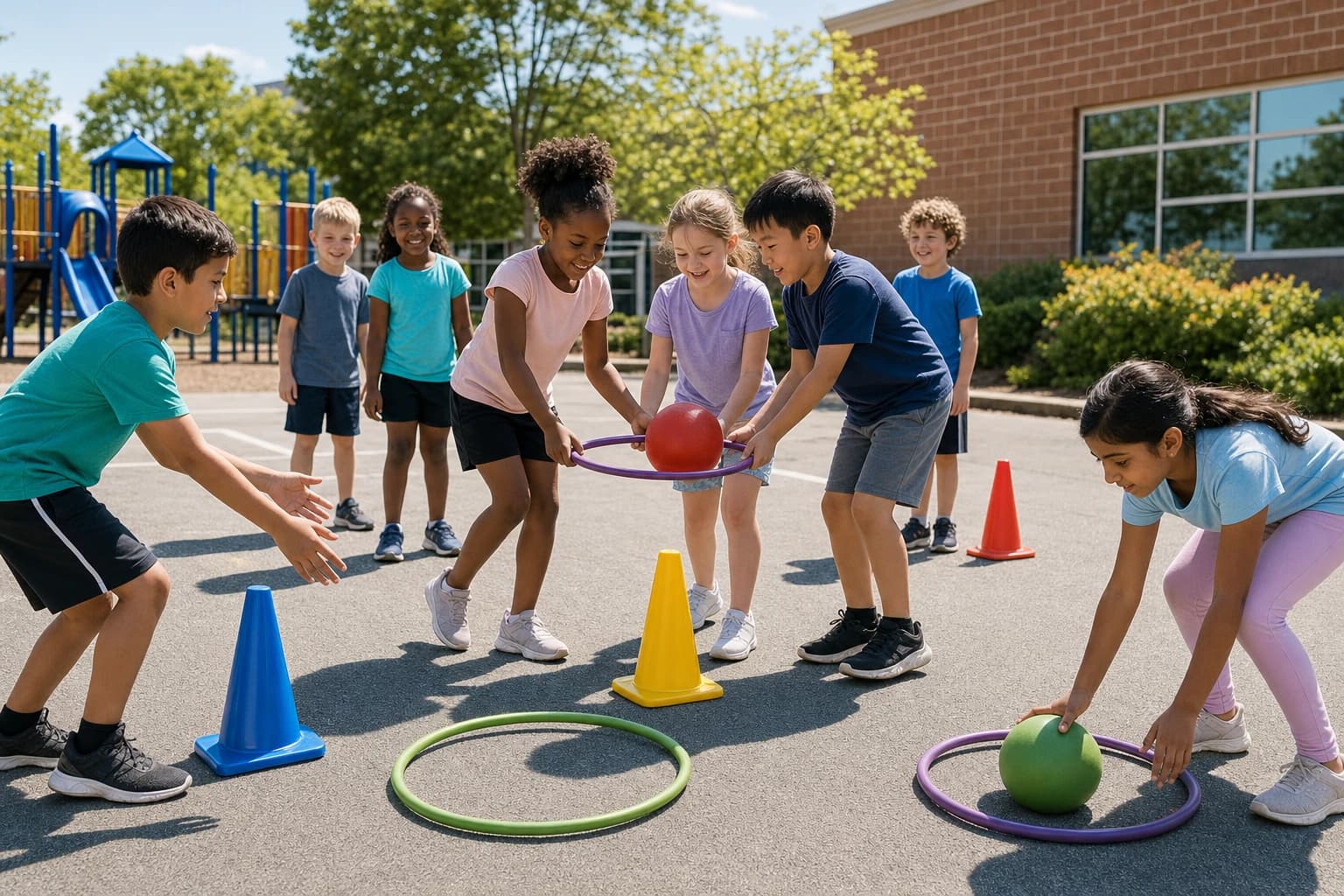
Hoop Pass Circle
Players: 8 to 30. Equipment: one or two hula hoops.
Players hold hands in a circle. Place a hoop over one pair of joined hands. The group must move the hoop around the circle without breaking hands by stepping through and ducking under it.
Cooperative rule: Time the first round, then ask students what would make the next round smoother. Add a second hoop going the opposite direction for a harder teamwork challenge.
Builders and Messengers
Players: 8 to 32. Equipment: cones, blocks, cups, or beanbags.
Create a small model structure behind a screen, bench, or turned-over bin. One messenger from each team looks at the model, returns to the builders, and describes it without touching the pieces. Builders recreate the structure.
Cooperative rule: Rotate roles every two minutes so quiet students, strong visual thinkers, and natural speakers all get a useful job. The class can compare structures at the end and name what instructions were clearest.
Partner Mirror Maze
Players: 6 to 30. Equipment: cones for a simple maze.
Set cones in a zigzag path. Partners face each other. One child leads with slow movements while the other mirrors them through the maze. Halfway through, switch leaders.
Cooperative rule: The score is based on smooth teamwork: matching speed, avoiding collisions, and encouraging a partner. This is a strong option when you want movement without a full-speed running game.
Scavenger Sprint
Players: 8 to 40. Equipment: picture cards, color cards, or safe objects.
Place cards or objects around a marked area. Call a group prompt such as find something blue, collect three triangle cards, or bring back one item that starts with B. Teams send one or two runners at a time, then switch.
Cooperative rule: Teams combine their finds into one class collection. For backyard or camp versions with more clues, adapt ideas from How to Set Up a Backyard Scavenger Hunt for Kids Ages 5–10.
Clean the Yard Together
Players: 10 to 40. Equipment: 20 to 40 soft balls, beanbags, or crumpled paper balls.
Scatter objects across two or more zones. On go, children move objects into a shared target area, such as a bucket line or center circle. Use walking, skipping, or crab-walking rules to match the group’s energy level.
Cooperative rule: Everyone is on the same team trying to clear the whole yard before the timer ends. Add sorting rules for older children, such as balls in one bucket and beanbags in another.
Bridge Builders
Players: 8 to 28. Equipment: cones, ropes, chalk lines, or hoops.
Mark two riverbanks about 20 feet apart. Give each team a limited set of bridge pieces, such as three hoops and two cones. Players must move the whole team across while always touching a bridge piece.
Cooperative rule: If a bridge piece is left untouched, it floats away and must be rescued by the whole team taking three steps back. This encourages planning without removing players.
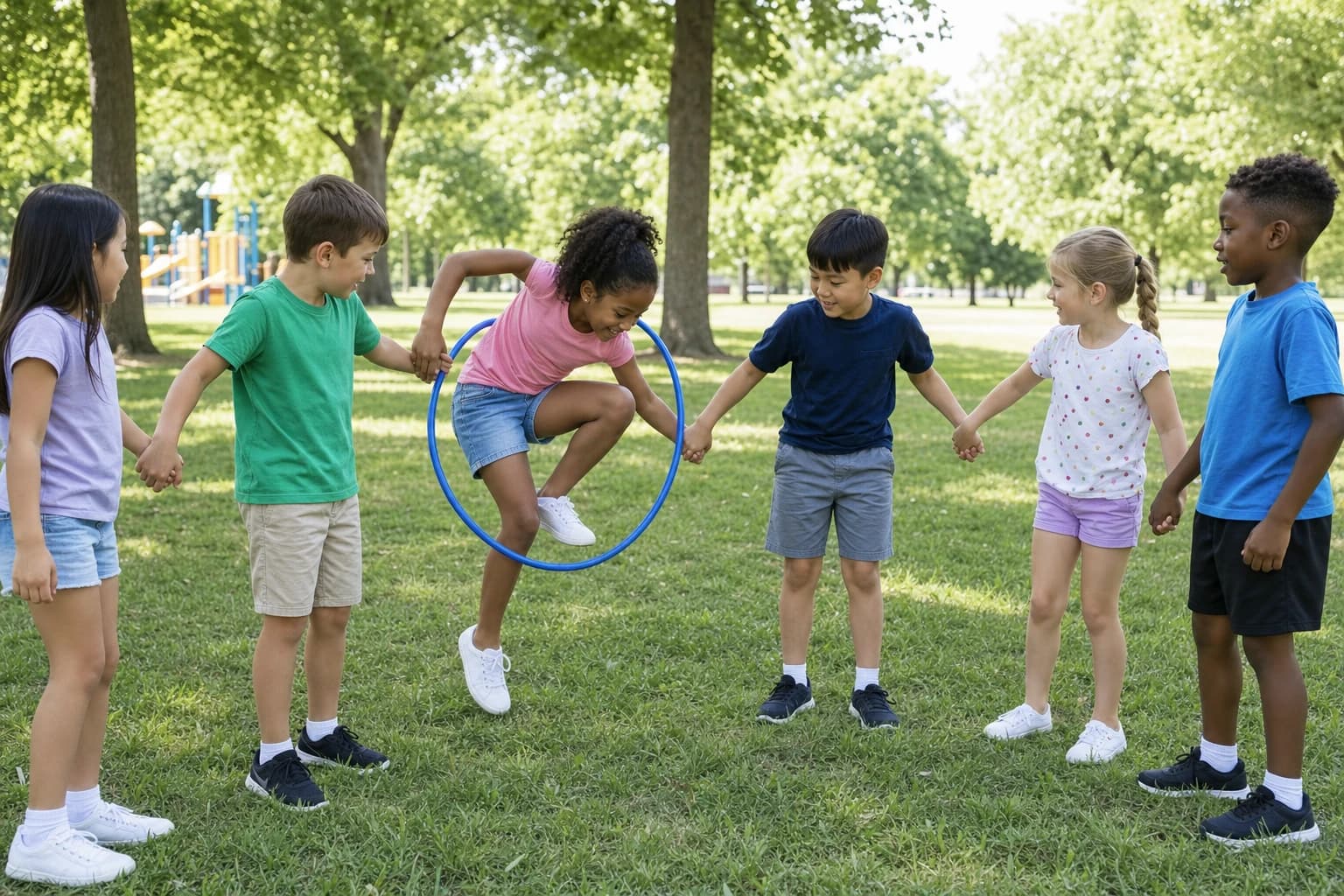
How to modify classic games so nobody sits out
You do not need to abandon every traditional playground game. Many classics become no elimination playground games with one or two rule changes.
- Replace outs with jobs. A tagged player becomes a helper, scorekeeper, coach, retriever, or gatekeeper for 30 seconds, then returns.
- Use class goals instead of winners. Try total passes, total laps, total successful rescues, or a beat-your-own-time challenge.
- Shorten waiting lines. In any relay, send pairs or trios instead of one player at a time. If a line has more than five children, split it.
- Let mistakes create strategy pauses. A dropped ball or missed pass can mean the team gets one quick huddle, not a penalty.
- Rotate roles on a timer. Every 2 to 4 minutes, switch runners, builders, callers, and defenders so the same children are not always leading.
If you are planning for a very large event rather than a recess period, you may also like Large Group Party Games for 20 to 50 People That Keep Everyone Playing.
Common mistakes to avoid
- Calling a game cooperative but scoring it like a tournament. If the only celebrated result is which team wins, students will naturally focus on beating others. Include points for assists, clear communication, and safe play.
- Making re-entry embarrassing. Avoid punishments such as public push-ups or silly tasks that single out one child. Re-entry should be quick, neutral, and useful.
- Using one difficulty level for everyone. Offer choices. A child might walk instead of run, use a larger ball, or partner with a buddy while still contributing.
- Explaining for too long. Give the goal, boundaries, safety rule, and re-entry rule. Then start. You can refine after the first short round.
- Ignoring space and surface. Fast tag games need open space and clear boundaries. Save tight blacktop areas for passing, circles, builders, and scavenger tasks.
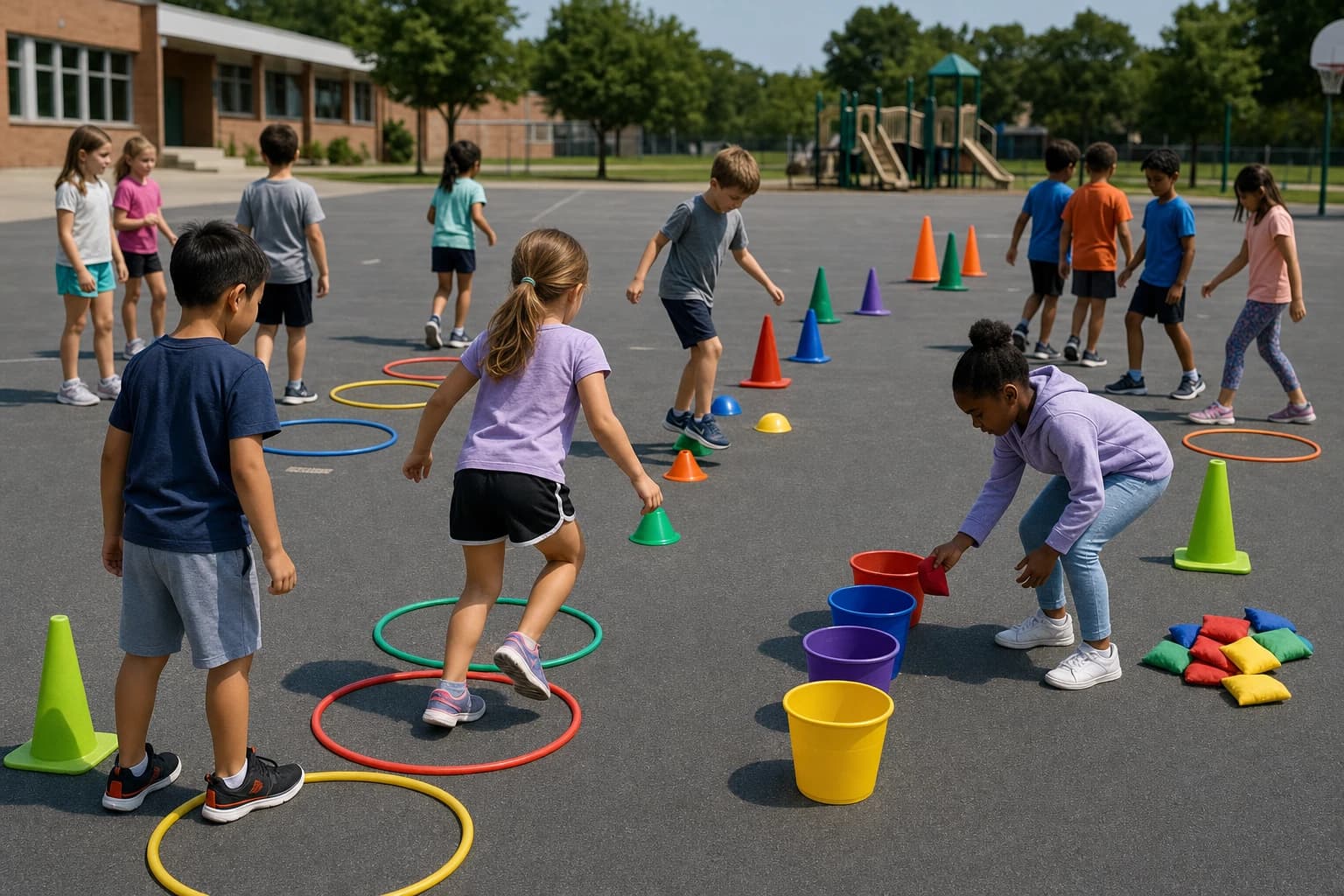
Tips for different ages and group sizes
For kindergarten to grade 2
Use fewer rules, visible equipment, and short rounds. Games like Parachute Popcorn, Clean the Yard Together, and Cooperative Four Corners work well because children can understand the goal quickly. Keep teams small enough that each child gets frequent turns.
For grades 3 to 5
Add planning choices. Older elementary students usually enjoy improving a score, solving Traffic Jam, designing a Ball Pass Countdown order, or modifying kickball. Give them one constraint, such as every teammate must touch the ball before a score counts.
For playground games for large groups
Use stations. Put 8 to 12 children at each station and rotate every 5 minutes. For example, one station can play Hoop Pass Circle, another can do Scavenger Sprint, and another can try Partner Mirror Maze. Stations reduce crowding and make adult supervision easier.
FAQ
What makes a playground game cooperative?
A cooperative playground game gives children a shared goal and keeps players involved after mistakes. Instead of eliminating students, the rules reward helping, communicating, rescuing, passing, or solving a challenge together.
How do you handle a child who keeps dominating the game?
Use role limits and team goals. For example, require three different players to touch the ball before a point counts, rotate leaders every round, or give the confident player a helper role such as encouraging quieter teammates.
Can competitive games still be inclusive?
Yes, if competition is balanced with participation. Short rounds, mixed teams, re-entry rules, and points for teamwork can keep a competitive format from turning into a sit-out game for less experienced players.
What are the best cooperative games with no equipment?
Everyone’s It With Helpers, Human Knot Walk, Traffic Jam, and Partner Mirror Maze can all be played with little or no equipment. Cones or chalk help with boundaries, but the core rules do not require special supplies.
How long should each recess game last?
For elementary groups, 3 to 8 minutes per round is usually enough. Short rounds keep energy high and give you natural moments to switch roles, adjust rules, or let students suggest a better strategy.
Conclusion
The best cooperative playground games for kids do more than prevent hurt feelings. They keep more children moving, give different personalities a way to contribute, and make classic recess formats easier to manage. Start with one familiar game, remove the sit-out rule, and add a shared challenge. Once students understand that helping is part of the game, inclusive play becomes much easier to repeat.