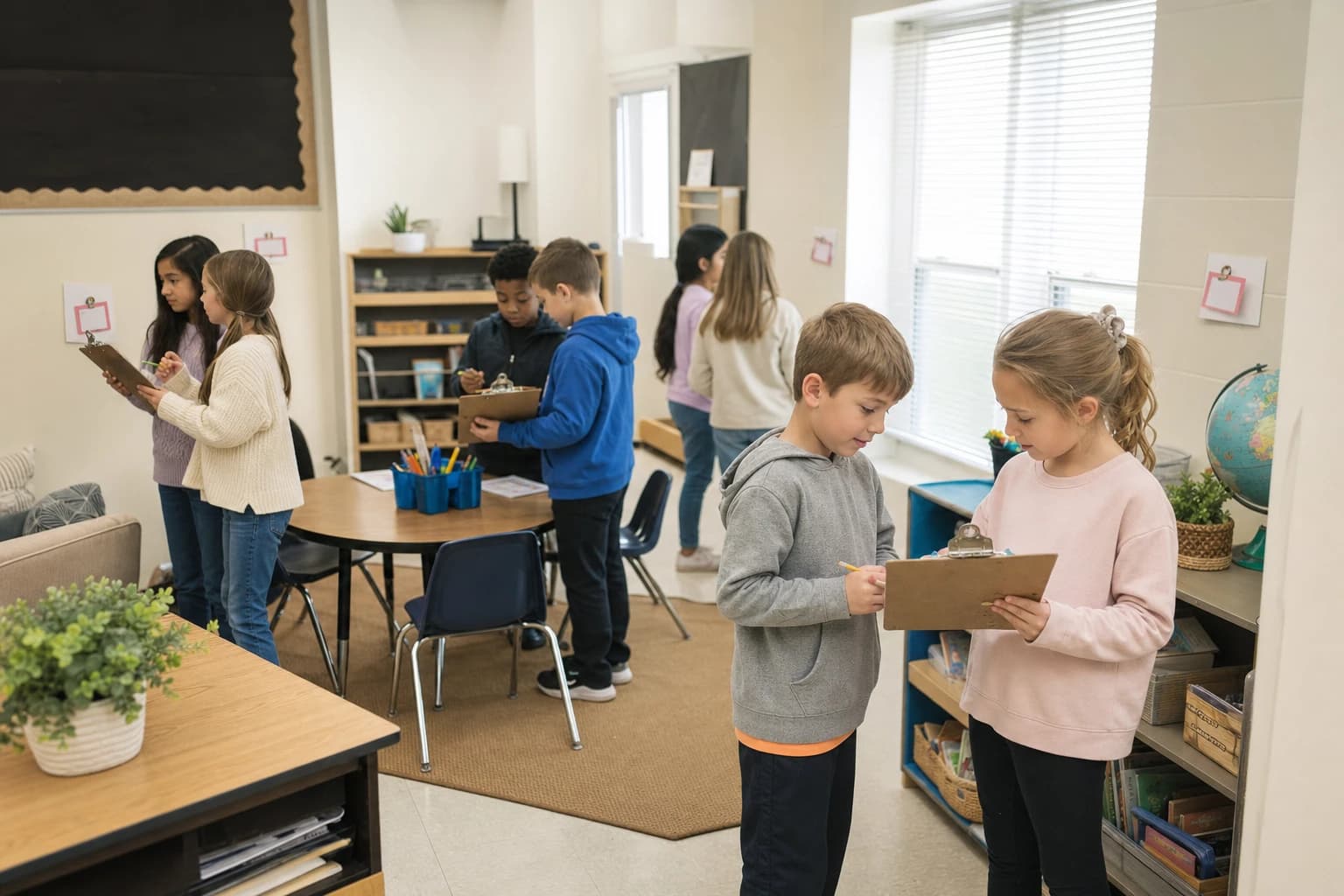

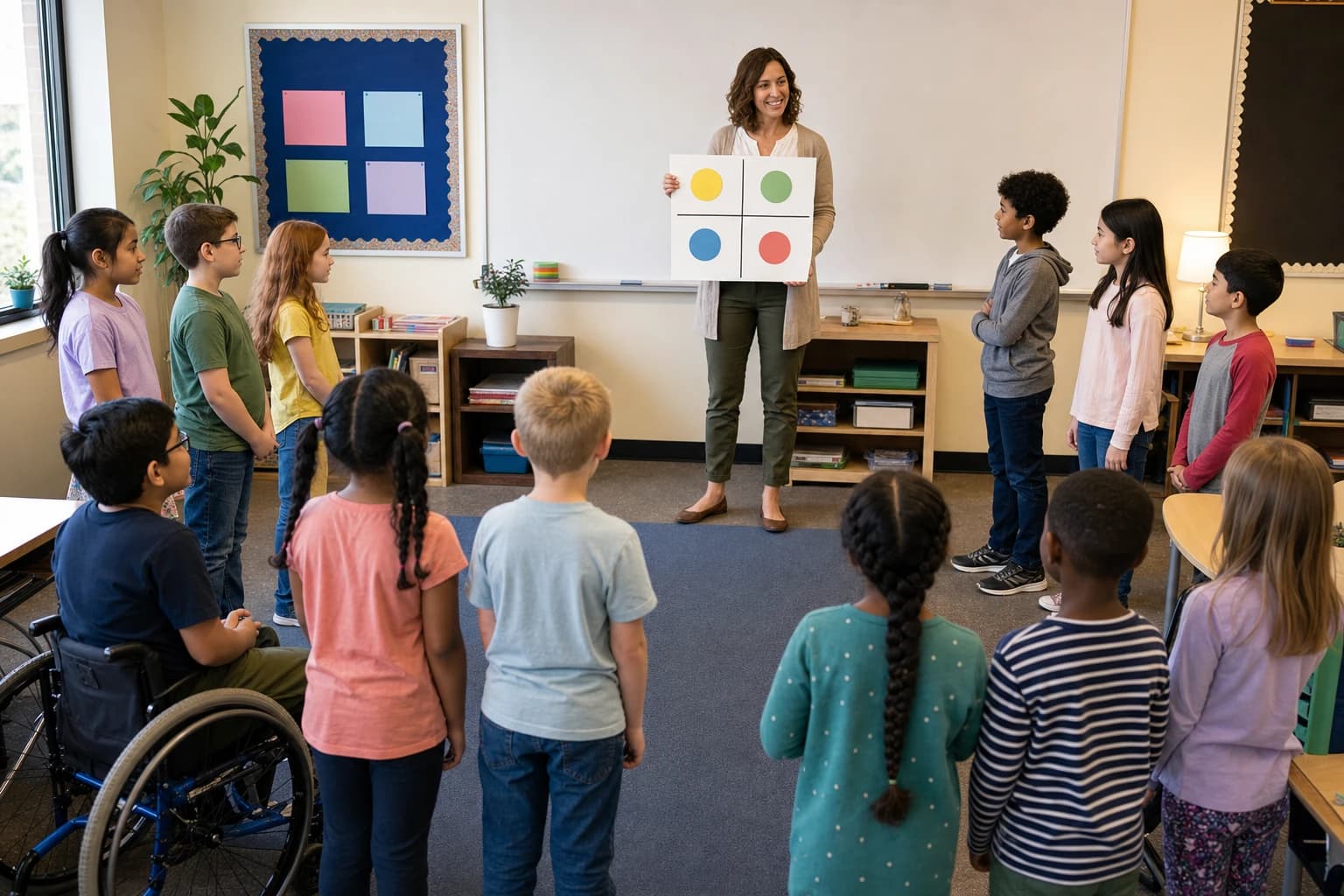
Four Corners is one of the easiest classroom games to start when students need movement but you do not have a gym, equipment, or much prep time. The basic idea is simple: label the four corners of the room, students choose a corner, and one person in the middle tries to guess where students are standing.
This guide explains how to play Four Corners in the classroom, including the classic rules, safer movement routines, inclusive non-elimination versions, academic review ideas, and teacher management tips for noise, fairness, and mixed-age groups.
Quick Answer: How Four Corners Works
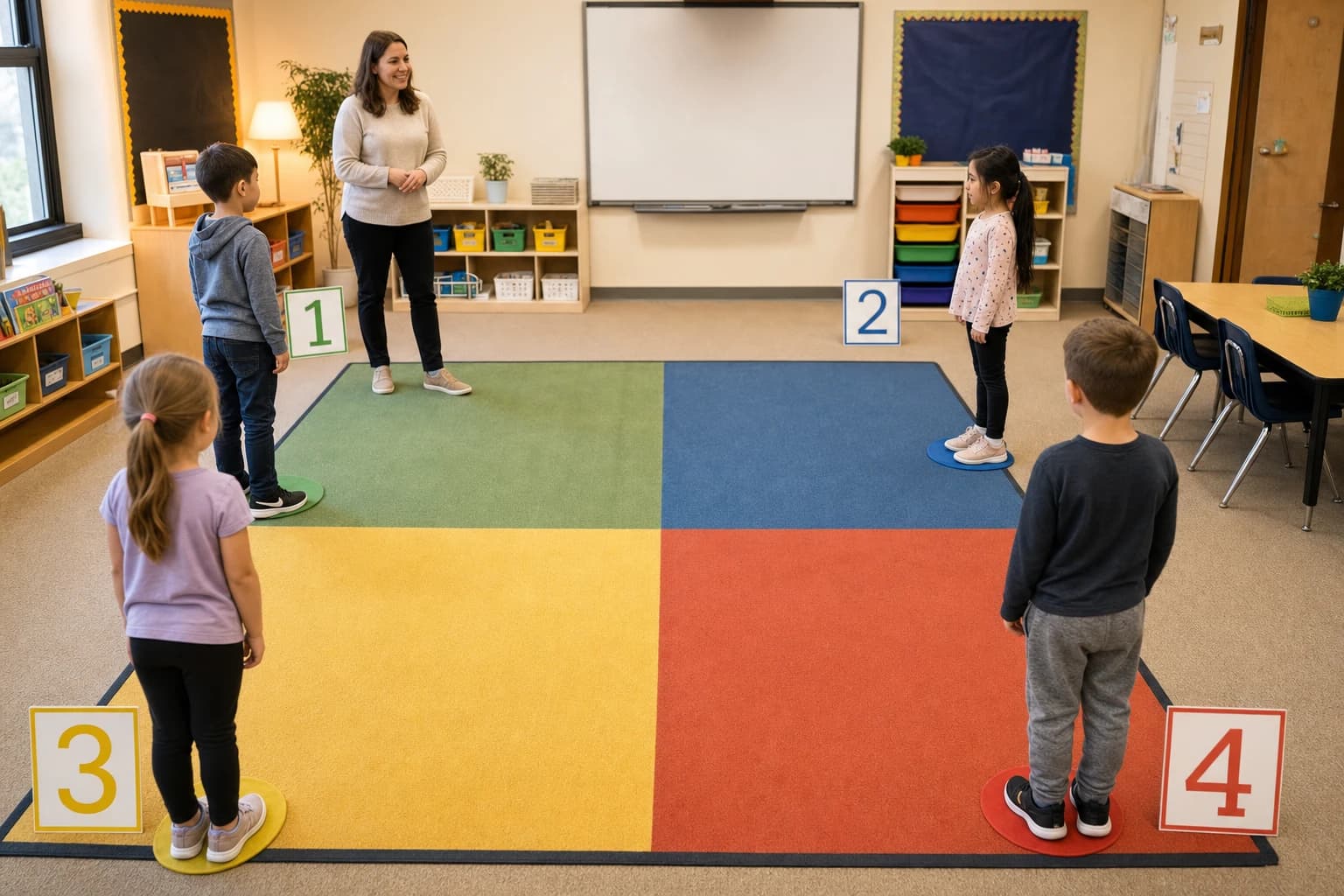
In the classic classroom version, each corner of the room is numbered 1 to 4. One student, often called the caller, stands in the middle with eyes closed or facing away. The rest of the class quietly walks to one of the four corners. Without looking, the caller names a corner number. Anyone in that corner is out for the round, and play continues until one student remains.
That is the traditional version, but it is not the only way to play. Many classrooms work better with a non-elimination format where students keep moving, earn points, answer questions, or switch roles instead of sitting out. This is especially helpful for younger students, large groups, indoor recess, and classes where exclusion can create behavior problems.
For another no-equipment indoor option, see Indoor Games for 8-Year-Olds With No Equipment. If you want more curriculum-friendly ideas, Educational Indoor Classroom Games for Grades 3–5 pairs well with the academic variations below.
Materials, Space, and Setup
Four Corners is popular because it needs almost nothing. A good setup, however, prevents confusion and helps the game feel calm instead of chaotic.
- Players: 6 to 30 students works well in one classroom. For more than 30, use teams or a non-elimination format.
- Time: 5 to 15 minutes, depending on whether you play one quick round or several short rounds.
- Difficulty: Easy for grades K–5, with simple rule adjustments for older students.
- Equipment: Four paper signs, sticky notes, or projected labels reading 1, 2, 3, and 4.
- Optional materials: Timer, question cards, whiteboard, music, cones, or tape for marking safe standing areas.
- Space needed: Four reachable corners or zones with a clear walking path between desks.
Safety First: Classroom Movement Rules
Four Corners should be a walking game indoors. Before starting, move backpacks, loose chairs, cords, and pencil boxes away from travel paths. The Centers for Disease Control and Prevention notes that classroom physical activity can be incorporated into the school day, but it should be planned and supervised appropriately: CDC classroom physical activity guidance.
Use a simple movement rule such as, Walk with quiet feet, keep hands to yourself, and stop when the countdown ends. If the room is crowded, create corner zones instead of using the exact physical corners so students are not pressed against shelves, doors, or teacher desks.
Classic Four Corners Game Rules
The classic rules are easy to teach in under two minutes. Use them the first time so students understand the structure, then switch to variations if needed.
- Label the corners. Put a visible number in each corner: 1, 2, 3, and 4. Say the numbers out loud while pointing to each location.
- Choose the caller. Pick one student to stand in the center, sit at the teacher desk, or face the board. The caller should not be able to see where classmates go.
- Start the movement countdown. Say, Walk to a corner in 10 seconds: 10, 9, 8... Students choose any corner. No running, pushing, or changing after zero.
- Caller names one corner. The caller says a number from 1 to 4 without looking. For example, Corner 3.
- Resolve the result. In the traditional game, students in that corner are out for the rest of the round and sit in a designated area.
- Repeat. The remaining students move again. Continue until one student remains, or stop after a set number of turns.
- Rotate roles. The winner, a volunteer, or the next student on a class list becomes the new caller.
A typical round takes 3 to 6 minutes. If you have only a short transition time, set a timer for 4 minutes and name the winner as whoever is still in at the end.
Inclusive Non-Elimination Ways to Play
Elimination can be fun for some groups, but it often creates the same classroom problem: students who are out still need something to do. Non-elimination Four Corners keeps everyone participating and reduces the chance that early-out students become loud, embarrassed, or disengaged.
| Version | How it works | Best for |
|---|---|---|
| Point Builder | If the caller names your corner, you earn 1 point and stay in. After 5 rounds, students total their points. | Indoor recess and mixed-ability groups |
| Switch the Caller | Students in the called corner are not out; one of them becomes the next caller. | Quick games with no scorekeeping |
| Team Corners | Each corner is a team. When a corner is called, that team answers a question or completes a quiet challenge. | Large classes and review games |
| Lucky Corner | The called corner is the safe or winning corner for that round. Students cheer silently or mark a point. | Younger students who dislike being out |
| Comeback Cards | In elimination play, students who are out can rejoin by answering a review question or helping as scorekeepers. | Classes that want the classic format with less waiting |
For most classrooms, Switch the Caller is the smoothest non-elimination option. It keeps the rules recognizable while making sure no student sits out for more than a few seconds.
Subject-Review Four Corners Variations
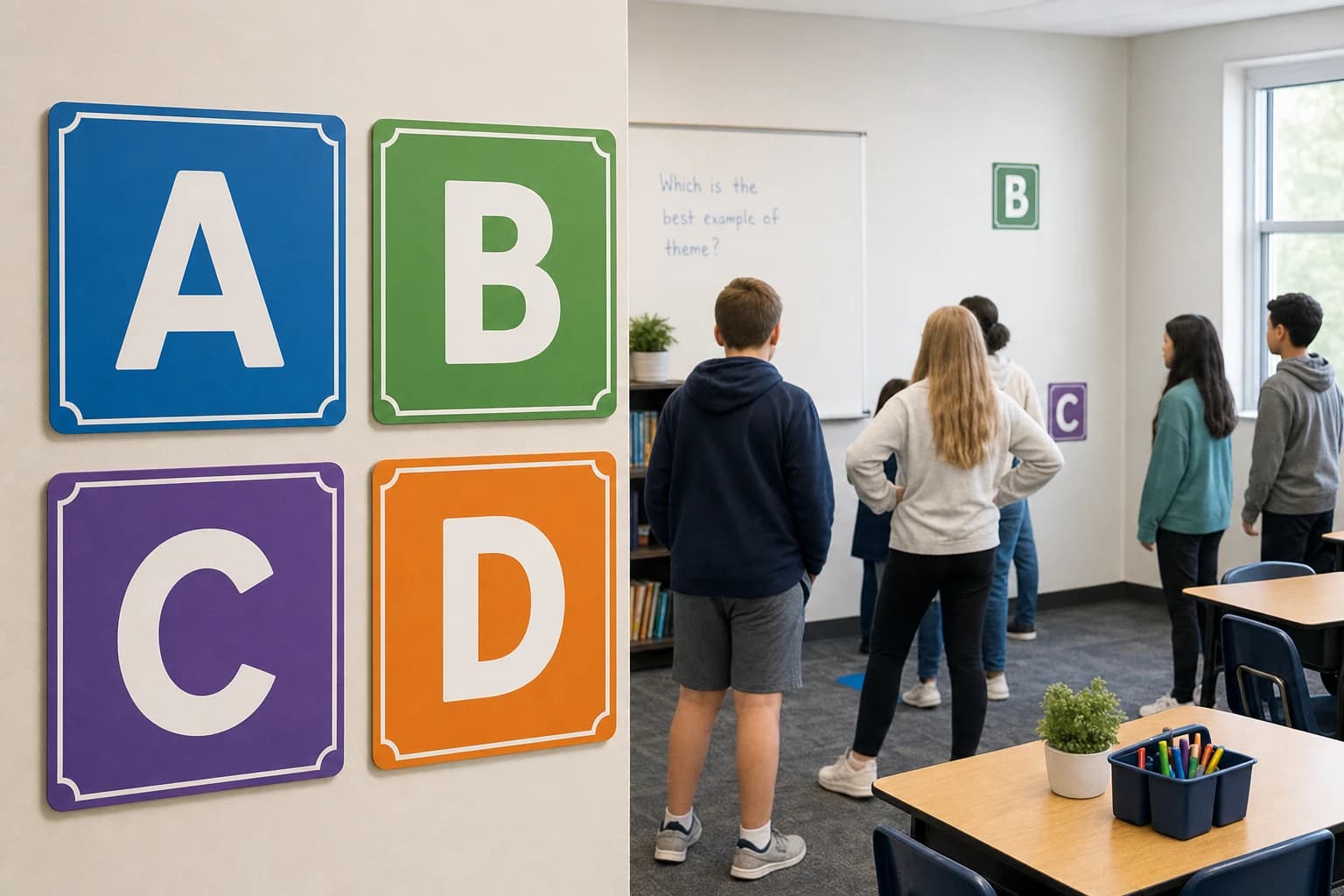
Four Corners can become a review activity without turning into a worksheet. The key is to make each corner represent an answer choice, opinion, category, or strategy. Students move to the corner that matches their answer, then discuss or explain.
1. Multiple-Choice Review
Label the corners A, B, C, and D instead of 1 to 4. Display or read a question. Students choose the corner that matches their answer. After everyone stops moving, reveal the correct answer and ask one or two students to explain their thinking.
Example: Which word is an adjective in the sentence The bright kite flew high? A: bright, B: kite, C: flew, D: high.
2. Math Strategy Corners
Use corners for strategies rather than answers. For example: draw a model, use repeated addition, use multiplication, or estimate first. Give a problem and have students stand by the strategy they would use. This is useful because more than one corner may be reasonable.
3. Vocabulary Category Corners
Assign categories such as synonym, antonym, example, and non-example. Read a word or phrase, and students move to the corner that fits. This works well for science and social studies vocabulary too.
4. Opinion and Discussion Corners
Use corners labeled strongly agree, agree, disagree, and strongly disagree. Read a classroom-safe prompt tied to literature, science, or social studies. Students move, then share with a partner in the same corner.
To keep discussion respectful, use prompts that invite reasoning rather than personal disclosure. For example, The character made the best choice available is safer than asking students to reveal private family or health information.
5. True, False, Not Sure, Prove It
This four-corner setup works when you want students to think beyond right or wrong. Students who choose Not Sure must name what information they need. Students who choose Prove It must cite a line from the text, a fact from notes, or a step in their work.
Teacher Management Tips for a Calmer Game
Four Corners can become noisy if the only instruction is go. A few routines make the difference between controlled movement and a stampede.
- Use a 10-second countdown. Long movement time invites wandering. Ten seconds is usually enough for a classroom-sized space.
- Teach freeze before play. Practice walking to a corner and freezing once before starting the real game.
- Limit corner crowding. If one corner becomes packed, say, Choose a space where you can stand without touching anyone.
- Use silent signals. A raised hand, chime, or lights-off signal works better than talking over excitement.
- Place the caller carefully. The caller can face the board, close their eyes, or sit behind a folder. Avoid blindfolds unless your school permits them and the student is comfortable.
- Set a voice level. For example: voice level 0 while moving, level 1 for partner explanation, level 2 only if the teacher invites sharing.
- Keep rounds short. Stop while students still want more. A 7-minute game is often better than a 20-minute game that loses structure.
A helpful classroom phrase is: If we can play it safely and quietly, we can play it again. This makes expectations clear without turning the game into a lecture.
Adapting Four Corners for Different Ages and Group Sizes
The same basic school game for large groups can feel very different in kindergarten, upper elementary, or middle school. Adjust the rules instead of forcing one version on every group.
For Kindergarten and Grade 1
Use picture signs, colors, or shapes rather than numbers only. Keep rounds to 3 or 4 turns. Instead of elimination, let the called corner do a simple action such as two claps, one quiet jump in place, or a whisper cheer.
For Grades 2 to 5
Students can handle numbered corners, quick rounds, and academic questions. Use a mix of luck-based rounds and review rounds so the game does not feel like a test every time.
For Older Students
Make it more strategic. For example, after a corner is called, students have 15 seconds to justify why they chose it. In literature, each corner might represent a theme. In science, each corner might represent a possible cause, variable, or claim.
For Large Groups
If you have 30 or more students, divide the room into four zones rather than tight corners. You can also assign students to two simultaneous games in different halves of the room if another adult is supervising. For broader large-group planning, Large Group Party Games for 20 to 50 People That Keep Everyone Playing has useful no-elimination principles that transfer well to school settings.
For Small Rooms
Use desk groups, wall signs, or carpet spots as corners. If walking across the room is not safe, students can point to a corner, hold up 1 to 4 fingers, or move only to nearby zones. For more compact play ideas, see Indoor Games for 10 People in a Small Room.
Common Mistakes to Avoid
Letting students sprint: Running is the fastest way for this indoor recess game Four Corners to become unsafe. Make walking a non-negotiable rule.
Using elimination for too long: If students are out early and wait for 10 minutes, the game is no longer engaging for them. Use a short timer or a non-elimination version.
Changing rules mid-round: Decide before the round whether the called corner is out, safe, earning points, or switching caller. Announce the format clearly.
Ignoring accessibility needs: Some students may not be able to move quickly, stand for long, or tolerate crowded corners. Let them choose by pointing, using a card, moving to a nearby marker, or serving as caller, judge, or question reader.
Making answer choices embarrassing: Avoid prompts that expose private information, ability level, family income, body image, or personal beliefs. Academic, fictional, and low-stakes opinion prompts are safer.
Sample 10-Minute Classroom Plan
- Minute 0-1: Clear walking paths and label four corners.
- Minute 1-2: Teach the rules: walk, choose, freeze, listen.
- Minute 2-4: Play two classic practice rounds with no elimination.
- Minute 4-8: Play four subject-review rounds using A, B, C, and D.
- Minute 8-9: Let the called corner explain or earn a point.
- Minute 9-10: Reset furniture, collect signs, and transition back to seats.
FAQ About Four Corners in the Classroom
What are the basic Four Corners game rules?
Label four corners, choose a caller who cannot see the group, have students walk to a corner, and let the caller name one corner. In the classic version, students in that corner are out for the round. In classroom-friendly versions, they may earn a point, answer a question, or become the next caller instead.
How many students can play Four Corners?
A regular classroom group of 6 to 30 students can usually play if there is a clear walking path. For larger groups, use zones instead of tight corners, shorten the rounds, or choose a non-elimination format so everyone stays involved.
Is Four Corners a good indoor recess game?
Yes, if it is played as a walking game with clear noise and space rules. It gives students a movement break without equipment, but it should not be used in a cluttered room or with running.
How do you play Four Corners without eliminating students?
Use points, role rotation, or review questions. For example, when the caller names Corner 2, those students stay in and one becomes the next caller. Another option is to give the called corner a question to answer as a team.
Can Four Corners be used for learning?
Yes. Label the corners A, B, C, and D for multiple-choice review, or use categories such as agree, disagree, not sure, and prove it. Ask students to explain their choice so the game includes thinking, not just movement.
What should I do if students keep crowding one corner?
Create a capacity rule such as no more than eight students per corner, or mark a larger zone with tape. You can also say students must stand where they have personal space and may not change corners after the countdown ends.
Conclusion
Four Corners is simple, flexible, and easy to run in a classroom when the expectations are clear. Start with four labeled corners, a caller, a short countdown, and a walking-only rule. Then choose the format that fits your class: classic elimination for a quick round, non-elimination for full participation, or subject-review corners when you want movement and learning together.
The best classroom Four Corners variations are the ones that keep students safe, included, and engaged. With clear signals, short rounds, and thoughtful prompts, this no-equipment game can work for indoor recess, transitions, review lessons, and large-group school activities.