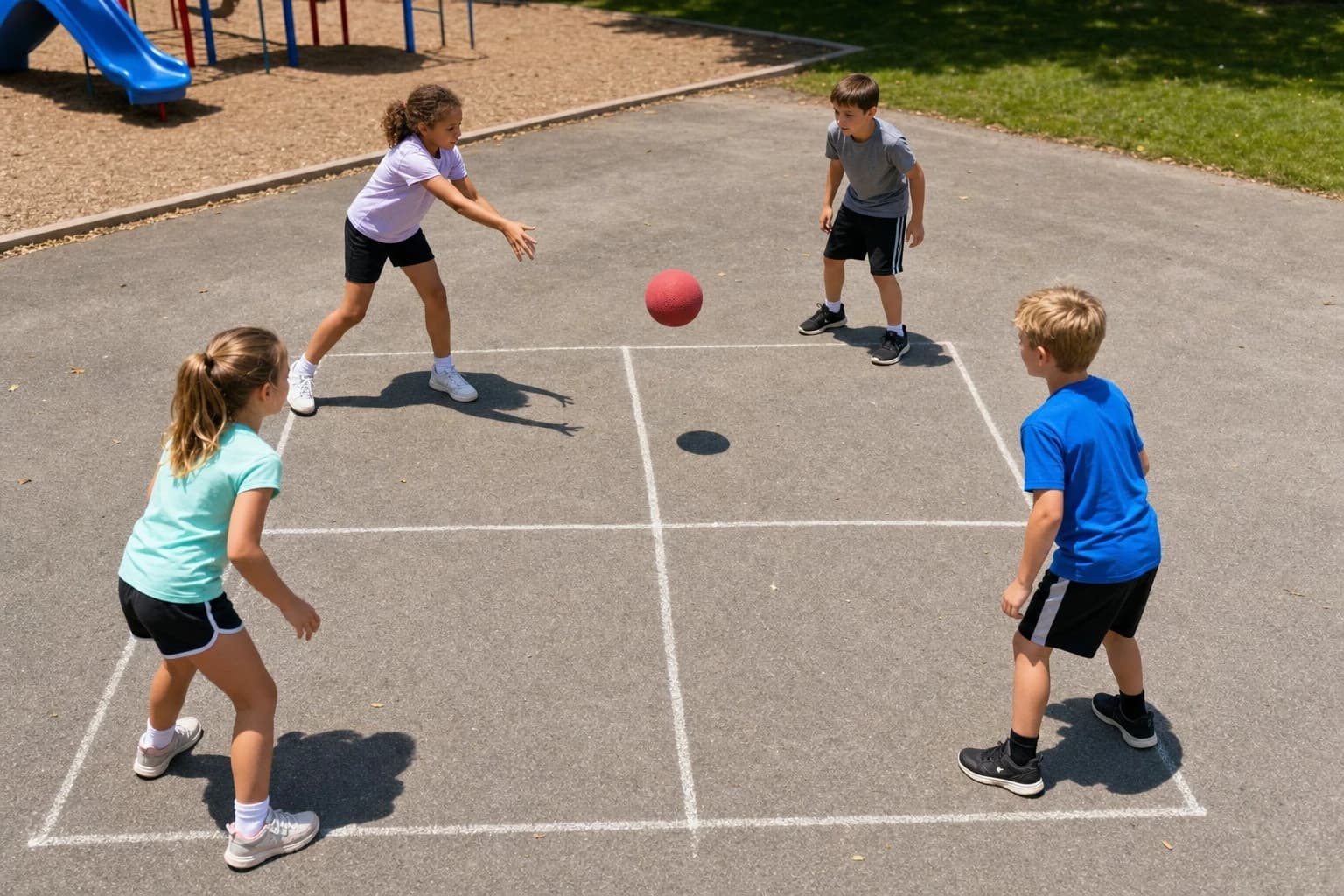
Four square is one of the easiest playground ball games to start, but it can get confusing quickly if players disagree about serving, lines, or special rules. This guide explains how to play four square in a clear, teachable way for parents, recess supervisors, camp leaders, and educators.
You will learn a simple four square court setup, what kind of ball works best, the core four square rules, how to handle common disputes, and how to add fun four square variations without overwhelming new players.
Quick Answer: How to Play Four Square
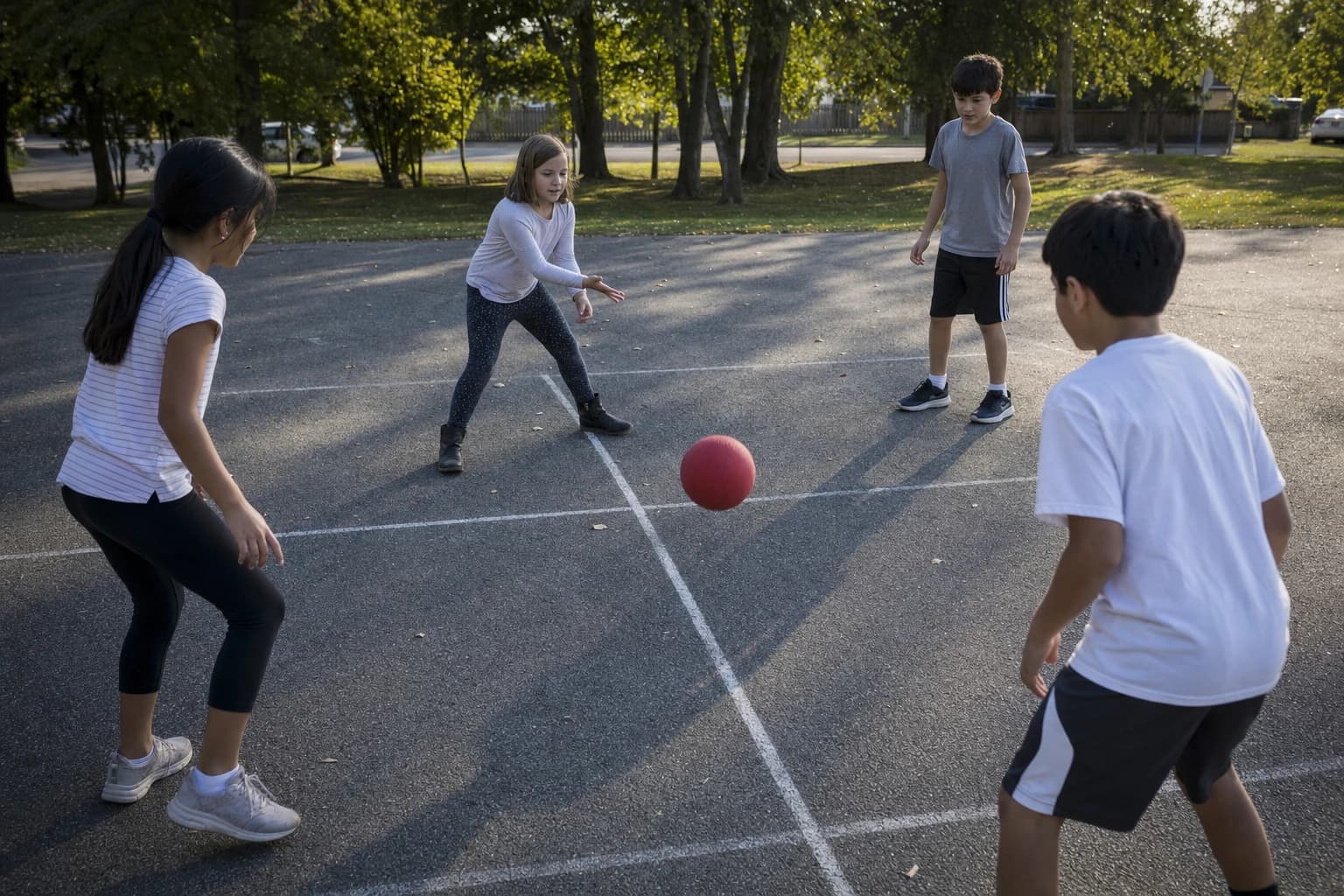
To play four square, draw a large square court divided into four equal smaller squares. Number the squares 1 through 4, with square 4 usually called the king, ace, or server square. Four players stand in the squares. The player in square 4 serves by bouncing the ball once in their own square and then hitting it into another player’s square. Players hit the ball after one bounce and try to keep it in play. A player is out if they miss the ball, hit it out of bounds, let it bounce twice in their square, catch or carry it, or break an agreed rule.
When a player is out, they leave square 1 or go to the end of the waiting line, depending on your group’s rotation. Everyone behind the empty space moves up, and a new player enters square 1. The goal is to work your way up to square 4 and stay there as long as possible.
There is no single worldwide rulebook for four square. Schools, camps, and neighborhoods often use slightly different rules. For a simple reference point, Playworks, a nonprofit known for school recess resources, describes four square as a game where players hit the ball into each other’s squares and rotate when someone is out: Playworks Four Square game guide. The best approach is to teach one basic version first, then add variations only when everyone understands the foundation.
Materials and Space Needed
Four square is popular because the equipment list is short. You do not need a gym, net, or expensive gear. A driveway, blacktop, schoolyard, or smooth patio can work as long as the surface is reasonably flat and safe for bouncing.
- One playground ball: An 8.5-inch rubber playground ball is a common choice for elementary-age players. Younger children may do better with a slightly larger, softer ball that moves more slowly.
- Chalk, painter’s tape, or court tape: Use sidewalk chalk for asphalt or concrete, painter’s tape for a temporary indoor-safe layout, or durable court tape for repeated use on a gym floor if permitted.
- Measuring tape or yardstick: Helpful for drawing a balanced court, especially when teaching beginners.
- Four players plus a waiting line: The game works best with 4 to 10 children. With more than 10, consider making a second court so players do not wait too long.
- Flat, open space: Leave extra room around the court so players can step out safely to avoid collisions.
Recommended Court Size
A standard playground setup is often a 16-foot by 16-foot large square divided into four 8-foot by 8-foot squares. This size gives older elementary students enough space to move and react. For younger children or small spaces, a 12-foot by 12-foot court divided into four 6-foot by 6-foot squares is easier to manage.
If you are introducing the game to new players, smaller is not always better. A court that is too small causes fast, crowded rallies. A slightly larger court with a softer ball gives children more reaction time.
Four Square Court Setup
The court should be easy to understand at a glance. Clear lines prevent many arguments, especially about whether a ball landed in bounds or on a divider line.
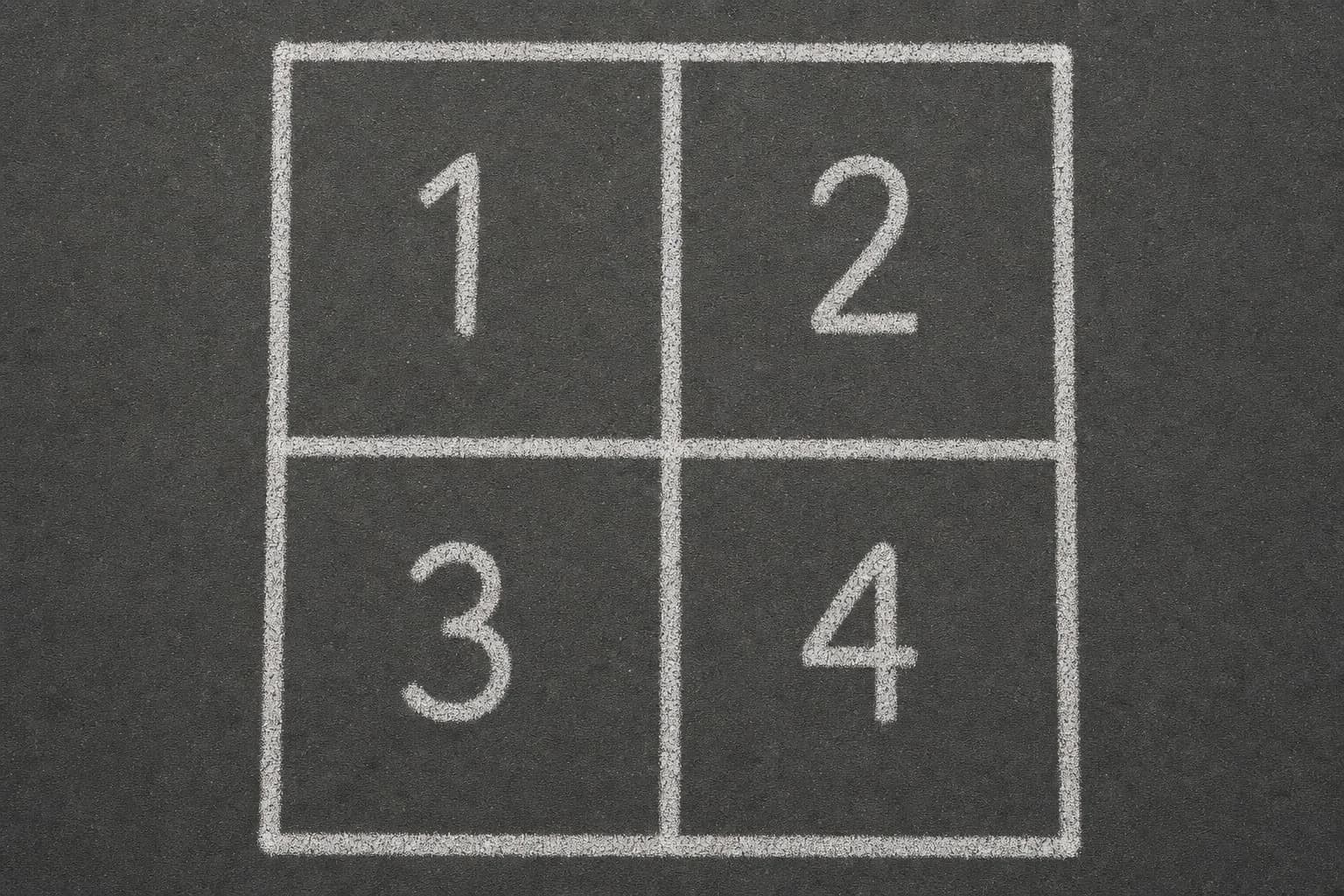
- Choose a safe surface. Look for a dry, level area without loose gravel, puddles, sharp cracks, or nearby obstacles. Avoid drawing the court close to walls, parked cars, playground equipment, or doorways.
- Draw the outside square. For a regular playground court, measure and mark a 16-foot by 16-foot square. If measuring is not practical, take about eight adult heel-to-toe steps per side as a rough temporary guide.
- Add the center lines. Draw one line down the middle from top to bottom and one line across the middle from left to right. You now have four equal squares.
- Number the squares. Label them 1, 2, 3, and 4. Many groups place square 1 in the lower left, square 2 in the lower right, square 3 in the upper right, and square 4 in the upper left, but any layout works if it stays consistent.
- Mark the waiting line. Have extra players line up outside square 1. When someone is eliminated, the first waiting player enters square 1 and the others rotate upward.
- Agree on line rules before play. Decide whether a ball that lands on an inside line is out or playable. A common beginner rule is: outside boundary lines are out, inside divider lines are in. Whatever you choose, say it clearly before serving.
Basic Four Square Rules for Beginners
These beginner four square rules are simple enough for recess, backyard play, and physical education warmups. They reduce arguments and keep the game moving.
1. The Server Starts Each Rally
The player in square 4 serves. The server must bounce the ball once in their own square, then hit it with an open hand or closed fist into another player’s square. For beginners, require the serve to be gentle enough to return. This prevents the strongest player from turning every serve into an instant elimination.
2. The Ball Must Bounce Once Before a Hit
After the serve, a player should hit the ball after it bounces once in their square. If it bounces twice in the same square, that player is out. If a player hits the ball before it bounces, some groups call that a “volley” and allow it, while others do not. For new players, avoid volleys at first because they make the game faster and harder to judge.
3. Players Hit, Not Catch or Carry
Players may use one or two hands to strike the ball, but they should not catch, hold, scoop, or carry it. A clean hit means the ball leaves the hand right away. If a child is still learning, allow a brief reminder before calling them out the first time.
4. The Ball Must Land in Another Square
A legal hit sends the ball into another player’s square. If the ball lands outside the court, the hitter is out. If the ball lands in the hitter’s own square first, the hitter is usually out. If the ball touches an inside divider line, use the line rule your group agreed to before the game.
5. Elimination Leads to Rotation
When a player is out, they leave the court and go to the end of the waiting line. Players in lower-numbered squares move up to fill the empty space. The next waiting player enters square 1. For example, if the player in square 3 is out, the player in square 2 moves to square 3, the player in square 1 moves to square 2, and the next waiting player enters square 1.
6. The Goal Is to Reach Square 4
Four square is not usually played to a final score. The ongoing challenge is to move up to square 4 and defend it. If you need a timed version for class or camp, play 5-minute rounds and have players count how many times they reach square 4.
Serving Rules That Prevent Arguments
Serving is where many four square disputes begin. The server has an advantage, so it helps to define a fair serve before the first rally.
| Serve issue | Beginner-friendly rule | Why it helps |
|---|---|---|
| Serve speed | The serve must be returnable and below shoulder height after the hit. | Prevents power serves from ending rallies immediately. |
| Serve bounce | The server bounces the ball once in square 4 before hitting it. | Creates a consistent starting action for all players. |
| Serve target | The serve may go to any other square, not back into square 4. | Keeps the server from controlling the ball too long. |
| Bad serve | Give one redo for young beginners; older players are out after an illegal serve. | Balances learning with accountability. |
| Trick serves | No spins, slams, or named special serves until variations are allowed. | Keeps the first version easy to teach. |
For mixed-age groups, use a “clean serve” rule: the server announces “ready,” waits for the other players to face the court, then serves with a simple bounce-and-hit motion. This small routine makes the game feel fairer for younger players.
Step-by-Step: Teach Four Square in 10 Minutes
If you are leading a group, resist the urge to explain every possible rule at once. Teach the game in layers. The following 10-minute plan works well for a recess introduction, backyard group, or after-school activity.
- Minute 1: Show the court. Point to squares 1 through 4. Explain that the goal is to move up toward square 4.
- Minute 2: Demonstrate the serve. Stand in square 4, bounce the ball once, and hit it gently into square 2 or 3. Have players watch where the ball lands.
- Minutes 3–4: Practice one-bounce returns. Let each player hit the ball after one bounce without eliminating anyone. Focus only on the rhythm: bounce, hit, bounce, hit.
- Minute 5: Add out-of-bounds rules. Explain that a ball hit outside the court makes the hitter out. Show one example so children can see it.
- Minute 6: Add double-bounce rules. Explain that if the ball bounces twice in your square, you are out. Demonstrate slowly.
- Minute 7: Practice rotation. Pretend the player in square 2 is out and have everyone move. Then pretend square 4 is out and rotate again.
- Minutes 8–10: Play with coaching. Start a real game, but pause briefly for teachable moments. Keep corrections short: “That was two bounces, so rotate,” or “That landed outside, hitter is out.”
After the first few rounds, players usually understand the structure. Save special rules for later, especially if the group includes younger children or first-time players.
Common Four Square Calls and How to Judge Them
Four square moves fast, and not every call will be obvious. A simple call system keeps the game friendly and prevents one confident player from controlling every decision.
- Out: The ball lands outside the court, bounces twice in a player’s square, is caught or carried, or is hit before a legal bounce if your group bans volleys.
- Line ball: Use your pre-game line rule. Many groups treat inside divider lines as playable and outside boundary lines as out.
- Interference: If a waiting player, backpack, cone, or passerby affects the rally, replay the point.
- Unclear call: Replay the point instead of arguing. “When in doubt, redo” is one of the best rules for children’s games.
- Body contact: If the ball hits a player before bouncing in their square, decide whether that counts as out. For beginners, it is often simpler to call it out only if the player intentionally blocks or catches it.
A Simple Dispute Rule for Schools and Families
Use this phrase before starting: “If two players disagree and no adult clearly saw it, the rally is replayed.” This protects the pace of the game and teaches players that fairness matters more than winning one point.
For older groups, you can let the player in square 4 make close calls, but that can feel unfair if the same child stays in charge for a long time. A neutral adult or a quick replay is usually better for mixed ages.
Four Square Variations That Are Easy to Add
Four square variations are part of the fun, but too many at once can make the game confusing. Add one variation at a time and name it clearly before the serve. If half the group does not understand the special rule, go back to basic play.

Cherry Bomb
A player hits the ball hard downward into another square, trying to make it bounce high and difficult to return. This is exciting for older players but can frustrate beginners. If you allow it, ban head-level shots and require enough space between players.
Popcorn
The ball may be tapped lightly upward before being sent into another square. This helps younger players practice control, but it can slow the game. Set a limit of one tap before the return.
Around the World
Players must send the ball to the next square in order, such as 1 to 2 to 3 to 4 and back to 1. This variation builds anticipation and is useful for beginners because players know where the ball should go next.
Team Four Square
Two players share each square, taking turns hitting the ball. This works well when you have more children than courts. Use larger squares if possible, and remind teammates not to crowd each other.
King’s Rules
The player in square 4 chooses one special rule before serving, such as “no cherry bombs” or “left hand only.” This is popular on playgrounds, but it can become chaotic. For younger players, limit the king to choosing from three approved rules posted or announced in advance.
No-Elimination Practice Round
Instead of sending players to the waiting line, simply replay after mistakes. This version is helpful for teaching skills before a competitive round. If you want more non-elimination ideas for recess, see 15 Cooperative Playground Games for Kids That Do Not Eliminate Players.
Adaptations by Age and Setting
The best version of four square depends on the players. A rule that works for fifth graders may be too fast for first graders, and a driveway game may need different boundaries than a school blacktop.
| Group | Best setup | Rule adjustments |
|---|---|---|
| Ages 5–7 | 12-foot by 12-foot court; soft playground ball | Allow one practice serve, use gentle hits, replay close calls. |
| Ages 8–10 | 16-foot by 16-foot court; standard playground ball | Use full rotation, clear line rules, and one simple variation. |
| Ages 11+ | 16-foot by 16-foot or larger court | Allow faster play, but agree on power-hit limits and dispute rules. |
| Mixed ages | Medium court with extra space around it | Older players serve gently to younger players; no aggressive slams. |
| Indoor gym | Tape lines only if allowed by the facility | Use a softer ball, control noise, and keep waiting players away from active play. |
For a classroom game with no ball and less movement, How to Play Four Corners in the Classroom is a better fit. For outdoor groups that want a larger field game after four square, try Capture the Flag Rules for Parks, Camps, and School Fields or Kickball Rules for Kids.
Safety and Supervision Tips
Four square is generally simple, but fast rebounds and crowded courts can create avoidable problems. A few setup choices make the game smoother and safer.
- Check the surface first. Sweep away loose stones, sticks, wet leaves, or sand that could cause slipping.
- Set a no-face-shots rule. Tell players that deliberate hits toward the head are not allowed. If it happens, pause the game and reset expectations.
- Keep the waiting line back. Waiting players should stand several feet away from the court, not on the boundary line.
- Match the ball to the group. A very firm ball can sting on hard hits. Use a softer ball for younger children or indoor play.
- Stop rule stacking. If players keep adding special rules, reset to basic four square for one full rotation.
Common Mistakes to Avoid
- Starting with too many variations: New players need the basic bounce-hit-rotate pattern before trick rules.
- Ignoring the waiting line: If children wait too long, they lose interest. Make a second court when possible.
- Letting one player control every call: Use replays for uncertain calls, especially with younger children.
- Using unclear line rules: Decide inside and outside line calls before the first serve.
- Allowing power serves too early: A fair serve gives the rally a chance to develop.
FAQ About How to Play Four Square
How many people do you need to play four square?
You need four active players, one in each square. The game also works well with extra players waiting in line because eliminated players rotate out and new players enter square 1.
What size should a four square court be?
A common playground court is 16 feet by 16 feet, divided into four 8-foot squares. For younger children or smaller spaces, a 12-foot by 12-foot court with four 6-foot squares is easier to manage.
Can the ball land on the line in four square?
That depends on your group’s rule. A simple beginner rule is that inside divider lines are playable and outside boundary lines are out. The important thing is to agree before play starts.
Can you hit the ball with two hands?
Yes, many groups allow one-hand or two-hand hits as long as the ball is struck cleanly and not caught, held, scooped, or carried.
What happens when the player in square 4 gets out?
The player in square 4 goes to the end of the waiting line. Players in squares 1, 2, and 3 move up one position, and the next waiting player enters square 1.
What is the easiest four square variation for beginners?
Around the World is one of the easiest variations because players hit the ball to the next square in order. It adds structure without introducing tricky serves or confusing special calls.
Conclusion
Learning how to play four square is mostly about setting clear expectations before the first serve. Draw a simple four-square court, choose a ball that fits the age group, teach the bounce-hit-rotate pattern, and agree on line calls and dispute rules early.
Once players understand the basic four square rules, variations like Around the World, Popcorn, or team play can add variety without turning the game into an argument. Keep the first version simple, use replays for unclear calls, and let the game grow as players gain confidence.