A park is a great place for a birthday party, but it also creates one big planning problem: you usually cannot tape clues to trees, hide items in landscaping, or ask kids to collect leaves, flowers, rocks, or anything that belongs in the park. This guide gives you a complete plan for an outdoor scavenger hunt for park birthday party guests that works in a public space without disturbing nature or breaking typical park rules.
You will find a supply list, timing plan, clue categories, ready-to-use clue examples, team rules, adult supervision points, prize ideas, and easy adaptations for different ages. The format is designed for children at a birthday party, not for a wilderness hike or competitive race.
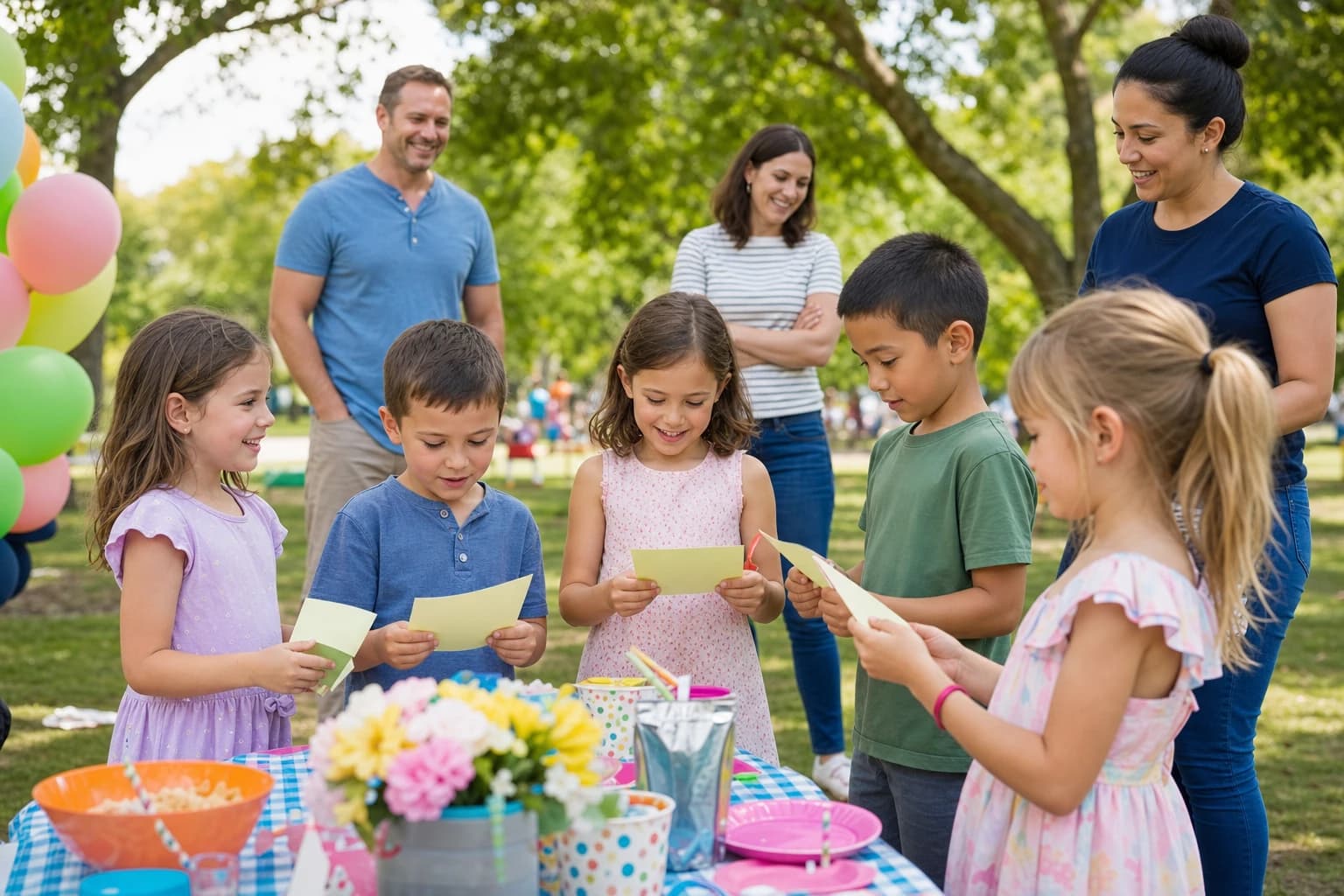
Quick Plan: The Park Birthday Scavenger Hunt at a Glance
For most birthday parties, the easiest format is a team-based checklist hunt. Children stay in a clearly marked game area, complete observation tasks, return to the home base table, and receive a small prize or treat. This avoids the problems that come with hiding objects in a public park, where another visitor may move them or where the park may not allow signs, tape, or decorations outside a reserved area.
| Planning item | Recommended setup |
|---|---|
| Best age range | Ages 5–12, with reading help for younger children |
| Group size | 6–24 children; divide into teams of 3–5 |
| Game time | 25 minutes of hunting plus 5 minutes for rules and 5 minutes for wrap-up |
| Game area | One visible section of the park, such as picnic tables, a walking path loop, a lawn edge, and a playground boundary |
| Winning style | Cooperative completion, point total, or timed return |
| Public park-safe format | Look, count, draw, photograph with adult device, answer, or point out; do not collect natural items |
Before You Start: Check Park Rules and Protect the Space
Public parks are shared spaces. Before the party, check your local parks department page or reservation confirmation for rules about group size, decorations, amplified sound, balloons, signs, and whether activities can be set up outside a reserved shelter or picnic area. Rules vary by city and park.
For nature-based tasks, use a “leave it where it is” approach. The National Park Service explains the Leave No Trace principle of leaving natural objects and cultural items undisturbed, which is a useful standard for planning respectful outdoor games. You can read the principle here: National Park Service Leave No Trace Seven Principles.
Good scavenger hunt rule for parks: “Find it with your eyes, not your hands.”
Materials and Setup Supplies
You do not need expensive supplies. The goal is to make the instructions clear enough that children can play independently while adults supervise the boundaries.
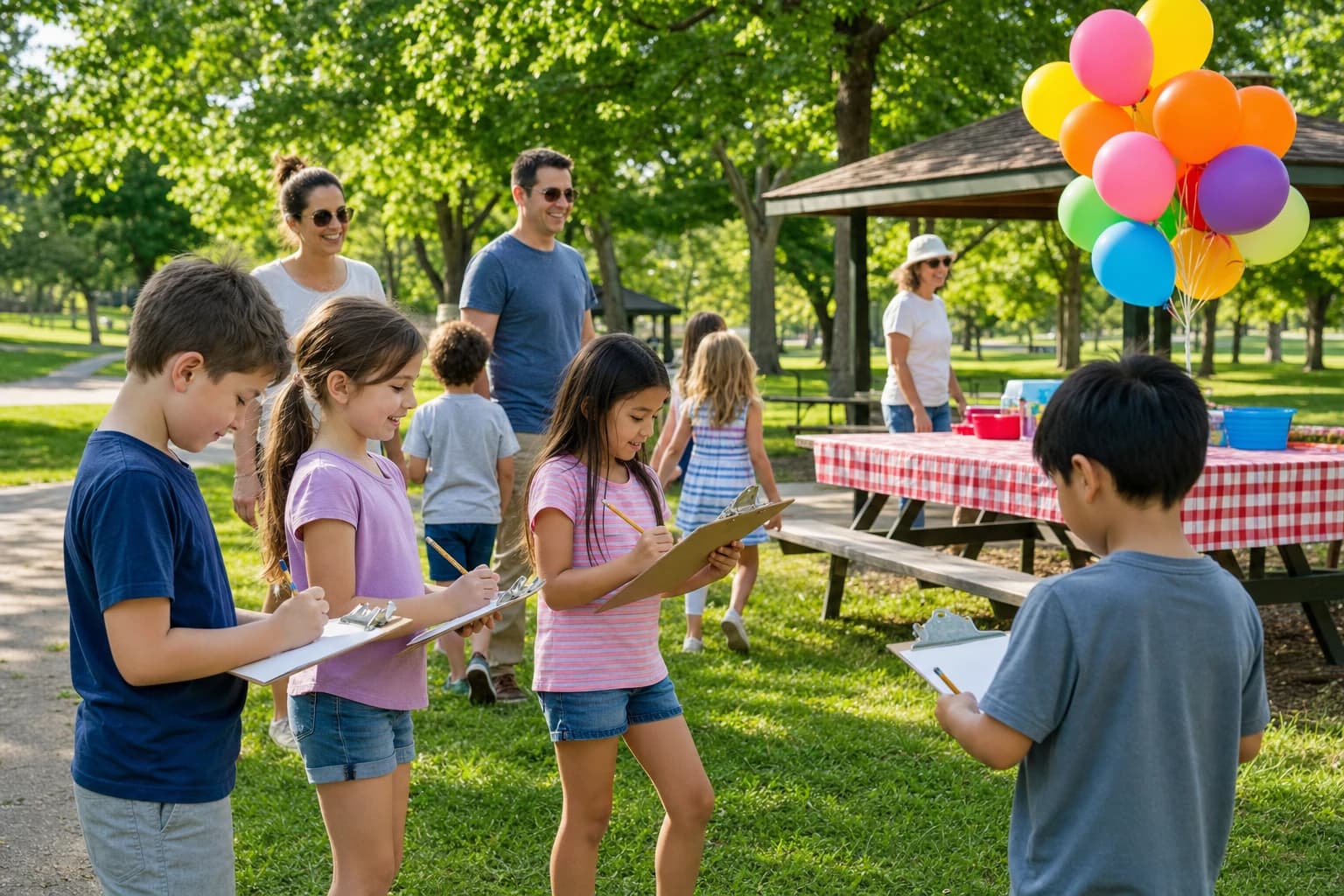
- Printed scavenger hunt cards: one per team, plus two extras
- Clipboards or stiff cardboard: one per team
- Pencils: two per team
- Colored team wristbands, stickers, or ribbons: one color per team
- Small cones, picnic blankets, or chalk marks to show the home base area
- Timer or phone alarm for the game leader
- Prize bags or a prize basket
- Optional: crayons for drawing clues, washable stamp for completed cards, and a small first-aid kit
If you are planning for younger children, laminate reusable cards or place each card in a clear sleeve. Kids often set clipboards in the grass or on picnic tables with spilled drinks nearby.
Choose a Public Park-Safe Hunt Format
Many traditional scavenger hunts ask players to bring back an acorn, feather, flower, or rock. That can be a problem in public parks because children may pick plants, disturb wildlife habitat, or remove objects that should stay where they are. A birthday party hunt works better when the “proof” is a checkmark, drawing, answer, adult signature, or team photo taken by an adult.
Use These Clue Categories
Mix several categories so children with different strengths can contribute. A good 25-minute hunt card has 12 to 18 total tasks.
- Color clues: Find something red, something yellow, something blue, and something with two colors.
- Counting clues: Count benches, picnic tables, swings, trash cans, or trail signs inside the game area.
- Shape clues: Find a circle, triangle, rectangle, spiral, or star shape in the park.
- Nature observation clues: Spot a bird, a leaf bigger than your hand, a tree with rough bark, or a shadow shaped like an animal.
- Sound clues: Listen for a bird call, rustling leaves, footsteps on gravel, or a dog bark.
- Movement clues: Do five jumping jacks near home base, walk like a crab for 10 steps, or balance on one foot for 10 seconds.
- Birthday clues: Find something that matches the birthday child’s favorite color or count how many candles would be on the cake.
- Kindness clues: Say “happy birthday,” cheer for another team, or thank an adult helper.
Ready-to-Use Park Scavenger Hunt Clues
Here is a birthday-party-ready list you can copy into a printable card. For younger children, use 10 to 12 clues. For older children, use 16 to 18 and add a tiebreaker question.
| Clue | How the team proves it | Park-safe note |
|---|---|---|
| Find a leaf that is bigger than one teammate’s hand. | Adult initials the card after seeing it. | Do not pick the leaf; point to it on the plant or ground. |
| Find three different shades of green. | Write or draw where you saw them. | Observation only. |
| Count the benches you can see from the home base. | Write the number. | Keeps children in view. |
| Find something shaped like a circle. | Draw it in the box. | Can be a wheel, sign, ball, or table. |
| Hear two different outdoor sounds. | Write both sounds. | Encourages quiet observation. |
| Find a safe shadow and make it look like a funny creature. | Adult initials after seeing it. | Works well on sunny days. |
| Spot a bird without chasing it. | Circle “yes” on the card. | Remind children to watch calmly. |
| Find the picnic table closest to home base. | Write the table color or number if marked. | Good orientation clue. |
| Find something that starts with the first letter of the birthday child’s name. | Write or draw it. | Personalizes the hunt. |
| Do a team statue pose for 5 seconds. | Adult initials. | Adds laughter without running. |
| Find a sign and copy one word from it. | Write the word. | Do not climb or touch signs. |
| Find something soft-looking and something hard-looking. | Write both items. | No touching required. |
| Count 10 steps from the home base and look for something tiny. | Draw what you saw. | Creates a close-range task. |
| Find a safe place where water might go when it rains. | Point it out to an adult. | Avoid entering drainage areas or puddles. |
| Give another team a friendly cheer. | Adult initials. | Reduces over-competition. |
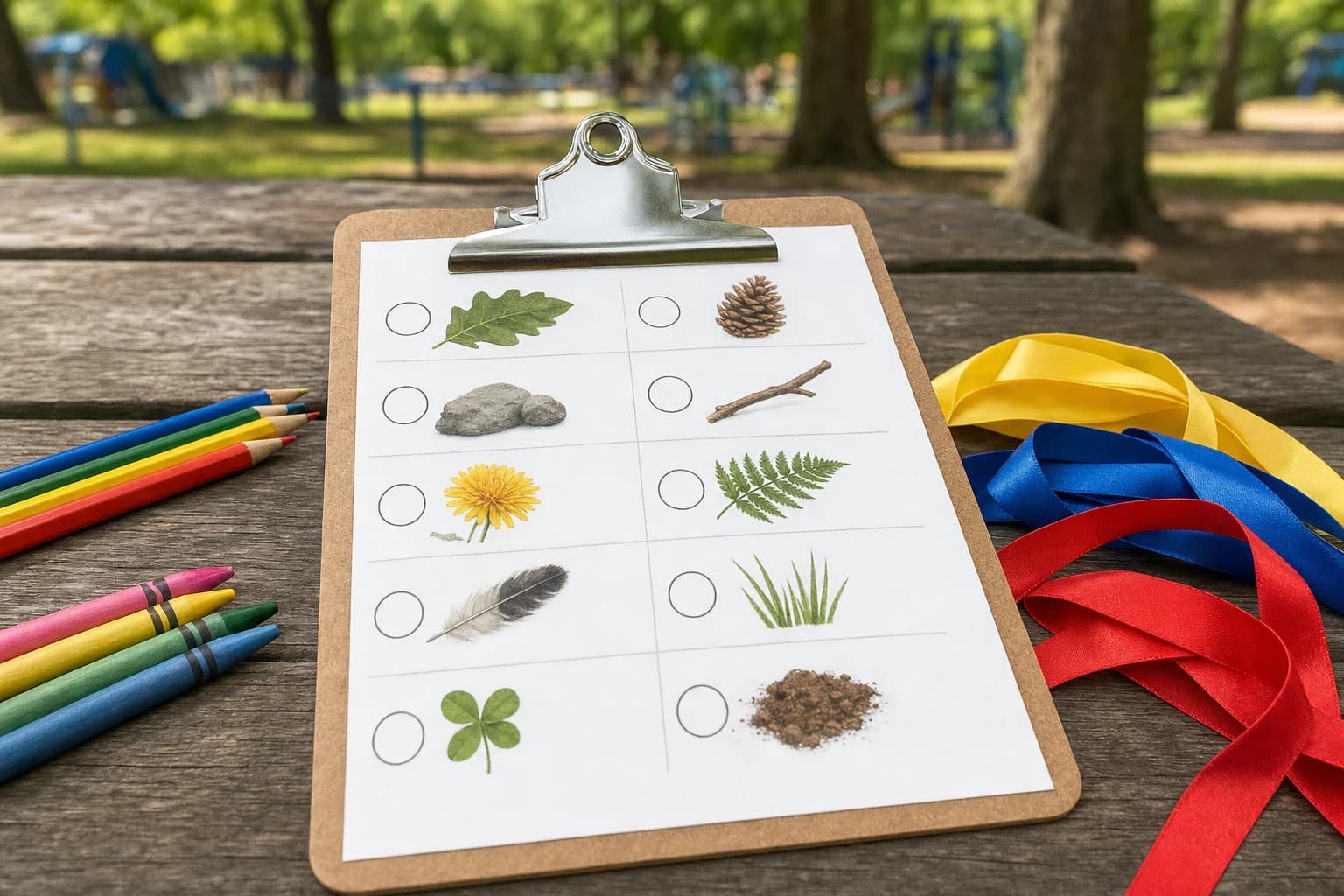
Step-by-Step Scavenger Hunt Setup for Children
This setup is designed for a typical birthday party timeline where food, cake, and other activities are also happening. If you want a smaller version for a home setting, you may also like How to Set Up a Backyard Scavenger Hunt for Kids Ages 5–10.
- Walk the area 30–45 minutes before guests arrive. Check for muddy spots, broken glass, animal waste, crowded areas, construction, or any feature you do not want children near. If the park is busier than expected, shrink the game area.
- Pick one home base. Use a picnic table, shelter, or blanket where children start and finish. Keep water, extra pencils, prize bags, and the adult timer here.
- Set clear boundaries. Choose boundaries children can understand: “Do not go past the blue playground fence,” “Stay on this side of the walking path,” or “You must be able to see the red picnic blanket.” Avoid vague instructions such as “stay nearby.”
- Divide teams by age and energy level. Teams of 3–5 work better than pairs because one child can read, one can write, and others can search. Put younger children with an older child or adult helper.
- Give the rules before handing out cards. Children stop listening once the card is in their hands. Explain boundaries, no picking, no running through other people’s picnic areas, and what to do if they need help.
- Start with a short practice clue. Say, “Point to something green without touching it.” This confirms everyone understands the no-collecting format.
- Set the timer for 20–25 minutes. Announce a 5-minute warning. For young children, shorter is usually better because excitement drops when the card feels too long.
- Use adult check-in points. Place adults where the game area naturally opens up: near the playground entrance, near the path, and at home base. Adults should redirect children calmly rather than chase them.
- End with a return signal. Use a handbell, clap pattern, or simple call-and-response. Avoid relying only on shouting across a busy park.
- Celebrate completion before scores. If you score the hunt, first praise teamwork and safe play. Then announce a winner, funniest drawing, best teamwork, or most observant team.
Simple Team Rules to Read Aloud
- Stay with your team the whole time.
- Stay inside the boundaries.
- Find things with your eyes, not your hands, unless an adult says touching is okay.
- Do not pick flowers, leaves, sticks, rocks, or anything from the park.
- Do not run through another group’s picnic, sports game, or playground line.
- If you hear the return signal, come back to home base right away.
- Teams may ask an adult for help, but the adult will not give every answer.
- Kindness counts. Pushing, grabbing, or yelling at teammates means a pause at home base.
Scoring, Time Limits, and Prize Ideas
Not every birthday party needs a winner. For mixed-age groups, a completion reward is often smoother than a strict point contest. If you do want scoring, keep it simple enough that adults can total cards quickly while children move on to snacks or cake.
| Scoring option | Best for | How to run it |
|---|---|---|
| Completion reward | Ages 5–7 or mixed ages | Every team that returns safely gets a prize. |
| Point total | Ages 8–12 | Each completed clue is 1 point; one bonus clue is 2 points. |
| Category awards | Parties where you want no hurt feelings | Give awards for teamwork, best drawing, fastest return, and funniest pose. |
| Timed return | Older children who like racing | Teams must return by the timer; late teams lose 1 point. |
Good prizes are small, equal, and easy to carry home. Consider stickers, bubbles, sidewalk chalk, mini notebooks, pencils, temporary tattoos, seed packets approved for home planting, or a wrapped snack if it fits your guest list and allergy plan. Avoid prizes that turn into litter at the park, such as confetti poppers, tiny plastic pieces, or loose candy that children may drop in the grass.
If you are planning a longer party with several activities, pair the scavenger hunt with other low-supply games. See Outdoor Birthday Party Games for Kids Ages 8–12 With Low-Cost Supplies for more ideas.
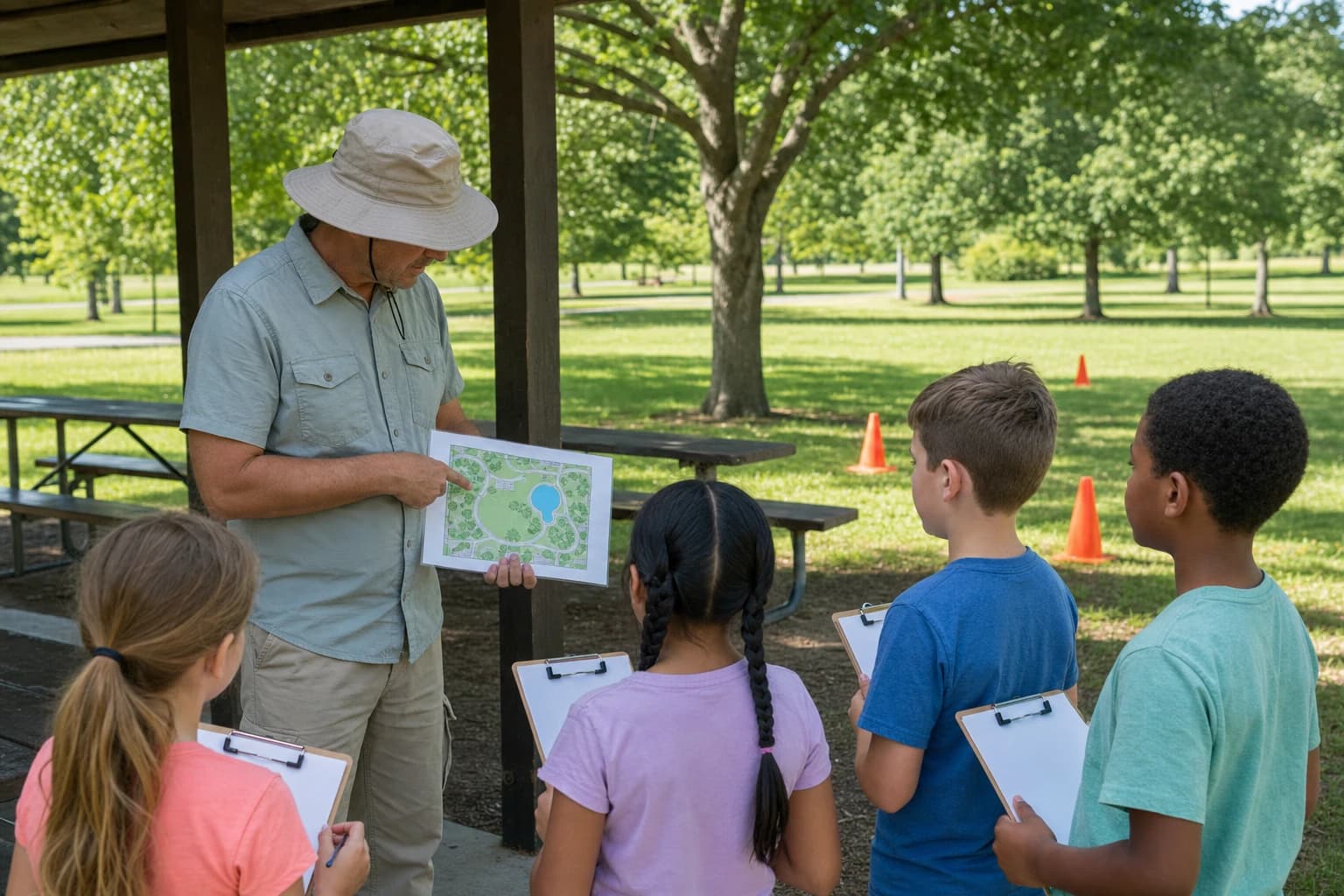
Adaptations for Different Ages and Park Conditions
For ages 5–6
Use picture clues, color clues, and adult-led teams. Limit the card to 8–10 tasks. Replace writing with circling, drawing, or stickers. Keep the game area very small and visible from the party table.
For ages 7–9
Use a mix of observation, counting, and simple riddles. Teams can usually manage one reader and one writer. A 12–15 clue card works well, especially if some clues involve movement or drawing.
For ages 10–12
Add logic clues, map-reading, or bonus challenges. For example: “Find a place where three paths meet, then write one thing you can see from there.” Older children may enjoy a points system, but keep boundaries firm.
For busy public parks
Make the hunt home-base centered. Choose clues that can be completed from one picnic area: count visible trees, identify sign colors, find shapes, listen for sounds, and draw objects. Do not send teams across sports fields, parking lots, or crowded playgrounds.
For rainy or windy weather
Use heavier clipboards and pencils instead of loose paper and markers. Move the home base under a shelter if one is available. Replace ground-based clues with “from the shelter” clues, such as sounds, colors, signs, umbrellas, puddle shapes, and cloud observations. Stop the game if weather makes the area unsafe.
Common Mistakes to Avoid
- Making the boundary too large. A wider area does not make the game better if adults cannot see the children.
- Hiding clues in public spaces. Hidden cards may be removed by other visitors, damaged by weather, or mistaken for litter.
- Using collect-and-return tasks. Asking children to bring back natural items can encourage picking, grabbing, and arguing over objects.
- Letting teams run unsupervised. A scavenger hunt should feel active, but not like a race through other people’s space.
- Creating one winner and many disappointed children. Birthday parties usually work better with group prizes or several award categories.
For more planning help with groups of different ages, read Common Mistakes to Avoid When Running Outdoor Games for Mixed-Age Groups.
Printable Hunt Card Structure
If you are making your own card, keep it to one page. Use big checkboxes, enough white space, and clear instructions at the top. A simple layout is:
- Team name line
- Boundary reminder: “Stay where you can see the picnic table.”
- Safety reminder: “Look, do not collect.”
- 12–18 clue boxes
- One bonus question
- Return time: “Come back when you hear the bell or at 25 minutes.”
If the children are older and want more challenge, you can use a clue path instead of a checklist. In that version, each completed answer tells them which category to do next. For example, “If your answer is a number higher than 5, do a sound clue next. If it is 5 or lower, do a shape clue next.” This adds puzzle energy without hiding objects in the park.
FAQ: Park Birthday Scavenger Hunts
Can I hide clues in a public park?
Sometimes, but it depends on local park rules and your reserved area. In many cases, it is safer and cleaner to avoid hiding anything. Use observation clues, adult initials, drawings, and checkboxes instead.
How long should a kids birthday party outdoor game last?
For a scavenger hunt, plan about 30–35 minutes total: 5 minutes for rules, 20–25 minutes for hunting, and 5 minutes to return cards and give prizes.
What if some children cannot read yet?
Use picture clues, pair younger children with older teammates, or assign an adult to each young team. You can also read one clue at a time from home base.
Should the birthday child’s team get an advantage?
Usually no. A small birthday-themed clue is fun, but the birthday child should play by the same rules so the game feels fair to guests.
What should teams do if they disagree about an answer?
Tell them to ask an adult checkpoint helper. The helper can accept any reasonable answer that follows the rules, especially for creative clues like shapes, colors, and drawings.
How do I make the hunt work without prizes?
Use a final group reward instead, such as choosing the next game, starting cake time, or taking a silly team photo. The hunt does not need material prizes to be successful.
Conclusion
A successful outdoor scavenger hunt for park birthday party guests is less about hiding clever objects and more about giving children a clear, safe mission. Use a visible home base, simple boundaries, small teams, observation-based clues, and adults at key check-in points. When the hunt rewards noticing, drawing, counting, listening, and teamwork, it stays fun for the children and respectful of the public park.
For a more nature-focused version with extra safety planning, visit How to Plan a Safe Nature Scavenger Hunt in a Park.