Planning recess games for large elementary groups is different from choosing a fun game for ten children. With 40, 60, or 100 students outside at once, small problems become big quickly: unclear boundaries, long lines, arguments about being “out,” unsafe running lanes, and adults trying to referee too many decisions at the same time.
This guide gives you two things at once: a practical mistake-avoidance plan and a set of complete, ready-to-run game cards. Each game includes group size, space, materials, setup, rules, re-entry or reset method, safety note, and grade-level variation so a teacher, recess aide, camp counselor, or after-school supervisor can run it without inventing rules on the spot.
Author note: Prepared by the PLAYATME editorial team for school, camp, and after-school game planning. It is designed as general educational guidance, not a substitute for your school district’s supervision rules, behavior procedures, accessibility policies, or playground inspection requirements.
Reviewed and updated: Last reviewed August 8, 2026, for clarity, safety language, search intent, and practical classroom/playground usability.
Quick Answer: What Makes Large Group Recess Games Work?
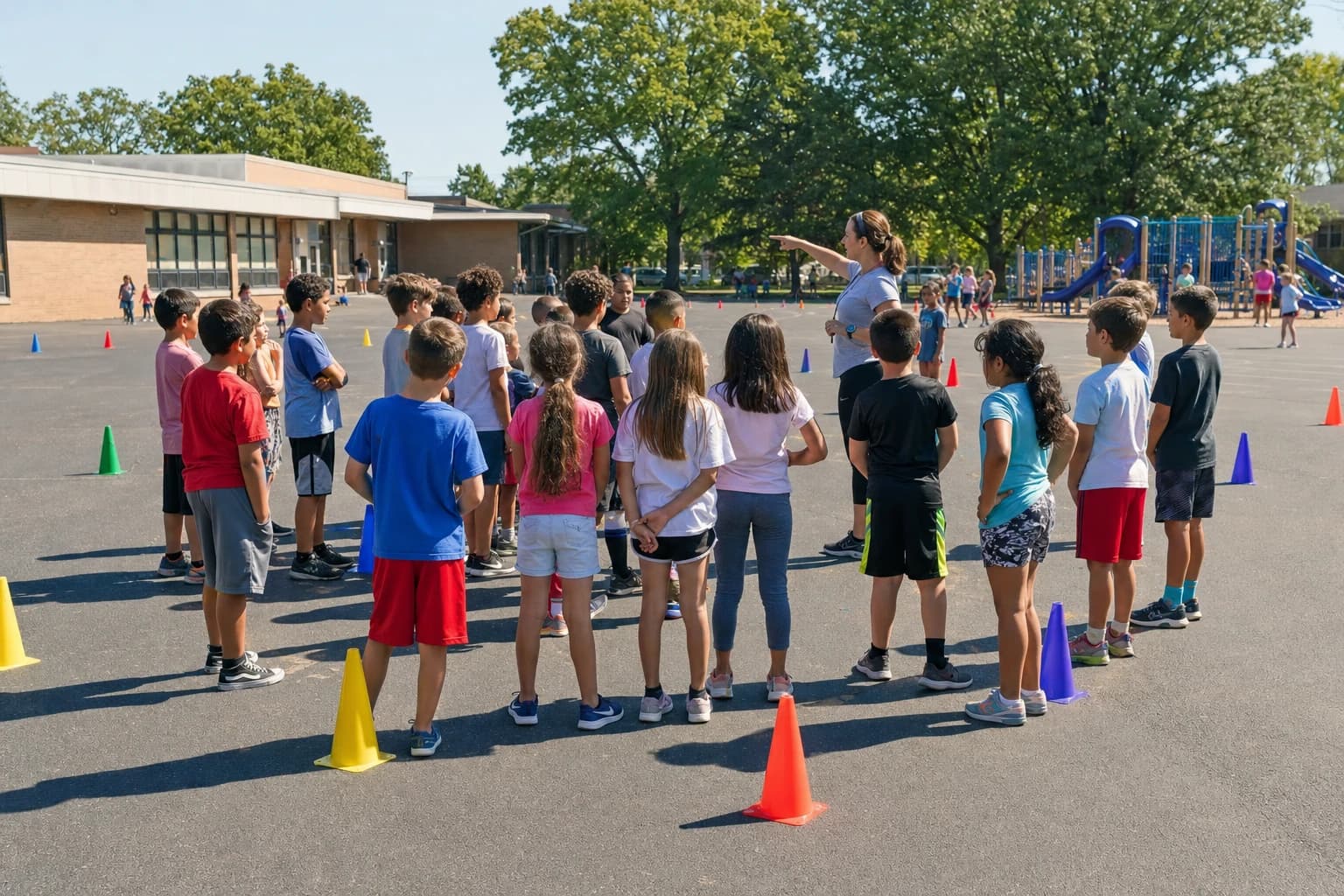
The best large group playground games have clear space, clear turns, and clear restart rules. Children should know where to stand, where to move, how to score or switch roles, and what to do after a tag, mistake, or round ending. If a game needs a long explanation, one ball for 50 students, or constant adult judgment calls, it is usually not a strong choice for crowded recess.
For large elementary groups, prioritize games that:
- Use visible boundaries such as cones, painted lines, fences, sidewalk edges, or field markings.
- Keep most children moving most of the time instead of waiting in one long line.
- Use quick re-entry instead of long elimination.
- Can be taught in under two minutes.
- Run in short rounds of 2 to 5 minutes.
- Have a known stop signal, such as a whistle pattern, raised hand, bell, or call-and-response approved by your school.
- Fit the age, space, footwear, weather, and supervision available that day.
For playground safety basics, the U.S. Consumer Product Safety Commission’s Public Playground Safety Handbook emphasizes age-appropriate play areas, protective surfacing, supervision, and equipment maintenance. Recess games should be planned around those same principles. Schools should also follow local district rules and accessibility obligations, including appropriate participation options for students with disabilities. The U.S. Department of Justice provides general information about the ADA and recreation accessibility.
Materials and Setup for 40 to 100 Students
You do not need a large equipment closet to run effective school recess activities. A small, predictable kit is easier to teach, store, and supervise.
- Cones or flat spot markers: 24 cones is a strong minimum for a large blacktop or field. Use 4 cones per game zone, plus extra cones for reset lines, no-run buffers, or station signs.
- Foam balls or soft playground balls: 4 to 8 balls. Use foam balls for throwing games and playground balls for kickball-style activities.
- Colored pinnies, wristbands, or cloth strips: 20 to 50 markers if teams are needed. If you do not have them, count off by numbers.
- Clipboard or laminated game card: Keep rules short enough to read in 30 seconds.
- Stop signal: A whistle, hand signal, bell, or verbal cue used according to school policy.
- Indoor backup list: At least three no-equipment games for rain, heat restrictions, air-quality alerts, or closed fields.
Suggested zone size: For a running game, a 40-by-60-foot rectangle is more usable than a narrow strip. For walking or partner games, a 25-by-40-foot zone may work. These are planning estimates, not safety guarantees; always adjust for the age of students, surface, crowding, weather, and school rules.
Sample 20-Minute Recess Plan for 60 Students
This sample plan assumes one large field or blacktop, three adults, and 60 students in grades 2 to 5. Adjust the number of zones if your supervision ratio or district policy requires something different.
- Minute 0 to 2: Line release and zone choice. Students walk to one of three marked zones: Zone A tag, Zone B cooperative pass, Zone C partner mirror moves. Cap each zone at about 20 students.
- Minute 2 to 4: Rules and demonstration. Each adult explains one game using this script: “Boundaries, goal, movement, reset, stop signal.” Demonstrate one quick example.
- Minute 4 to 9: Round 1. Run the first round. Adults watch boundaries and re-entry rules instead of tracking every score.
- Minute 9 to 10: Reset. Stop signal. Students freeze, breathe, and rotate clockwise if rotations are being used.
- Minute 10 to 15: Round 2. Run a second short round. Switch taggers, captains, or starting teams.
- Minute 15 to 17: Choice round or calm version. If the group is regulated, play one more round. If play is getting rough, switch to walking tag, four corners fitness, or partner challenges.
- Minute 17 to 20: Clean up and transition. Students return balls to a cone bucket, walk to line spots, and use a quiet transition such as “show me five” or a class call-back.
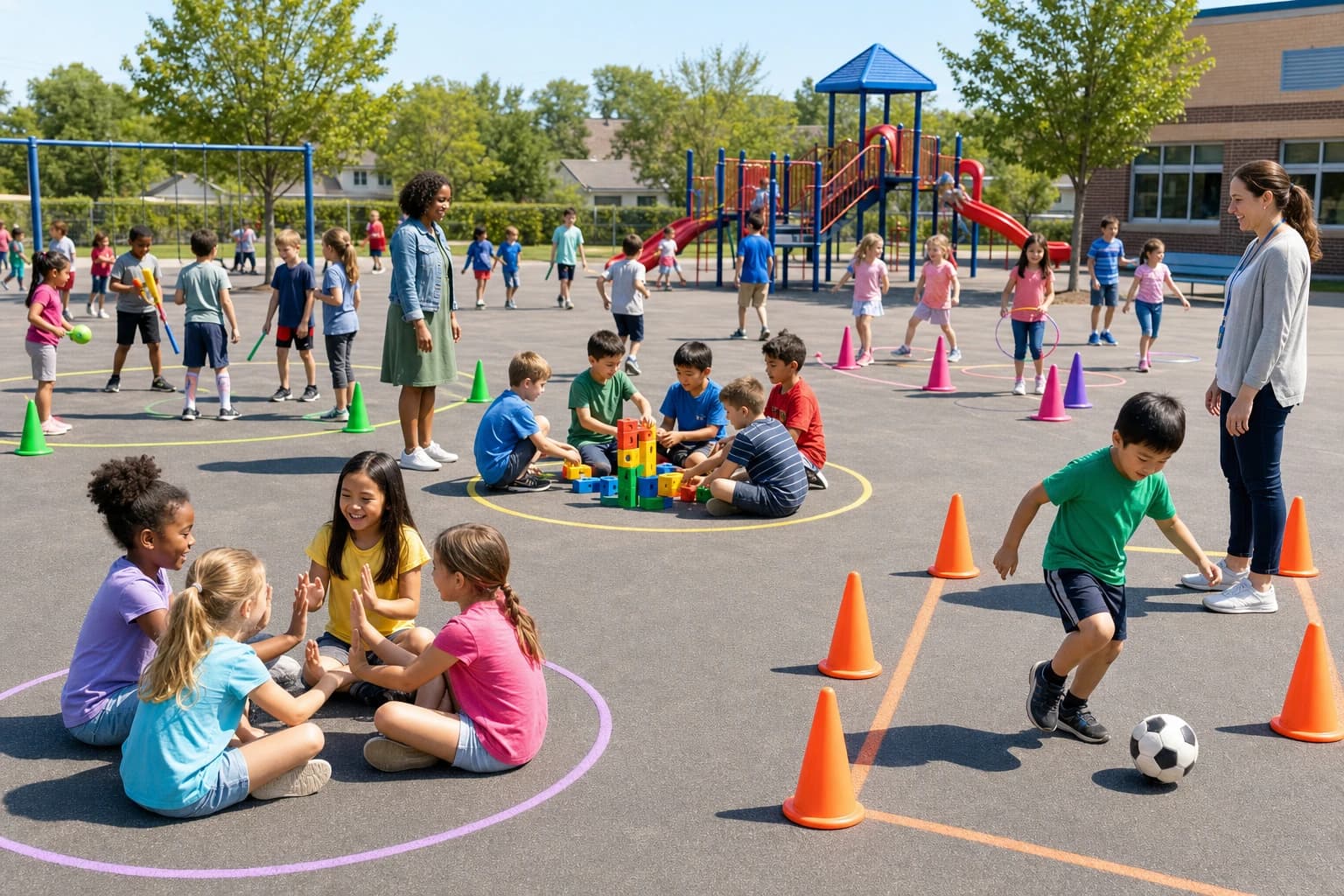
Sample Playground Zone Layout
A simple layout prevents games from overlapping. The exact dimensions depend on your site, but the idea is to separate fast, medium, and low-speed activities.
| Zone | Best activity type | Suggested group | Boundary idea | Adult focus |
|---|---|---|---|---|
| Zone A: Field corner | Running tag or walking tag | 15 to 25 students | 4 corner cones plus 6-foot buffer from fence or equipment | Speed, tags, safe re-entry |
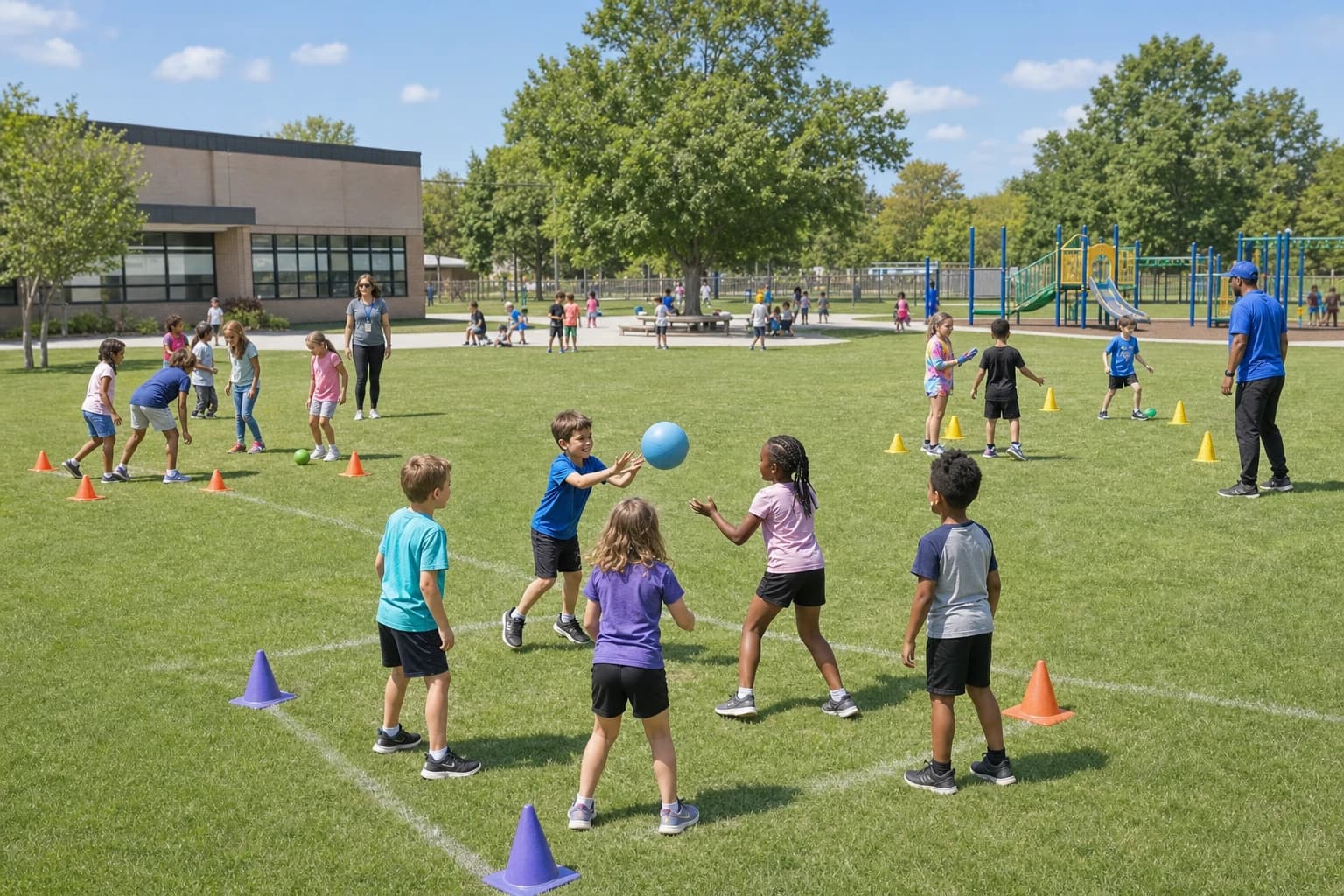
| Zone B: Center field or blacktop | Cooperative pass or foam-ball challenge | 20 to 30 students | Rectangle with a center line | Throwing direction and spacing |
| Zone C: Side blacktop | Partner mirror moves or four corners fitness | 15 to 25 students | Four labeled corners or four cone clusters | Participation and calm movement |
| Zone D: Open field edge | Modified kickball or cone relay stations | 24 to 36 students | Mini field or 4 relay lanes | Turn order, fair play, no sliding |
8 Recess Games That Work for 40 to 100 Elementary Students
These game cards are designed for large groups because they use short explanations, visible boundaries, quick resets, and limited waiting. If you have 80 to 100 students, run two to four games at the same time instead of forcing everyone into one game.
1. Zone Tag
- Group size: 12 to 25 students per zone; run 2 to 4 zones for 40 to 100 students.
- Space needed: One open rectangle per zone, about 40 by 60 feet for grades 2 to 5; smaller for younger students.
- Materials: 4 cones per zone, plus 1 reset cone per zone. Optional pinnies for taggers.
- Setup: Mark separate rectangles. Place one reset cone just outside each zone.
- Rules: Choose 2 taggers for every 15 to 20 players. On “go,” taggers try to tag runners with a gentle touch on the shoulder or upper back. No guarding the reset cone.
- Reset or re-entry: Tagged players walk to the reset cone, count to five, then rejoin.
- Safety note: No pushing, grabbing, diving, or tagging near the head. If running gets too fast, switch to walking tag immediately.
- Grade variation: K to 1 can play “freeze and melt” with one adult helper. Grades 4 to 5 can add a safe base that closes after three seconds.
2. Four Corners Fitness
- Group size: 16 to 40 students in one large zone; run multiple zones for bigger groups.
- Space needed: Blacktop, gym, or field square with four clear corners.
- Materials: 4 cones. Optional index cards with movement choices.
- Setup: Mark four corners: jump, balance, stretch, and march. If your school avoids fitness language, use animal names or color names.
- Rules: Students move safely around the area while music, counting, or a clap pattern continues. When the signal stops, each student chooses a corner. The adult calls one corner, and that group completes a 20-second movement task.
- Reset or re-entry: No one is out. After the task, everyone rejoins the walking path.
- Safety note: Use walking or skipping only. Keep corners away from doors, benches, and equipment.
- Grade variation: K to 1 can copy animal walks. Grades 3 to 5 can create student-led corner tasks such as 10 high knees, 5 slow squats, or 15 seconds of balance.
3. Partner Mirror Moves
- Group size: 20 to 100 students because everyone works in pairs.
- Space needed: Any open area where pairs can stand about 6 feet from other pairs.
- Materials: None, or cones to mark the outer boundary.
- Setup: Students pair up and stand face-to-face. Partner A leads first; Partner B mirrors.
- Rules: Leaders use slow, safe movements: arm circles, side steps, toe taps, balance poses, robot arms, or slow-motion sports moves. After 30 to 45 seconds, partners switch roles.
- Reset or re-entry: If a pair gets confused, they freeze, smile, and restart with three slow claps.
- Safety note: No chasing, spinning into others, or contact movements. This is a strong option when the playground is crowded or students need a calmer recess choice.
- Grade variation: Younger students mirror simple shapes. Older students can create a four-move pattern and teach it to another pair.
4. Cooperative Pass Challenge
- Group size: 8 to 12 students per team; run 4 to 8 teams for large recess.
- Space needed: One small circle or rectangle per team.
- Materials: 1 foam ball per team, 4 cones per team.
- Setup: Create team zones. Students spread out inside the zone with one foam ball.
- Rules: The team tries to complete as many clean passes as possible in two minutes. A clean pass means the ball is thrown under control and caught or safely stopped. Everyone must receive a pass before the same student receives a second pass.
- Reset or re-entry: If the ball drops, the team says “reset” and starts counting again from zero, or keeps a total count if you want a less competitive version.
- Safety note: Use chest-height or bounce passes only. No hard throws, head-level throws, or throwing across other teams’ zones.
- Grade variation: K to 1 can roll the ball. Grades 4 to 5 can add a defender who must keep hands low and stay two steps away.
5. Walking Tag
- Group size: 12 to 30 students per zone.
- Space needed: A clearly marked rectangle on blacktop or grass.
- Materials: 4 cones per zone, 1 pinnie for each tagger.
- Setup: Mark boundaries and choose 2 or 3 taggers.
- Rules: Everyone must walk heel-to-toe or at normal walking speed. Taggers tag gently. If a student runs, they go to the reset cone just like a tagged player.
- Reset or re-entry: Tagged players complete one slow lap around the outside of the zone and rejoin.
- Safety note: This is useful for crowded spaces, hot days, or groups that are becoming too rough. Adults should enforce walking consistently.
- Grade variation: K to 1 can play with one tagger and shorter rounds. Grades 3 to 5 can use “statue tag,” where tagged players pose until another player gives an air high-five without touching.
6. Cone Relay Stations
- Group size: 6 to 10 students per lane; 4 to 10 lanes for large groups.
- Space needed: Field or blacktop with parallel lanes about 30 to 50 feet long.
- Materials: 2 cones per lane, plus optional beanbags or foam balls.
- Setup: Create lanes with a start cone and turn cone. Keep lanes at least several feet apart so students do not cross paths.
- Rules: The first student travels to the turn cone and back using the assigned movement, then tags the next player with a hand wave or verbal “go” instead of physical contact. Use movements such as speed walk, side shuffle, bear walk for short distances, or carry-and-return a beanbag.
- Reset or re-entry: If a lane gets confused, the whole lane freezes, returns to the start cone, and restarts the round.
- Safety note: Avoid backward running and sharp turns on wet surfaces. Do not make students race if the surface is crowded or slippery.
- Grade variation: Younger students use simple out-and-back walking. Older students can rotate through four stations: balance carry, zigzag walk, pass-and-go, and memory cone sequence.
7. Clean Your Backyard With Foam Balls
- Group size: 20 to 60 students in one game; split into two games for more than 60.
- Space needed: A large rectangle divided by a center line.
- Materials: 10 to 20 lightweight foam balls, 8 cones.
- Setup: Divide the field into two equal “yards.” Place the same number of foam balls on each side.
- Rules: On “go,” students toss or roll foam balls to the other side. The goal is to have fewer balls on your side when the round ends after 60 to 90 seconds. Students may not cross the center line.
- Reset or re-entry: No one is out. After each round, students freeze, count balls on each side, and help reset them evenly.
- Safety note: Use foam balls only. Require underhand throws or rolls for younger students. No aiming at people, faces, or heads.
- Grade variation: K to 1 roll only. Grades 4 to 5 can add zones where balls must land to count, but avoid rules that create arguments.
8. Modified Kickball
- Group size: 18 to 36 students per field. For 60 or more students, create two smaller fields or rotate teams every inning.
- Space needed: Open field or blacktop away from equipment and doors.
- Materials: 1 playground ball, 4 bases, 4 to 8 cones for foul lines and waiting areas.
- Setup: Make a small diamond. Create a waiting line behind a cone, not directly behind the kicker. Use short outfields so players are not standing too far from supervision.
- Rules: Each team kicks through the order once, or use three outs if students already know kickball. No bunting, no pegging runners, no sliding, and no arguing balls and strikes. The adult or student leader rolls one fair pitch at a time.
- Reset or re-entry: If a runner is out, they return to the team line and cheer or become a base coach. Teams switch after all kickers kick or after three outs, whichever format your group can handle calmly.
- Safety note: Keep the kicking line to the side, not behind the kicker. Use a soft playground ball and make fielders throw to bases instead of at runners.
- Grade variation: Grades 1 to 2 can use “everyone kicks once” with no outs. Grades 4 to 5 can use innings, but clarify fair/foul, force outs, and base running before play starts. For more details, see kickball rules for kids.
Planning Mistakes That Cause the Most Recess Problems
The following mistakes are common because they often look harmless during planning. They become serious once children are moving, negotiating rules, and reacting to wins and losses. Avoiding them is the heart of good elementary playground management.
Mistake 1: Starting Without Clear Boundaries
Unclear boundaries create disputed tags, children drifting into other games, collisions near equipment, and arguments about whether someone was “safe.” Verbal boundaries like “stay over there” are not enough for a large group.
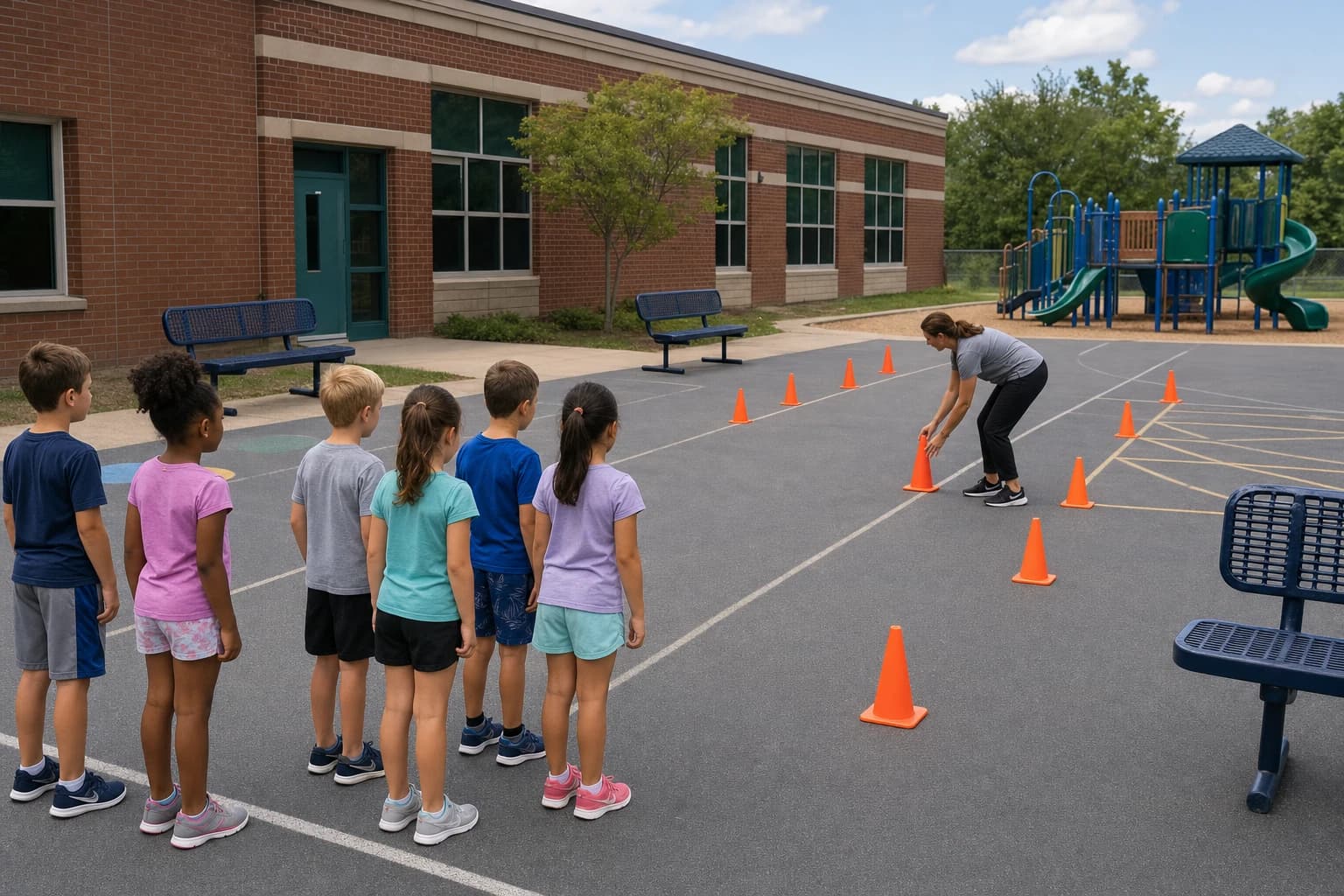
Use physical markers whenever possible. Four cones can mark a rectangle. A row of cones can separate a running game from a basketball area. If cones are limited, use fixed features such as a fence, painted line, edge of the grass, or side of the building. Say the boundaries out loud and have students point to them before play begins.
Simple boundary script: “This game stays inside the four orange cones. The sidewalk is out. The benches are out. If you step out, walk back in at the reset cone and keep playing.”
Mistake 2: Choosing Games With Long Wait Times
Games with one ball, one line, or one turn at a time often fail with large groups. Children who wait too long may wander, talk over instructions, or create side games that interfere with the main activity.
When possible, use parallel play. Instead of one giant kickball game with 36 students, set up two smaller fields or use activity roles: kicker, fielders, base coaches, scorekeeper, and warm-up line. For younger students, avoid any format where more than one-third of the group is waiting with nothing to do.
If you need more no-equipment options that keep many children active, see no-equipment tag games for elementary recess. Tag games still need boundaries, but they can be easier to scale than single-ball games.
Mistake 3: Using Elimination Rules That Remove Children for Too Long
Traditional elimination rules create two problems. First, children who are out early may be inactive for most of recess. Second, eliminated players can become harder to supervise because they are no longer part of the game structure.
Use re-entry rules instead. In a tag game, a tagged player might walk to a reset cone, complete five slow jumping jacks, or become a helper for the next round. In a cooperative challenge, the group can earn points for rescuing teammates rather than removing them. For more inclusive formats, see cooperative playground games with no elimination.
Mistake 4: Making Teams Too Uneven
Uneven teams lead to frustration, especially in grades 3 to 5 where students quickly notice skill differences. Letting captains pick teams can also leave children feeling singled out. For large group recess, team creation should be fast, neutral, and easy to redo.
Try counting off by numbers, assigning teams by line order, using colored wristbands, or splitting by birthday months. For repeat recess games, rotate team mixes instead of keeping permanent “strong” and “weak” teams. In competitive games, use short rounds so a lopsided matchup can be corrected quickly.
Mistake 5: Placing Running Games in Unsafe Zones
Running games need room to slow down. Avoid setting sprinting games near walls, doors, playground equipment, benches, tree roots, wet pavement, or crowded walking paths. A game can be age-appropriate and still be poorly placed.
Plan a buffer zone around any fast game. If the field is muddy or the blacktop is crowded, switch to a lower-speed option such as walking tag, four corners fitness, partner mirror moves, or a cooperative pass challenge.
Safety and policy note: This article provides general planning ideas only. Always follow your school’s supervision ratios, emergency procedures, student support plans, behavior policies, accessibility requirements, weather rules, and playground inspection procedures.
Mistake 6: Teaching Too Many Rules at Once
Large groups do not absorb complicated rule sets well during recess. Noise, excitement, and limited time make long explanations ineffective. If a game has several special cases, penalties, exceptions, or scoring rules, simplify it.
Use the “one goal, one movement, one restart” test. Students should be able to answer three questions: What are we trying to do? How do we move? What happens after a tag, score, or mistake? If those answers are unclear, the game is not ready for large group use.
Mistake 7: Having No Backup Plan
Even a strong recess plan can fail because of weather, closed fields, missing equipment, substitute supervision, or a group that arrives more energetic than expected. Backup options are not extra; they are part of the plan.
Keep three backups ready: one low-equipment outdoor game, one indoor movement game, and one quiet transition game. If recess moves inside, indoor PE games for small spaces can help. For short classroom gaps before or after recess, try no-equipment classroom games for elementary transitions.
Comparison Table: Better Choices for Common Recess Problems
| Common problem | Risk during large recess | Better planning choice | Example adjustment |
|---|---|---|---|
| One long line | Waiting, wandering, side conversations | Use stations or parallel games | Split 48 students into four 12-player zones |
| Elimination rules | Inactive students and supervision gaps | Use quick re-entry tasks | Tagged players walk to a reset cone and return |
| Unmarked field | Arguments and collisions with other games | Mark corners and no-run edges | Use 8 cones: 4 corners and 4 buffer markers |
| Captain-picked teams | Hurt feelings and uneven teams | Use neutral grouping | Count off 1-2-3-4 for four teams |
| Too much running in small space | Hard stops and contact | Choose lower-speed movement | Change tag to walking tag or partner mirror moves |
| Complex scoring | Rule disputes and adult refereeing | Use simple round goals | “How many clean passes in two minutes?” |
Age-by-Age Adaptations for Elementary Groups
Large group recess should look different for first graders than it does for fifth graders. The game may have the same name, but the rules, boundaries, and adult support should change.
Kindergarten to Grade 1
Use small play zones, simple movement, and very short rounds of 1 to 3 minutes. Avoid games that require children to track multiple rules or remember complex team roles. Good choices include freeze and melt, animal walks, color corners, rolling pass games, and follow-the-leader challenges.
Grades 2 to 3
Students can handle basic team roles, but they still need visible boundaries and quick restarts. Use cooperative scoring, partner challenges, tag games with safe bases, and short relays. Keep rule changes minimal from round to round.
Grades 4 to 5
Older elementary students may enjoy strategy, but they also argue more about fairness if the rules are vague. Announce the rule that causes the most debate before the game begins. For example, if playing kickball, clarify whether bunting is allowed, how many outs end an inning, whether pegging is allowed, and what counts as a fair ball.
Simple Game Formats That Scale Well
Instead of searching for one perfect game, it helps to know which formats scale. These formats can be adapted to different themes without rebuilding the whole recess plan.
- Zone tag: Several small tag games run at the same time. Each zone has its own taggers and reset rule.
- Cooperative missions: Teams try to complete a task together, such as moving objects across a space or making a target number of passes.
- Rotating stations: Groups rotate every 4 to 5 minutes through throwing, balancing, jumping, and strategy stations.
- Partner challenges: Students work in pairs within a marked area, reducing crowding and wait time.
- Modified sports: Use smaller teams, shorter rounds, and simplified rules instead of one full-scale game.
Recess Game Planning Checklist
Before starting a large group game, run through this checklist. It can prevent most recess problems before they begin.
- Can the game be explained in under two minutes?
- Are all boundaries visible from where students stand?
- Is there a buffer between runners and playground equipment, walls, doors, or benches?
- Will most students be active most of the time?
- Is there a re-entry rule instead of long elimination?
- Are teams made in a neutral, quick way?
- Is the stop signal known before the game begins?
- Is there a lower-speed version if the group gets too rough?
- Is there an indoor or small-space backup?
- Does the activity follow school rules, supervision expectations, and accessibility needs?
SEO and Publishing Notes
For publication, use descriptive file names and compressed images for the three playground visuals, such as large-elementary-recess-game-zones.webp. Keep captions specific because they help readers understand the setup. This article already includes an FAQ section that can be marked up with FAQ schema by your publishing system if that is part of your site’s SEO workflow. The comparison tables can also be enhanced with table schema where appropriate, but avoid adding schema that does not match visible on-page content.
FAQ: Recess Games for Large Elementary Groups
What are the best recess games for large elementary groups?
The best options are games with visible boundaries, short rounds, and quick re-entry. Zone tag, walking tag, four corners fitness, partner mirror moves, cooperative pass challenge, cone relay stations, clean your backyard with foam balls, and modified kickball can all work for large groups when the space is divided well.
How many students should be in one recess game?
There is no single perfect number because space, age, and supervision matter. As a practical planning rule, if more than one-third of the group is waiting or the adult cannot see the whole play area, split the game into smaller zones or stations.
How do you run recess games for 80 to 100 students?
Do not run one giant game unless the activity is designed for it. Divide the playground into three or four zones, cap each zone at about 20 to 30 students, and use games with the same stop signal. Rotating every 4 to 5 minutes can help students experience more than one activity without crowding.
Should elimination games be avoided completely?
Not always, but long elimination is a poor fit for many school recess settings. If a game removes players, add a fast way to rejoin, such as a reset cone, helper role, short movement task, or next-round return.
How do you reduce arguments during recess games?
Clarify the most disputed rule before starting, use visible boundaries, keep rounds short, and avoid rules that require constant judgment calls. When possible, design the game so play continues after small mistakes instead of stopping for debate.
What should you do when the playground is too crowded?
Switch from one large running game to stations, walking games, partner challenges, or classroom-style outdoor games. Crowded space is a sign to reduce speed and simplify movement, not to rely on children to “just be careful.”
Conclusion: Plan the Problems Out Before Recess Starts
The strongest recess game planning tips are usually simple: mark the space, keep rules short, avoid long waits, replace elimination with re-entry, make teams fairly, keep fast running away from hazards, and prepare a backup before you need it.
When those basics are in place, recess games for large elementary groups become easier for adults to supervise and more enjoyable for children to play. A well-planned game does not need constant correction. It gives students enough structure to move, cooperate, compete fairly, and return to class ready for the next part of the day.